
Service Details
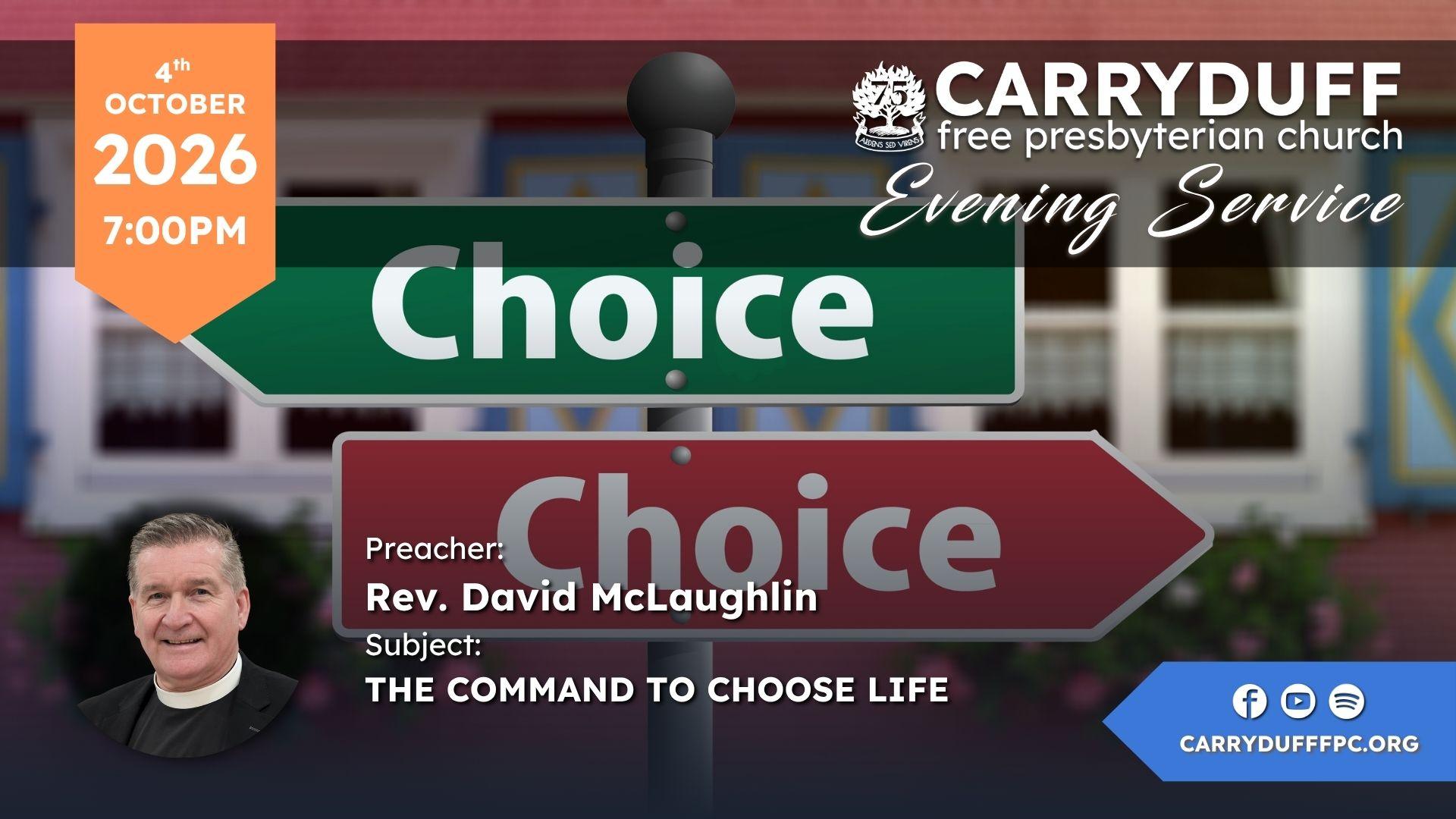
Date: SUN 7:00pm 4th October 2026
Preacher: Rev. David McLaughlin
Bible Reference: Deuteronomy 30:19-20
Podcast
Sermon Summary
Introduction and Text
The sermon takes as its text Deuteronomy chapter 30, verses 19 and 20, and is preached under the theme “The command to choose life.” The preacher opens by recalling a recent Monday evening when the pro-life organisation Precious Life displayed a banner bearing the words “choose life” in opposition to the lighting of City Hall in green in support of abortion. Standing with that protest, the preacher was struck by those two words and traced them back to their original source in Scripture. The sermon is therefore a treatment of Deuteronomy 30:19–20, read in the wider context of verses 11–20.
The Historical Setting
The passage is set in the plains of Moab, on the far side of the River Jordan. The preacher establishes the context carefully:
- Moses is 120 years old, near the end of his life and his leadership of Israel.
- A previous generation had stood at the same river some forty years earlier, and despite tasting the good fruit of the land and hearing the faithful report of the spies, they murmured, rebelled, and were turned back into the wilderness.
- That entire generation died in the wilderness, their corpses buried in the sand as a testimony against unbelief.
- Only Joshua and Caleb survived from that generation.
- Forty years on, Moses calls a solemn assembly of the whole congregation and delivers his final sermon.
The preacher notes that Deuteronomy is essentially one long sermon, beginning in chapter 1 and running through to the end of chapter 33, in which Moses rehearses God’s covenant faithfulness and calls the people to faith, love, and obedience before they enter the promised land. Chapter 34 is described as Moses’ own death notice, penned under the inspiration of the Holy Spirit, recording his age, physical condition, burial place, and who officiated. Before that death, at the close of the sermon, Moses issues the powerful call: “choose life.”
The Character of the Command
The preacher turns to the character of this command, noting that choosing life is not an emotional, isolated decision made independently of God—it is a choice of the Lord Himself. Several points are drawn out:
- In verse 15, Moses sets before the people “life and good, and death and evil.”
- In verse 16, choosing life is explained as loving the Lord with all the heart, soul, mind, and strength, walking in His ways, and keeping His commandments, statutes, and judgments.
- In verse 17, the opposite path is described: a heart that turns away, refuses to hear, is drawn away, and worships other gods. The consequence is that they “shall surely perish,” a phrase the preacher notes is emphatic—”in perishing thou shalt perish.”
- In verse 20, the reason is given: “for he is thy life.” To choose life is to choose the Lord Himself, echoing Christ’s words about coming that we might have life more abundantly.
The preacher affirms the absolute sovereignty of God, the necessity of the new birth (regeneration), the total depravity of the sinner, and unconditional election. Yet he insists with equal force on the responsibility of man. The Bible, he argues, teaches both divine sovereignty and human responsibility, and Deuteronomy 30 brings them remarkably close together. The key is the work of grace in the heart: the Lord will circumcise the heart, giving a new heart, new will, new sight, new understanding, new desires, and new affections. The command to choose life exposes man’s responsibility while promising the gracious work by which the heart is changed.
The choice is described as stark and simple—there is no third road, no neutral ground, no fence to sit on:
- It is not a choice between two equally good philosophies or comparable religions.
- It is between life and death, blessing and cursing, obedience and disobedience.
- It is between a relationship with the Lord and rebellion against Him, between the true and living God and the false gods of human imagination.
The preacher draws parallels with Psalm 1 (the way of the righteous and the way of the ungodly), Psalm 23 (the shepherd’s way and the sinner’s way), and the Sermon on the Mount (two gates, two ways). He illustrates the solemnity with an analogy of a railway junction where one line leads to certain death and the other to liberty and life—no faithful preacher would tell someone standing there that it does not matter which line they take, so long as they are sincere. Moses, described as “a great gospel preacher,” set forth the character of the gospel plainly: man is a sinner with a soul that must be saved, who must repent, believe, and choose life. The natural man, left to himself, will not choose life; he must be born again, and God makes the unwilling willing through the new heart. Human self-salvation is entirely rejected, yet sinners must still be called to come to Christ.
The Company of the Command
The preacher then considers the company addressed by this command—the children of Israel, a most privileged people. Their privileges included:
- Physical deliverance by the blood of the lamb out of Egypt.
- Witnessing God’s wrath upon Pharaoh and his army at the Red Sea.
- Seeing God’s wonders in the wilderness—water from the rock at Horeb, heavenly manna for forty years, and healing through the brazen serpent.
- Being gifted a faithful leader, Moses, who prayed for them and preached to them plainly despite their murmuring, disputing, and criticism.
- Receiving the law of God, the revelation of the Lord, the standard of perfect obedience, the sentence of death for disobedience, and the provision of substitutionary blood sacrifice.
The preacher applies this directly to his congregation in Northern Ireland, describing them as a privileged people—blessed with life, health, strength, and years of sitting under gospel preaching. Every physical, material, and temporal blessing comes from God’s hand, and one day those privileges will rise up as a witness against those who remain without Christ. The people were not only privileged but professing: many professed to know the Lord, adhered outwardly to the law, prayed, gave, offered sacrifices, and read the law, yet had no real heart relationship with Him and were not born again. The preacher warns against mere outward profession—belonging to a church, reading the Bible, and praying on the Lord’s Day without a deep delight in the things of God. He cites Deuteronomy 31:26–27, where Moses declares the people’s rebellion and stiff-necked nature, noting how much more they would rebel after his death.
The Consequence of the Command
The final section addresses the consequences of the choice. Good choices bring good consequences; bad choices bring bad consequences—because God has created a moral universe. Sin is not harmless; it is hellish rebellion. Turning away from the Lord is turning away from the giver, sustainer, and producer of life. The preacher emphasises several points:
- Sin never delivers what it promises. It promises liberty but ends in bondage, emptiness, vanity, and unhappiness.
- The harvest season testifies against many, displaying God’s faithfulness, mercy, and goodness even to those not in right relationship with Him.
- Every person will give an account to God; no one can end life in their own way.
- Moses’ warning in verse 18—”I denounce unto you this day, that ye shall surely perish”—stands as the consequence.
- Galatians 6 is cited: “Be not deceived; God is not mocked: for whatsoever a man soweth, that shall he also reap.” Sowing to the flesh reaps corruption; sowing to the Spirit reaps life everlasting.
The preacher applies this in national, personal, and congregational terms:
- Nationally, Proverbs 14:34 is quoted: “Righteousness exalteth a nation: but sin is a reproach to any people.” The nation’s life is being reproached because of sin.
- Personally, the prodigal son is invoked—”sin will cost you more than you want to pay, take you further than you want to go, and keep you longer than you want to stay.” Naomi’s ten years in Moab, losing her husband and sons, illustrates that choices have consequences.
- Congregationally, the blessings Christ gives are set out: forgiveness of sins, life, full and free justification, reconciliation with God, adoption into God’s family, a new heart, new joy, new peace, and the assurance of eternal life as a present possession.
Closing Application
The sermon closes with a note of urgency. The matter is urgent and present—”today, if ye will hear his voice, harden not your hearts.” The summons is personal, powerful, and present. The preacher’s thoughts turn to recent deaths in the congregation’s community: a young man of twenty-two killed in a tragic accident, two men who died in a trench accident, and a woman who battled cancer for years and was called home that morning. He recalls the words of a visiting minister that none of us knows what will happen five minutes down the road, never mind tomorrow.
The final appeal is to those who may be merely professing faith without a real relationship with the Lord. The command to choose life means choosing the Lord, and the life that follows is a new life in Christ: “if any man be in Christ, he is a new creature: old things are passed away; behold, all things are become new.” The evidence of that new creation is a changed life—new desires for the Bible, the house of God, the day of God, and the people of God, replacing old desires for drink, cigarettes, gambling, and the dance floor. The change is from the inside out, and the preacher urges his hearers to heed the command to choose life, closing with a blessing and thanks to the congregation, with a prayer that the Lord would apply the word to every heart, including those listening online.