
Service Details
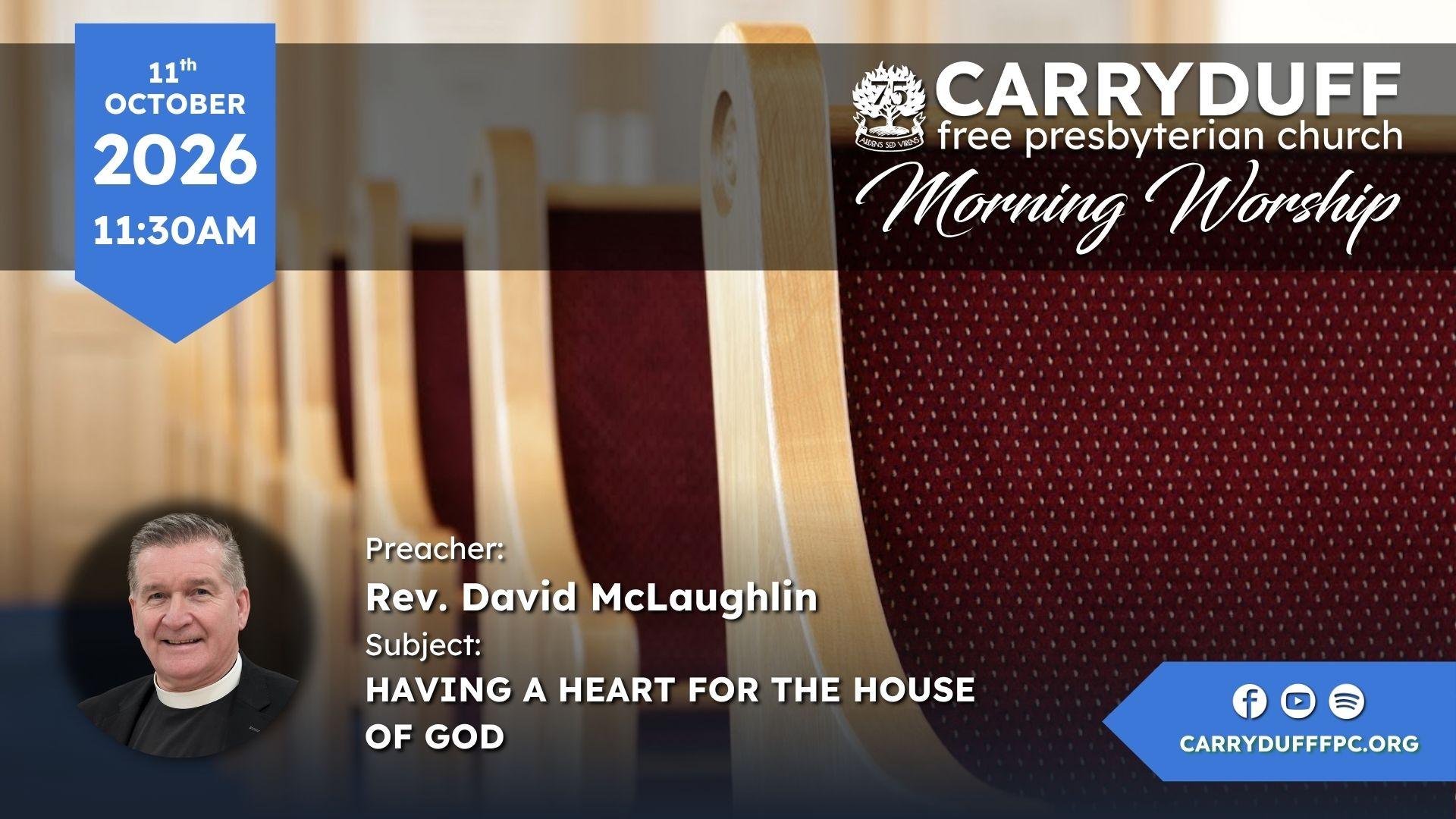
Date: SUN 11:30am 11th October 2026
Preacher: Rev. David McLaughlin
Bible Reference: Psalm 122:1
Podcast
Sermon Summary
Introduction and Text
The sermon opens with a call to turn to the Holy Scriptures, specifically Psalm 122, read in full at the outset. The preacher explains that on the previous Sabbath evening, before retiring for the night, he had been reading this Psalm and two messages came into his mind from it. He resolved to preach one of them. The text chosen is Psalm 122 verse 1: “I was glad when they said unto me, Let us go into the house of the Lord.” The title given to the message is simply “Have you a heart for the house of God?”
The preacher notes that Psalm 122 is one of fifteen “songs of degrees” or “songs of the steps” found in the Psalter, running from Psalm 120 to Psalm 130. Psalm 122 is the third of these songs. Each of them is associated with the worshipper travelling toward the city of Jerusalem, particularly during the great feasts of the Lord, such as the Feast of the Passover, the Feast of Pentecost, and the Feast of Tabernacles. Jerusalem was the city where the temple stood, and the temple was the appointed place for public worship under the old covenant. As the pilgrims travelled toward Jerusalem, they were not merely making a journey to a geographical location. They were going up and into the house of the Lord. They were going up to worship the true and living God, to offer praise, to pray, to hear His word of truth, and to gather with the people of God.
This raises, the preacher says, a most searching question. As he read that Psalm on the Sunday night past, before going to bed, he asked himself: “David, do you have a heart for the house of God? And more importantly, do you have a heart for the God of the house?” The sermon is built around that self-examination and extends it to the congregation.
The Central Question of Approach
The preacher poses the question of how the Lord’s Day is approached. Do we anticipate it with joy and gladness? Do we prepare our hearts and minds to come? Do we rejoice to be present for the time of worship? Are we excited that the day has come? He paints a picture of the pilgrims travelling up to Jerusalem, catching sight of the holy city, entering through the gates, journeying through the streets, and then entering into the house of God. He draws a parallel to the congregation arriving at the car park, approaching the door, entering the meeting place, and coming to meet with God.
The question is how we come:
- Do we come with anticipation of meeting God?
- Do we come with adoration for who the Lord is in the fullness of His revelation?
- Do we come with much assurance of Him meeting with us?
One of the great dangers the people of God face in every generation, the preacher warns, is that true worship becomes a vain, heartless, cold, empty, ritualistic religious exercise. Physical attendance can become a mere habit, a cold empty duty where we feel obliged to be present, or just something squeezed into a busy schedule for the Lord’s Day when nothing more attractive presents itself. The issue is deeper than coming to a lovely building or coming to hear a particular preacher or enjoy the singing. The deeper and more radical question is whether we really love the God who calls us to gather in His name and present ourselves as true worshippers.
The preacher recalls praying often the words of John 4 verse 24: “God is a spirit, and they that worship him must worship him in spirit and in truth.” That is what the congregation comes to do every Lord’s Day. He then says that before going to bed he thought of a number of things and reduced them down to three. The sermon follows these three points.
First: The Passion for the House of God
The first point concerns the passion for the house of God. The preacher draws attention to the opening words of the text: “I was glad.” There is something profound and wonderful in the words of King David. He did not say “I was obliged.” He does not say “I was persuaded” or “pressurised by others.” He did not say “I was ordered by my advisors” or “I went because it was expected of me as the king to do.” No. He said “I was glad.”
The preacher asks what this gladness means. It means his heart was stirred. It means he was filled with holy joy at the thought of going to worship God and going into the house of God. The challenge is whether the hearer is filled with such holy joy and gladness at the prospect of the Lord’s Day in the house of God.
He returns to the warning that one of the greatest dangers in attending to the worship of God is that worship can become a vain, heartless, cold, empty religious exercise. He notes that it is possible even for true worship to become vain, cold, empty, and ritualistic. This was one of the great sins of ancient Israel in the days of Jeremiah. He reads from Jeremiah chapter 6 verse 10: “To whom shall I speak, and give warning, that they may hear? behold, their ear is uncircumcised, and they cannot hearken: behold, the word of the Lord is unto them a reproach; they have no delight in it.”
He then turns to Jeremiah chapter 7 verse 4: “Trust ye not in lying words, saying, The temple of the Lord, The temple of the Lord, The temple of the Lord, are these.” The phrase “the temple of the Lord” was three times on their lips. Then in chapter 7 verses 9 and 10, the Lord asks: “Will ye steal, murder, and commit adultery, and swear falsely, and burn incense unto Baal, and walk after other gods whom ye know not; and come and stand before me in this house, which is called by my name, and say, We are delivered to do all these abominations?”
The preacher explains that Jeremiah was a faithful preacher. The temple services continued normally in his day. The sacrifices were offered and the priests fulfilled their role, but the people were guilty. Their heart was not in it. The word of God had become a reproach to them. They were simply trusting in their religious appearances. They talked of the temple of the Lord and offered their sacrifices, but their heart was not in it.
The preacher connects this to the words of the Lord Jesus in Matthew chapter 15 verses 7 and 8, where He says: “Ye hypocrites, well did Esaias prophesy of you, saying, This people draweth nigh unto me with their mouth, and honoureth me with their lips; but their heart is far from me. But in vain they do worship me, teaching for doctrines the commandments of men.” The children of Israel were not sincere in their attitude and approach to worship. Their heart was not fully engaged. They could come and go into the temple of the Lord and go through all the motions outwardly, with all the appearances and all the action, but it was all cold and lifeless, a hollow religious experience.
The danger is the same today. Millions of professing Christians, professing born-again believers, sadly have no real heart for the worship of the living God. They come, they carry their Bible, they sing, they say all the right things, but the question is whether their heart is cold and distant. Do they have a passion for the Lord’s Day? A heart full of holy joy for the house of God and the God of the house?
The preacher cites David in Psalm 26 verse 8: “Lord, I have loved the habitation of thy house, and the place where thine honour dwelleth.” That was the bent and characteristic of David’s heart. David was not perfect. He sinned gravely against God and made many mistakes, but that was the bent of his heart. He had a passion for the house of God and was full of joy and gladness for it.
The question for the congregation is whether they have such a passion for the Lord’s Day. Often we are not thrilled, not full of joy, not delighted, not excited. The preacher addresses this to all and to the Free Presbyterian Church generally: the Lord’s Day privileges enjoyed must not degenerate into a joyless religious exercise and experience. One of the outstanding points is that King David had a personal passion for the house of God, a personal joy, and we too should be excited about the worship of God. David was delighted and brightened up with the thought of it. When people said to him, “Come, let us go up to Jerusalem, let us go up into the house of God,” David joined them and brightened up with the thought of it. His soul flowed with holy gladness and it lifted his soul.
The preacher presses the point home: do we have a passion for the house of God? Is our heart in it? Are we there full of joy and gladness?
He then tells a story. The doctor Ian Paisley told the students years ago in the class about a Saturday morning chore given to him by his mother. One of his jobs was to clean a brass fender over a fireplace. He confessed that he hated it. Whenever his mother inspected it, she would say, “Ian, it’s not right, you need to redo it.” He used to spend the whole of the Saturday morning cleaning this thing. One particular morning, having spoken to it and even kicked it on one occasion, saying “I hate you” to the brass fender, he changed his attitude. He said to the fender, “I’m going to make you shine like you never shone before.” He discovered a very valuable life lesson: if you have the right attitude to something, then you will have a joyful experience. True worship is rooted in having a right attitude, and that right attitude is a passion, a joy, and a gladness.
True worship is not, young people, a dry boring cold lifeless exercise. If it is to you, then the problem is a heart problem. You are approaching it with the wrong attitude. Maybe you come to the house of God on a Sabbath day and your heart is full of fear, full of doubt, or your mind is full of problems and pressures of life. You need to bring all of them and set them to one side to worship this God. The Bible says, “Casting all your care upon him; for he careth for you” (1 Peter 5 verse 7) and “Cast thy burden upon the Lord, and he shall sustain thee” (Psalm 55 verse 22).
He tells another story. A young man growing up in one of the churches was dragged out every Sunday morning, in his own words, by his mother and father. He would come to the church door with the thought in his heart, “I hate this. I hate coming in here.” Often he did not sing, and often he criticised the minister for being too long or too complicated. He had a real bad attitude about the house of God every Sunday morning. Then one day his heart was changed. From a wrong attitude he now had a right attitude. He stood up in the pulpit testifying and said, “I am here because I want to be here. My heart is in this place.” That is the difference. That is what David had. He had a loving passion for the house of God. Without that passion it leads to wrong choices and unthoughtful consequences. The Bible exhorts in Colossians 3 verse 23: “And whatsoever ye do, do it heartily, as to the Lord, and not unto men.” Do it sincerely, wholeheartedly, with love, for the Lord Jesus Christ.
Second: The Priority for the House of God
The second point concerns the priority for the house of God. Returning to the text, “I was glad when they said unto me, Let us go into the house of the Lord,” the preacher asks: whose house is it? It is the house of the Lord. The chief question is not mere attendance in the house of God but that you come into the house of the Lord with an appreciation and an anticipation of the One to whom you come to worship. It is more than mere attendance. It is not just about the splendour of the building or the structure. In our approach there must be anticipation and appreciation of the Lord as the living and true God. We come on the Lord’s Day to gather before Him, the living God.
He cites Jeremiah chapter 10 verse 10: “But the Lord is the true God, he is the living God, and an everlasting King: at his wrath the earth shall tremble, and the nations shall not be able to abide his indignation.” In Psalm 42 verse 2 the Psalmist said, “My soul thirsteth for God, for the living God: when shall I come and appear before God?” Again in Psalm 84 verse 2: “My soul longeth, yea, even fainteth for the courts of the Lord: my heart and my flesh crieth out for the living God.”
David’s mind is not just about attendance in the house of God, which is important, but about anticipation and appreciation of meeting the Lord. His mind is in the Lord. He anticipates His presence, learning about His power, rejoicing in a pardon, knowing and experiencing His provision. David was not just passionate about the place of worship. He was filled with a passionate priority of meeting the Person to be worshipped. David’s heart and mind were filled with a sense of the Lord of the place. The house of the Lord, whose house is it? It is the Lord’s house.
We live in a day when thousands of professing Christians have lost sight of the fact that they are coming on the Lord’s Day to meet with the living God. We do not gather as a social club. You do not merely gather to hear a preacher. You do not gather just to meet with family and friends. You do not just gather to enjoy the familiar surroundings and have a cup of tea and buns when we have it. We come to worship the living God.
He cites the Apostle Paul in Hebrews chapter 10, concerning having a high priest over the house of God, drawing near with a true heart and full assurance of faith, hearts sprinkled from an evil conscience and bodies washed with pure water, holding fast the profession of our faith without wavering, for He is faithful that promised. We come here to meet with God.
Young people, a true heart for God’s house is centred on a true understanding of God’s character. Psalm 96 verse 6 says, “Worship the Lord in the beauty of holiness.” Who is He that we come to meet? He is the true and living God. He is creator and maker. He is absolutely sovereign. He is thrice holy. He is a righteous judge. He is true and faithful. He is a covenant-keeping God. He is a gracious God. He is long-suffering. He is a God who has plenteous redemption. But He is a God to be feared. The Bible says it is a fearful thing to fall into the hands of the living God. He is also the God and Father of our Lord Jesus Christ.
The preacher notes that sometimes on a Sunday morning when he begins with prayer and tries to bring the congregation into the thought of meeting with God, he knows they are listening, and he repeats things deliberately because it is important to understand the One before whom we come to meet. He asks where the sense of meeting with God is, where the sense of majesty, the awe, and the reverence of being in His presence are. Have we not lost sight of trembling in the presence of God?
He believes that when we grasp something of the holiness of God, who is holy, thrice holy, and today at this moment the seraphim and cherubim in heaven are saying, “Holy, holy, holy, is the Lord God Almighty, which is, and which was, and which is to come,” we have lost sense and sight of the holiness of God. Once we grasp that and come to meet God in all the fullness of the revelation of His character, then true worship ceases to be vain, empty, a boring exercise, mere casual entertainment, something heartless and lifeless. Why? Because it is the response of a heart full of love for God, full of gratitude for who He is and what He has done, full of fear of Him, because the Bible says the fear of the Lord is the beginning of wisdom, and the knowledge of the holy is understanding. We are to be in the fear of Him, in the dread of Him, with a heart full of humble adoration.
He adds that a true sight of God will expose our sin. In Isaiah 6, when Isaiah was in the temple and saw the Lord high and lifted up on His throne, and the train of His robe filled the temple, he said, “Woe is me, for I am undone, I am a man of unclean lips.” This is not a magical place. God is not confined to these four walls, but when we get sight and sense of Him, we become conscious of our sin, our shortcomings, and our weakness. At the same time we discover, as Isaiah did, not only confession of sin but cleansing, because he was cleansed in the temple and then commissioned, and God communicated His truth to him: “Whom will I send, and who will go for us?” When we encounter the Lord through the ministry of the word, as the Lord speaks to us and we see His greatness, we also see our guilt. When we see His sovereignty, we also see our sinfulness, and we recognise our need to fall before Him and cry out, “Lord, have mercy. Lord, remember me. Lord, help me.” The whole of our being is included: our heart, our mind, our soul, our strength. It is not a cold heartless exercise. “Be still, and know that I am God.”
The text at the very doors, as you come into the meet-and-greet area, says, “Know Him better, know Him greater, know Him deeper.” This is more than just a building. He is not suggesting it is magical or consecrated, but this is the place where we gather to meet with the Lord. Our mind should be in Him. That is the priority for the house of God.
Third: The Purpose of the House of God
The third and final point concerns the purpose of the house of God. David said, returning to the text, “I was glad when they said unto me, Let us go into the house of the Lord.” The preacher underlines the words “they said unto me, let us go into the house.” The inference is of a company saying to David, “Let us go into the house of the Lord to worship.” The inference is to worship, to meet with the living God, to offer praise. It is wonderful that we can come here and sing praise unto Him who loved us, who gave Himself for us, and who saved us by free sovereign grace. It is wonderful that we can come here to present our gifts and offerings, and you do that every week, which is why as part of our worship we literally take up an offering. It is wonderful that we can come here and offer our prayers, bow our heads, and hear His word.
He cites Matthew chapter 18 verse 22, where Jesus says, “Where two or three are gathered together in my name, there am I in the midst of them.” He suggests they might do a series sometime on the words “in the midst of them.” Where two or three are gathered together in His name, there He is in the midst of them. He is here. He is the first to be present. The preacher believes in the doctrine of His omnipresence but also believes in the doctrine of His conscious presence. There is a special blessing.
Paul said to the church in his day in Hebrews 10 verse 21 that we have a high priest over the house of God. The high priest is here, the Lord Jesus. He is present. Grasp that truth: we are coming to meet with Him because He is coming to meet with us. He is King of kings and Lord of lords. He is a great King, a gracious King, a generous King. That should impact upon our minds. We should be careful in our approach to Him, coming to approach the King of kings and Lord of lords. We should be careful in our appearance before Him, because that involves careful preparation of heart and mind.
The preacher says he personally believes, though he is not insisting, that it should have an impact upon our dress. If you got an invitation to meet King Charles at Buckingham Palace, you would not be dressing down. You would not come in jeans and a t-shirt, and you would not have some sort of silly writing on the t-shirt, either on the front or the back. When you get an invitation to the palace, with the invitation you get a dress code. He is not saying we have to be dressed as if going to a wedding, but we should not be deliberately dressing down to meet the King. Should we not try to present ourselves as best we can? And if all we have is that, then come like that. There should be an anticipation of meeting with the King, coming with praise and prayer, presenting our gifts, and receiving the preaching of the Word.
The Lord’s Day, the preacher notes, finds many tired because they have worked hard six days in the week and their mind is heavy. But the seventh day, this day we call the Lord’s Day, is really not a day for me. It is a day for the Master. The great acid test and antidote to how you feel and what you think is this mindset: this is a day for me to come and meet with God, my Maker, my Master. Once we enjoy the Lord, when we have a high view and a high value of Him, we see the problem. The problem is that we think so little of Him, really nothing of Him.
He returns to the questions: where is the adoration? Where is the anticipation of Him? Where is the biblical approach? Where is the affection for the Scriptures? Is it not great to receive God’s Word? He speaks to us. Romans 10 verse 17: “So then faith cometh by hearing, and hearing by the word of God.” In Jeremiah’s day, Jeremiah 6 verse 10, the Word of God had become a reproach to them, not a rejoicing but a reproach. They had lost their appetite for the Word of God and their delight in it. Their spiritual ears were closed. They were not welcoming the message of the Lord. They were not enjoying worship.
This is not just a day in the calendar. This is a gift from God, a gift from God Himself, a day set apart for worship, for fellowship, for spiritual nourishment. And that spiritual nourishment is always through the Word. “Sanctify them through thy truth: thy word is truth.” We are not here to earn salvation by our coming, but we come because we belong to the Lord and are saved through faith alone, by grace alone, in Christ alone. Because we are saved and belong to the Lord, we make this a prayer as we come: “Lord, help me to meet with you, my Master and Maker. Lord, speak to me today.” Or as the late John Douglas used to say, “Lord, lend me Samuel’s ears.”
Do we come to hear a saving word, a word to repent and believe the gospel? A sanctifying word that will challenge us and touch us in relation to some sin of thought or word? A searching word that will cut right into the heart? A serving word that will call us to go out and use the best of opportunities to witness for the Master? All of that is bound up in having an affection for the Scriptures, but it starts with our heart attitude as we present ourselves.
Affection for the Saints
Finally, the preacher speaks of an affection for the saints. Returning to the words “they said unto me,” “they” refers to the people of God. They were addressing the king. One can picture the king at the palace out for a stroll in the garden, and then a company comes and says, “It’s time for the feast, King David. Come with us, lead the way, brother.” That is the picture.
Biblical Christianity is personal but not individualistic. God saves sinners through repentance and faith, and God brings them into His church. The church is the body of Christ. There is a congregation here of people of different ages, occupations, educational status, temperament, and personalities, but we belong to the Lord. We are brothers and sisters in Christ. We are members of the one body. We are united to the Redeemer, and we need one another. We are to pray one for another, encourage one another, counsel one another, comfort one another, and have compassion one for another.
There are times when somebody comes and feels really strong and great, on the mountain. There are other seasons when the same individual or different individuals come in feeling very weak. They have been traumatised because of the death of a loved one, or traumatised because of some tragedy that has happened, or traumatised because something is going on in their life that you know nothing about. They are looking a bit downcast and a bit burdened, fearful and struggling. What do they need? They do not need a whole sermon. They just need a handshake. Maybe they need a hug. Maybe they just need a smile. Sometimes that weary brother or weary sister’s heart can be lifted because of the affection for the saints. He is not talking about nosiness or gossip. He is talking about those who are troubled in heart and mind, coming into the house of God and thinking, “What’s in this for me individually?”
He answers: what is in it is a meeting with the Master and hearing Him speak to you out of His Word, because that is the means of sustaining your heart and life. That is a good place to be. In that place you can serve the body of Christ in whatever way God gives you enablement and help.
Concluding Appeals
The preacher concludes by expressing his trust that what he has said and preached to his own heart will be a help and a blessing, and that the Lord will help the congregation to have a heart for the house of God and the God of the house. He asks the hearer to consider several questions as the sermon finishes:
- Do you anticipate meeting with God? Do you come to worship with reverence and faith and the desire to hear His Word?
- Do you have an affection not only for the Saviour but for the saints, seeking their spiritual good, bearing with their weakness, serving them in Christian love?
- Does true worship have a real priority in your life, so that you order your affairs around the Lord’s Day and say, “I am going to prepare my heart to come and worship”?
- Will you persevere even when you do not feel like coming? When the devil tells you that you do not feel like coming, and you are not sick in the hospital, then come, because that is the time you will have the greatest blessing and the greatest help.
He closes with the testimony of David: “I was glad when they said unto me, Let us go into the house of the Lord.” May the Lord take this word and bless it to our hearts.