
Service Details
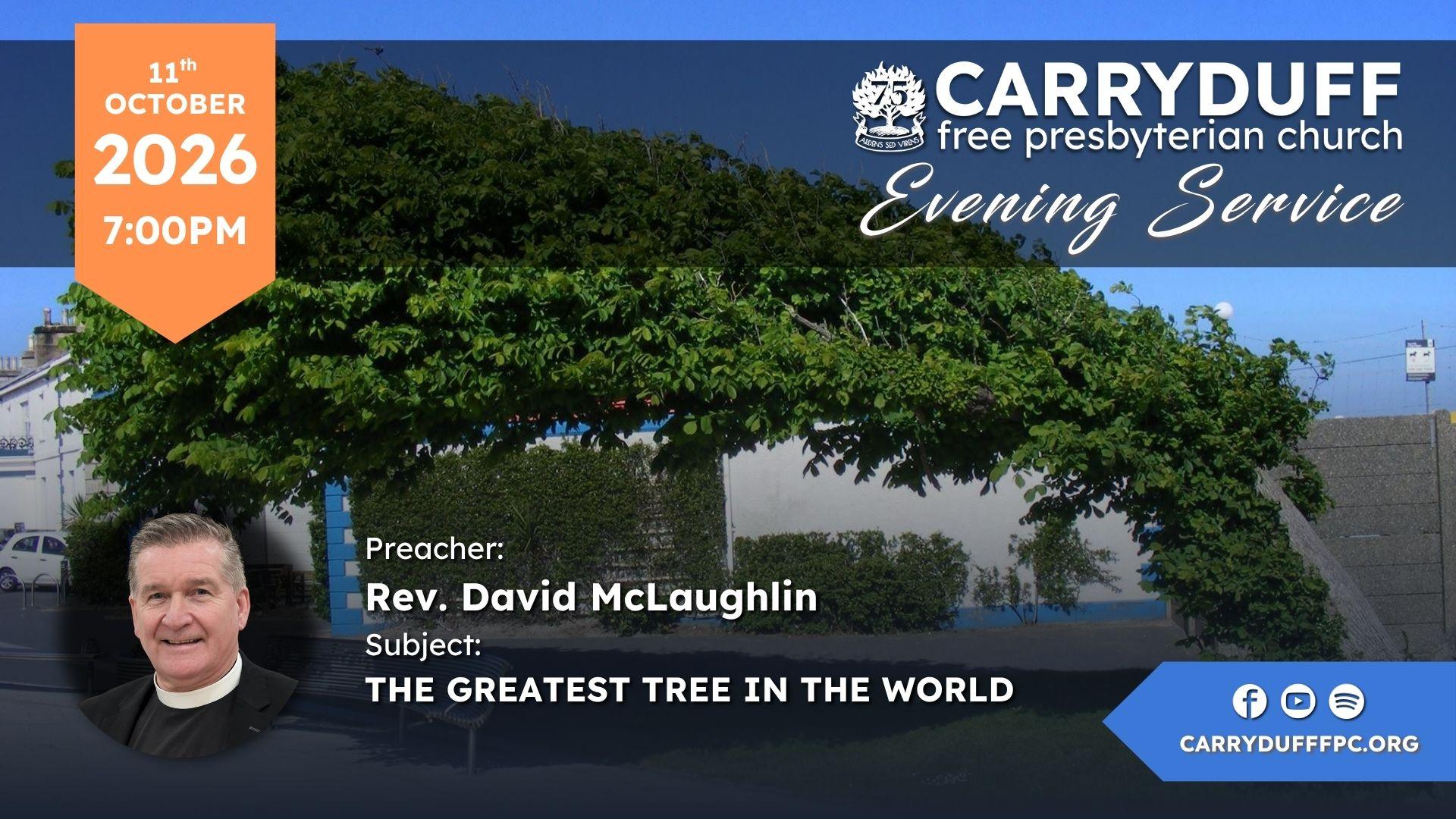
Date: SUN 7:00pm 11th October 2026
Preacher: Rev. David McLaughlin
Bible Reference: Acts 10:39-40
Podcast
Sermon Summary
Introduction and Context
The sermon is a Reformed exposition of Acts chapter 10, verses 39 and 40, preached from the King James Bible. The preacher opens by situating the passage within its narrative context: Peter is preaching in the house of Cornelius, a Gentile, and the sermon therefore marks a pivotal moment in the unfolding of the gospel beyond the boundaries of Israel. The reading begins at verse 34, where Peter declares that God is no respecter of persons, and continues through verse 43, culminating in the promise that whoever believes in Christ shall receive remission of sins.
The chosen text is Acts 10 verses 39 and 40:
“And we are witnesses of all things which he did both in the land of the Jews, and in Jerusalem; whom they slew and hanged on a tree: Him God raised up the third day, and shewed him openly.”
The preacher entitles the message The World’s Greatest Tree, drawing attention to the wooden structure of crucifixion, which he argues is the most significant tree in all of history.
The Occasion: A Reflection on Remarkable Trees
The preacher begins by acknowledging the many remarkable trees celebrated throughout the world. He offers a series of illustrations to establish a contrast:
- The General Sherman tree in California, famous for being among the largest trees in the world.
- The Methuselah tree, a bristlecone pine also in California, renowned for its extraordinary age.
- The Avenue of the Baobabs in Madagascar, noted for its enormous trunks and distinctive forms.
- The Major Oak in Sherwood Forest, celebrated for its great age and its legendary association with Robin Hood.
- The ancient yew trees found in churchyards such as St Mary’s Church, and weeping willows in churchyards across the United Kingdom.
He then notes a contemporary event: the Bendy Tree, a Welsh elm on the seafront of Newcastle, County Down, in Northern Ireland, had just been announced as the winner of the Woodland Trust United Kingdom Tree of the Year 2026. He observes that the tree is more than 150 years old, has endured the fiercest winds sweeping across the Irish Sea, has survived Dutch elm disease, and possesses an unusual, almost horizontal shape. That shape, he suggests, tells the story of a tree that has weathered the storms of life and still stands, providing shelter. He notes, with a touch of local humour, that the tree has been featured on television, in the press, and on the radio, and invites listeners to visit and send him a photograph.
These trees, he says, remind us of living things that have stood for centuries and become symbols of history, beauty, and endurance. Yet he proposes that there is one tree greater than all of them.
The Greatest Tree: Introduction to the Theme
The tree the preacher has in mind is not beautiful, has not been honoured with an award, is not planted in a royal garden, and is not protected in a national forest park. It is, however, mentioned five times in the New Testament:
- Acts 5:30
- Acts 10:39 (one of the texts)
- Acts 13:29
- Galatians 3:13
- 1 Peter 2:24
This tree is the wooden structure upon which the Lord Jesus Christ was crucified. Upon it, Christ gave Himself up to shame, to blood, and to death. The greatness of this tree lies not in its age, its beauty, its history, or even the actual wood, but in the glorious Person who hung upon it. The preacher directs attention to the sacrifice offered upon this tree and the great salvation God accomplished through Christ’s death and resurrection.
The gospel, he states, is that Jesus Christ, the Son of the living God, was put to death by crucifixion on this tree; that on this tree He took upon Himself the curse and wrath of God and bore our sins in His own body; and that by this cross work He carried out the greatest redemptive act in all of human history. As a testimony to that finished work, God raised Him from the dead. Peter’s sermon in the house of Cornelius is cited as evidence: the gospel was not confined to the Jews alone, but the Gentile world was to hear about Jesus Christ, His Person, and His work. Peter was a witness to the historical reality of Christ’s death on the tree, His bodily resurrection, and His ascension to God’s right hand.
The preacher then structures the remainder of the sermon around three main points:
- The greatest tree was a tree of terrible suffering.
- The greatest tree was a tree of truthful salvation.
- The greatest tree was a tree of triumphant splendour.
First Point: A Tree of Terrible Suffering
The preacher observes that Peter does not hide the horror of Calvary. In verse 39, Peter states plainly that wicked men put Jesus Christ to death and hanged Him on a tree. That tree was an instrument of Roman execution, designed to inflict the most terrible pain and public humiliation. It was an instrument of tremendous suffering and great shame.
The Shame of the Saviour
The preacher turns to Deuteronomy 21:22-23, which declares that a man hanged on a tree is accursed of God, and that his body should not remain overnight but be buried the same day. He notes that Paul makes this connection explicit in Galatians 3:13:
“Christ hath redeemed us from the curse of the law, being made a curse for us: for it is written, Cursed is every one that hangeth on a tree.”
The preacher draws out the wonder of this statement:
- The One who made the trees was nailed to a tree.
- The One who spoke the universe into existence, who said “Let there be light,” voluntarily submitted Himself to the hands of wicked men who executed Him by crucifixion.
- The One who was eternally the holy, blessed Son of the living God became a curse for us.
- The One who gave the code of the law bore the curse of the law.
- The One who knew no sin was made sin for us.
He emphasises that the death of the Lord Jesus via this tree was not an accident of history, nor a tragic interruption to His ministry in Galilee. Christ came as the Lamb slain from the foundation of the world. Acts 2:3 teaches that Christ was delivered by the determinate counsel and foreknowledge of God. Wicked men with wicked hands were wholly responsible for their actions, yet by the shame of this tree God was accomplishing His saving work and redemptive purpose.
The Suffering of the Saviour
The preacher then asks what the Lord Jesus Christ endured upon the tree, and considers the physical agony of crucifixion:
- In John 19 verse 1, Pilate took Jesus and scourged Him. His flesh was torn from His back.
- A crown of thorns was plaited and crushed onto His brow, with blood running down His face.
- They spat upon Him, slapped Him in the judgment hall, and mocked Him, saying “Prophesy, who smote thee?” and “Hail, King of the Jews.”
- When the crowd cried “Crucify him, crucify him,” He was led through the streets carrying the cross until He could carry it no longer. According to Matthew 27 verse 32, Simon of Cyrene was pulled from the crowd and compelled to carry the cross to Calvary.
- At Calvary He was stripped naked and His hands and feet were nailed to the wood.
- He endured public humiliation, physical exhaustion, the pain of nerve injuries, blood loss, muscle strain, breathing difficulty, and continued ridicule and the challenge to save Himself. He suffered thirst.
The preacher then turns to the mental and spiritual sufferings of the Saviour. He cites Psalm 22 verse 1: “My God, my God, why hast thou forsaken me?” He argues that the deepest mystery of the cross work was not the physical suffering, terrible as it was, but the doctrine of a substitutionary atonement. Christ stood in the place of His people and bore the penalty of their sin.
He cites Isaiah 53 verse 5:
“But he was wounded for our transgressions, he was bruised for our iniquities: the chastisement of our peace was upon him; and with his stripes we are healed.”
The repeated emphasis, he notes, is upon substitution: our transgressions, our iniquities, our peace, our healing. The emphasis falls on the law, on justice, on the seriousness of sin, and on the holiness of God.
An Illustration of Substitution
To illustrate substitution, the preacher tells a story. A king discovered that someone was stealing from his royal pantry and announced escalating punishments for the thief: first ten lashes, then twenty, then thirty, and finally, in his anger, forty lashes. When the culprit was caught, it was the king’s own daughter. The question arose: would the law be upheld? Would justice be seen to be done? On the day of punishment, the daughter was brought to the public square, tied to the whipping post. As the man raised the whip for the first lash, the king shouted “Stop.” He rose from his throne, removed his royal robe, tore open his own shirt, and embraced his daughter, exposing his back to the crowd while shielding her. He told the man to carry out the punishment. The preacher explains that this is the idea of substitution: the law was fulfilled, justice was satisfied, and mercy was shown because the father stood in relation to his daughter and took her punishment.
The Satisfaction of the Saviour
The preacher turns to the satisfaction of the Saviour. Christ cried out, “It is finished.” This finished work points sinners away from works-based righteousness, from human merit, and from personal worth. The question asked at the cross is not whether one is religious, respectable, righteous, or better than one’s neighbour, but whether one is in a personal relationship with Jesus Christ through faith.
Why was the cross necessary? Because God is holy, His law is righteous, His law has been broken, and every sin deserves judgment and punishment. God does not pretend that sin does not matter, nor does He sweep sin and guilt under the carpet. At Calvary He demonstrated both His justice and His mercy. Romans 6 verse 23 and related passages teach that God is just and the justifier of him which believeth in Jesus.
The Religions of the World Contrasted
The preacher considers the religions of the world and asks what the main principle of these religions is. He argues that they are all based on a works-based righteousness, a system of religious merit. They teach followers to do all the good they can, to be righteous, respectable, and religious, and to hope that at death their good deeds will outweigh their bad deeds so that they are accepted and admitted to heaven.
He asks directly whether this is what the listener believes, and then states that this is not what the Bible teaches. The Bible teaches the opposite: Christ Jesus satisfied the demands of God’s holy law, satisfied divine justice, and embodied God’s absolute holiness. Acceptance by God comes not at the end of life but at the start of the Christian life, when one is brought into a right relationship with God and reconciled to Him. It is based not on one’s own merit but on the meritorious work of Christ. Acceptance comes at the beginning of the Christian life because the satisfaction of Christ’s redemptive work has been accepted by the Father.
The preacher cites John 3 verses 17 and 18, which he had emphasised to the boys in Sunday school that morning:
“For God sent not his Son into the world to condemn the world; but that the world through him might be saved. He that believeth on him is not condemned: but he that believeth not is condemned already, because he hath not believed in the name of the only begotten Son of God.”
He also cites 1 Peter 2 verse 24:
“Who his own self bare our sins in his own body on the tree, that we, being dead to sins, should live unto righteousness: by whose stripes ye were healed.”
The cross, he states, is not a place of compromise between righteousness and love. It is the place where God’s righteousness was fully satisfied and His saving love was displayed and demonstrated. He cites Romans 5 verse 8: “But God commendeth his love toward us, in that, while we were yet sinners, Christ died for us.” Acceptance is announced in Ephesians 1 verse 6: “Accepted in the beloved.” It is a reward not for being good or doing good, but a reward to guilty, hell-deserving sinners who required mercy and who have received Christ as Lord and Saviour.
The Greatest Tree Surpasses All Others
The preacher returns to his opening illustrations. The General Sherman tree, enormous as it is, cannot remove one’s sin. The great yews that have stood for thousands of years in churchyards cannot reconcile one sinner to God. The Bendy Tree in Newcastle, which can survive the fiercest storms and winds, cannot rescue one’s soul from eternal judgment. But the greatest tree in the world can.
Second Point: A Tree of Truthful Salvation
The preacher notes that verse 39 continues: “whom they slew and hanged on a tree, him God raised up the third day.” He asks what the purpose of Christ’s death was. The gospel, he argues, is more than a proclamation that Christ died on the cross. It is a declaration that through Christ’s death God accomplished something, accomplished eternal redemption.
He cites Hebrews 10 verse 12:
“But this man, after he had offered one sacrifice for sins for ever, sat down on the right hand of God.”
He cites Mark 10 verse 45: “For even the Son of man came not to be ministered unto, but to minister, and to give his life a ransom for many.” He cites 1 Timothy 1 verse 15: “This is a faithful saying, and worthy of all acceptation, that Christ Jesus came into the world to save sinners; of whom I am chief.” Christ came to redeem a people for Himself, to fulfil the broken law, and to do for us what we could not do for ourselves.
Salvation Is of the Lord
The preacher affirms that salvation is all of God, of grace. He cites Jonah 2 verse 9: “Salvation is of the Lord.” Salvation is by grace alone, through faith alone, in Christ alone. He notes that it is Reformation Month and expresses awareness of the teaching of Roman Catholicism. He argues that while Roman Catholicism teaches that people are saved by faith through grace, it does not teach salvation through grace alone or by faith alone. In other words, according to Roman Catholicism, salvation by grace alone, through faith alone, in Christ alone is not entirely sufficient; something must be added.
The preacher states that we contribute nothing to the atoning work of Christ. We cannot supplement His sacrifice with our own good works. He cites Ephesians 2 verses 8 and 9: “For by grace are ye saved through faith; and that not of yourselves: it is the gift of God: Not of works, lest any man should boast.” The cross leaves no room for human boasting. No sinner could say “I saved myself,” or “I contributed something to my salvation,” or “Christ did most of the work, but I added a wee bit at the end by my good works.” Salvation rests entirely upon the finished work of Christ. Good works are not the ground of salvation; they are the fruit and the evidence.
The Power of Christ’s Death
The preacher turns to the power of Christ’s death, citing 1 Corinthians 1 verse 18:
“For the preaching of the cross is to them that perish foolishness; but unto us which are saved it is the power of God.”
The cross is a great display, demonstration, and declaration of Christ’s finished work. It was not a tragedy but a triumph. It was not a failure. It is the place of redemption, demonstrating divine wisdom and declaring divine love.
The Price of Christ’s Death
The preacher then considers the price of the cross. On the cross the Lord Jesus shed His precious blood. He cites 1 Peter 1 verses 18 and 19:
“Forasmuch as ye know that ye were not redeemed with corruptible things, as silver and gold, from your vain conversation received by tradition from your fathers; But with the precious blood of Christ, as of a lamb without blemish and without spot.”
He asks what price could purchase a guilty soul. Silver and gold will not do it. Human reputation will not do it. Church membership will not do it. Morality will not do it. Religious traditions will not do it. Respectability will not do it. The price is the blood of Christ. He references the hymn “There is Power in the Blood”: “There is power, wonder-working power in the blood of the Lamb.” He also references a hymn by Horatius Bonar, number 317, “I heard the voice of Jesus say, I am this dark world’s light; look unto me, thy morn shall rise, and all thy day be bright.” He reflects that faith alone looks to the finished work of Christ on the tree.
Third Point: A Tree of Triumphant Splendour
The preacher turns finally to the triumphant splendour of the greatest tree. He notes that there is a summons from the cross, a real invitation. It is not to make oneself worthy and ready, but to repent and believe the gospel. He returns to Peter’s words in verse 40: “Him God raised up the third day, and shewed him openly.” This is the turning point. Yes, they slew and hanged Christ on a tree, but Him God raised up the third day and showed Him openly. Resurrection victory.
The preacher declares that today the tree is empty and the tomb is empty. The death of Christ was not the end of the story, nor was His burial. Christ is not on the cross. He addresses Roman Catholic fellow countrymen who carry the crucifix, noting that Christ is not on the cross. The cross is empty. The crucified Christ became the risen Christ, and the crucifix does not mention that.
The Resurrection Declared
The resurrection is declared in Peter’s words: “Him God raised up.” The resurrection was the Father’s vindication of His Son, the fullest vindication. Death could not hold Him. The preacher states that the resurrection is not a matter of ideas, nor a symbol of hope as liberals want to tell us. It is literal, historical, bodily, and real. He literally and bodily rose again from the dead, this same Jesus.
The Resurrection Demonstrated
The resurrection demonstrates that Jesus Christ is who He claimed to be. Christ was not defeated by death. The grave could not hold Him. He was the Prince of Life. The resurrection demonstrates that all the promises of God are real and true, yea and amen. The death of Christ and His physical, mental, and spiritual sufferings are not the final word.
The Resurrection Delivered
The preacher concludes that the cross and resurrection go together. Where you have one, you must have the other. The Saviour who died is the same Saviour who lives. The Saviour who shed His blood on the tree lives, and the announcement is that the blood of Jesus Christ His Son cleanseth us from all sin. The Redeemer is not powerless; He lives, He sees, He keeps, and He prays for us in heaven. He is our great High Priest.
He cites Hebrews 7 verse 25:
“Wherefore he is able also to save them to the uttermost that come unto God by him, seeing he ever liveth to make intercession for them.”
The preacher draws the connections together: Christ did live, Christ did die, Christ arose from the dead, Christ saves, and Christ now is in heaven interceding and praying. He is able to save from the uttermost to the uttermost. Why? Because His resurrection was declared, demonstrated, and delivered. It is delivered in the sense that it changed and transformed those who repented of their sin and put their faith and trust in Jesus Christ.
Conclusion and Application
The preacher returns to his opening theme. Yes, let us talk about the Bendy Tree in Newcastle, but that is not the greatest tree in the world. The greatest tree in the world is the tree upon which the Saviour hung. Five times it is mentioned in Scripture. It is a tree of terrible suffering, and the preacher invites the listener to ponder the shame, the physical suffering, the mental suffering, and the spiritual suffering, when God made Him to be sin for us who knew no sin, that we might be made the righteousness of God in Him. It is a tree of truthful salvation, because it reveals the purpose, the power, and the price of the cross. It is a tree of triumphant splendour, because it is not the end of the story. It is sad when somebody dies, but it is not the end of the story. There is resurrection victory, and it is found in Christ, and it can be declared and demonstrated because Christ’s resurrection is real.
The preacher closes with a series of questions directed to the listener:
- Jesus saves; Jesus keeps. Is He keeping you?
- Are you trusting in Him?
- Is He your Lord and Redeemer this evening?
He expresses his trust and prayer that if the listener does not know Christ and has not yet trusted in Him, they would come to this greatest tree by faith and receive Christ to be their Lord and Saviour. He concludes with a prayer that the Lord would take these few thoughts from the preacher and bless them to those listening.