

Date: Sun PM 17th June 2018
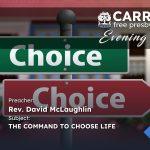
Preacher: Rev. David McLaughlin
Bible Reference: Deuteronomy 30v19
I call heaven and earth to record this day against you, that I have set before you life and death, blessing and cursing: therefore choose life, that both thou and thy seed may live:
Summary of the Sermon: “God’s Call to Choose Life”
This sermon was preached at the opening of a new series of gospel meetings, taking as its text Deuteronomy 30:11–20 in the Authorised Version, with the theme verse being Deuteronomy 30:19: “I call heaven and earth to record this day against you, that I have set before you life and death, blessing and cursing: therefore choose life, that both thou and thy seed may live.” The preacher’s stated theme is God’s call to choose life, and the sermon is organised around four alliterative heads — the company, the character, the cost, and the consequence of this choice — with the central section further subdivided. The tone throughout is evangelistic and urgent, addressed both to the professing congregation and, with particular force, to the unconverted and to young people. What follows traces the sermon’s movement from its historical setting through each of its main divisions to its closing appeal.
The Setting of the Text
The preacher begins by establishing the historical setting. Moses, the servant of the Lord, is addressing the children of Israel as they stand on the plains of Moab facing the River Jordan. He is one hundred and twenty years old, his natural strength unabated and his eyesight undimmed, yet God has told him that his death is near and that he will not lead the people into the land. Joshua will succeed him after forty years of wilderness leadership. The preacher reminds the congregation that forty years earlier a previous generation had stood at a different point facing the same river, and despite tasting the good fruit of Canaan and hearing the good report of the two faithful spies, that generation murmured and rebelled in heart and mind against the Lord. God therefore turned them back into the wilderness, where they wandered until the whole generation died, thousands upon thousands buried in the sand as a witness and testimony against them. Only Joshua and Caleb survived.
Now, forty years later, Moses remembers that tragedy and summons the whole congregation to a solemn assembly, delivering what is effectively his final message under God. The people are at a crossroads: the wilderness is behind them, the Jordan before them, and the promised land beyond. Into that moment Moses speaks the call to choose life, and the preacher makes clear that this same call now goes out to all who will hear it inside the meeting house.
The Company of This Choice
The first main division concerns the company to whom the choice is given, and the preacher identifies them as a truly privileged people. Israel had seen deliverance by the blood of the Lamb out of Egypt, had witnessed the wrath of God destroying Pharaoh and his army at the Red Sea, and had beheld wonders including the plagues of Egypt, water from the rock at Horeb, the provision of heavenly manna, and the lifting up of the brazen serpent among the fiery serpents. They had been gifted a faithful leader who led them despite their murmurings, disputings and backslidings — one who prayed for them, pleaded with them and preached the Word of God to them. Above all, the law and government of God had been made known to them in the Ten Commandments. They were taught three things in particular:
- the standard of the law, God’s demand for perfect obedience;
- the sentence of the law, that the wages of sin is death and the soul that sinneth shall die;
- the substitution of the law, namely that the broken law could be atoned for by the blood of the Lamb, for without the shedding of blood there is no remission.
The preacher then draws a direct parallel with his own hearers, asking whether they have not likewise been greatly privileged. They have been gifted with life, health and strength, spared on many occasions from death — whether in a car accident or a serious illness in hospital — and have been brought under the sound of the gospel. They know the standard of the law, the sentence of the law, and the substitute who kept the law perfectly and paid its penalty by His death on the cross, appearing once in the end of the world to put away sin by the sacrifice of Himself. Their hearts have at times been touched with the knowledge that they are sinners needing to be saved.
Yet Israel was also a professing people, and this is where the preacher presses hardest. Among the company of God’s people were many who professed to know the Lord in an experimental way, who read their Bibles regularly, allowed God to speak to their hearts, offered prayer and engaged in almsgiving — and yet had no real right relationship with God. They were not born again, not true believers, and had no real love for the Lord, for God’s Son, for the Scriptures, for the Sabbath day, or for the souls of men. The preacher applies this with force to his own land, observing that thousands profess the name of the Lord, claim church membership and engage in religious activity, yet have no true relationship with Him, no new birth, no peace with God and no delight in the things of God. He cites Jeremiah’s words that the heart is deceitful above all things and desperately wicked, and offers Simon Magus in Acts 8 as a warning case — a man who “believed,” was baptised and made an outward confession, yet of whom Peter declared, “Thy heart is not right in the sight of God.”
The Character of This Choice
The second and longest division examines what kind of choice this is, under five headings.
It is, first, a definite choice. Moses sets before the people two options only, life or death, blessing or cursing, obedience or disobedience. There is no middle road, no pathway in between, no sitting on the fence. This choice is not a political opinion, nor a matter of the moral state of society, nor any particular issue other than the choosing of life. In the context of Deuteronomy, the preacher argues, “choose life” has to do with the gospel. Verse 14 — “the word is very nigh unto thee, in thy mouth, and in thy heart, that thou mayest do it” — is quoted by Paul in Romans 10:8 as the word of faith which he preached: confess with thy mouth the Lord Jesus, believe in thine heart that God raised Him from the dead, and thou shalt be saved. Therefore to choose life is to choose Christ, for Christ is the sum and substance of the gospel. The gospel is not a system of religion, a code of ethics, or a system of works; Christ Himself said, “I am the way, the truth, and the life,” and “I am come that they might have life, and that they might have it more abundantly,” while John wrote, “In him was life.” The preacher observes that many young people look for life in drink, drugs, sexual fulfilment, rock and roll, parties and other things, yet remain deeply dissatisfied, craving something else — and the great message of the Bible is that life is in the Lord.
It is, second, a deciding choice, because it determines where a man or woman spends eternity. Choosing life brings pardon from sin, deliverance from sin’s penalty, peace with God through justification by faith, pleasure in God, and power from God to live the Christian life. Verse 17 sets out the alternative: if the heart turns away, refuses to hear and is drawn away to worship other gods and serve them, the Lord denounces that person and he shall surely perish. This is no trivial matter but the most important choice a man or woman, boy or girl, will ever make. The preacher contrasts it with the everyday choices of life — education, clothing, holidays, the doctor, the dentist, a rattle in the car — and insists this is not about those things. He states plainly that he does not care what people think of him or of the Free Presbyterian Church, because salvation is not in the church. No one is invited to join the church in order to be saved; salvation is in Christ, and there is no other name under heaven given among men whereby we must be saved. He recalls Pilate’s question, “What shall I do with Jesus, which is called Christ?” and the crowd’s choice to crucify or release Him, extending the question to the hearer: receive Him or reject Him? Bow to Him or badmouth Him? Quoting Albert Simpson — what will you do with Jesus, you must decide; someday your heart will be asking what He will do with me.
It is, third, a demanding choice, requiring an urgent and immediate response. The uncertainty of life is stressed with the words “Boast not thyself of tomorrow; for thou knowest not what a day may bring forth,” and the certainty of death is stressed with a personal recollection: a phone call at four o’clock from a rector to say that a dear cousin of the preacher’s wife had died aged fifty-four, and another woman of fifty-two who had passed into eternity. He cites 2 Corinthians 6:2 — “Behold, now is the accepted time; behold, now is the day of salvation” — and Hebrews 3:7–8, “Today, if ye will hear his voice, harden not your hearts, as in the provocation,” which takes the hearer back to Israel’s rebellion in the wilderness. He tells the story of the Reverend Timothy East, a friend of Spurgeon, who pleaded with a lady who agreed she needed to be saved but said she would not be saved that day. Some weeks later he was called by her little girl, a Sunday school pupil, to her home and found the woman dying and unable to speak. He stood and wept, never knowing whether she closed with Christ. The application is that the hearer’s soul is in question and delay may be fatal.
It is, fourth, a documented choice. Verse 19 calls heaven and earth to record against the people. Moses commands the heavenly bodies and the earth beneath to act as a panel of witnesses, recording the acts of rebellion and rejection of the people. The sun, moon, stars, mountains, valleys, trees and seas were eyewitnesses of their conduct and their choice. God keeps a record, and every instance heard and seen will one day rise up and testify. The preacher applies this directly: every time the gospel has been heard, every tract received, every sitting in the house of God is documented. Sin is documented and will be held against us on the final day — the day for which all other days were made.
It is, fifth, a distinct choice. The words “against you” show that this is personal. It is not the person in front of you or behind you; it is you personally. It is addressed to boys and girls, who can be saved and need to be saved, and to men and women both inside the church and outside it in the community.
The Cost and Consequence of This Choice
The third division concerns the cost. There is an amazing offer of abundant and eternal life, a life of blessing, power and victory, lived in a great relationship with the Lord. There is an amazing obligation, namely that the hearer must choose life. There is an outcome — “that thou mayest live, and thy seed shall live” — for decisions have consequences, and some decisions prove costly not only financially but in bodily health and relationships. The opposite of life is death, and the opposite of blessing is cursing. To reject Christ, to refuse Him, to fail to repent of sin and to fail to own Him as Lord and Saviour, will cost the knowledge of sins forgiven, eternal life, and the soul itself. The preacher cites Christ’s words, “What shall it profit a man, if he shall gain the whole world, and lose his own soul?” He observes that the way of the transgressor is hard, and that many young people are deeply unsatisfied, living a life of misery and mere existence, whether in addiction to drugs, drink or otherwise — a life wrapped in sin and often ruined before the age of forty.
The fourth division concerns the consequence. This choice determines life in the here and now and life in eternity, and determines whether one is part of the true family of God. It determines whether one can say of Christ, “This is my beloved, and this is my friend,” and know the Lord’s presence in the journey of life. The psalmist could say, “Yea, though I walk through the valley of the shadow of death, I will fear no evil: for thou art with me,” and “Surely goodness and mercy shall follow me all the days of my life: and I will dwell in the house of the Lord for ever.” If life is refused and the path of cursing chosen, the person remains without God, without Christ and without hope in the world, without peace with God, without a right future and without assurance of heaven. Christ said three times in John’s Gospel that if a person dies in their sins, where He is they cannot come. The preacher states plainly that the Bible speaks of a place called hell — utter darkness, where the worm dieth not and the fire is not quenched — and that the wicked shall be turned into hell and all the nations that forget God. He cites the rich man in Luke 16, who died and in hell lifted up his eyes; he did not go to hell because he was a wretch, but because he did not repent, did not recognise his sin and did not cry out like the publican, “God be merciful to me a sinner.”
Conclusion
The preacher draws the sermon together by returning to his four heads: the company of this choice, a privileged but professing people; the character of this choice, definite, deciding, demanding, documented and distinct; the cost of not choosing life; and the consequence of not choosing life, namely to die in one’s sins and have a lost soul in hell for all eternity. He affirms that hell is as real as heaven, and says he does not preach on this subject merely to frighten but to set before the hearer the truth of God’s Word, confessing that he does not preach on it without feeling it in his own heart. He notes that we live in uncertain times, that no one knows the day of their death, and therefore urges in the Lord’s name, “Choose life, that both thou and thy seed may live.” The service closes with an invitation to speak with him over a cup of tea and a prayer that the Lord will meet with the congregation.
In method, the sermon reads Deuteronomy 30 in full and expounds it verse by verse, with cross-references to Romans 10, John 1, John 10, John 14, 2 Corinthians 6, Hebrews 3, Jeremiah 17, Acts 8, Luke 16 and the Psalms. Its central thesis is that the choice set before Israel by Moses is the same choice set before the hearer by the gospel — Christ or death — and that it must be made personally, immediately, and with the knowledge that heaven and earth record it.