
Service Details
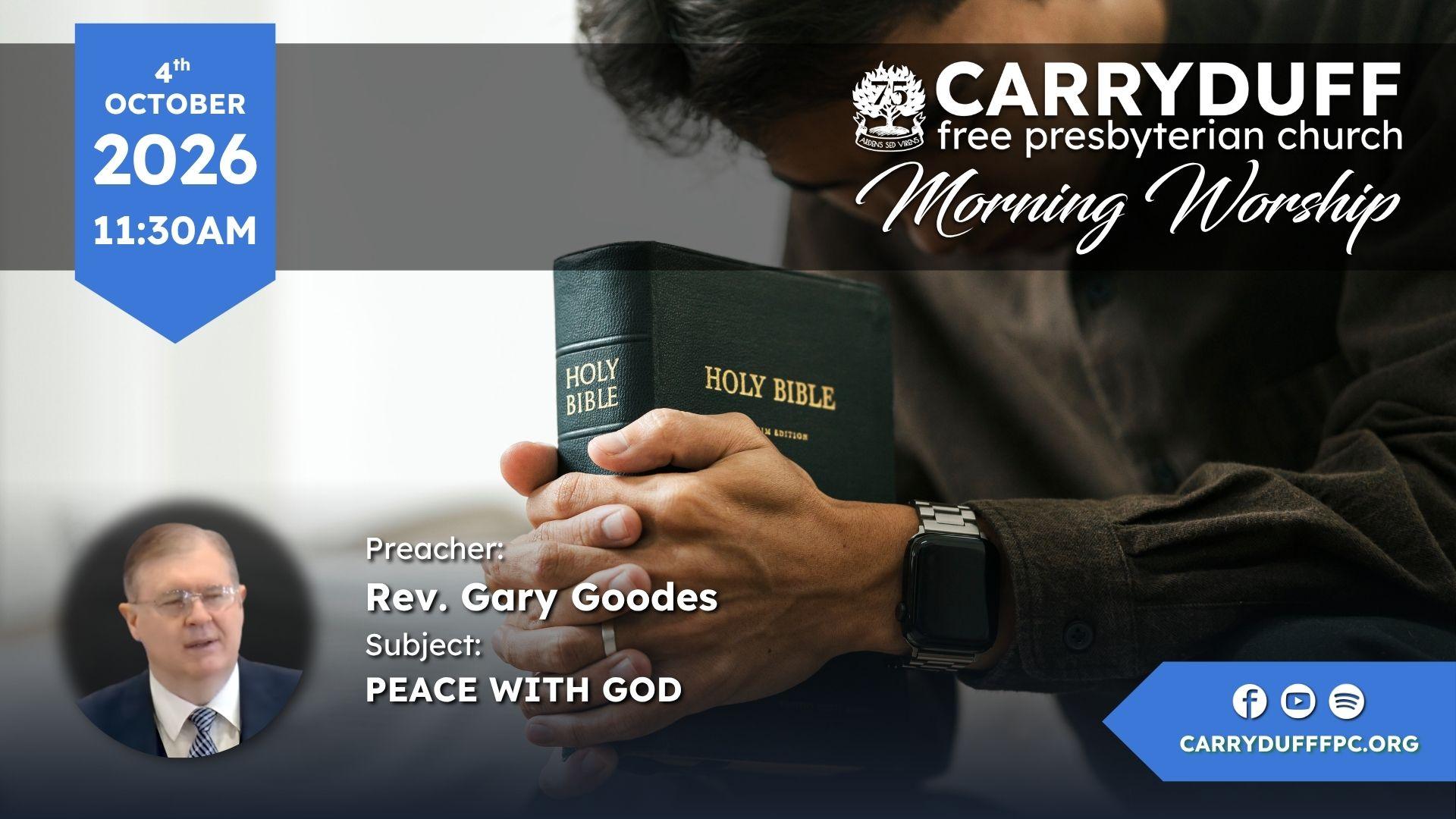
Date: SUN 11:30am 4th October 2026
Preacher: Rev. Gary Goodes
Bible Reference: Romans 5:1-11
Podcast
Sermon Summary
Introduction and Setting
The sermon opens with the public reading of Romans chapter 5, verses 1 through 11, followed by a brief pastoral prayer. The preacher then introduces the central theme of the passage in the opening verse: “Therefore being justified by faith, we have peace with God through our Lord Jesus Christ.” From this single verse, the entire message is developed around the subject of peace with God.
To illustrate the power of this text, the preacher draws on the conversion of John Wesley. On the 24th of May 1738, Wesley — then a discouraged and, by his own admission, unconverted missionary — attended a religious meeting in London, where he heard a reading of the preface to Martin Luther’s commentary on Romans. Wesley recorded in his journal that at about a quarter before nine he “felt his heart strangely warmed,” that he trusted in Christ alone for salvation, and that assurance was given him that his sins were taken away. The preacher notes the striking fact that a man could be a missionary and yet not be saved, and applies this to the present day by suggesting that unconverted ministers may be found in pulpits across the province. Wesley’s earlier journal entry — “I went to America to convert the Indians, but oh, who shall convert me?” — is cited to show the honesty of a man who knew he was not yet a Christian. That evening in Aldersgate Street answered his question, and the result was the Wesleyan revival that swept across England and transformed the nation.
The preacher then connects this to the wider history of the church, noting that both the Protestant Reformation and the Wesleyan revival were fruits of this same epistle. Paul wrote the letter from Corinth, believed to be around AD 56. The preacher emphasises the privilege that the same inspired letter, the same Holy Spirit who taught and convicted Luther and Wesley, can teach and convict the hearers that morning.
The Structure and Logic of Romans
Attention is drawn to the very first word of the chapter — “therefore” — and to the logical character of the epistle. This little word appears repeatedly throughout the book and serves as a marker of Paul’s argument. The preacher identifies several of these pivotal “therefores”:
- The therefore of condemnation in chapter 3
- The therefore of justification in chapter 5
- The therefore of no condemnation in chapter 8
- The therefore of dedication in chapter 12
He advises the listener to underline this word whenever it appears, as it breaks the epistle down into its argumentative sections. In presenting his case, Paul proves that the whole world — all the descendants of Adam — is guilty before God, and that no one can be saved by religious deeds or by keeping the law. The preacher laments that many go astray here today, noting that he has spoken to people in Northern Ireland whose ministers told them simply to do their best, be the best neighbour, and set the best example. That, he insists, is not what the Bible teaches. The epistle of Romans is written to quash this misconception, explaining that God’s way of salvation has always been by grace through faith. Salvation cannot be earned or deserved; it is offered fully and freely as a gift. Abraham is used in the epistle as the great illustration of this principle. If a reader were to stop at chapter 5, he would already know both that he needs to be saved and that he can be saved.
Three Tenses of Salvation
A short anecdote is used to illuminate the three tenses of salvation. A little girl asked a man on the street whether he had been saved. The man, a Christian, replied with an apparently puzzling answer: “Yes, young lady, I have been saved; but beyond that I am being saved; and one day I will be saved.” The preacher explains this using the teaching of Romans:
- As a Christian, I have been saved from the penalty of sin — justification.
- I am being saved from the power of sin — sanctification, the ongoing work of the Holy Spirit in the believer’s heart.
- I will be saved from the presence of sin — glorification, when the believer receives a resurrection body and stands in the very presence of God.
The preacher notes that in chapter 5 Paul explains salvation from sin’s penalty; in chapter 6 he speaks of salvation from sin’s power; and in chapters 7 and 8 he speaks of the day when the believer will be saved from sin’s very presence. Paul was evidently so excited about this truth that in the opening verses of chapter 5 he gives a preview of what is to come in chapters 6, 7 and 8.
The Grace We Enjoy Regarding Our Past
The first main heading of the sermon concerns the grace that believers enjoy regarding their past. Paul has already established that man has a problem: we are born in sin and shaped in iniquity. Sin is a problem because it separates us from God. This is the fundamental issue — sin in our hearts and lives separates us from the Lord, and this is why we must be saved. When a person is saved, he is brought into fellowship with the Lord now, and in eternity he will not be separated from God but will come into His presence.
The Old Testament is cited in support: Isaiah 59 speaks of iniquities separating between man and God, with sins hiding His face so that He will not hear. The unsaved person, whose sins are not forgiven, finds that even his prayers are not heard until he prays the sinner’s prayer of repentance. When Adam sinned in the Garden of Eden, he was immediately cut off from fellowship with the Lord. Before the fall, God walked with Adam in the garden; after the fall, instead of God walking with Adam, God is looking for Adam. Before, Adam and God were talking; now Adam runs away from God. Sin created a great gulf between God and man. When the Lord Jesus Christ came into the world, He removed that barrier and restored the blessing of fellowship with the Lord. The preacher quotes the hymn: “O the love that drew salvation’s plan, O the grace that brought it down to man, O the mighty gulf that God did span at Calvary.”
Because of Calvary, the believer has two things restored that were lost by Adam in the garden.
Acceptance with God
The first is acceptance with God. The opening verse declares that being justified by faith, we have peace with God through our Lord Jesus Christ. Every person outside of Christ is in a constant state of war with God. War was declared in the Garden of Eden — not by God against man, but by man against God — and man and God have been at odds ever since. Every person without Christ is at enmity with God. The carnal mind is enmity against God, for it is not subject to the law of God, neither indeed can it be. The preacher testifies from his own life: he was not saved until the age of 23, raised in Australia as an atheist, never attending church or Sunday school, never believing in God and never opening a Bible. His life was a life of self and sin. That verse was true of him — he had no desire to become a Christian, no desire to change his life or be saved, because he was ruled by a heart of sin. This is why unsaved people have no desire to walk with God or follow the Lord: there is a barrier of sin between man and God.
This also means there is no neutral ground in the war between God and man. A person is either for the Lord or against Him. He that hath the Son hath life; he that hath not the Son shall not see life, but the wrath of God abideth on him. The preacher notes how often people claim to be “neutral” — saying they sort of believe but are not living as they should. There is no neutrality; the Lord Himself said, “He that is not with me is against me.”
People all over the world are looking for peace. We live in a world of anxiety and fear. The preacher confesses that he goes days without watching the evening news because it is so depressing — the turmoil, tribulation and disasters only depress him. But what people are really looking for is an internal peace in the heart. The test is this: when you put your head on the pillow at night and consider that God might take you before the morning, would there be peace in your heart at going out to meet the Lord? The Bible says there is no peace, saith my God, to the wicked. But for the believer, God will keep him in perfect peace whose mind is stayed on Him, because he trusts in Him. The phrase “perfect peace” is significant — it tells us that every other peace people find in the world apart from the peace that comes through salvation is an imperfect peace that does not last. The only perfect peace is the peace of God, and you will never know the peace of God until you are first at peace with God. When a person is saved, he is at peace with God; he is no longer at war with God, and moreover the Lord puts His Spirit within him and gives him the very peace of God.
People look for peace in all the wrong places: the alcoholic in the bottle, the addict in the pill. But peace is not something you find so much as something you receive. A dying woman was asked by a well-meaning friend whether she had made her peace with God. She replied, “Son, I am already resting in the peace that Jesus Christ has made with me.” She had discovered that only through the Lord Jesus Christ can one find peace and acceptance with God. The preacher presses the application: can you say this morning that you have acceptance with God, that if the Lord were to take you out of this world you would be ready to go? None of us knows what a day may bring forth. He relates that just as he was about to leave the house that morning, the phone rang and a mother told him her daughter had died that morning. The old must die, but the young can die too. We all think we will be here until we are 100, but we will not. Go into any cemetery and look at the ages — everything from babies to senior citizens. This is why the subject is so important.
Access to God
The second thing restored is access to God. Adam lost fellowship with God in the garden when he sinned, but when a person is saved, verse 2 applies: “By whom also we have access by faith into this grace wherein we stand, and rejoice in hope of the glory of God.” The word access literally means introduction — it means to bring entrance to the King through the favour of another. When the preacher was saved, he not only enjoyed peace with God and the peace of God in his heart, but he could now enjoy the presence of God, something he had never experienced in his first 23 years. Because of the Lord Jesus Christ, we can come again and not only walk with the Lord but talk with the Lord.
In the Old Testament, the Jew was kept away from the presence of God by the great veil that hung in the temple, and the Gentile was kept out by the wall of the temple, upon which was a warning that any Gentile who entered would be killed. When the Lord died, He tore down the veil that separated the Jew from God and broke down the wall that separated the Gentile from God. Now both Jew and Gentile have unlimited access through the Lord. Ephesians 2 tells us that through Him we both have access by one Spirit unto the Father.
It is one thing to say you believe in God; it is another thing to enjoy daily fellowship with the Lord. Many will say they are not Christians but that they “believe.” But do you enjoy daily fellowship with the Lord? It is one thing to hold an abstract belief that there may be a God; it is a different thing to say, “I know the Lord and I walk with Him and talk with Him every day.”
The preacher illustrates access with the story of a little boy standing outside the gates of Buckingham Palace in London more than a century ago. The guards were rude, shoved him away and told him to leave. The boy dissolved into tears, giving up all hope of meeting the king. Then a well-dressed young man came along, saw the boy crying and asked what was wrong. Hearing the story, he said, “Son, just hold my hand. Come with me and don’t pay any attention to the soldiers.” The boy gingerly took the young man’s hand. To his amazement, as they walked up to the gates, the soldiers stood to attention. They walked through the palace grounds, past the guards, along carpeted hallways, through wide-flung doors, until finally they came into the throne room. There was the king of England himself. The boy could not believe or understand it. Then the young man holding his hand said, “Father, I brought a friend to meet you.” The boy had not known that the stranger who took his hand was the son of the king. In the same way, believers are not only blessed with acceptance with God but with access to the Lord. Even though we have been sinners in the past, through the wonderful grace of God manifested in our hearts, we can talk with the Lord, walk with the Lord, and fellowship with the Lord through His Son. This is the great truth that changed the life of John Wesley and transformed the life of Martin Luther.
The Growth We Experience in the Present
The second main heading concerns the growth that believers experience in the present. Verse 3 continues the progression: “And not only so, but we glory in tribulations also, knowing that tribulation worketh patience.” This is a difficult statement to read and to grasp. How can one glory in tribulation — in the troubles and trials of life?
Two principles are given to keep in mind when going through trials.
God Has a Purpose in Every Trial
The first principle is that God has a purpose in every trial that comes into your life. The English word tribulation comes from the Latin tribulum. In Paul’s day, a tribulum was a heavy piece of timber with spikes, used by a farmer to thresh grain — swung through the grain to separate the wheat from the chaff. In later times it was also used to inflict injury on others, and it is from this that the word became synonymous with tribulation. This is exactly how the Lord uses trials in the lives of His children. Even though a person is saved, there is still chaff in his life that needs removing. No believer is sinless in this world; we are saved, but we will not be perfect until glory, for we are still in these old bodies. How does the Lord remove the chaff from the wheat and the dross from the gold? Peter reminds us in 1 Peter 1 that though for a season, if need be, we are in heaviness through manifold temptations, the trial of our faith is much more precious than gold that perishes, though it be tried with fire, and it will be found unto praise and honour and glory at the appearing of Jesus Christ.
We are so concerned all the time with what happens to us, but as far as God is concerned, He is more interested in the reaction that comes from us. Often the Lord allows trials to come into our lives to try our faith, to test it and strengthen it. The preacher recalls a quote from a Bible commentator whose name he cannot remember: “The faith that can’t be tested is the faith that can’t be trusted.” A soldier going into war with a sword would not want to go into battle with an untested sword. He would want to put it to the test and try it out first, so that it would not break in the day of battle. That is what the Lord does with our faith — He tests it.
Many people today are like Job’s comforters and get it all wrong. When a trial comes into your life, they say there must be something wrong with you for this trouble to come. In fact, it is often the opposite. The whole book of Job was written to show that Job was the most upright man in his day and generation. He suffered more trials and troubles than we ever will, but it was all because the Lord was going to demonstrate the faith he had in the midst of all that trial. When the rug is pulled out from under us, that is when faith either shines or crumbles.
The preacher returns to the mother whose daughter had died that morning. She said, “Now she’s with the Lord, and her suffering is over.” That woman’s faith shone. She was standing on her faith, leaning on it and looking to the Lord. Trials will do one of two things: they will either drive you closer to the Lord or be a wedge that drives you away from God. You determine which by your reaction. All that will live godly in Christ Jesus shall suffer persecution. Study the life of Christ Himself — He was sinless, yet look at all He suffered for us. Look at the apostles, all but one of whom were martyred for the faith. Go through the Old Testament and see how many suffered, and why — because they were believers.
A further example is given. In Lisburn a few weeks earlier, the clerk of session spoke of how his wife had taken a fall and broken a hip, requiring hospital and an operation. They could not understand why the Lord allowed it. But weeks later, while tests were being done to make sure there was nothing else wrong, it was discovered that she needed a heart valve replaced. Had it not been discovered, she would have died. Through the fall and broken hip, the problem was found, and it was possible to do everything at the same time. God has a plan and purpose.
The Presence of God in Tribulation
The second principle is that we are not to forget the presence of God in the midst of tribulations. The light of the sun is never more appreciated than during the darkness of the night. You will never be closer to the Lord than in the darkest moments of your life. Spurgeon was right when he said the refiner is never far from the furnace when his gold is in the fire. When trouble comes — and trouble will come — if you respond to it in a godly fashion, God lays layers of glory upon it.
The preacher recalls visiting a pearl farm or oyster farm in northern Australia, where the process of making pearls was demonstrated: an oyster is opened, a little piece of grit is placed inside, and the oyster closes up and lays layers upon the grit to stop it irritating it. That is how pearls are made. Something so beautiful and so prized comes from the pain and irritation experienced by the oyster. The Lord can do the same for the believer.
Amy Carmichael is introduced as one of the most amazing women the preacher has read about. In 1895 she left a comfortable home to be a missionary in India, staying for 56 years. She risked her life to rescue little children from superstitious bondage. In 1931 she suffered a serious fall and for the next 20 years was confined to a room, in almost constant pain. Yet during that time she continued her missionary work, received visitors to whom she witnessed, and wrote 13 books. During that period she wrote: “We must learn to pray far more for spiritual victory than for protection from battle wounds, relief from their havoc, or rest from their pain. This triumph is not deliverance from trials but victory in trials.” We all want an easy life, perfectly healthy and happy, but when those things are taken away, those are the times when the Lord encourages us to pray for victory during the darkest moments. This is the growth experienced in the present.
The Glory We Will Exemplify in the Future
The third main heading concerns the glory that believers will exemplify in the future. It is one thing to be saved, another thing to be sure, and another thing to be secure in your salvation — knowing that you are saved and can never undo what God has done. Three proofs of the security of salvation are given, and these guarantee glory.
The Love of the Father
The first proof is the love of the Father. We never have to wonder whether God loves us, because He loved us so much that He gave His only begotten Son to die for us. The preacher draws an analogy from parenthood: when your first child is born, that child steals your heart. You do not have to decide to love it; it has your heart from the moment it is born. Then ask yourself whether you would sacrifice that child for anything or anyone. Most would say no, never. Yet such is the love of God for us that He gave His only begotten Son for us. We can trust in the love of the Father.
The Life of the Son
The second proof is the life of the Son, seen in verses 9 to 11. “Much more then, being now justified by his blood, we shall be saved from wrath through him. For if, when we were enemies, we were reconciled to God by the death of his Son, much more, being reconciled, we shall be saved by his life. And not only so, but we also joy in God through our Lord Jesus Christ, by whom we have now received the atonement.” Paul argues from the lesser to the greater: if God saved us when we were enemies by the death of His Son, how much more will He bless us through the life of His Son now that we are saved. Because of Christ, we have gone from the prison to the palace. In chapters 1 and 2 we are brought before the judge and declared guilty before a holy God. In chapter 3 we are thrown into prison and condemned. Then the judge Himself offers us free pardon and changes our death sentence into a life sentence because of Christ. This is Paul’s argument throughout these chapters. As long as Christ lives, all those who are in Christ shall live also, and He is alive forevermore. This is the great truth thrilling the heart of the apostle.
The Leading of the Spirit
The third proof is the leading of the Spirit, in verse 5: “And hope maketh not ashamed, because the love of God is shed abroad in our hearts by the Holy Ghost which is given unto us.” When a person is saved, it is not merely that his sins are forgiven, nor merely something that judicially happens like a judge declaring a pardon. More than that, we are born again by the Spirit of God, and the Spirit of God comes in. When the Spirit comes in, the love of Christ is shed abroad. That is what transforms lives. That is what pushed John Wesley to go on horseback and preach the gospel across the countryside. That is what led Martin Luther to nail his 95 theses to the church door at Wittenberg, which saw the birth of the glorious Protestant Reformation. The Lord comes and changes us from the inside out. The things we used to hate we now love; the things we used to love we now hate. The Holy Spirit does a work in our heart and He is there to stay. He does not come into your heart as into a hotel with a checkout time of twelve o’clock, but He comes in and abides forever.
Conclusion and Appeal
The sermon closes by returning to the opening verse: “Therefore, being justified by faith, we have peace with God through our Lord Jesus Christ.” The preacher presses the question: can you say this morning that you have this peace? Can you say that you are at peace with God? Can you say that you have experienced the peace of God, the joy of salvation, and the assurance of heaven ruling and reigning in your heart? If not, you can have it this day before you leave, for you can bow your head and accept Christ as your own and personal Saviour. The appeal is made plainly: will you come to Christ? Will you trust in Him? He is commended for Jesus’ sake.
A closing prayer follows, giving thanks for the Lord’s presence and the light of His word shining on the page of Scripture. The preacher acknowledges the richness of the book of Romans and how even this one verse comes with a challenge, a blessing and a comfort. For those going through trials, there is comfort in knowing we are at peace with God. For any still outside of Christ, the challenge is to come to the very Prince of Peace, because there will be no peace without the Prince of Peace. The prayer asks the Lord to write His word on every heart, to mould the hearers into the men and women of God He would have them to be, for Jesus’ sake.