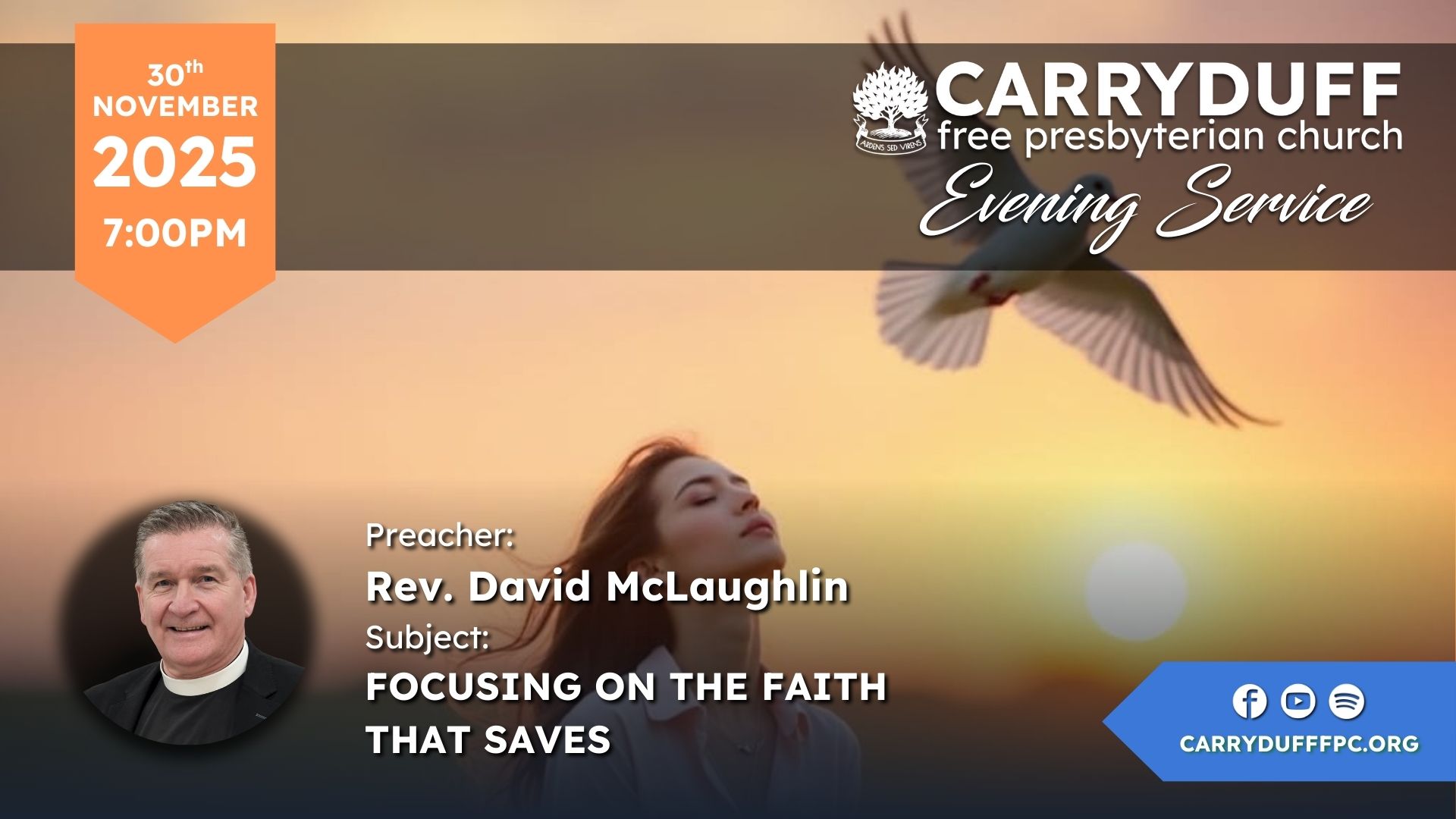

Date: SUN 7:00pm 14th June 2026
Preacher: Rev. David McLaughlin
Bible Reference: Psalm 107:20
Podcast
Sermon Summary
The sermon is based on Psalm 107, verse 20: “He sent his word, and healed them, and delivered them from their destructions.” The preacher entitles this message “The Sent Word That Saves.”
The reading is taken from the King James Bible, covering verses 15 to 22 of Psalm 107, though the wider context of the entire psalm is examined. The preacher opens by noting that Psalm 107 is a grand hymn celebrating the covenant mercy of God towards His redeemed people. It begins with the exhortation: “Oh, give thanks unto the Lord, for he is good: for his mercy endureth for ever” (verse 1).
The Structure of Psalm 107: Five Pictures of Human Misery and Divine Deliverance
The preacher identifies five distinct sections within the psalm, each presenting a vivid picture of human distress followed by divine rescue:
- Verses 1 to 8: Wanderers lost in the wilderness, hungry and thirsty, whose soul fainted within them until they cried unto the Lord.
- Verses 9 to 16: Prisoners sitting in darkness and in the shadow of death, bound in affliction and iron, who fell down and had none to help.
- Verses 17 to 22: Fools afflicted because of their transgression and iniquities, drawing near to the gates of death — this is the section containing the sermon text.
- Verses 23 to 32: Sailors caught up in a terrifying storm, whose soul is melted because of trouble, at their wits’ end.
- Verses 33 to 43: The poor suffering by way of oppression and sorrow, whom God sets on high from affliction.
The Repeating Pattern
Each of these five sections follows an identical fourfold pattern:
- First: The distress is linked directly to human depravity and sin.
- Second: The sufferers earnestly cry unto the Lord for help.
- Third: God works in mercy by divine intervention, delivering them.
- Fourth: Thanksgiving follows for the mercy received.
This pattern is underscored by a refrain that appears four times in the psalm, at verses 8, 15, 21, and 31: “Oh that men would praise the Lord for his goodness, and for his wonderful works to the children of men.”
The Immediate Context: The Foolish Afflicted Because of Sin
The sermon text belongs to the third section of the psalm. The preacher draws particular attention to verse 17: “Fools because of their transgression, and because of their iniquities, are afflicted.”
Several observations are made about this verse:
- The sufferers are not described merely as sick people. They are described as fools, and their foolishness is explicitly connected to their transgressions and iniquities.
- Their suffering has a moral cause. Their affliction and misery are not random or purely circumstantial; they are connected to their sin.
- They have brought the misery upon themselves through their own sinful choices.
- Their condition is desperate: their soul abhors all manner of food, they have lost all appetite, and they draw near to the gates of death. Human remedies have failed entirely.
- The turning point comes when “they cry unto the Lord in their trouble, and he saveth them out of their distresses.”
The critical question the sermon poses is: How did the Lord save them? The answer is found in verse 20: “He sent his word and healed them and delivered them from their destructions.”
Part One: The Misery of the Sinner
Before appreciating the healing, the preacher argues, one must understand the nature of the disease.
The Biblical Definition of Folly
The Bible defines folly not merely as intellectual weakness but as spiritual rebellion. Psalm 14, verse 1, is cited: “The fool hath said in his heart, There is no God.” The preacher notes that in the Authorised Version the words “there is” are in italics, having been added by the translators. When removed, the text reads: “The fool hath said in his heart, No God.” This is not merely atheism in the intellectual sense; at its heart is rebellion — a refusal to fear God, know God, love God, or serve God.
The Two Evils of Jeremiah
Jeremiah the prophet identified two evils committed by the people:
- They had forsaken God, the fountain of living waters.
- In their foolishness, they hewed out broken cisterns that can hold no water.
This is the essence of sin: rejecting the fountain of living water in favour of broken cisterns — rejecting that which is life-giving for that which is empty and cannot satisfy.
Sin Defined and Illustrated
The preacher provides a concise theological definition of sin:
- Sin is the transgression of the law of God.
- Sin is any want of conformity unto, or transgression of, the law of God.
- Sin is the sinner rebelling against a holy God, rejecting the knowledge of God, and living in defiance of the love of God.
- Sin is a rejection of divine authority.
The prodigal son is offered as the prime illustration. He demanded his inheritance before his father had died, left the house of his birth, journeyed to a far country, wasted his substance in riotous living, and ended up feeding among pigs. His misery at the pig pen flowed directly from his own sinful choices. The preacher draws out the universal application:
- Sin promises freedom but produces bondage.
- Sin promises pleasure but delivers pain.
- Sin promises life but ends in death.
The picture in Psalm 107, verse 18, is one of absolute helplessness: the soul abhorring all manner of food, drawing near to the gates of death, with no appetite, no strength, no remedy, no help, and no hope in themselves. That is the misery of the sinner.
Application to Northern Ireland
The preacher applies this diagnosis to the contemporary situation in Northern Ireland, referencing recent scenes of disorder — rioting in certain areas, the burning of homes, and the intimidation of people. He acknowledges that issues such as immigration (described as unvetted, undocumented individuals entering without proper control) must be addressed by the government and states plainly that this is wrong. However, he insists that immigration is not primarily to blame, nor is the UK government.
To those involved in the violence, he quotes James 1, verse 20: “For the wrath of man worketh not the righteousness of God.” Mob violence, revenge, hatred, and anger against people of other ethnicities has never advanced the kingdom of God.
The root problem, he contends, is not economic, not political, not social, not cultural, not psychological. The root problem is spiritual.
He cites Romans 3, verses 10 through 18, as the true diagnosis of the human heart:
- There is none righteous, no, not one.
- There is none that understandeth, there is none that seeketh after God.
- They are all gone out of the way, together become unprofitable.
- Their throat is an open sepulchre; their tongues have used deceit.
- Their mouth is full of cursing and bitterness.
- Their feet are swift to shed blood.
- Destruction and misery are in their ways.
- The way of peace they have not known.
- There is no fear of God before their eyes.
The preacher concludes this section by asserting that a multitude stand guilty before God, dead in trespasses and sins, under the judgment of Almighty God. He quotes the Puritan Thomas Watson: “The disease of the heart is the root of the problem.” And he adds the observation: “Till sin be bitter, Christ will not be sweet.”
God must bring sinful man to see the misery of his condition, just as a surgeon must diagnose the disease before operating. Christ only becomes precious when sin becomes exceeding sinful. The great need, whether in Carryduff, Belfast, or the major towns and cities, among liberal people, nominal Protestants, Roman Catholics, and those of other ethnicities, is deep conviction for sin — for people to see the exceeding sinfulness of their sin.
The preacher identifies a lack of fear of God as a central problem in Northern Ireland. People have lost sight of:
- Who God is.
- His holiness.
- What sin is.
- The great gospel message.
- The Bible as the book of God — its authority, its sufficiency, and its supremacy.
Part Two: The Ministry of the Saviour
The second major section turns to the text’s great statement: “He sent his word and healed them.”
God’s Remedy Is His Word
The remedy is not human philosophy, not religious ceremonies, not worldly wisdom, not a word from an expert or a professor with a PhD from Queen’s University. God’s remedy is His precious word.
The Word Reveals Our True Condition
Hebrews 4, verse 12, is quoted: “For the word of God is quick, and powerful, and sharper than any twoedged sword, piercing even to the dividing asunder of soul and spirit, and of the joints and marrow, and is a discerner of the thoughts and intents of the heart.”
The Scriptures uncover the heart and expose sin. They reveal our true need: regeneration, a new heart. The preacher illustrates this with an anecdote of a man who felt merely tired and fatigued but, upon visiting the doctor, was told to go straight to hospital. His heart was so bad that a heart attack was imminent and emergency surgery was required. Spiritually, many in Northern Ireland think they are well — good, honest, upright people — but Scripture declares that “all have sinned and come short of the glory of God” without exception.
The preacher expresses concern that there is a wholesale rejection of the word of God at this moment. He points to Acts 2, verse 37, where at Pentecost the hearers were “pricked in their heart.” That is what is needed: the word convicting, exposing sin, humbling people before God, convincing them of their need of Jesus Christ as Lord and Saviour, and leading them to repent and believe the gospel.
The Word Regenerates Our Condition
The new birth comes about by the instrumentality of the word of God. First Peter 1, verse 23, is cited: “Being born again, not of corruptible seed, but of incorruptible, by the word of God, which liveth and abideth for ever.” The preacher notes the Latin rendering: “Verbum Domini manet in aeternum” — the word of the Lord endures forever. This is a living word.
The Holy Spirit uses the word in the gospel to awaken sinners. The example of Lydia is given: the gospel was preached at the riverside, the Lord opened her heart, the word entered, life followed, and because life was given, the gift of faith was deposited. Faith follows regeneration — that is the biblical order. The same pattern is seen in the conversion of Paul on the Damascus Road.
The Word Redeems Our Condition
Psalm 19, verse 7, is cited: “The law of the Lord is perfect, converting the soul.” The written word is connected to the incarnate word. John 1, verses 1 and 14, are quoted: “In the beginning was the Word, and the Word was with God, and the Word was God… And the Word was made flesh, and dwelt among us.”
The greatest sending is not merely the written word — it is the incarnate word, the Lord Jesus Christ. He is God’s final, fullest, and forever word. Every promise (some 7,300 in the book), every precept, every sacrifice, and every prophecy points to Him. Spurgeon is quoted: “Every word of God is the chariot of Christ.”
A Lament Over the Pulpits
The preacher pauses to lament the state of many pulpits, though he states he is not naming names or taking a swipe at other denominations. He observes that far too many ministers occupy pulpits as a job, a career, concerned with how much money they can get and how little work they can do. They lack love for the people and love for the Scriptures. They are not preaching the gospel, and people who attend find nothing there for them. What is offered is light and airy, but it is not the preaching of the word. This, he states, is part of the problem.
Part Three: The Mercy of the Sovereign
The final section examines the words: “He healed them and delivered them from their destructions.”
The Healing Was Sovereign
The initiative came entirely from the Lord. The text does not say they healed themselves or discovered a cure. It says He sent. God acted in free sovereign grace. Salvation is of the Lord; the shepherd seeks the lost sheep; the father runs to welcome the prodigal. Healing always originates in divine grace and mercy. As First John 4, verse 19, states: “We love him, because he first loved us.”
The Healing Was Saving
The gospel is not a self-improvement scheme — it is life-changing and life-transforming. The word of God was given not merely for instruction or revelation but for transformation. Psalm 119 is quoted: “Wherewithal shall a young man cleanse his way? By taking heed thereto according to thy word.” And verse 11: “Thy word have I hid in mine heart, that I might not sin against thee.”
The preacher draws out three elements:
- The right book: Thy word, the God-breathed word of the living God.
- The right place: Not merely in the head but in the heart. Many Protestant people have the word of God in their head — they believe in God, the Bible, Jesus Christ, and the Lord’s Day — but it has not changed or transformed their lives. It must move from the head to the heart.
- The right attitude: Hiding the word in the heart in order not to sin against God. The preacher states: “This book will keep you from sin. Sin will keep you from this book.”
The gospel changes and transforms lives. If any man be in Christ, he is a new creature; old things are passed away, and all things are become new. The gospel is connected to the birth, life, death, and resurrection of Christ. Romans 1, verse 16, is quoted: “For I am not ashamed of the gospel of Christ: for it is the power of God unto salvation to every one that believeth.”
The preacher summarises the work of Christ:
- The blood of Christ shed at Calvary satisfies divine justice and removes the sinner’s guilt.
- The righteousness of Christ clothes the sinner and provides acceptance.
- The Spirit of Christ regenerates the heart, dead in trespasses and sins, giving new life.
- The grace of Christ justifies the sinner, adopts the sinner into God’s family, and sanctifies the sinner.
- The resurrection of Christ — the empty tomb — is proof of all this.
The Lord Jesus is a perfect Saviour. Here is the cure for the greatest of all sicknesses: the sickness of sin. It is not enough to admire the gospel; it must be accepted and appropriated. The preacher draws a parallel with Naaman in Second Kings 5, who was afflicted with leprosy and initially protested against the simple instruction to dip in the Jordan seven times, preferring the rivers of Syria. Only when he obeyed was his leprosy cleansed.
The Healing Was Satisfying
The verse concludes: “and delivered them from their destructions” — plural. Sin creates many destructions. It destroys relationships, dashes hopes, ruins lives, destroys homes, and leads to ultimate eternal destruction. The preacher notes the variety of those Christ has delivered: Manasseh, the dying thief, Saul of Tarsus, the Centurion’s servant. The Centurion came to Christ and said, “Speak the word only, and my servant shall be healed.” Christ spoke, and the servant was healed — no ceremony, no human intervention, just the power of the word of Christ.
Concluding Exhortations
The preacher closes with three exhortations:
- Learn to trust the all-sufficiency of the Scriptures. The church’s task is not innovation or entertainment; it is the faithful proclamation of the word of God. Spurgeon is quoted: “The sick medicine for the soul is only somewhere between the covers of the book of God.”
- Seek the face of Christ. To those out of Christ, the preacher urges them to know Him as Lord and Saviour. It is not enough to admire Christ — one must appropriate Christ. It is not enough to admire the Bible — one must appropriate it, placing the right book in the right place: the heart. He asks pointedly: Are you daily reading your Bible? Are you prayerfully studying the Scriptures? Are you obediently living it out? Are you faithfully laying hold upon it?
- Offer thanks for delivering grace. The word that healed was sovereign, saving, and satisfying. The preacher draws attention once more to the closing words of the text: “and delivered them from their destructions.” How satisfying that deliverance is.