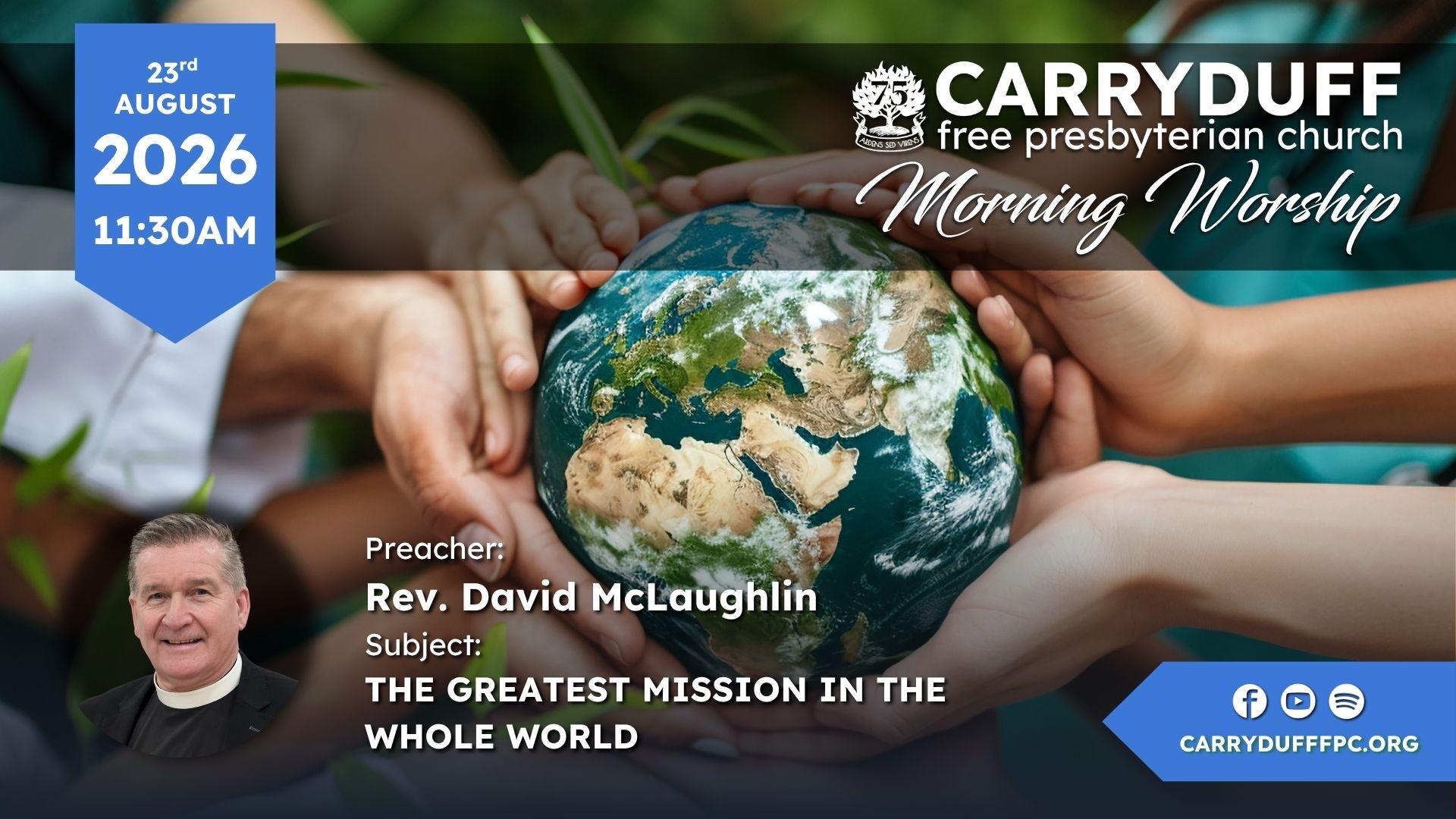

Date: SUN 11:30am 22nd August 2026
Preacher: Rev. David McLaughlin
Bible Reference: Mark 16:15-16
Podcast
The Greatest Mission in the World: A Summary
Preacher: Rev. David McLaughlin
Text: Mark 16:9–16 (sermon focus on verses 15–16)
Subject: The Great Commission as the supreme calling of the Church
Estimated reading time: 12 minutes
Introduction: What the Greatest Mission Is Not
The preacher opens by posing a question he has been pondering: What is the greatest mission in the whole world? He answers negatively first, eliminating several contenders before arriving at his central thesis.
It is not a military mission. He cites Operation Overlord — the D-Day landings of 6 June 1944 — when 150,000 Allied forces landed in Normandy to liberate Europe from Nazi Germany. That was a great military undertaking, involving soldiers risking their lives to free a people from an oppressor. Yet even that monumental effort could not liberate anyone from the kingdom of darkness or from the guilt and power of sin.
It is not a scientific mission. Apollo 11 in 1969 represents, by common consent, the greatest scientific mission — a vast engineering effort to conquer space, to place three men on the moon and bring them home, pushing the boundaries of human knowledge. But science, however magnificent, cannot introduce men to God or reconcile sinners to Christ.
It is not a medical mission. The global fight against smallpox, Ebola, and cancer — battles still ongoing — has produced great strides and successes, particularly since 1980. Yet medicine alone cannot save men from the guilt and power of sin.
It is not an environmental mission. Great attempts to save the planet and protect the environment are commendable; the preacher states he is in favour of restoring polluted rivers and wells. But environmental action cannot give the water of life.
It is not a social mission. Many worthy causes exist: relieving poverty, fighting injustice, overcoming loneliness, feeding the hungry, caring for the poor, rescuing victims of war, stopping human trafficking, improving education, advancing medicine, protecting the vulnerable. The preacher puts on record his gratitude for every legitimate act of mercy. The Bible commands care for the poor, compassion, love of neighbour, and defence of the weak and afflicted.
But there is something greater.
Why the Great Commission Surpasses All Other Missions
The preacher’s reasoning turns on a single diagnostic principle: man’s greatest problem is not physical but spiritual.
- Man’s greatest problem is not physical poverty — it is spiritual poverty.
- Man’s greatest need is not hunger for bread — it is hunger for the bread of life.
- Man’s greatest need is not release from political oppression — it is release from the bondage of sin.
- Man’s greatest need is not ultimately sickness of the body — it is sickness of the soul.
- The problem is not merely the death of the body — it is the loss of the soul.
He then presses the point with a series of vivid contrasts:
A man with food in his belly can still be lost. A man with a roof over his head can still be under the wrath of God. A man could have a university degree, ten stars in A-levels, and yet be ignorant of the truth. A man can possess great wealth, good health, influence, a flashy car, a big house — he could even have a trophy wife — and yet that man can still die without Christ.
This is why the Great Commission is the greatest mission in the whole world. The Lord Jesus gave His Church a greater mission than all the military, scientific, environmental, medical, and social missions combined.
The Relationship Between Compassion and Evangelisation
The preacher is careful to avoid a false dichotomy. The true Church must never choose between compassion and evangelisation; it will engage in both. But it must never confuse the fruit of Christianity with the gospel itself.
- Why do we feed the hungry? Because Christ commanded us to love our neighbour.
- Why do we preach the gospel? Because Christ commands us to reach and save the lost through the proclamation of God’s Word.
It is good to help men and women with temporal needs, but we must never give them bread alone while refusing or failing to give them the bread of life.
The Lord Jesus did not give the Church a political programme. He did not command us to go into all the world and improve society, make people feel good about themselves, or make people prosperous and rich. He commanded one thing: preach the gospel to every creature.
Charles Haddon Spurgeon called this command “Christ’s parting mantle, which the Church must take up.”
Six Headings from Mark 16:15–16
The preacher structures his exposition around six elements drawn from the text.
1. The Principle That Is Commanded: “Go Ye”
Christianity is not a religion that sits still. The gospel comes to us in power and in blessing, but it does not stop with us. Christ saves, and then Christ sends us forth.
The Church is not a spiritual museum where converted people gather to admire what God has done. It is God’s missionary army. Soldiers are enlisted and then exhorted to obey commands. The command to the soldiers of Christ is not to wait until sinners come — it is to go.
The preacher references Isaiah 6:8: “Whom shall I send, and who will go for us?” Isaiah stepped forward and said, “Here am I, Lord; send me.”
He then applies this directly to the congregation: Are you willing to go for God? As autumn approaches, go to your family and friends and bring the gospel to bear upon their lives, hearts, and minds.
2. The Place That Is Commanded: “Into All the World”
The scope is vast and specific:
- Go into the streets, villages, towns, schools, workplaces, prisons, universities, and homes.
- Go across the United Kingdom — not just Northern Ireland, but the Republic of Ireland, Scotland, Wales, and England.
- Go across the world. There is no geographical limitation.
The preacher quotes John Wesley: “The world is my parish.” Jesus Christ is not merely the Saviour of Jerusalem, the United Kingdom, Europe, or Western civilisation — He is the Lord of the nations. He cites Psalm 2:8 and Acts 1:8 to demonstrate the outward-moving pattern: Jerusalem (home), Judea, Samaria, and the uttermost parts of the earth.
A sobering assessment of the United Kingdom as a mission field:
The preacher presents a stark statistical contrast. Approximately 5% of the UK population attends a weekly church service. The Church of England has roughly 720,000 in weekly attendance; the Roman Catholic Church about 550,000 — out of a population of 70 million. Among the under-35s, attendance drops to about 4%. The best estimate is that 4 million people out of 70 million attend a weekly church service of some description.
By contrast, there are roughly 4 million Muslims living in Britain. On a Friday, approximately 2 million — 50% — go to the mosque.
The preacher draws a pointed conclusion: We need to stop thinking of the UK as a place where we send missionaries from to elsewhere. The United Kingdom needs missionaries today.
What the UK needs:
- Churches that preach the gospel, not merely sing-alongs or charity arms
- Pulpits that openly proclaim “thus saith the Lord”
- Christians who stand up and speak out
- Godly fathers who teach the gospel to their children
- Godly mothers who pray for their households
- A generation of young people, under 35 and under 20, who are not ashamed of Christ — young men like Shadrach, Meshach, and Abednego, who will neither bend, bow, nor burn against false religion
- A race of preachers who will preach against sin, righteousness, and judgment; who will preach repentance and belief in Christ; who will preach salvation by grace alone, through faith alone, in Christ alone, to the glory of God alone
The method is not political force. The preacher explicitly rejects reclaiming the nation through the gun, the sword, threats of death, or taxation for non-conversion. The Reformation did not transform the United Kingdom through clever marketing, entertainment programmes, or political campaigns. It began with preachers in the pulpit, preaching the gospel and relying on the sovereign work of the Holy Spirit.
3. The Practice That Is Commanded: “Preach”
The word “preach” means to herald — to proclaim publicly as an official messenger. The preacher is not the originator of the message; he is the messenger.
The analogy is that of a king sending an ambassador to a foreign court. The ambassador does not present his personal opinion. He announces the king’s message. If he does otherwise, he is an unfaithful ambassador. So it is with preachers: “We are ambassadors for Christ, as though God did beseech you by us: we pray you in Christ’s stead, be ye reconciled to God.”
Preachers are not to invent or reinvent the message. The preacher laments that there are too many ministers in Northern Ireland telling congregations they do not believe the Bible to be the Word of God, or the virgin birth, or the sinless life, or the atoning death of Christ.
He invokes a lineage of preachers who upheld the primacy of preaching: Dr. Martin Lloyd-Jones, who described preaching as “the highest and greatest calling that the Church must recover”; C.H. Spurgeon; R.C. Sproul; Voddie Baucham; and John MacArthur.
What preaching means: to profess, proclaim, publicise, and persuade. True evangelism is more than distributing literature, inviting someone to church, being nice, or saying “Jesus loves you.” It involves proclaiming the whole counsel of God (Acts 20:27).
4. The Proclamation That Is Commanded: “The Gospel”
The heart of the command is not morality, family values, social reform, political conservatism, self-improvement, or entertainment. It is the gospel.
The preacher defines the gospel systematically:
The gospel begins with God — holy, righteous, just, true, and good — who created us for His glory. Man fell in sin. Romans 3:23: “For all have sinned and come short of the glory of God.” Man is not basically good with a few mistakes; he is a sinner by nature and practice, having broken God’s law and offended a holy God. The wages of sin is death.
The gospel centres in Christ (Galatians 4:4). Jesus Christ, the eternal Son of God, became man, lived a perfect sinless life, obeyed the law perfectly, and went to the cross. There He bore the wrath and judgment of God due to sin (Isaiah 53:5). He died as a surety, a substitute, a sin offering, and a sin-bearer. He was buried, rose again the third day, ascended into heaven, and now reigns at the Father’s right hand. He is Lord of all.
The good news is that penitent sinners can be forgiven, guilty sinners justified, the condemned pardoned, the lost found, the spiritually dead made alive, and the rebel redeemed.
This is the apostolic gospel (1 Corinthians 15:3–4) — the gospel that converted Patrick in the third century and that Columba carried to Iona. Salvation is by grace alone, through faith alone, in Christ alone, as revealed in the Scriptures alone, to the glory of God alone.
The preacher warns against false gospels:
- The social gospel, which replaces salvation with social transformation
- The prosperity gospel, which replaces Christ with cash — he notes he has discovered twenty false churches on TikTok whose ministers are all connected to this, making “give us your money” the heart of their ministry
- The therapeutic gospel, which replaces repentance with self-esteem
- The liberal gospel, which removes sin, judgment, and the blood atonement
- The modern gospel, which denies the Bible as God’s Word and all supernatural events in Christ’s life
- The works-based gospel, which teaches sinners to earn salvation — found in Islam, Buddhism, Judaism, Mormonism, Jehovah’s Witnesses, Seventh-day Adventists, Roman Catholicism, and large swathes of the Anglican communion
The gospel must be declared, defined, and defended (Jude 3).
5. The People That Are Commanded: “Every Creature”
The scope of the audience is breathtakingly comprehensive. Not merely the respectable, educated, religious, or interested — but every creature:
- The drunkard and the wife-beater
- The gambler and the drug addict
- The homosexual, the fornicator, and the adulterer
- The university professor and the university student
- The businessman and the shop assistant
- The prisoner and the politician
- The professional and the pensioner
- The atheist, the agnostic, and the immoral
- The Muslim, the secularist, and the Hindu
- The rich and the poor, the old and the young
The gospel is for all because everyone is born in sin, shaped in iniquity, possesses a precious soul, and needs to be saved.
6. The Procedure That Is Commanded: “He That Believeth… Shall Be Saved; He That Believeth Not Shall Be Damned”
The two-fold response:
Believing means to trust in, adhere to, and rely on Christ. Unbelief is a terrible sin. John 3:18 makes this clear: “He that believeth on him is not condemned: but he that believeth not is condemned already, because he hath not believed in the name of the only begotten Son of God.”
The choice is simple: rejection of Christ or reception of Christ. Christ or condemnation.
Baptism and its relationship to salvation:
The preacher anticipates an objection: If baptism does not save, why does the text say, “He that believeth and is baptized shall be saved”? His answer: baptism is the appointed sign of true discipleship and obedience. It is connected to Christian obedience as the answer of a good conscience before God (1 Peter 3:21).
Baptism is not the instrument by which a sinner is justified. He cites:
- Ephesians 2:8–9: “For by grace are ye saved through faith… not of works, lest any man should boast.”
- Romans 3:28: “Therefore we conclude that a man is justified by faith without the deeds of the law.”
- The thief on the cross, who was saved without baptism
- Paul’s statement: “Christ sent me not to baptize, but to preach the gospel” (1 Corinthians 1:17)
The preacher explicitly rejects the doctrine of baptismal regeneration and the practice of renewing baptismal vows as if one were getting converted.
The wedding ring analogy: A wedding ring is important — it is a public sign of a marriage. But the ring does not create the marriage; it is not the substance. So with baptism: it is God’s appointed sign, a public sign of union with Christ, a way of identification with Christ and His Church. Faith receives Christ; baptism confesses Christ. It is not the water that washes away sin — it is the blood of Jesus Christ.
The solemn warning: “He that believeth not shall be damned.”
The preacher confronts modern sensibilities directly. Modern Christianity wants a Christ who saves but does not judge, who blesses but never warns, who comforts but never condemns. Yet here is the Lord Jesus Himself speaking of damnation. Jesus spoke of hell thirteen times for every time He spoke of heaven. The preacher states plainly: “I believe in the doctrine of hell. I believe in the salvation of the soul, but I also believe in the sentence of the soul to eternal damnation.”
Jesus said three times in John 8: “If ye die in your sins, where I am, there ye cannot be.”
The gospel is not a suggestion. It is not something to take or leave. The gospel is a command.
Conclusion: How the Church Fulfils This Mission
The preacher closes with a practical exhortation. How do we fulfil this mission in our own locality?
Not by human cleverness, force of arms, manipulation, watering down the message, or trying to make Christianity fashionable.
But by three things:
- Preach the Word (2 Timothy 4:2) — in season and out of season. Expository, biblical, Christ-centred preaching that explains the text, applies the text, and tells sinners who Christ is, what He is like, and what He has done. Preaching that calls sinners to repentance and faith.
- Pray for the harvest — before we go, while we go, and after we have gone. Salvation is God’s work. We plant, we water, but only God gives the increase.
- Practice the truth — go with holy confidence, boldness, and conviction, yet with compassion. On the one hand, truth; on the other, tears. Weeping for lost souls. Paul said, “Knowing therefore the terror of the Lord, we persuade men” (2 Corinthians 5:11).
Final appeal and illustration:
The United Kingdom — in its homes, villages, towns, and cities — is ignorant of God and the gospel. There is an eclipse of God. Churches are closing. Despair is felt both in the nation and in the Church.
The preacher’s answer: Stand up for Christ. Stand for the Scriptures, the Saviour, the sovereignty of God, holiness, family values, and the substitutionary atonement. Speak out. Invite family, friends, and neighbours to hear and receive this good news.
He closes with a parable: Imagine a village where a terrible disease is spreading, and you — as the chief of the village — possess the cure. If you refused to alarm anyone, to annoy or upset anyone, to hurt anyone’s feelings, saying, “You have your opinion and I have mine,” you would be ashamed. The Church possesses the answer.
Can Northern Ireland, Scotland, Wales, and England be saved? The preacher does not believe the country is beyond redemption. The gospel is the power of God. The same gospel that saved this country in the days of the Reformation can save it in twenty-first-century Britain. The same Spirit empowers, and the same apostolic message endures.
Here is the greatest message in the greatest mission in the whole world. Go. Preach. Call every creature to belief and obedience.
Live Broadcast
You are warmly invited to our Lord’s Day Services this Sunday at Carryduff Free Presbyterian Church on the Killynure Road.
Come and join us for worship, prayer, and the preaching of God’s Word.
All are warmly welcome.
Tea, coffee, and fellowship will follow after the evening service. We’d love you to stay and join us.
📍 Carryduff Free Presbyterian Church, Killynure Road
🕰️ Sunday at 11:30am & 7:00pm
🍵 Refreshments after evening worship
Service Details
Date: SUN 11:30am 6th September 2026
Preacher: Rev. David McLaughlin
Bible Reference: 2 Samuel 23:15-17