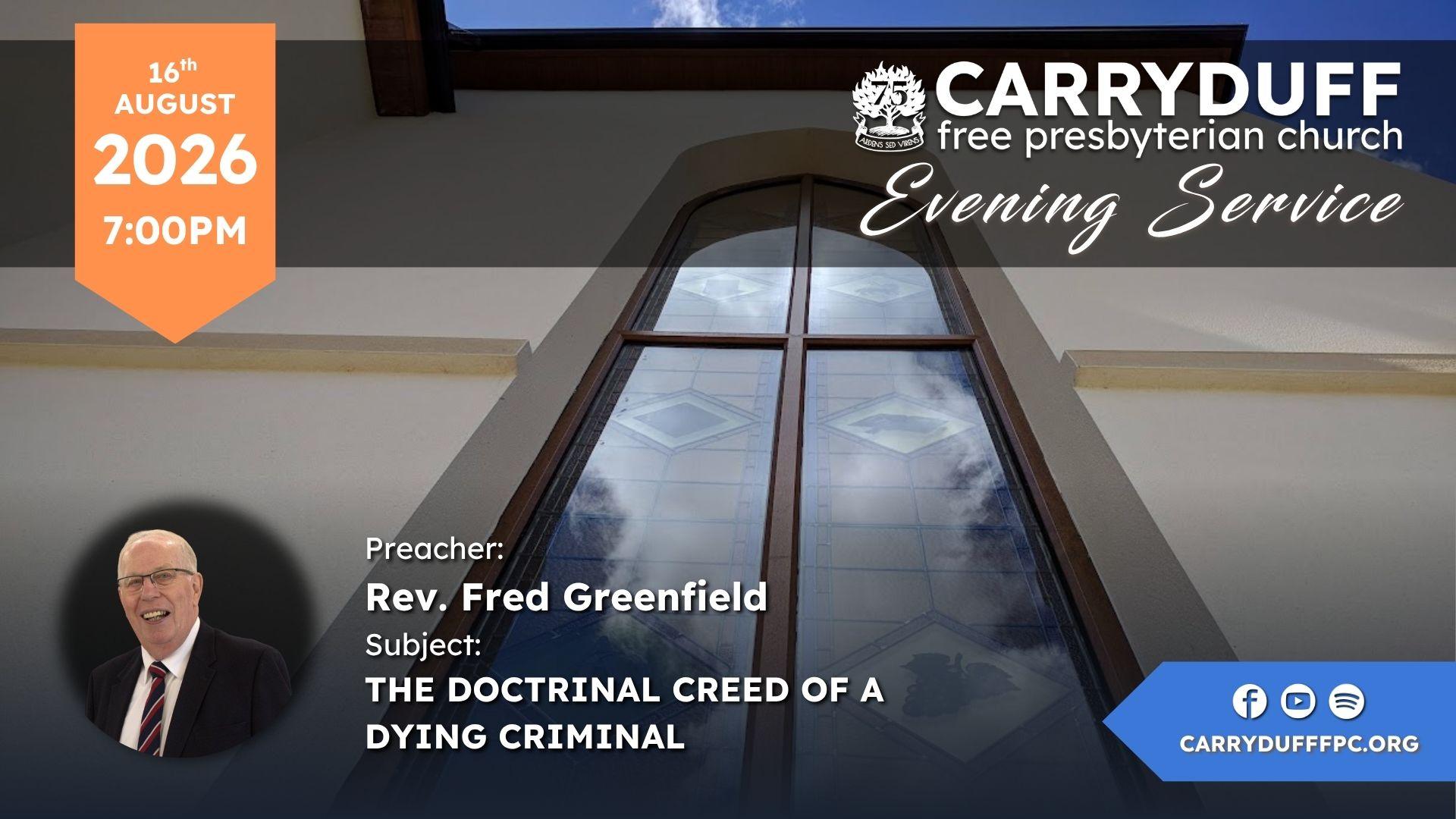

Date: SUN 7:00pm 16th August 2026
Preacher: Rev. Fred Greenfield
Bible Reference: Luke 23:32-43
Podcast
Sermon Summary: “The Doctrinal Creed of a Dying Criminal”
The preacher opens by recalling a previous Lord’s Day evening service, when the Reverend Gary Goodes preached on the superscription written above the head of the Lord Jesus Christ upon the cross of Calvary. Returning to the same passage, he reads from Luke’s Gospel, chapter 23, beginning at verse 32.
The passage describes how two malefactors (criminals) were led out with Jesus to be put to death. Arriving at Calvary, they crucified Him, with the two criminals placed one on His right and one on His left. Jesus prayed, “Father, forgive them; for they know not what they do.” The soldiers parted His raiment and cast lots, while the people stood beholding and the rulers derided Him, saying, “He saved others; let him save himself, if he be Christ, the chosen of God.” The soldiers also mocked Him, offering vinegar and saying, “If thou be the king of the Jews, save thyself.”
Above His head hung the superscription, written in Greek, Latin, and Hebrew: “This is the King of the Jews.” One of the criminals railed on Him, saying, “If thou be Christ, save thyself and us.” But the other rebuked him, saying, “Dost not thou fear God, seeing thou art in the same condemnation? And we indeed justly; for we receive the due reward of our deeds: but this man hath done nothing amiss.” He then said, “Lord, remember me when thou comest into thy kingdom.” Jesus answered, “Verily I say unto thee, To day shalt thou be with me in paradise.” The reading concludes at verse 43.
The Theme: What Did the Dying Thief Believe?
The preacher introduces his subject under the title “The Doctrinal Creed of a Dying Criminal.” He explains that, as Free Presbyterians, the congregation subscribes to the Westminster Confession of Faith and the Larger and Shorter Catechisms as a true record of what they believe. He notes, in passing, the parallel documents of other traditions:
- The Savoy Confession (Congregational churches)
- The Baptist Confession (Baptist churches)
- The Thirty-Nine Articles (Anglican churches)
- The letters, journals, and words of John Wesley (Methodism)
Each of these documents sets forth in order what a tradition believes about God, the Bible, creation, redemption, salvation, and the second coming of Christ. Yet in the words of the dying thief, the preacher argues, we find something more personal: the thoughts, beliefs, and fears of a single soul — in effect, a doctrinal creed of his own.
The preacher expresses his love for this story, because it answers some of the great questions of the gospel and of life:
- Can a man or woman be saved at the eleventh hour?
- Can a person be saved just before going out into eternity?
- Can a person be saved after living a long and exceedingly sinful life?
- Can a person be truly sure that they are saved?
- Can a person know where they will be in eternity?
Reading the passage carefully, he insists, all these questions are answered in the affirmative. Yes, a precious soul can be saved at the eleventh hour. God is not willing that any should perish, but that all should come to repentance. Even at the last hour, a man or woman who in sincerity and faith believes in the Lord Jesus Christ can be saved, regardless of the sins committed or the life lived, for “the precious blood of Christ cleanseth us from all sin.”
Objections Answered: “Could God Save Me?”
The preacher acknowledges the difficulty many have with this truth. Over years of ministry, he says, he has spoken to many people who can believe God would save someone brought up in the church, baptised, and good-living — but who doubt whether God could save them, given the things they have done, said, and the places they have been. To such, he answers: thank God, He can. The Bible says Christ is able “to save them to the uttermost that come unto God by him.” Quoting the Ulster evangelist W. P. Nicholson, he adds: He can save “from the uttermost to the guttermost.”
An Illustration: The Chiropractor’s Certificate
The preacher offers an illustration drawn from his own experience. Having trouble with his back, he visits a chiropractor from time to time — a fact his wife teases him about, suggesting they have retired on a yacht and bought a large house with the money he has spent trying to get his back straightened.
While witnessing to this chiropractor, the man told him something interesting. In that culture, a university or college graduate typically receives a diploma or certificate stating that the person has fulfilled all qualifications, passed all examinations, and is therefore granted a BA, MA, or PhD. But this man said there was one college of chiropractic medicine whose certificate bore only the name of the college, one letter, and the person’s name. That single letter represented the word “able.” In other words, the certificate did not say the person was qualified — it said they were able to practise chiropractic medicine.
The preacher draws the parallel: the Bible says the Lord Jesus, the Saviour of sinners, is able to save to the very uttermost all who come unto God by Him. The dying thief heard the words, “To day shalt thou be with me in paradise,” and was sure both of his salvation and of where his soul would be in eternity.
The Creed of the Dying Thief: Seven Articles
The preacher then runs through the elements of the dying thief’s “creed,” each drawn directly from the text. These may be summarised as follows:
1. He Believed in God (verse 40)
One thief listened to the crowd; the other listened to the Christ. Though both initially railed on the Lord Jesus, after this man heard the words from the Saviour’s lips he turned to the other thief and said, “Dost not thou fear God?”
The preacher observes that we live in an age when belief in God is not the common practice or the majority worldview. He cites the theories of Hawking and Dawkins, the theories of the evolutionists, and the agnostics who do not know whether to believe in God or not. Yet this man believed. The Bible begins not with a “big bang” or a “little muddy puddle” where a single-celled amoeba developed and eventually produced a masterpiece like Hitler — no, “in the beginning God created the heaven and the earth.”
He notes with concern a recent article reporting that various hotel chains across Great Britain are removing the Bibles placed there by the Gideons, taking the Word of God out of the hotels and motels. He calls for the Ten Commandments to be brought back and placed on school walls, and for prayer in the schools, because we live in an age when men and women have turned their back upon God and the old gospel.
Quoting Psalm 14, he reminds the congregation that “the fool hath said in his heart, There is no God.” To suit their lifestyle and worldview, people want to rule out God’s existence, crying, “We will not have this man to rule or reign over us.” But the Puritan preacher Stephen Charnock, who wrote a wonderful commentary on the attributes of God, said that a man may be intellectual and versed in this world’s knowledge, yet if he rejects the existence of God he is, as the psalmist says, a fool. The preacher notes the psalm says the fool has said it “in his heart,” not “in his head” — for if a man would think about it, weighing the evidence and looking at creation through a telescope or a microscope, he would come to the conclusion that there is a God in heaven.
2. He Believed in Life After Death (verse 42)
The thief said, “Lord, remember me when thou comest into thy kingdom.” The preacher observes that many today say there is no need to worry about the gospel or religion, because “when you die you die as a dog” — you are annihilated, and there is nothing beyond this life. But the dying thief believed in life after death, and in a heaven and a hell.
Quoting Hebrews 9:27 — “it is appointed unto men once to die, but after this the judgment” — he notes that the thief knew from all he had seen and heard that there was something kingly, something majestic, in the person on the middle cross. He called Jesus “Lord,” and spoke of His kingdom.
3. He Believed in Judgment for Sin (verses 40–41)
The thief said, “Dost not thou fear God, seeing thou art in the same condemnation? And we indeed justly; for we receive the due reward of our deeds.” In other words, he acknowledged that he and the other thief were on the cross because of their sins — the long arm of Roman law had caught up with them, judged and condemned them, and nailed them to a Roman cross.
The preacher quotes Numbers 32:23 — “be sure your sin will find you out” — and Galatians 6, which speaks of the inexorable law of God’s harvest: “whatsoever a man soweth, that shall he also reap.” The wages of sin is death; the soul that sinneth, it shall die. A famous evangelist, he recounts, once said that a man may sin as he likes — drink all the alcohol he wants, smoke all the cigarettes he wants, take all the dope and drugs he wants — but he must remember he will have to pay for it, and his sin will find him out.
4. He Believed in Jesus as the Saviour
The preacher returns to the thief’s cry: “Lord, remember me.” As the thief owned his own sin and condemnation, he recognised that Jesus was the sinless Saviour — “this man hath done nothing amiss.” Looking upon that blood-stained face and the head crowned with thorns, the thief could see that Christ was God’s perfect, sinless Son, dying on the cross.
He was not only a sinless Saviour but a substitutionary Saviour. Quoting the old gospel hymn — “Why did they nail Him to Calvary’s tree?” — the answer comes: “all our iniquities on Him were laid, and He bore them all to the tree.” Jesus paid the debt of our sins in full.
Yet He is also a sovereign Saviour. The preacher reflects that when Jesus was on the cross, as it were with one finger He touched the sun and it darkened over the whole earth; He touched the soldiers and the centurion confessed, “Truly this was the Son of God”; He touched the sepulchre, for up from the grave He arose in mighty triumph over His foes. The dying thief looked upon the Saviour and realised there is only one way — Jesus is the way, the truth, and the life; the only door; the only mediator between God and man.
5. He Believed in Repentance for Sin
The thief had turned from his sin when he acknowledged, “we indeed justly” — accepting what God says about sin. Some people try to justify their lifestyle, no matter how vile, but this man acknowledged he was a sinner and looked to Christ in repentance.
The preacher recalls General Booth, founder of the Salvation Army, who said a day would come when a gospel would be preached that spoke of heaven but not hell, and of salvation without repentance. But the first message of the Lord Jesus Christ was “except ye repent”; the message of the apostles was “repent”; and from Genesis through to Revelation, the message of the Bible in its totality is a call for men and women to repent of their sins.
6. He Believed in the Assurance of Salvation
As the thief cried out to the Lord Jesus — his only hope, his only Saviour, his only way — Jesus answered, “Verily I say unto thee, To day shalt thou be with me in paradise.”
The preacher remembers Dr. Paisley’s teaching: it is the blood of the Lord Jesus Christ that cleanses us from our sin and washes our sins away, but it is the word of Jesus Christ that takes our doubts away. Jesus spoke, and His word to the dying thief was “verily” — truly — “to day shalt thou be with me in paradise.”
Closing Illustrations and Application
The preacher shares two personal recollections of assurance. He tells how he used to say to his wife, Jean — a godly lady whose life the Lord has changed — that he had more faith, hope, belief, and assurance in her salvation than in his own. In the end, he says, we have the word of Christ to rely on.
He also recalls the late pastor Ivan Thompson, a great evangelist and friend. When Ivan was very ill in hospital and had lost his sight, his friend Pastor George Bates called to see him. Ivan asked George to put his head down because he wanted to tell him something. Leaning over the bed, Ivan said: “George, you remember that hymn — ‘Strength for today and bright hope for tomorrow’? I want you to tell them at my funeral that every word of that hymn is true. I have strength for today; I have a bright hope for tomorrow.”
So the dying thief believed in God, in life after death, in eternity, in judgment upon sin, that Jesus was the only Saviour, in repentance unto salvation, and — thank God — in the assurance of salvation.
The Appeal
The preacher closes by turning the question upon his hearers, echoing the question asked in the Acts of the Apostles: “Have you on the Lord believed?” He asks whether they have repented of their sins, turned from their sin to Christ, and cried to Him like the dying thief for salvation, mercy, and grace. He quotes the promises of Christ: “him that cometh to me I will in no wise cast out,” and “Come unto me, all ye that labour and are heavy laden, and I will give you rest.”
The Bible declares, “now is the accepted time; now is the day of salvation.” To those present who do not know the Saviour, he offers himself as a servant of the Lord Jesus Christ, ready to show them from God’s Word how they can be saved, how they can know they are safe, and how they can be sure that it is well with their soul in life, death, and eternity. To those watching online, he invites them to contact the church. He urges them not to leave the meeting without getting right with God, finding salvation, and having that blessed assurance of which the hymn writer spoke.