
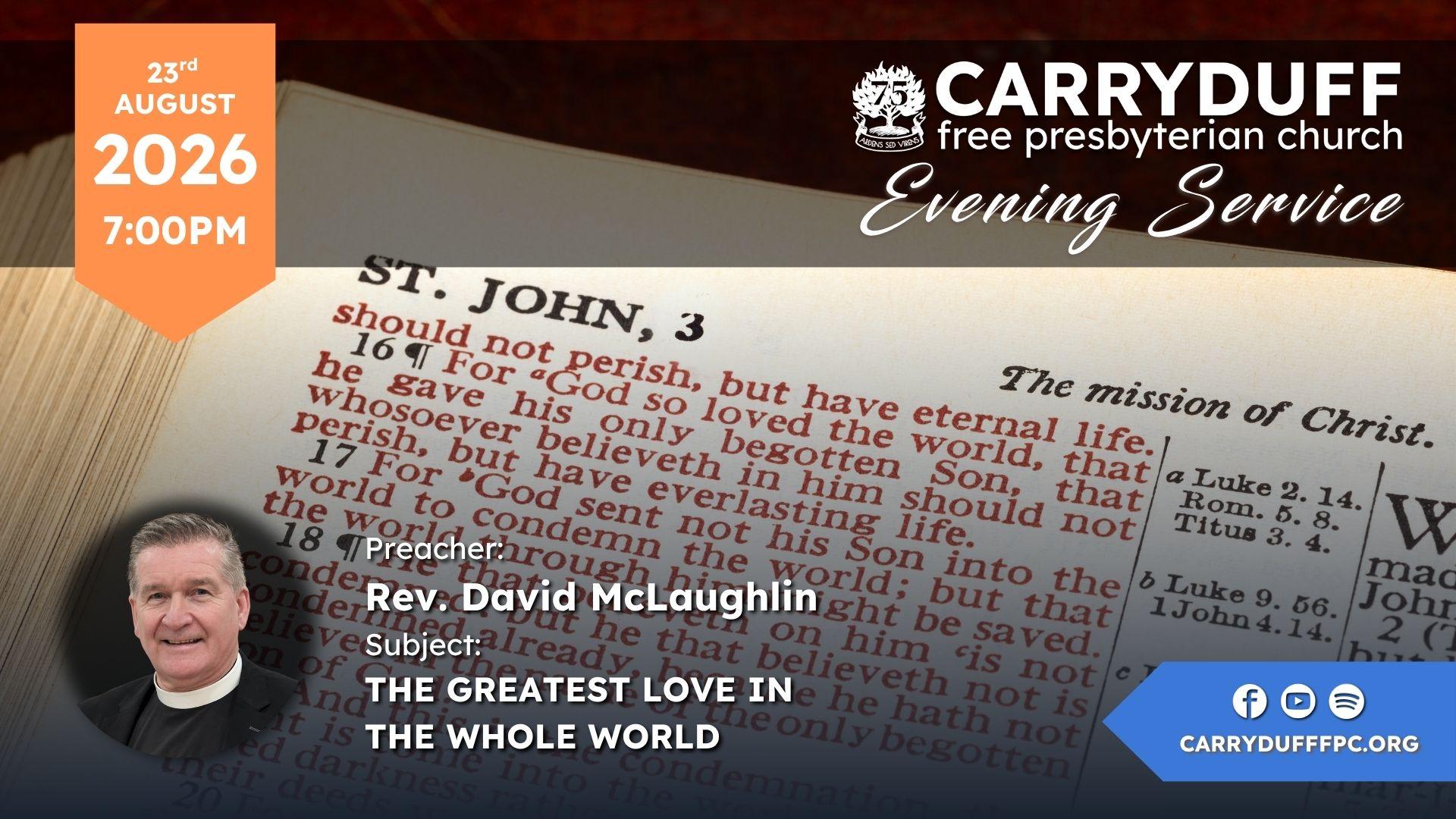

You are warmly invited to our Lord’s Day Services this Sunday at Carryduff Free Presbyterian Church on the Killynure Road.
Come and join us for worship, prayer, and the preaching of God’s Word.
All are warmly welcome.
Tea, coffee, and fellowship will follow after the evening service. We’d love you to stay and join us.
📍 Carryduff Free Presbyterian Church, Killynure Road
🕰️ Sunday at 11:30am & 7:00pm
🍵 Refreshments after evening worship
Service Details
📅 Date: Sunday, 23rd August 2026
🕖 Time: 7:00pm
🙋♂️ Preacher: Rev. David McLaughlin
📖 Text: John 3:16
Podcast
The Greatest Love in the Whole World: A Summary
Introduction and Context
The sermon is based on John chapter 3, verses 10 through 21, with the central text being John 3:16. The preacher sets the scene by noting that the Lord Jesus is speaking to Nicodemus, a master of Israel, who comes to Jesus by night and asks, “How can these things be?” Jesus responds by pointing Nicodemus — and by extension all who hear — toward the heavenly realities that surpass earthly understanding.
The preacher reads the full passage, which includes the famous declaration of God’s love, the sending of the Son, the reality of condemnation for unbelief, and the sobering truth that men love darkness rather than light because their deeds are evil. This provides the immediate context for the sermon’s theme: the greatest love in the whole world.
Why John 3:16 Is the Greatest Verse in the Bible
The preacher offers three reasons why this single verse stands above all others in Scripture.
First, it is the gospel in a nutshell. No other verse contains such a complete survey of God’s redemptive work. Martin Luther is cited as having called John 3:16 “the gospel in a nutshell.” Every essential component of salvation is present: the source (God), the motive (love), the object (the world), the action (He gave), the gift (His only begotten Son), the condition (whosoever believeth), the negative outcome avoided (should not perish), and the positive outcome secured (everlasting life).
Second, it has been the instrument of salvation for tens of thousands. The preacher notes that this verse, perhaps more than any other, has been used by God to bring His message of salvation to multitudes. Charles Spurgeon is referenced as having said that John 3:16 could stand at the forefront of his entire ministry because it was his life’s work and burden to preach the gospel of the love of God in Christ.
Third, it reveals the greatest expression of God’s love in all of Scripture. John 3:16 is not merely about love in general, nor even simply about God’s love in the abstract. It reveals a love that surpasses every human experience of love — a love that is sacrificial, unconditional, everlasting, and universal.
The Danger of Familiarity
Before unpacking the verse in detail, the preacher issues a warning: familiarity can be dangerous. Many people can recite John 3:16 from childhood memory. It appears on roadside signs, in sermons, in open-air preaching, and in everyday conversation. The risk is that one hears the words without truly hearing them — that the profound truths they contain no longer astonish.
The preacher confesses that this is only the third or fourth time in twenty-seven years of ministry that he has preached specifically on John 3:16, suggesting that even he has been cautious about approaching a text so well-known, lest its familiarity dull its impact.
The Divinity of God’s Love
The sermon’s first major point examines the opening words: “For God.”
The preacher observes that John begins with God, not with man. He does not begin with human goodness, man-made religion (which Nicodemus represented), or good works. The gospel starts with God because, apart from divine revelation, the only love humanity knows is human love — and human love is flawed, defective, and subject to change.
God is the true source and author of all love. Drawing on 1 John 4:8 and 4:16, which declare that “God is love,” the preacher emphasises that this love is eternal, infinite, unchangeable, pure, holy, just, and true.
God’s love is sinless. Here the preacher makes a point he believes contemporary culture needs to hear: human love can be sinful. Love directed at the wrong object becomes sinful — whether it be love for alcohol, drugs, money, another person’s spouse, immorality, iniquity, or spiritual darkness. This is precisely what verse 19 describes: men loved darkness rather than light because their deeds were evil. The love of darkness is a sinful love. God’s love, by contrast, is sinless — pure, holy, good, and true.
The gospel begins with what God has done, not what man must do. The gospel does not ask, “What can you do for God?” It declares what God has done for sinners. God initiated the plan of redemption in the council chambers of eternity — Father, Son, and Holy Spirit together. Before there was a Bethlehem, there was the triune God in eternity. Before there was a cross, there was an eternity of fellowship and interpersonal relationship within the Godhead. Before anyone ever loved God, God first loved them. God’s love stretches back to eternity and is rooted in His very nature.
The Delight of God’s Love
The second major point focuses on the little word “so”: “For God so loved.”
The preacher argues that this word points to the intense delight of God’s love. It is not simply that God loved — that would have been true enough — but that God so loved. The Bible nowhere attempts to define this love; it simply declares it and illustrates it. John 3:16 is the greatest illustration.
Ephesians 3:18-19 is cited, where Paul prays that believers might comprehend the breadth, length, depth, and height of the love of Christ which passes knowledge. The language points to something that cannot be fully grasped, only experienced and received.
Love demonstrated in sacrifice. Spurgeon is quoted as saying that the true love of God cannot remain dormant because it expresses itself in deeds, especially in costly sacrifice. God’s love is not sentimental claptrap; it is sacrificial. It is not merely something God says, but something He does.
1 John 4:9-10 is referenced: “In this was manifested the love of God toward us, because that God sent his only begotten Son into the world, that we might live through him. Herein is love, not that we loved God, but that he loved us, and sent his Son to be the propitiation for our sins.”
The cross as the measure of love. The preacher urges his congregation not to look at their circumstances, themselves, others, the church, or the failures of pastors and elders when they want to know what God’s love looks like. They are to look at the cross. He paints a vivid picture: the nails driven into Christ’s hands, the crown of thorns upon His brow, the blood running down His face, the blanket of darkness surrounding the cross, the voice of the Father declaring, “This is my beloved Son, in whom I am well pleased.”
The ocean as an illustration. The preacher recounts walking along the Strand Beach and East Strand in Portrush during a holiday on the North Antrim coast. Reflecting on the ocean — seven miles deep at its greatest depth — he notes that no one truly understands how deep the ocean is until they descend into it. Recreational scuba divers can reach perhaps one hundred to one hundred and thirty feet. The deepest scuba dive on record is one thousand and eighty-nine feet — only about 0.19 of a mile. To go deeper requires a submarine, which might reach about 2.3 miles. Yet the ocean is seven miles deep. In the same way, only at Calvary does God show the depth of His love. The cross of Jesus Christ is the true measurement.
A pastoral word to the suffering. The preacher addresses those struggling with various trials in their homes and families. He warns that the devil whispers lies: “The Lord doesn’t really love you. Look at your circumstances. If the Lord loved you, why would He let this happen?” The believer in such an hour is urged not to listen to the lie but to look to Calvary. Likewise, those whose consciences trouble them because of some particular pet or chief sin are directed to look to Christ on the cross, to the cleansing blood, to confess their sin. Those in pain — and the preacher admits he hates pain, joking that he cries when he gets a thorn in his finger and runs to his wife Rosie to remove it — are told not to think God has forgotten them but to look to the cross and discover the depth and delight of His love.
The Depth of God’s Love
The third point examines the object of God’s love: “the world.”
The preacher clarifies what “world” means in this context. It does not primarily refer to the size of the planet — its vast continents, oceans, and islands — nor to the 8.3 billion people who inhabit it, nor to the birds, trees, and plants. A transcendent, infinite God could love a world of that size, but that is not the meaning.
What kind of world? The world God so loved is not an innocent world. It is not a world of people naturally searching for God. It is a morally dark world, a world of sin and iniquity. Verse 19 again provides the interpretation: “This is the condemnation, that light is come into the world, and men loved darkness rather than light, because their deeds were evil.”
The world God loved is a fallen, rebellious, sinful world — a world that rejected its Creator, a world that crucified its Saviour, a world that hated and murdered the Son of God. The word “world” refers to fallen, sinful men and women: creatures exposed to God’s righteous judgement, in need of God’s salvation, yet still the objects of His love and care.
The universal scope. The preacher believes the reference is to men and women from every tribe and nation under heaven. The gospel is to go into the world of fallen humanity proclaiming repentance and faith.
The urgency of the gospel. Verse 16 cannot be separated from verses 18 and 19. While God announces the provision of salvation, He also announces the reality of condemnation: “He that believeth not is condemned already.” The gospel is an urgent message. It is not simply that God loves you — true as that is — but that God loves sinners, Christ died for sinners, Christ arose for sinners, and Christ saves Jew and Gentile summoned to flee sin and flee to the Saviour.
The doctor illustration. The preacher offers an illustration: a doctor tells a dying patient named Charlie that he has found a cure for his disease. Charlie replies, “I don’t need it. I don’t want it.” The problem is not with the cure but with the patient. In the same way, the sinner’s problem is not with God’s salvation or the availability of the gospel. The sinner’s problem is himself: by nature, he does not want the Lord. The sinner is not basically good; the sinner needs to be born again.
The Display of God’s Love
The fourth point focuses on the gift: “He gave his only begotten Son.”
A note on translation. The preacher strongly rejects the NIV rendering of “only begotten Son” as “one and only Son,” arguing that this fails to capture the meaning. The emphasis is on the unique relationship and identity of Jesus Christ as the Son of God. While God has other sons and daughters by adoption, there is no other Son like Him. The word “begotten” conveys a unique relationship by way of sonship and points to the incomparable value of the gift.
What God gave. God did not give an angel, a prophet, a miracle worker, or a teacher. He gave His only begotten Son. Jesus Christ was — and is — eternally the only begotten Son of the Father, the beloved Son, the incarnate Son. This is why the doctrine of the incarnation matters. This is why the doctrine of the virgin birth matters. God did not send someone else to deal with sin; God came Himself in the person of His Son.
Galatians 4:4-5 is cited: “When the fulness of the time was come, God sent forth his Son, made of a woman, made under the law, to redeem them that were under the law, that we might receive the adoption of sons.”
Philippians 2:5-8 is also quoted, describing Christ who, being in the form of God, made Himself of no reputation, took the form of a servant, was made in the likeness of men, and humbled Himself to death — even the death of the cross.
The paradox of the cross. The one who created the heavens hung beneath the sky He created. The one who gave breath to all surrendered His breath to death, crying “It is finished.” The one who made the tree hung upon the tree. He did this because His love was true and real.
Substitutionary atonement. God’s love was not detached from truth, purity, or justice. God does not overlook sin. 1 Peter 2:24, 1 Peter 3:18, and Isaiah 53 are cited to establish that Christ bore our sins in His body on the tree — the just for the unjust — that He might bring us to God. This is substitutionary atonement, a doctrine the preacher laments is denied in many so-called Protestant churches throughout the land, a situation he says needs to be reversed.
Christ took the place of the guilty and condemned. He bore what sinners deserved. But He did more than take the punishment: He gives a free and full pardon and the possession of His righteousness. 2 Corinthians 5:21 is quoted: “For he hath made him to be sin for us, who knew no sin; that we might be made the righteousness of God in him.” The exchange is complete: our sin for His righteousness, our guilt for His innocence, our death for His life.
The Derry tombstone. The preacher recounts visiting St Columb’s Cathedral in Londonderry, where a tombstone from the time of the siege bears the inscription: “I died because I am sinned. I live because Jesus died and rose again.” This encapsulates the gospel in a single sentence.
The Deliverance of God’s Love
The fifth point examines the promise: “that whosoever believeth in him should not perish, but have everlasting life.”
Whosoever. The invitation is universal. Jew or Gentile, rich or poor, religious or irreligious, moral or immoral, young or old, atheist, agnostic, the respectable and the notoriously wicked — all may come. The person who has spent years in sin and rebellion, who has lived like the prodigal and wonders “Can I come?” receives the answer: yes, whosoever.
Believeth. The word means to trust in, adhere to, and rely on. It is in the present continuous tense: I am believing, I have believed, and I will keep on believing. It is more than a momentary decision. It is more than intellectual agreement with the facts of the gospel. True saving faith receives Christ, rests alone in Christ for heaven, rejoices in Christ, and abandons self-righteousness to flee to Christ’s righteousness. True saving faith is the empty hand that receives Christ.
Ephesians 2:8-9 is cited: “For by grace are ye saved through faith; and that not of yourselves: it is the gift of God: not of works, lest any man should boast.”
The Reformation summary. Salvation is by grace alone, through faith alone, in Christ alone, as revealed in the Scriptures alone, to the glory of God alone.
In Him. The gospel is “whosoever believeth in him” — not in the church, not in good works, not in the pastor, the pope, the priest, or self. It is in Christ alone.
The Destiny of God’s Love
The final point addresses the two possible outcomes: “should not perish, but have everlasting life.”
Two destinies, no third option. The preacher emphasises the stark binary. The word “perish” speaks of judgement and eternal hell. Hell is real. God’s condemnation is real. The Lord Jesus Himself emphasised it: “He that believeth not is condemned already, because he hath not believed in the name of the only begotten Son of God.”
The preacher recounts a conversation with a young man named Ryan at City Hall, telling him that Christ is either Lord of all, a lunatic, or a liar. There is no middle ground. One must choose.
The good news. No one has to perish. No one has to die in their sin. There is a Saviour. There is forgiveness. There is an eternal relationship with God.
Everlasting life. This is more than mere endless existence. Eternal life is a life with God — a life of knowing Him, loving Him, and enjoying Him. It is life in the family of God as adopted children, like sheep in the fold with Christ as the Shepherd. It is a life forever with God.
Eternal life is a present possession. The moment someone trusts Christ, they are given eternal life and will never perish. At death, the soul leaves the body and enters heaven, sweeping through the gates of the New Jerusalem, washed in the blood of the Lamb.
Application and Conclusion
To the converted. The preacher warns against letting familiarity with John 3:16 rob believers of contemplation. They are urged to reflect on the divinity, delight, depth, display, deliverance, and destiny of God’s love.
To the unconverted. Those who have heard the gospel hundreds of times are asked a direct question: do you believe it — not merely in your head, but in such a way that you have trusted in Christ? It is not enough to know about the ark, as the people of Noah’s day knew about it but did not enter in. It is not enough to know about the cure, as Charlie the patient knew about it but refused to take it. One thing is to know about Christ and to say “I believe”; quite another is to trust Him.
The greatest love in history. Human love — a mother’s love for a child, a soldier’s love for his country, a husband’s love for his wife, a friend’s love for a friend — is but a faint reflection of a greater love. It is a love that is divine, delightful, deep, displayed, delivering, and decisive of destiny. It is a love deeper than the ocean, shown at the cross, available to whosoever will believe, and determining whether one perishes or has everlasting life. This, the preacher concludes, is the greatest love in the world.