
Service Details
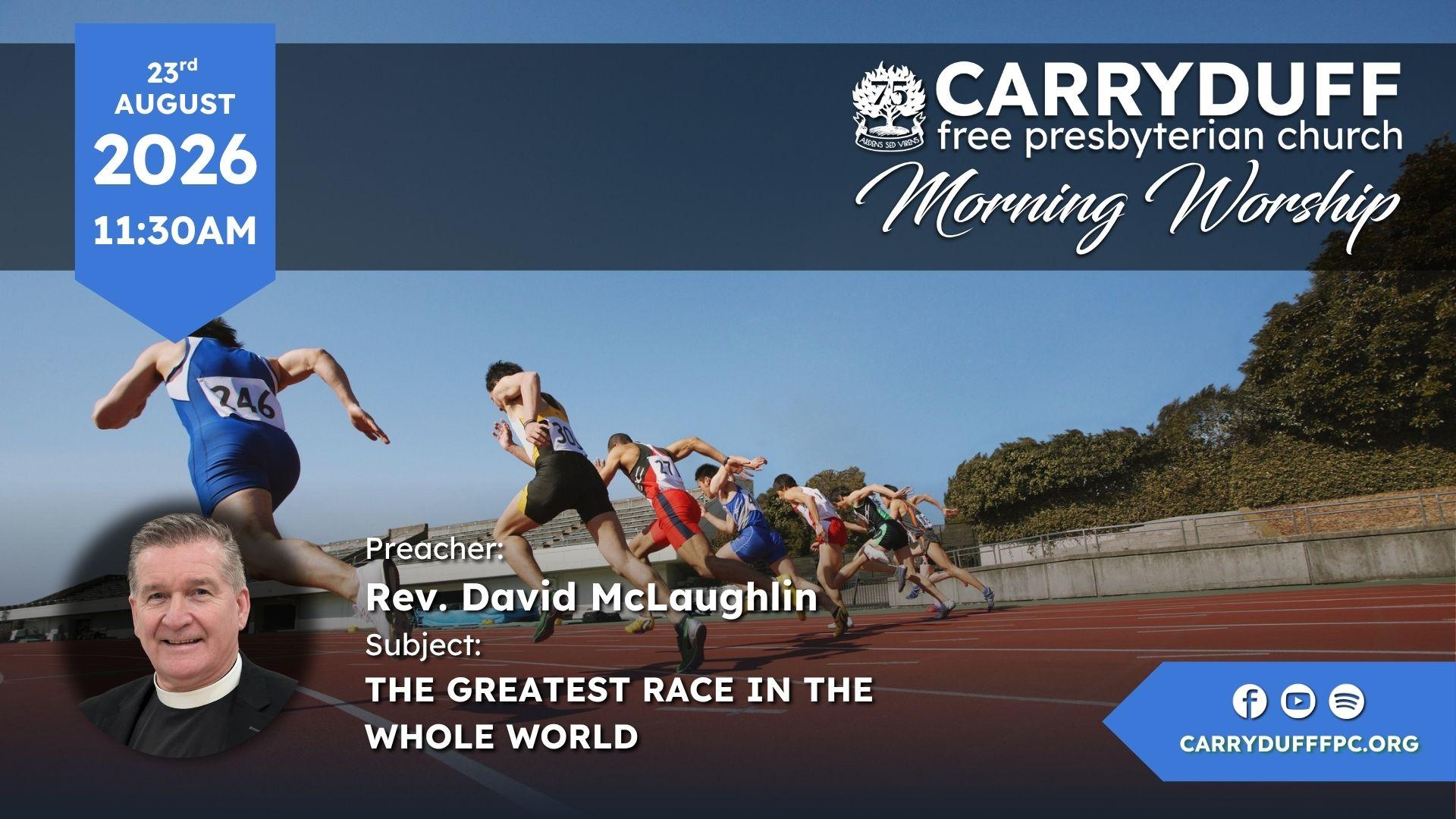
Date: SUN 11:30am 30th August 2026
Preacher: Rev. David McLaughlin
Bible Reference: Hebrews 12:1-3
Podcast
Sermon Summary
Why the Theme of Running?
The preacher explains that the idea of running had been on his mind for many weeks, prompted by several observations:
- Seeing a brother from the congregation, Matthew Crawford, running down the Killynure Road before his wedding
- Witnessing numerous runners on the North Antrim coast during a holiday, particularly on the beach
- Encountering a running club passing through Killynure and Alveston upon returning home
- Recalling the Commonwealth Games held in Glasgow, Scotland (23 July to 2 August), where 3,000 athletes from 74 Commonwealth countries competed, with Northern Ireland finishing 12th overall—securing 3 golds, 4 silvers, and 9 bronze medals
The various running events at those games—the 100m, 400m, 800m, and others—prompted deeper reflection on the concept of running and, ultimately, on what constitutes the greatest race ever run.
Earthly Races and Their Limitations
The preacher acknowledges that history records many great races: events held in vast stadiums before thousands of spectators, races across mountains and deserts, over oceans and continents, races that have made men famous. He highlights the story of Eric Liddell at the 1924 Paris Olympics, who refused to run the 100m heats scheduled for a Sunday out of conviction regarding the fourth commandment—”Remember the Sabbath day to keep it holy.” Instead, Liddell competed in the 400m, a race he was not originally favoured to win, yet he took gold. This story, immortalised in the film Chariots of Fire, illustrates discipline, endurance, sacrifice, and victory.
The preacher also references the first Olympic games in Athens, noting that the Athenians understood the glory of athletic competition. The Olympic ideal was bound up with:
- Discipline
- Endurance
- Sacrifice
- Victory
Athletes trained for years, sacrificed everything, endured pain, pushed their bodies to the limit, and their aim was to cross the finishing line to the roar of the crowd.
Yet, the preacher insists, no matter the distance—whether the 100m, 400m, 800m, 1500m, 5000m, 10000m, the hurdles, the 3000m steeplechase, the 4×400 mixed relay, or the marathon—none of these is the greatest race ever run or won. The greatest race in the whole world is the Christian race described in Hebrews 12.
Contrasting Earthly and Heavenly Races
The preacher draws several sharp contrasts between earthly athletic contests and the Christian race:
The Prize:
- In an earthly race, the runner competes for a corruptible crown—a medal of gold, silver, or bronze.
- In the Christian race, the runner pursues an incorruptible crown. He is not after a medal but a Mediator, not a decoration but the Master. Christ Himself is the prize: to be with Christ, which is far better; to be like Christ in eternal glory.
The Duration:
- An earthly race takes minutes or hours to complete.
- The Christian race begins at the day of conversion and continues until the day of death and entrance into heaven.
The Opposition:
- The earthly athlete competes against other men and women.
- The Christian competes in a struggle with the world, the flesh, and the devil.
The Reality of the Christian Race
The Starting of the Race
Every race, the preacher notes, has a starting point and an end point, with a mapped-out course between them. One cannot start a race in any old place. Using the Belfast marathon as an illustration—while making clear his opposition to its being run on the Lord’s Day—he explains: the marathon officially starts on the Upper Newtonards Road near the Stormont estate. If he were to decide to run it but started from his own house in Alveston, running down the Killianure Road to the finish at Ormeau Park (26.2 miles away), he would be disqualified. The officials would rightly say he never registered, did not start at the official place, and failed to comply with the rules.
What is true of the earthly race is true of the Christian race. The starting point is the place of true conversion. The Lord Jesus said to Nicodemus, “Marvel not that I say unto thee, ye must be born again.” When a person is born again of the Holy Spirit and awakened to their sin and need of a Saviour, there is repentance toward God and faith in the Lord Jesus Christ. At that moment, new life in Christ begins.
The preacher identifies a widespread problem: many people in Northern Ireland, the United Kingdom, and beyond make up their own rules regarding the Christian race. They run to become sons or daughters of God. They run to receive salvation based on a works-righteousness. They run believing they are earning and meriting heaven by human performance, good works, and religious activity. But the true Christian is not running to be saved—he is running because he is saved, because he has been born again of the Spirit and put into Christ, because the heavenly Redeemer has purchased salvation for him by His precious blood.
Many make up their own starting point using philosophy, religion, and good works. They are completely disqualified because they have not started at the right place. The race starts when one kneels at the cross, confesses sinnership, and trusts Christ as Lord and Saviour.
The preacher presses the question directly: Have you knelt at the cross? Have you confessed your sin? Have you repented and asked Christ to save you? Have you received Christ as Lord and Saviour? If not, you are not actually in or on the Christian race. You have not started yet.
The Setting of the Race
The text says, “Let us run with patience the race that is set before us.” The word “set” is critical. The course is set. God has marked out the course for each believer. The Christian does not invent his own brand of Christianity; God has given His Word. Citing Matthew 4:4—”Man shall not live by bread alone but by every word that proceedeth out of the mouth of God”—the preacher affirms his belief in the infallibility, inerrancy, and authority of Holy Scripture.
God has given His Word as a means of grace, along with prayer, the sacraments, and church discipline. He has given each believer a race of grace, in his or her own place. That course is the journey of life from the day of conversion until the day of death—that is your course.
The preacher cites Spurgeon, who made the point forcibly that the Christian is not free to run in whatever way he pleases; he must keep to the appointed course. God is sovereign and works providentially in all lives. He is sovereign over the course, having foreordained a road that leads His people destined to glory. There is a calling, a commission, a charge, and a course.
Yet the preacher confesses honestly that none of us, himself included, has read and studied the Scriptures as we ought, given ourselves to prayer as we ought, or been as holy as we ought to be and should be for God. This requires discipline over time spent in Scripture and prayer, crying out to God for help and blessing for families, the church, the community, and the nation.
The Responsibility of the Christian Race
The text outlines three responsibilities: laying aside every weight, laying aside the sin that so easily besets, and running with patience.
The Weights Beside Us
The text distinguishes between weights and sin. There must be a stripping for the race. The true athlete strips himself of all that is unnecessary, all that would hinder or burden, so that he can run his race at whatever distance and over whatever terrain.
Returning to the Belfast marathon illustration, the preacher imagines himself entering the marathon wearing a heavy army topcoat and Dr. Martens boots, fully clothed. People would laugh and tell him to wise up—to take off the heavy coat and boots, put on a lightweight top, shorts, and running shoes, get into good physical condition, shed excess body fat, adopt a strict diet, and submit to rigid discipline.
The runner is not asking whether the coat or the boots are sinful—there is nothing sinful about wearing an army coat or Dr. Martens. The question is not “Is it sinful?” but “Will it help me or hinder me to run?” That is the searching question. The things we occupy our time with should be examined by this standard: Is it helping me to run after Christ?
This principle extends to friendships. How many Christians have ungodly, worldly friends? Is that friendship helping them run after Christ? The same question applies to ambitions, mindsets about time, desires, and careers. The true Christian runner must lay aside all that would hinder or hamper him in his race. The question is not “How closely can I resemble the world?” or “How closely can I live in conjunction with this ungodly, anti-Christian, anti-God world?” The question is “How can I faithfully run after Christ?”
The Wickedness Within Us
The text speaks of “the sin which doth so easily beset us.” Here is the great enemy in the Christian life. The Christian’s greatest problem is not the human government, not society or Hollywood or social media, not the antics of the king and the throne or the prime minister or the culture of the day. No, the greatest enemy is sin—the wickedness within.
Sin entangles, entraps, distracts, wounds, weakens, and wearies the believer. The answer is to lay aside the weights beside us and the wickedness within us, living in constant awareness of the power of indwelling sin and the struggles faced. Sin shall not have dominion over the believer.
The Weariness Before Us
The text says, “Let us run with patience.” The word “patience” carries the idea of endurance, steadfastness, perseverance under pressure. The Christian life is not a hundred-metre dash. It is a strenuous race with mountains and valleys, pain, hardship, opposition, and persecution. There will be days when one feels like quitting, days of exhaustion, days when one cries out, “Lord, I don’t know how much more I can take of this. Lord, I feel I can’t go on.”
The Christian race requires endurance. For those who are weary and ready to quit, feeling it is too hard and difficult, the answer is not found within—it is found in the text.
The Requirement of the Christian Race: Looking Unto Jesus
Verse 2 provides the answer: “Looking unto Jesus, the author and finisher of our faith, who for the joy that was set before him endured the cross, despising the shame and is set down at the right hand of the throne of God.”
The Christian runner is required to look away from every weight, every sin, and every difficulty. He is encouraged to look back at the witnesses who have gone before—the heroes of faith in Hebrews 11, the great cloud of witnesses—but he is also required to look up to Christ, the author and finisher of faith. This is the heart of the passage, the real answer to the problem of the weights, the wickedness of the human heart, and the weariness of spirit and soul.
The word “looking” denotes a singular object. It means looking away from self, away from the witnesses, away from others. The idea is viewing and beholding the object with fixed, undivided attention—looking away from all else, every distraction, and fixing the gaze upon Christ. Do not stop running. Do not turn aside. Do not look back. Do not look at the other runners beside, before, or behind. Do not look within for inner strength. Look to Jesus.
A Look of Total Dependence
Look upon Christ for all you need—not occasionally, not when it is convenient, but daily, diligently, deeply. A deep, disciplined, delightful, penetrating look. Fill your mind with all that Christ is in His person and work. Draw strength, wisdom, and grace from Him. Look away from all difficulties, from all the hardness of the labour—whether mothers in the kitchen looking after children with school recommencing and husbands out working, or those suffering physically in body or mentally in mind with every fear and temptation. Here is the answer to spiritual weariness: the look of total dependence on Christ, saying, “Lord, I’m dependent on Thee for all I need today.”
A Look of Total Obedience
Allow nothing to distract attention from running the Christian race. Keep your eye on Christ, remembering that He is the heavenly runner. When He ran His race, it was full of commitment to do the Father’s will—and the Father’s will is revealed in the Father’s Word. The Lord Jesus said, “My meat is to do the will of Him that sent Me.” God the Father gave Him a work to do; He came to earth with a mission to fulfil, and He did it with full and total obedience.
Love for Christ should stir the believer to run the race after Christ, endeavouring not just a look of total dependence but a look of total obedience, to say with the Psalmist, “I delight to do Thy will, O my God.” Many professing Christians say they believe the Bible to be the Word of God yet ignore much of what it teaches about living out the Christian life. They do their own thing on the Lord’s Day, are never found at the prayer meeting, and are never bothered about witnessing. There is a need to regain that look of total obedience.
A Look of Total Steadfastness
The Lord Jesus ran His race with single-minded purpose. If Christ is Lord and Saviour, and if there is only one life to live, one race to run, and one true eternal destination—heaven and home—and if Christ is the prize, then the mindset must be: “I will, by the grace and help of God, run my race keeping on looking to Jesus.” Not to self, not to circumstances, not to others, not to achievements. Christ is the author—the beginner—and the finisher. Salvation begins and ends with Christ. He is not merely an example; He is the heavenly Redeemer, Lord of all.
The preacher then expounds Christ’s own race: coming from the bosom of the Father, the eternal Word made flesh, born of the Virgin Mary at Bethlehem, living in Nazareth, ministering in Galilee, going all the way to Jerusalem. One must think of Gethsemane, Gabbatha at the judgment hall, and Golgotha. Between the garden and the glory of the ascension stood the cross—physical suffering, the shame of nakedness, the scourging, the nails, the crown of thorns. Christ endured the wrath of God and drank the cup of God’s wrath.
Why did He do it? “Who for the joy that was set before him endured the cross.” He was not joying in suffering—the shame, suffering, and pain were real—but He looked forward to the joy of accomplishing the Father’s will, vindicating God’s righteousness, defeating the devil, destroying the sting of death and hell, saving His people, presenting the redeemed to the Father, and sitting at the right hand of God as God’s man.
A Look of Total Victory
Christ is set down at the right hand of the throne of God. The heavenly runner finished the course. His race did not end in the grave or in defeat but in the throne room. He crossed the finishing line because He finished the redemptive work the Father gave Him to do. The cross was not a tragic failure or an afterthought in the plan of God. The resurrection was not merely an escape plan—it led to the glorious ascension.
The preacher offers a final illustration: imagine a marathon runner with a short distance to go, almost exhausted, legs unable to carry on, yet seeing a loved one—a mother, father, sister, or brother—waiting at the finishing line. With an extra spurt, he runs because he sees his loved one there. In the same way, the heavenly Lord Jesus, seated at the Father’s throne, is looking for His runners who are looking to Him to come home all the way to glory. That should give help and inspiration.
The Reward of the Christian Race
Verse 3 says, “For consider him that endured such contradiction of sinners against himself, lest ye be wearied and faint in your minds.” When weary, tired, ready to quit, tempted, or having already fallen, the answer is not “try harder” or “do better.” The answer is simply to consider Christ in all the fullness of His person and work.
Christ is the prize of the high calling of God. The command is to run faithfully—not a fast run, but a faithful run. The reward at the end is to be with Christ, which is far better; to be like Christ; and in the day of resurrection to have a glorious, resurrected body, reunited with soul, and to hear the “well done” of God: “Enter thou into the joy of thy Lord.”
That is the reward of the Christian race. It is not about a medal but the Master. It is not about a corruptible crown but an incorruptible crown.
Concluding Application
The preacher closes by asking the congregation: How are you running the Christian race? Do you remember that you are in a race? He prays that the Lord will help all present as they think about the greatest race in the whole world. The next time they see runners or hear about a marathon, the Olympic games, or the Commonwealth games, they should take that into their minds—and then talk to others about the greatest race in the whole world. Tell them that you have entered that race and are running it. And that race is the Christian race.