
Service Details
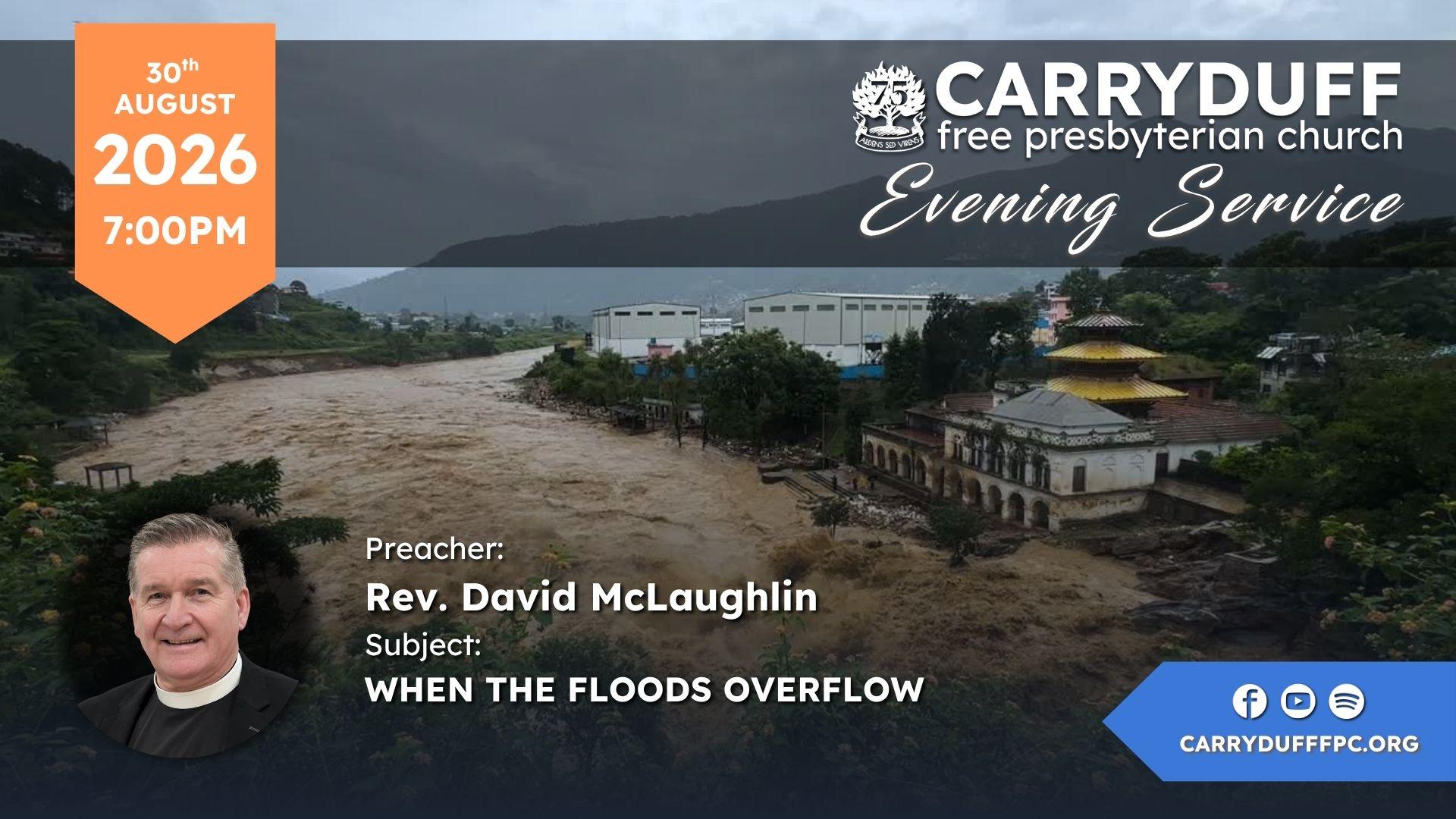
Date: SUN 7:00pm 30th August 2026
Preacher: Rev. David McLaughlin
Bible Reference: Psalm 69:1-2
Podcast
When the Floods Overflow: A Biblical Response to the Floods in Nepal
Text: Psalm 69:1-2 — “Save me, O God, for the waters are come in unto my soul. I sink in deep mire, where there is no standing: I am come into deep waters, where the floods overflow me.”
Introduction and Context
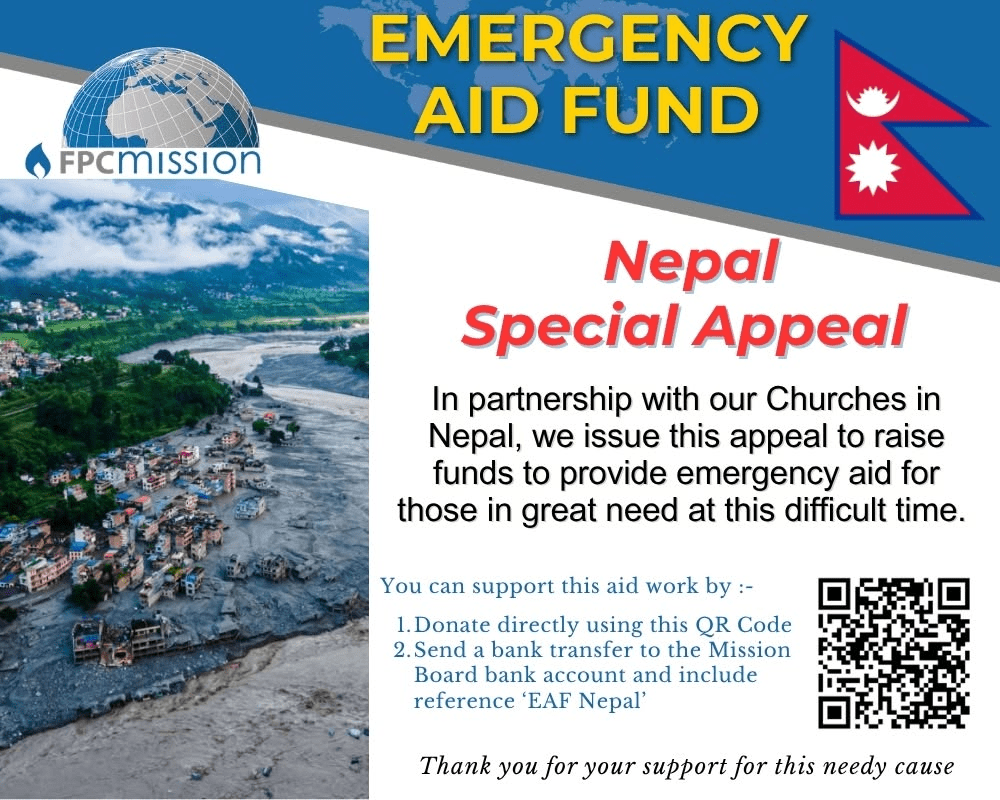
The preacher opens by acknowledging the recent catastrophic flooding in Nepal, which has produced scenes of enormous devastation. A collapsed glacier in the Rasuwa district triggered a chain reaction: mountain rock and glacial debris blocked a high-altitude lake, creating a natural dam. When that blockage failed, a powerful flood surged downstream through the entire river system.
By 29 August, the toll stood at 781 dead, 3,000 reported missing, and at least 219 injured. Whole communities, roads, bridges, a border station, a hotel, hydroelectric facilities, houses, and villages were swept away as if they had suddenly disappeared. The Nepalese government estimates the repair bill at four to five billion.
The preacher acknowledges that scientists, true to form, are blaming climate change — alleging that warming glaciers and changing permafrost are making high-altitude regions unstable. Their proposed lesson for the world is preparedness, and they warn that such events serve as a caution to other nations, including India, Bangladesh, and Bhutan.
However, the preacher states plainly that there is a disaster even more serious than the floods in Nepal. It is not a flood of water, but a flood of death — a flood that will usher every man, woman, and child before the Judge of all the earth to face the judgment to come. Behind every death lies the matter of sin, for “the wages of sin is death, but the gift of God is eternal life” (Romans 6:23). The chief question facing every person is this: How will I fare in the day of my death? How will I fare when I stand before Almighty God in the judgment?
David’s cry in Psalm 69 is not the cry of a man who thinks he can save himself. He is sinking. He has no standing. He is surrounded, swept away, overwhelmed. His cry is simple and plain: “Save me, O God, for the waters are come in unto my soul.”
From this text, the preacher draws out five points.
I. The Providence of the Flood
The flooding disaster in Nepal is only one of many. Behind every earthquake, every tsunami, every natural or manmade disaster stands the God of the Bible, who is absolutely sovereign. This disaster did not happen in a vacuum, nor did it take God by surprise. He governs all things according to His wise providence and eternal purpose.
The Lord Jesus Himself spoke of the signs of the last days in Matthew 24:7:
- Nation shall rise against nation, and kingdom against kingdom
- There shall be famines, pestilences, and earthquakes in divers places
- All these, He said, are the beginning of sorrows
The preacher is careful not to claim knowledge of God’s secret purpose in the life of every individual caught in the disaster. Some were appointed to die, others to be spared, others to be injured or traumatised. Some have been involved in rescues. But the message of the Bible is that God controls the natural world.
Scriptural evidence is marshalled:
- “The Lord hath prepared his throne in the heavens; and his kingdom ruleth over all” (Psalm 103:19)
- “He sendeth forth his word, and melteth them: he causeth his wind to blow, and the waters flow” (Psalm 147:18)
- “Whatsoever the Lord pleased, that did he in heaven, and in earth, in the seas, and all deep places” (Psalm 135:6)
- Job 37 states that God causes the elements to come, whether for correction, or for His land, or for mercy
The same providential event can have different purposes in relation to different people. We cannot simply say a disaster happened and leave it at that. We cannot merely donate money or express relief that we live in Northern Ireland. We must acknowledge that God is sovereignly ordering the circumstances of each person’s life and death. Job 14:5 declares, “Seeing his days are determined, the number of his months are with thee, thou hast appointed his bounds that he cannot pass.” In God we live and move and have our being. The psalmist said, “My times are in thy hands.”
The death of nearly 800 individuals is not outside God’s sovereignty. Neither is the injury of 219 people, nor the 3,000 missing, nor the flood waters themselves.
The Flood as a Sign of Judgment
This flood is a sign of God’s displeasure upon the world. We live in a fallen, sinful world, and every catastrophe is connected to the judgment that entered through sin. Romans 5:12 teaches, “Wherefore, as by one man sin entered into the world, and death by sin; and so death passed upon all men, for that all have sinned.” Death itself is a judicial testimony to the fall of man into sin and misery. The whole creation groans under the weight and burden of sin — “For we know that the whole creation groaneth and travaileth in pain together until now” (Romans 8:22). That travailing in pain is seen in part through earthquakes, tsunamis, floods, disease, and national disaster.
This flood is more than a mere meteorological event. It occurs in a world under the curse of sin. It is the sound of God’s judgment, a warning that calls for repentance. The earthquakes, floods, and diseases happening across the world are not given to help us identify a particular prophetic timetable. Rather, the return of the Lord Jesus Christ and the period preceding it will be marked by intense upheaval, great suffering, pain, woe, and sorrow. Because of the intensity of these things, we are called to watch and be ready.
We can say something terrible has happened — and it has. But we must say more: this world is not meant to be like this. It is like this because it is a fallen, sinful world, and God is speaking in the midst of it. God’s judgment is real. God’s judgment is fearful. This world is temporary and passing away. Christ is coming, and therefore men are called to repent and be ready. No one is guaranteed tomorrow. “Boast not thyself of tomorrow, for thou knowest not what a day may bring forth” (Proverbs 27:1). “Prepare to meet thy God” (Amos 4:12) — and the context is that God is coming in judgment.
II. The Peril of the Flood
David describes a situation in which he is overwhelmed. The waters are not merely around him; they have come in unto his soul. The danger is not distant. He senses it. He feels it. The Bible uses this figurative language of a flood to describe David’s overwhelming experience.
David speaks elsewhere of being overcome with fear:
- “The sorrows of death compassed me, and the floods of ungodly men made me afraid” (Psalm 18:4)
- “Then the waters had overwhelmed us, the stream had gone over our soul” (Psalm 124:4)
There are moments when human beings discover how fragile life truly is. Watching water rise in a river, knowing it will burst its banks — that is genuinely frightening. Think of the rich and famous: one minute they have money in the bank, plans for tomorrow, mansions, careers, families. In a moment, it all changes. In a moment, it is gone.
James asks, “For what is your life? It is even a vapour, that appeareth for a little time, and then vanisheth away” (James 4:14). This flood is a reminder that life is fragile, and one day we shall all physically die.
Yet there is a greater peril than physical death: the judgment. “It is appointed unto men once to die, but after this the judgment” (Hebrews 9:27). There is a God, and every person must stand before Him and give an account. Many deny this, pretending that death is no big deal and need not be feared. But what comes after? Meeting God in judgment. You may escape a car accident. You may escape disease. You may escape many things. But you will not escape the cold hand of death. You will not escape meeting God in the judgment — unless you are found in Christ, having repented and believed the gospel.
III. The Plight in the Flood
Verse 2 states, “I sink in deep mire, where there is no standing.” What a picture. David is sinking. There is no firm ground. There is no place to stand. There is nothing in himself upon which he can depend.
What is true of David is true of all men, for all have sinned and come short of the glory of God. The respectable sinner, the immoral sinner, the religious sinner, the church member, the preacher, the elder, the deacon, the woman, the young people, the boys and girls — they all need Christ.
The preacher recalls old pirate films in which a villain sinks into quicksand. The more he struggles to break free, the deeper he sinks. That is the picture here. The only way to escape such a situation is for another to pull you out.
What can pull a person out of the mire of sin, death, hell, and judgment?
- Not religion. The church does not offer religion but a relationship with God through faith in Christ.
- Not baptism. It is not baptism that washes away sin — it is the blood of Christ.
- Not church membership, though it is good to have church membership and to faithfully attend a Bible-believing Protestant Reformed church.
- Not good works.
- Not hands-giving.
- Not trying harder or turning over a new leaf.
The sinner needs what David needed. David cried, “Save me, O God, for the waters are come into my soul.” Salvation is by grace alone, through faith alone, in Christ alone, as revealed in the Scriptures alone. No one can stand before God in his own righteousness. Every person needs a Saviour. Every person needs the righteousness of another — someone to put His hand in theirs and pull them out of the depth of the mire: the mire of sin, the mire of death, the mire of judgment, the mire of the wrath of God.
IV. The Plea in the Flood
David’s prayer is straightforward: “Save me, O God.” He knows he cannot save himself, so he cries to the One who can. The message is clear: “Whosoever shall call upon the name of the Lord shall be saved” (Romans 10:13).
The word whosoever is powerful. Not just the rich, the respectable, the self-righteous, or the religious — but whosoever. The question is: Have you called?
David’s plea demands comprehension of the name of the Lord. One must think about who He is, what He has done, and what He is like. Do not trust in baptism, church membership, good works, hands-giving, or prayers. God is not asking anyone to save themselves. He is telling them they cannot save themselves and is pointing them to the One who can.
The Philippian jailer, in the midst of an earthquake, realised he could have died. Trembling before Paul and Silas at midnight, he cried out, “Sirs, what must I do to be saved?” The answer came: “Believe on the Lord Jesus Christ, and thou shalt be saved” (Acts 16:30-31). A precious, powerful, personal answer. Not make yourself better. Not join yourself with a church. Not save yourself. Not wise up. But believe — put your faith and trust in Christ. Trust in the One who saves.
V. The Person in the Flood
The text says, “I am come into deep waters, where the floods overflow me.” Consider the word I. Consider the word me.
Psalm 69 is more than a picture of David in distress during some flood disaster. The New Testament connects this psalm directly with the suffering of Christ. It is messianic. The language of being overwhelmed by deep waters — the waters of the depth — points to the depth of the suffering of the Lord Jesus. He entered into the deepest waters of God’s judgment and became sin for us, that He might be our Saviour.
The preacher traces four specific New Testament quotations from this psalm:
- Verse 4: “They hated me without a cause” — cited in John 15:25
- Verse 9: “For the zeal of thine house hath eaten me up” — cited in John 2:17
- Verse 9: “The reproaches of them that reproached thee are fallen upon me” — cited in Romans 15:3
- Verse 21: “They gave me also gall for my meat; and in my thirst they gave me vinegar to drink” — cited in Matthew 27:34, Mark 15:23, and John 19:28-29
These are all particular to the cross of Christ and His life and witness. Here is God’s word to the sinking sinner: salvation is not in the philosophy of man. It is not in a programme. It is not in a church, whether Protestant or Roman Catholic. It is in a Person.
What Christ Did
- He came from heaven.
- He was born of the Virgin Mary — “Great is the mystery of godliness: God was manifest in the flesh” (1 Timothy 3:16).
- “When the fulness of the time was come, God sent forth his Son, made of a woman, made under the law, to redeem them that were under the law” (Galatians 4:4-5).
- He took upon Himself human flesh. He was a real, physical man.
- He lived a sinless life. He kept the law of God perfectly. He did no sin in thought, word, or deed.
- He went all the way to Calvary. He was nailed to the tree. On the cross He shed His blood and died in the sinner’s place.
- He arose again the third day, victorious over sin, hell, and the grave.
“God commendeth his love toward us, in that, while we were yet sinners, Christ died for us” (Romans 5:8). The flood of God’s judgment and wrath should have fallen on us. But Christ took our place. He became our Substitute. He took our punishment. He paid the debt we could not pay. He shed His blood to redeem us.
God’s solution is more than temporary relief from a flood-like situation. God’s salvation is not temporary — it is eternal. The Lord Jesus said, “My sheep hear my voice, and I know them, and they follow me: and I give unto them eternal life; and they shall never perish, neither shall any man pluck them out of my hand” (John 10:27-28).
Conclusion and Application
This world is full of floods, tsunamis, and earthquakes, and we shall hear more and more of them as we await the return of Jesus Christ in power and glory. Alongside these natural disasters, there are floods of sorrow, floods of fear, floods of trouble, floods of persecution, floods of opposition, and floods of death and judgment.
In the midst of it all, the believer can know the Saviour is with him. God told Isaiah, “Fear not: for I am with thee” (Isaiah 43:2). David said, “Yea, though I walk through the valley of the shadow of death, I will fear no evil: for thou art with me” (Psalm 23:4).
The preacher then turns the question on its head. The question is not: Why did those dear people die in Nepal, in that flood disaster — nearly 800 of them — when they did, in the way that they did? The real question is: Why are you and I still alive? Why has God given us breath? Why does He allow us to see tomorrow when He warns, “Boast not thyself of tomorrow, for thou knowest not what a day may bring forth”?
If you can think on that, then answer this: Have you prayed as David did? Have you cried, “Save me, O God”?
Do not wait for another flood. Do not wait for another warning or another tragedy. Do not wait until you are older or better. The Bible says, “Behold, now is the accepted time; behold, now is the day of salvation” (2 Corinthians 6:2). Again, “Today if ye will hear his voice, harden not your hearts” (Hebrews 4:7).
The providence in the flood. The peril in the flood. The plight in the flood. The plea in the flood. But get your eyes on the Person in the flood — and rejoice that you are alive to call upon the Saviour.