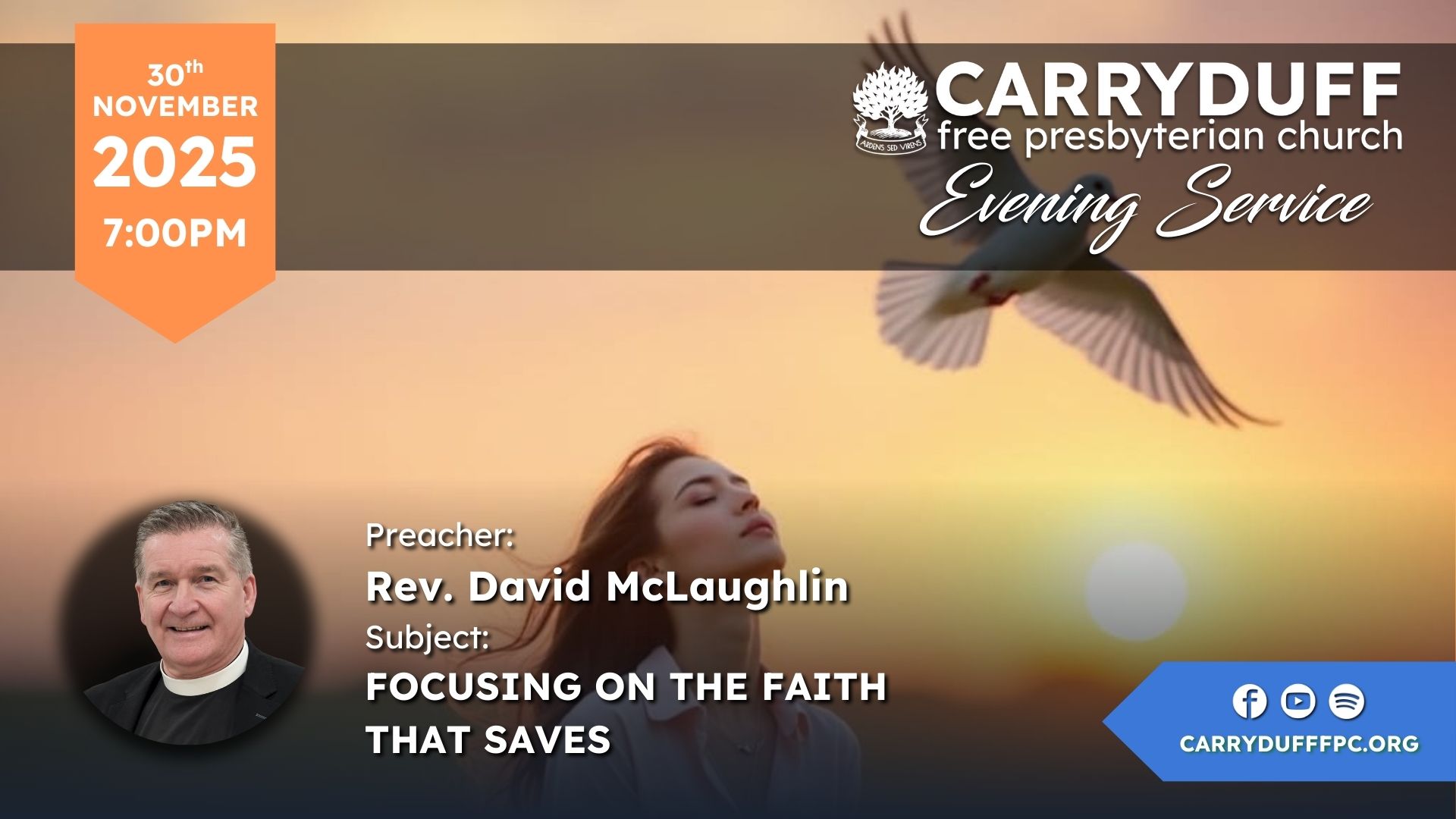


Date: SUN 7:00pm 26th July 2026
Preacher: Rev. David McLaughlin
Bible Reference: John 15:13-15
Podcast
The Greatest Friend in the Whole World — A Sermon Summary
Preached from John 15:1–16, with the text drawn from verses 13–15
Introduction and Occasion
The preacher opens by recounting how the sermon came to be. Whilst sitting at the Royal Black Perceptory Parade in Scarva, eating at the Independent Christian School stall, a stranger approached him and handed him a gospel tract entitled The Best Friend. A brief exchange followed in which both men testified to being saved, and the stranger was asked to pray that God would use His Word. That tract became the seedbed for this sermon, and the preacher acknowledges his debt to an unknown brother in Christ for the provocation.
The reading is taken from John 15:1–16 in the King James Version, with the sermon text proper being verses 13–15:
Greater love hath no man than this, that a man lay down his life for his friends. Ye are my friends, if ye do whatsoever I command you. Henceforth I call you not servants; for the servant knoweth not what his lord doeth: but I have called you friends; for all things that I have heard of my Father I have made known unto you.
The theme is announced simply: the greatest friend in the whole world.
The Universal Longing for Friendship
Every human heart, the preacher argues, harbours a deep desire for friendship. God created man as a social being — one of the first divine declarations after creation was that it was not good for man to be alone (Genesis 2:18). Friendship is among the greatest earthly gifts.
Scripture is replete with friendships, both noble and treacherous:
- Abraham was called the friend of God (Isaiah 41:8).
- Moses spoke with God face to face, as a man speaketh unto his friend (Exodus 33:11).
- David and Jonathan shared a covenant friendship that remains one of Scripture’s finest examples of loyalty and affection.
- Job experienced the failure of earthly friendships when his comforters turned accusers.
- Judas Iscariot demonstrated the treachery of a false friend, betraying Christ whilst being numbered among the twelve.
The book of Proverbs commends faithful friends whilst cautioning against flattering ones. Yet every earthly friendship — however good, true, or precious — stands as only a shadow, a faint reflection of the perfect friendship found in the Lord Jesus Christ. Proverbs 18:24 provides the touchstone: “There is a friend that sticketh closer than a brother.” Earthly friendships prepare us for the one they dimly reflect.
The Context of the Upper Room
The words of John 15 were spoken in the upper room, mere hours before the cross. The Lord Jesus was preparing His disciples for His departure. Within hours He would face arrest in Gethsemane, an unjust nocturnal trial, crucifixion, and burial. Yet in that moment, He chose to speak words of extraordinary comfort.
The preacher notes the staggering nature of Christ’s address. The everlasting Son of the everlasting Father, the Creator of heaven and earth, calls a group of weak, timid, sinful, redeemed men His friends. And He does not say it once — He says it three times:
- Verse 13: “his friends”
- Verse 14: “ye are my friends”
- Verse 15: “I have called you friends”
Three in Scripture is the number of complete witness. Spurgeon is quoted: “Jesus Christ has no fair-weather friend; He sticks closer than a brother — in life, in death, and throughout all eternity.”
The preacher then structures the remainder of the sermon under four headings.
1. The News of the Greatest Friend
Text: Greater love hath no man than this, that a man lay down his life for his friends (v. 13).
The gospel is fundamentally good news — not practical advice, not a moral improvement scheme, not ritualistic religious performance. It is an astonishing announcement: “When the fulness of the time was come, God sent forth his Son, made of a woman, made under the law, to redeem them that were under the law” (Galatians 4:4–5). At its heart is the message that God sent forth His Son to save sinners (1 Timothy 1:15).
This Friend Was Promised
Immediately after the Fall, God gave the first gospel promise in Genesis 3:15: “I will put enmity between thee and the woman, and between thy seed and her seed; it shall bruise thy head, and thou shalt bruise his heel.”
Throughout the Old Testament, everything pointed to Christ:
- Every sacrifice anticipated the one true sacrifice for sin.
- Every priest at the altar foreshadowed Christ.
- Every prophet spoke of Him.
- Every type typified Him.
- Every king that existed pointed to Him.
Abraham rejoiced to see Christ’s day (John 8:56). The Puritan John Flavel wrote: “The whole Scripture is but one entire revelation of Him.” On the road to Emmaus, Christ expounded unto the two disciples “in all the scriptures the things concerning himself” (Luke 24:27). Moses wrote of Him, David sang of Him in the Psalms, Isaiah preached of Him. The Old Testament announced His coming.
This Friend Was Proclaimed
When the New Testament opens, the promised friend has come: “The Word was made flesh, and dwelt among us” (John 1:14). He is called Emmanuel — God with us. The incarnation and virgin birth are vital doctrines because Jesus Christ is not merely a good man, a great man, a gentle man, or a gracious man — He is the God-man. As Calvin wrote: “Christ became our elder brother, that He might make us the children of God.”
This Friend Was Put to Death
The supreme evidence of friendship is this: a man lay down his life for his friends. Romans 5:8 declares: “But God commendeth his love toward us, in that, while we were yet sinners, Christ died for us.” Spurgeon again: “The cross is God’s heart written in blood.”
Christ did not merely speak about love — He demonstrated, commended, and showed what true love is. True love is measured by sacrifice. Jonathan loved David, Ruth loved Naomi, Paul loved Timothy — but only Christ died on the cross. Only Christ could bear the wrath of God. Only Christ could satisfy the demands of divine justice. Only Christ could reconcile sinners to God.
2. The Need of the Greatest Friend
Why does man need such a friend? The answer lies in identifying man’s greatest problem. Many answers are offered — money, housing, education, environment, loneliness, politics, sociology, depression. These are problems, yes, but they are not life’s greatest problem.
Man’s greatest problem is sin and guilt.
Many religions begin with man’s felt need. True, Bible-believing Christianity begins with man’s factual need — pardon from sin, forgiveness of sins, removal of guilt. Modern religion begins with human recognition; true religion begins with human ruin.
Naturally, we are not God’s friends — we are God’s rebels. We are alienated from God, enemies in our minds, dead in trespasses and sins. The first task of the preacher is to show man his need, just as a doctor shows a patient his condition before prescribing the cure. Romans 5:10 states: “For if, when we were enemies, we were reconciled to God by the death of his Son, much more, being reconciled, we shall be saved by his life.”
Christ did not come into the world to start making friends — He came to find His enemies and make them into His friends. That is sovereign grace. Until a man knows he is a lost sinner, the seeking Shepherd will never become precious to him.
Human friendships, though real and precious, are limited:
- They cannot forgive sin.
- They cannot conquer death.
- They cannot stand in the judgment for us.
There is no death of sin without the death of the Saviour. Death breaks every earthly friendship; every grave and funeral reminds us of separation and mortality. But Christ, by His sacrificial, atoning death, defeated sin, the grave, the devil, and hell. To His redeemed He says: “Because I live, ye shall live also” and “I will never leave thee, nor forsake thee.”
3. The Nature of the Greatest Friend
What kind of friend is the Lord Jesus? Drawing from John 15 and the Song of Solomon — “This is my beloved, and this is my friend” (5:16) — the preacher identifies four aspects of Christ’s friendship.
He Is a Sacrificial Friend
Verse 13: “Greater love hath no man than this, that a man lay down his life for his friends.”
Note the language — it is voluntary, not forced. He cheerfully became obedient unto death, even the death of the cross. He did not merely risk His life; He gave it voluntarily, substitutionally, effectually, purposefully. His death was not that of a mere martyr, nor was it merely exemplary. It was vicarious and substitutionary. As He Himself said in John 10:17–18: “I lay down my life, that I might take it again. No man taketh it from me, but I lay it down of myself.”
He Is a Speaking Friend
Verse 15: “For all things that I have heard of my Father I have made known unto you.”
Friends communicate — they talk, they are open, honest, clear, and true. A good friend will not gossip, tell lies, spread rumours, or tell tales. Christ came as the speaking friend to reveal the Father to His redeemed children. The Bible is the speech of our friend. Dr Martyn Lloyd-Jones said: “The Christian lives upon truth.” Where does the truth come from? From the mouth of his friend. That is why the Bible is a God-breathed book — profitable for doctrine, reproof, correction, and instruction in righteousness.
He Is a Sovereign Friend
Verse 16: “Ye have not chosen me, but I have chosen you.”
The friendship began with election in eternity past. Sovereign grace stands first; grace even precedes our faith and repentance. It was grace that caused God to act and to take the initiative on the sinner’s heart. Spurgeon: “Our choosing of Christ in time is the result of Christ choosing us in eternity.”
He Is a Sanctifying Friend
Verse 14: “Ye are my friends, if ye do whatsoever I command you.”
Obedience is not the cause of friendship but its evidence. The Christian obediently demonstrates true discipleship. This is not teaching salvation by obedience; rather, the true faith that saves is life-giving, life-changing, life-sustaining, and life-transforming. True friendship with Christ produces growth in holiness, a desire to know Him, to love Him, and to be loyal to Him.
4. The Nearness of the Greatest Friend
Verse 15: “I have called you friends.”
Consider Who Says It
The eternal Son of God, the Creator and Maker, the only Redeemer of sinners, the eternal Judge, the King of Kings and Lord of Lords — yet here in the upper room, He stoops to call redeemed sinners His friends.
Consider What It Says
His friendship is:
- Personal — He addresses individuals.
- Precious — Friends will disappoint, fail, hurt, and upset; the Lord Jesus never will.
- Priceless — There is no friend like the lowly Jesus. He knows our weakness, waywardness, and wanderings, yet His heart is still toward His people.
- Eternal — Nothing can separate us from the love of Christ. Romans 8:38–39: “I am persuaded, that neither death, nor life, nor angels, nor principalities, nor powers, nor things present, nor things to come, nor height, nor depth, nor any other creature, shall be able to separate us from the love of God, which is in Christ Jesus our Lord.”
The Required Response
Such a declaration demands an answer. The preacher outlines four responses:
- Receive Him — “As many as received him, to them gave he power to become the sons of God” (John 1:12). The question is not whether one knows about Him outwardly, but whether one knows Him through receiving Him by faith.
- Rest in Him — Not in works, not in the church, not in ritualistic ceremonies, not in self-righteousness. Rest in Christ alone.
- Remain in Him — The true believer enjoys communion with Christ through His Word, through prayer, through obedience. Abiding is the evidence, not the ground, of salvation.
- Rejoice in Him — It is a privilege to hear “I have called you friends.” What more could be said? What more could be bestowed?
Closing Illustration
The preacher concludes with a story. A young man boasted hundreds of contacts on his phone and followers on social media. At twenty-nine, he was diagnosed with aggressive cancer. Friends sent messages, then fewer, then none. One afternoon, months into his diagnosis, he sat in despair, looking at his phone. One name stood out — a childhood friend.
He rang. The friend answered immediately: “I’ll be there in twenty minutes.” And he was. Every week thereafter, he drove him to appointments, sat for hours, helped him walk, pushed his wheelchair. When asked why he was giving up so much, the friend replied: “Because the Lord Jesus is my greatest friend, and He helps me from day to day. I want to help you.”
True friendship is not measured by texts or likes. It is measured by one who comes and stays when no one else is there. That is a faint picture of the Lord Jesus Christ, who says to His people: “I will never leave thee, nor forsake thee” — five negatives in the original, the preacher notes: never, never, never, never, never. Not when it is convenient. Even when we cannot walk, He carries us. In every valley, every lonely hour, every darkness — He is there.
Final Appeal
The preacher closes with an earnest appeal to the unconverted and the believing alike:
- To discover the nature of this friend.
- To acknowledge the need — the problem of sin and guilt.
- To receive the news — the friend who was promised, proclaimed, put to death, and who commends His love to sinners.
He finishes with the words of Mrs Sykes, wife of the Scottish evangelist, who used to say at the end of their meetings: “Will ye nae take Him hame with ye?” – I recommend Christ as the greatest friend in the whole world.
And the final text, left ringing in the ear: “But God commendeth his love toward us, in that, while we were yet sinners, Christ died for us” (Romans 5:8).