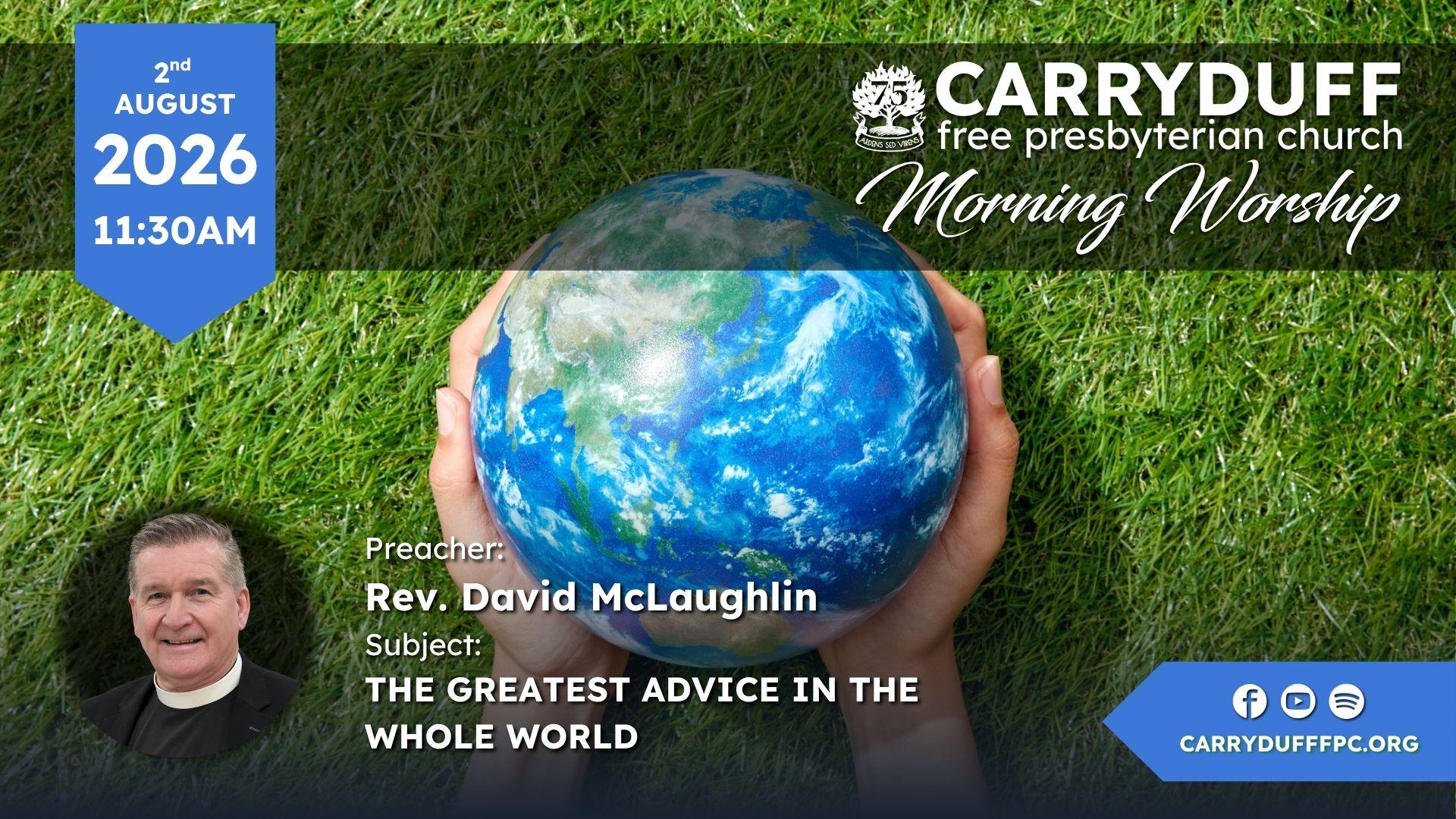

Date: SUN 11:30am 2nd August 2026
Preacher: Rev. David McLaughlin
Bible Reference: Proverbs 3:5-6
Podcast
Sermon Summary
This sermon sets out to expound what the preacher identifies as the single greatest piece of advice available to any human being. Drawing on the book of Proverbs—specifically chapter three, verses five and six—the message is a sustained call away from self-reliance and toward wholehearted dependence upon the covenant-keeping God of the Bible.
The sermon falls naturally into several sections. The opening establishes the text and its claim to uniqueness, followed by a detailed exposition of the key terms and phrases. The conclusion applies the message to unbelievers, struggling Christians, and anxious believers alike.
The Uniqueness of the Text
The preacher begins by imagining a scenario: take all 66 books of the Bible, containing 31,102 verses, and distil from them the two verses that best summarise the greatest advice ever given. The answer, he asserts, is Proverbs 3:5–6.
Trust in the LORD with all thine heart; and lean not unto thine own understanding. In all thy ways acknowledge him, and he shall direct thy paths.
This is not merely a pleasant sentiment suitable for wedding days or moments of personal crisis. It is, rather, counsel for every single day of life. It is a profound covenant command that summons sinners away from self-confidence and self-dependence toward a life of complete dependence on the true and living God.
The preacher references Dr Martin Lloyd-Jones, who often reminded his congregation at Westminster Chapel that the greatest tragedy of mankind is the insistence on trusting oneself rather than trusting in the Lord. The essence of sin, the sermon argues, is self-reliance, self-confidence, and self-autonomy. The essence of true faith is a life of dependence on God. These two verses strike at the very root of fallen human nature.
The Nature of Proverbs
Before unpacking the text itself, the preacher locates the book of Proverbs within the wisdom literature of the Old Testament—alongside Job, Psalms, Ecclesiastes, and the Song of Solomon. Proverbs contains 31 chapters and 915 verses, many of which stand alone as one-off sayings covering diverse aspects of life on earth.
Crucially, these sayings are not merely the observations of a clever man living a thousand years before Christ. They are inspired sayings from God. Citing 2 Timothy 3:16, the preacher affirms that all Scripture is given by inspiration of God and is profitable for doctrine, reproof, correction, and instruction in righteousness. Proverbs, therefore, are best understood as laws from heaven for life on earth.
The opening nine chapters are presented as a father instructing his son—King Solomon, under divine inspiration, exhorting his family to embrace God’s wisdom and reject the folly and filth of an ungodly, anti-Christian world.
The Six-Part Structure of the Exposition
The preacher breaks Proverbs 3:5–6 into six components, each examined in turn.
1. The Principle That Must Be Adopted: Trust
The first word—trust—exposes the folly of self-reliance. The Hebrew term means:
- To fully rely on
- To place one’s confidence in
- To rest securely upon
- To receive with assurance that what one is told is absolutely true
The word pictures an individual leaning or placing their entire weight upon something or someone that cannot fail. The preacher contrasts this with modern man, who prides himself on intellect, education, and self-confidence, yet remains unable to solve the great problems of life: sin, war, suffering, death, and evil. The Holy Spirit begins where human philosophers end. The Bible says trust, not take or turn to this or that.
The central message of the entire Bible, the preacher argues, is found in Psalm 118:8: “It is better to trust in the LORD than to put confidence in man. It is better to trust in the LORD than to put confidence in princes.”
The word trust is linked to faith and believe. The preacher recalls being taught that the word believe can be understood through the acronym T-A-R: Trust And Rely on.
2. The Person That Must Be Accepted: The LORD
Trust must rest in a person, not in circumstances, feelings, the church, human wisdom, wealth, friends, or professed experiences. The object of faith is not self, nor faith in one’s own faith—for faith is only as good as its object.
The word LORD appears in capital letters in the Authorised Version, translating the covenant name of God: Jehovah. The preacher then develops a brief doctrine of God:
- God is transcendent—infinite, eternal, unchangeable in His being, wisdom, power, holiness, justice, goodness, and truth
- God is self-existent and everlasting—from everlasting to everlasting (Psalm 90:2)
- God is triune—a mystery that cannot be fully fathomed
- God is holy—as the cherubim cry out, “Holy, holy, holy, is the LORD God Almighty”
- God is faithful—”Great is thy faithfulness” (Lamentations 3:23)
- God is the only wise God—glorious in holiness, fearful in praises, doing wonders
- God is absolutely sovereign—declaring the end from the beginning, His counsel standing, doing all His pleasure (Isaiah 46:9–10)
- God is Redeemer—revealed perfectly in the person and work of the Lord Jesus Christ
The preacher moves to the New Testament, citing John 1:14 and 1:18, affirming the incarnation: Jesus Christ is God manifest in the flesh. He believes in the virgin birth. Christ is Jehovah incarnate, who said to His disciples, “Ye believe in God, believe also in me”—where believe means to trust, adhere to, and rely on.
God is the only wise God, the true and living God, the everlasting King (Jeremiah 10:10). He is perfectly faithful, absolutely trustworthy, eternally unchangeable. He divinely intervened in our fallen world and is our heavenly Father (John 3:16; Romans 5:8; 1 John 4:10).
The preacher uses an illustration: a child needing to cross a busy road—cars and lorries travelling fast, no traffic lights, no zebra crossing. The child is fearful, worried, anxious. The father takes the child by the hand and guides him safely across. The child gets across safely because the child is holding the father’s hand—but more importantly, the father is holding the child’s hand. The question: in whom do you trust?
3. The Practice That Must Be Attempted: With All Thine Heart
The word heart here does not refer to the organ that pumps blood, but to the inner man—the real you: mind, will, emotions, and affections.
God will not accept a divided heart. Not 90 percent. Not even 99 percent. Only 100 percent. A partial, divided trust is not true biblical trust.
This wholehearted trust applies:
- In days of prosperity, when things are good
- In days of adversity, ill health, sickness, trouble, calamity, failure, doubt, and abandonment
- When hurt by friends
- In the eventuality of the day of one’s death
- When life falls apart and the whole world collapses around you
- When tempted to deny God
Faith remembers and says: God is too good to do anything bad, and God is too wise to make a mistake. God’s character makes Him trustworthy.
The preacher challenges his hearers: many in Northern Ireland profess belief in God, but do they really, practically trust in the Lord? Many live independently of Him, as if He is not there, as if He does not matter. Their professed belief makes no change or impact upon how they live in the home, in society, at work, at school, or at university.
4. The Prohibition That Must Be Announced: Lean Not unto Thine Own Understanding
To lean on something is to support oneself upon it. Human will, understanding, and affections have been affected and corrupted by sin:
- “The heart is deceitful above all things, and desperately wicked” (Jeremiah 17:9)
- “For my thoughts are not your thoughts, saith the LORD” (Isaiah 55:8)
- “The carnal mind is enmity against God” (Romans 8:7)
Human understanding is limited. Sin has darkened our understanding. Sin has made us proud creatures. Sin prompts us to believe in self.
The preacher identifies a particular problem in Northern Ireland: the tendency to place human reasoning above heaven’s revelation. Many reject the fact that God has spoken in the Scriptures. People depend on circumstances, feelings, the church—the Roman Catholic depends on the priest and all the trappings of Roman Catholicism. People depend on the pastor, the philosopher, the politician, or the prince on the throne.
Human wisdom is:
- Limited
- Short-sighted
- Often deceptive
- Often unjust
- Induced by fear
Man’s greatest problem is confidence in himself rather than full confidence in the Lord.
5. The Path That Must Be Aligned: In All Thy Ways Acknowledge Him
The course of life is brought into alignment with God’s will by an acknowledgement of Him in every area:
- Every decision
- Every ambition
- Every relationship
- Every trial
- Business
- Family life
- Daily chores
- Ordinary journeys
This is not merely for times of worship, nor only in crises or major decisions. To acknowledge Him literally means:
- To know Him
- To recognise who He is
- To submit to Him
- To seek His glory
- To confess dependence on Him
- To seek His will
- To obey His word
- To live a life of humble dependence on Him
It means bringing every area of life under the authority of Scripture.
The preacher then provides an acrostic for PRAYER:
- Praise
- Remission (confession of sins)
- Asking for things generally and specifically
- Yielding oneself in total surrender, living in humble dependence
- Encouragement received through answered prayer
- Redemption—praying on the ground of the blood of Christ
Every road should begin with prayer. There should be no small matters, because every matter, small and great, should be brought to the Lord.
6. The Promise That Must Be Appropriated: He Shall Direct Thy Paths
This is not a promise of an easy road, but it is a promise of a guided road. The word direct carries the idea of making straight, removing obstacles—according to God’s purpose and will. It means to establish the way: not the shortest road, not the simplest road, but the straightest road.
This promise inspires stability, joy, guidance, and confidence. If one can trust the Lord for salvation, one can allow Him to direct one’s paths.
God’s guidance is certain and unconditional to the trusting believer. It is not perhaps, not if, not maybe—but shall. The preacher identifies several means by which God directs:
- By the Scriptures—governing life by the authority of Holy Scripture
- By providence—bringing people across one’s path
- By the Holy Spirit—prompting, never leading into sin or silliness, always into saintliness. Anyone claiming the Spirit led them to commit adultery is lying; that leading comes from the devil or the flesh
- By sanctified wisdom and common sense
- By godly counsel—turning to men and women and asking them to pray
- By opening doors
- By closing doors
Application
To the Unbeliever
The first step in the Christian life is to trust the Lord as Redeemer—to trust that Jesus Christ is Jehovah incarnate in His person and in His work. The hearer is asked directly: are you trusting in the God of the Bible? Can you say, “In God I trust”?
To the Struggling Christian
Many are not truly trusting in the Lord. They trust in self, morality, works-righteousness, or religion. The call is to abandon every false refuge and trust in the Lord on the journey of life. There is such a thing as human inability, but there is also the sufficiency of divine revelation. It is possible to have true faith in a sovereign God and in the certainty of the gospel. Whatever the struggle, the key to living the Christian life is to trust in the Lord with all the heart.
To the Anxious Believer
Peace is possible. “Thou wilt keep him in perfect peace, whose mind is stayed on thee: because he trusteth in thee” (Isaiah 26:3). How is peace possible with all that is happening in the world? Because the believer trusts in the One who holds the future—and the One who holds the future holds the believer’s hand, like the father guiding the child across the road.
Christ as the Perfect Example
Christ perfectly trusted His heavenly Father. Christ never leaned on human wisdom. He said, “The words that I speak unto you, I speak not of myself: but the Father that dwelleth in me” (cf. John 14:10). He perfectly came to fulfil and do the Father’s will. By His birth, life, atoning death, and bodily resurrection, He can reconcile sinners to God and enable them to fulfil and receive this tremendous advice.
The Burden for the Present Generation
The preacher closes with a burden for the young people of his generation—those attending Queen’s University, those in grammar schools across the province. The tragedy of this generation is not a lack of intelligence. The problem is the absence of trust in the sovereign God.
He recounts meeting a man called Wilder Smith, reputed to be one of the most intelligent men who ever lived, who wrote a book titled He Who Thinks Has to Believe. The point: intelligence and education are not the issue. Far too many young people grow up in educational environments and emerge trusting in science, in themselves, in the scholars—not in the Saviour. That, the preacher concludes, is contrary to the Book.
The Book says:
Trust in the LORD with all thine heart; and lean not unto thine own understanding. In all thy ways acknowledge him, and he shall direct thy paths.
The final exhortation is summarised in six imperatives:
- Take on board this principle: trust
- Accept this person: trust in the LORD
- Attempt this practice: with all thine heart
- Announce this prohibition to your own soul: lean not unto thine own understanding
- Align your life with this path: in all thy ways acknowledge him
- Appropriate this promise: he shall direct thy paths