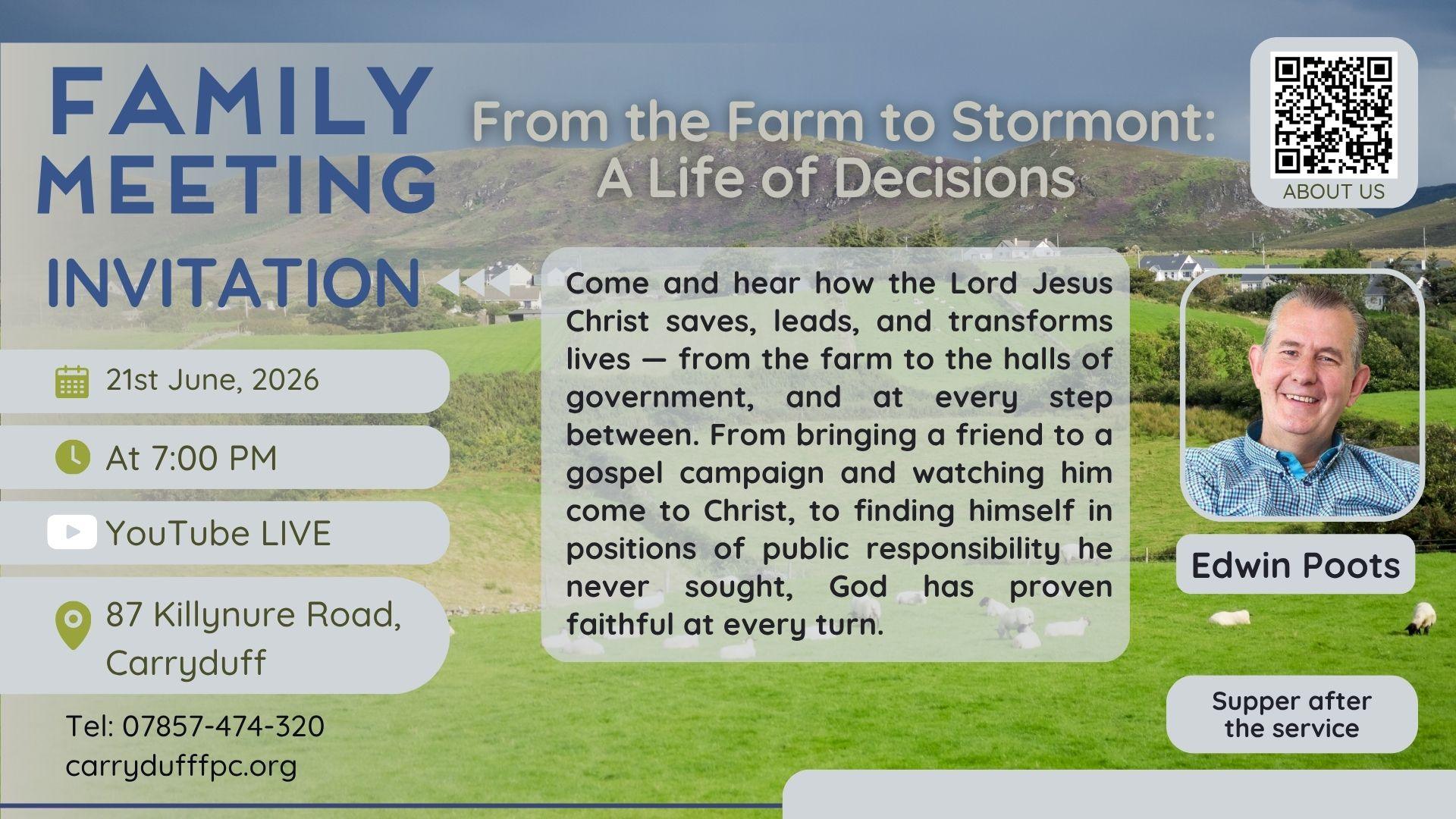

🗓️ Sunday, 21st June 2026 🕖 7:00 PM
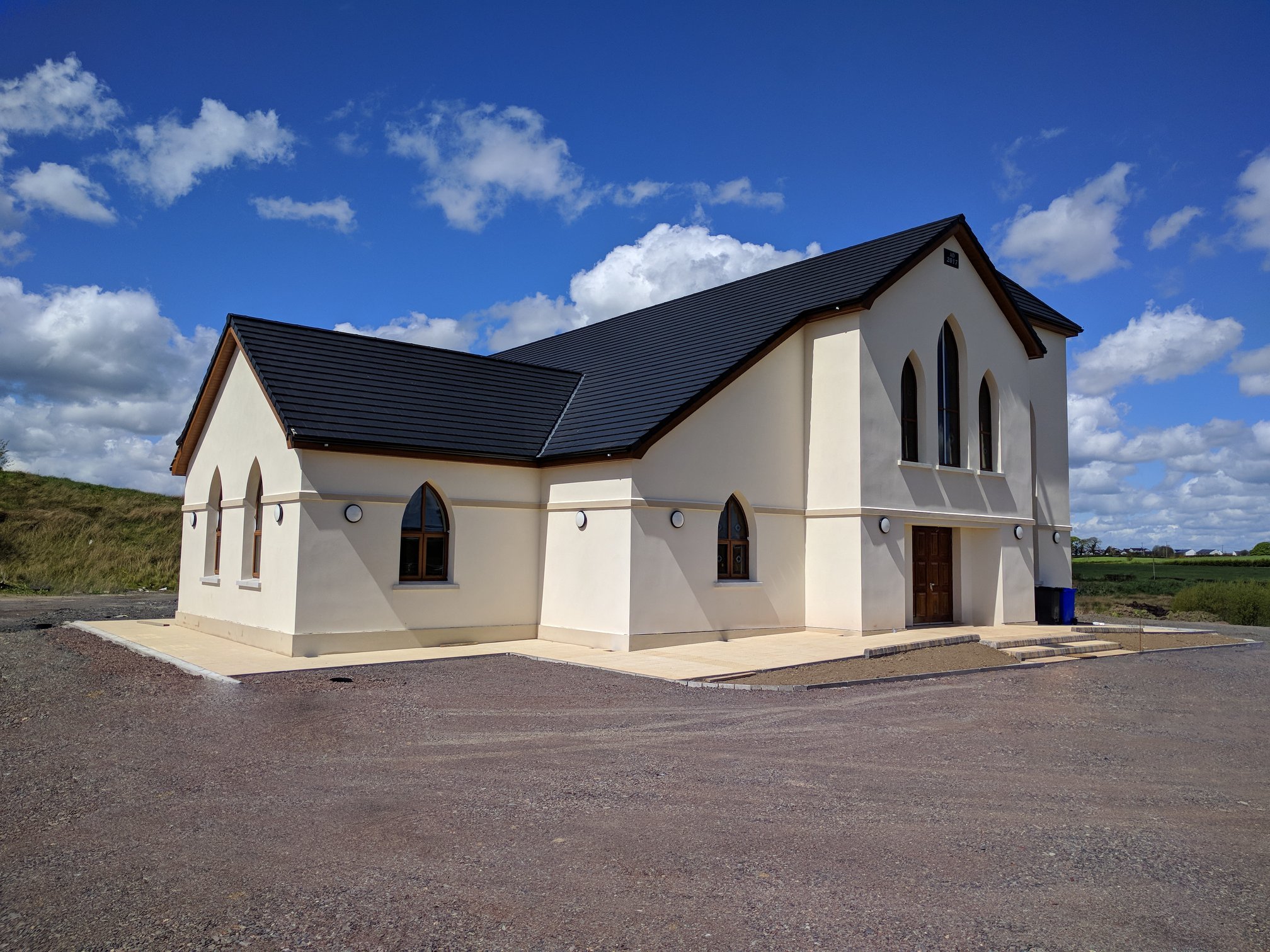
📍 Carryduff Free Presbyterian Church
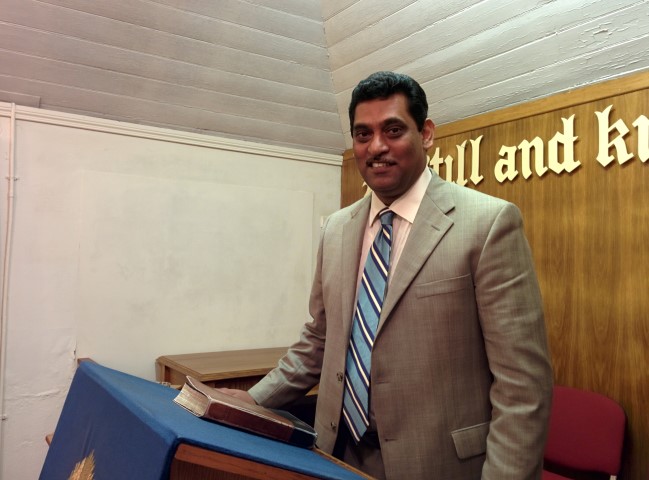
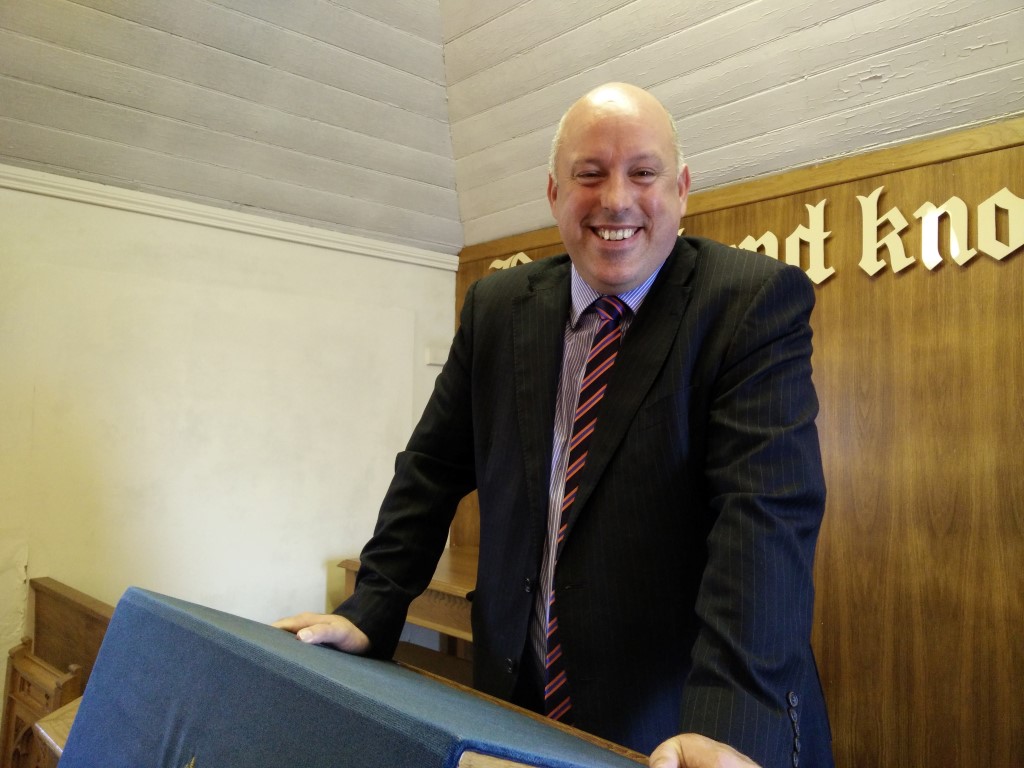
Service led by Rev. David McLaughlin
“Choose you this day whom ye will serve… but as for me and my house, we will serve the Lord.” — Joshua 24:15
Podcast
Summary of Edwin Poots’ Testimony and Gospel Sermon
Introduction and Opening Remarks
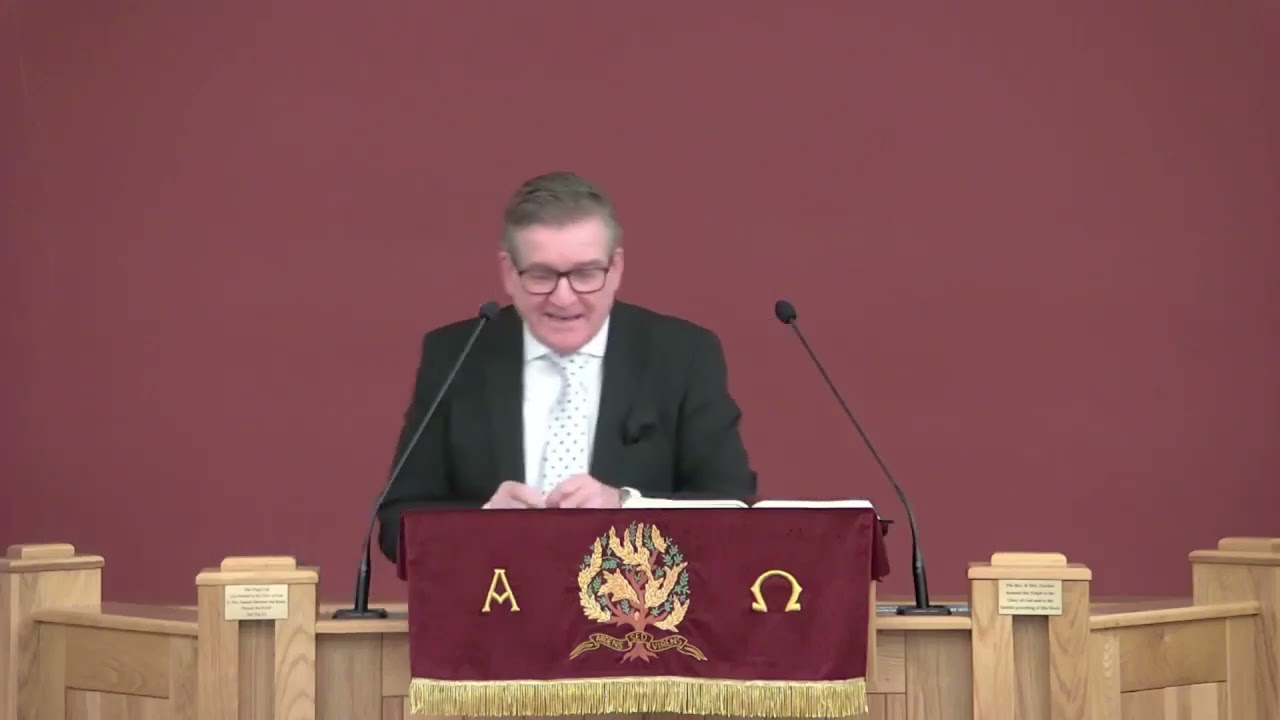
The speaker, Mr Edwin Poots, was introduced as a dear friend of the congregation and a servant of the Lord. He opened with warm remarks about the presiding minister and made a light-hearted comment about his choice of attire—noting that while he was tempted to wear a waistcoat like the minister, he feared his buttons might “take somebody’s eye out,” as he needed to lose more weight before donning such clothing again.
He then acknowledged the significance of the day being Father’s Day, using it as a platform to speak about the importance of fathers in family life and society at large.
The Importance of Fathers
Poots observed that across many communities, children are increasingly being raised by single mothers with fathers “nowhere to be seen.” He cited the biblical proverb: “Train up a child in the way he should go, and when he is old he will not depart from it.”
Key points he made regarding fatherhood:
- Fathers have a duty to be present in their children’s lives
- Fathers must pray for their children and seek to win them for the Lord Jesus Christ
- Family is “absolutely critical” to the well-being of everyone in society
- It is vital to bring families to church and to the house of God
He expressed concern that in the present day, children are not attending Sunday school or children’s meetings, and he voiced a desire for this trend to be reversed so that people would once again become accustomed to hearing what God has done for them.
Scripture Reading: Joshua Chapter 1, Verses 1–9
Poots read the first nine verses of the book of Joshua, which recount the Lord’s charge to Joshua after the death of Moses. The passage includes the following key elements:
- God’s command for Joshua to arise and lead the people across the Jordan into the land promised to Israel
- The assurance that no man would be able to stand against Joshua all the days of his life
- The promise that God would be with Joshua just as He had been with Moses: “I will not fail thee, nor forsake thee”
- The repeated exhortation to be strong and of good courage—stated three times in the passage
- The instruction to meditate on the book of the law day and night and to observe all that is written therein
- The concluding promise that God would be with Joshua wherever he went
He noted that this passage would be referenced later in his testimony, particularly the theme of courage.
Early Life and Family Background
His Parents and Upbringing
Edwin Poots was brought up by Charlie and Ethel Poots on a farm at Legacurry, approximately five miles from where the service was being held. He had lived in the same location for 59 years, apart from a period of 22 months.
His father was the eighth of ten children (the sixth of seven sons), and his mother was the seventh of nine children (the youngest daughter). Both parents were raised in what he described as “tough times.”
A Lesson on Hardship
Poots recounted a conversation with his daughter, who once suggested that the present era was the toughest time to be a young person. He disagreed emphatically, pointing to his father’s generation:
- His father was born in 1929
- There followed a ten-year economic depression
- Then came a six-year world war
- Rationing continued after the war
He concluded: “You don’t know about tough times.” His parents’ generation, he said, were “made of stern stuff” and were taught:
- The concept of hard work—”grindingly hard work, heavy, heavy work”
- How to make do with very little
This was the reality for hundreds of thousands of people across Northern Ireland at that time, where there was not an abundance of money.
His Father’s Start in Life
Poots described how his father, after working on his own father’s farm until age 24, realised he needed to provide for his wife. At that time, married women in the civil service were required to resign, and his mother had taken a nursing position at Cairn Heron Hospital to support them.
His father began his farming enterprise by purchasing a sow from a neighbour—on credit, as he had no money. The neighbour told him: “Take the sow, young fella, and bring her back whenever she’s farrowed.” From the sale of the pigs, his father began building a farming business.
Both parents worked extremely hard, eventually buying their own farm and building it up over time. His father also bought and sold calves around the countryside, and young Edwin would accompany him on these trips, enjoying the small tips (a shilling or two) given by the farming families they visited.
He noted with some amusement that many of the modest cottages they once visited have since been bought by “posh people” and replaced with 5,000-square-foot houses with horses instead of calves—a sign of how the countryside has changed.
Early Spiritual Life and Conversion
A Christian Home
Most importantly, Poots emphasised, he was brought up in a home where both parents were saved and taught him the way of salvation from his earliest days. Two memories stood out:
- His father audibly praying at the side of his bed every night
- His mother taking him to gospel meetings from a very young age
He received what he called a “triple dose” of gospel influence, as his Aunt Annie Wilson—a faithful mission pilgrim—would often stay at their house and was “always pushing the gospel.”
The Moment of Conversion
When his two oldest sisters were saved, a conversation about their conversions prompted young Edwin to ask questions. He realised he was “somewhat different from the rest of them.” This occurred one Sunday night while waiting in the car after church as his father talked with others.
The following Sunday night, at the original Free Presbyterian Church in a wooden hut (before the grand building that now stands), the Reverend Ken Elliott was preaching. Poots described the atmosphere:
- Great singing
- Great spirit
- A “great revivalist spirit”
- People hungry for souls to be saved
At the end of the meeting, when Reverend Elliott made an appeal, young Edwin put his hand up. He was “quite insistent,” though his father was initially unsure. He went in afterwards, prayed with the minister, and accepted Christ as his Saviour.
He described this as “the most important decision of my life, made as a child—childlike faith.” He urged the congregation never to despise the faith of a child, noting that approximately 80% of people are saved before the age of 18. He stressed that the church must focus on its children and young people.
School Years
Primary School
Poots attended Curry Primary School, which he described as a “great wee school” and enjoyed his time there. He shared a humorous anecdote about his tendency to stand up and look out the window whenever tractors passed by on the road. He could identify each tractor by its sound—Harvey Ferguson’s, Davey Brown’s, Sydney’s International, Jimmy Yuri’s 135. His teacher once remarked: “Edwin, if the 11-plus is on tractors passing the window of this school, you’ll pass with flying colours. But it’s not—you need to get on with your work.”
High School
He attended Wallace High School in Lisburn and candidly admitted he did not like it. On the first day, he was told to expect half an hour of homework per subject, with four subjects per night—amounting to two hours of homework daily. This was a “major disruption” to his life on the farm, where there were:
- Chickens and hens to feed
- Sheep to tend, particularly during lambing season (sheep, he noted wryly, “seem to be born to die if you’re not on top of it”)
- Calves to feed
- Various other farm duties
By age 13, he had decided that school was not for him and that he preferred farming. His plan was to leave as soon as he reached fifth year and attend agricultural college.
The homework burden actually increased to two-and-a-half to three hours per night before he finished. He managed to obtain a few O-levels, but admitted this was not through hard work at school—he simply “happened to get a few.”
A Critical Lesson on Bitterness
Poots recounted a pivotal incident from his youth. His father had been taking lambs to the livestock market in Lisburn. As he drove out of the market, two individuals were waiting for him and shot at him. His father, sensing something beforehand, ducked and accelerated simultaneously. The gunman dropped the weapon, and the bullet struck the car door, missing his father.
When young Edwin came home, his mother was distressed. The incident created a “bitter heart” in him, and he blamed all Catholics for what had happened.
However, he observed his father afterwards at the market, chatting with Catholic cattle dealers and farmers just as he always had. It had made no difference to him. From this, Poots learned a profound lesson: bitter spirits are not good for you.
He expanded on this point:
- Nursing a grudge is harmful to the one who holds it
- He has seen many people in his life and work who want to settle scores
- Such people can never find peace
- They often go to the grave “in a dry, empty condition”
- Their bitterness does absolutely no harm to the person they resent
Agricultural College and Standing for Christ
A Spiritual Failure in High School
Poots made a candid confession: during his high school years, he lacked the courage to tell people he was saved. At primary school it had not been an issue, but at high school he hid his faith. He connected this to the Joshua passage, noting that God commands His people three times to be strong and of good courage, because God places believers exactly where He wants them—whether in a joinery workshop, a lawyer’s office, or anywhere else.
He stated plainly: “If we truly love the Lord Jesus Christ, we have to be a witness for Him wherever we are. We can’t hide our light under a bushel.”
Ironically, everyone at school assumed he was a Christian anyway because he did not swear, did not go to discos, did not drink, and did not participate in the things his peers were doing.
The Test at Agricultural College
At agricultural college, where he stayed away from home during the week, he faced a stark choice. The other lads, aged 16, were heading down to the pub and getting drunk. When they invited him along, he found the courage to say: “No, I’m not coming. I’m a Christian, and I can’t do that.”
The result surprised him: the other students respected him for it. The thing the devil had told him to fear—mockery—never materialised. God gave him the courage and strength, and, he said, “I have never looked back since that.”
Marriage, Family, and Service
Marriage
Poots met his wife Linus when he was 28; she was a nurse. He cited the proverb: “Whoso findeth a wife findeth a good thing.” He described marriage as God’s creation and God’s plan—one man and one woman coming together in family.
When challenged about not accepting other forms of marriage, his response is to ask: “Who created marriage in the first place? Which government was it?” The answer, he said, is obvious: God created marriage between one man and one woman, and that is how it is to be.
Children
The couple’s first child, Luke, was born a year after their marriage. They then experienced three years without more children, during which they lost two babies through miscarriage.
When Linus was scheduled for a medical procedure, she discovered she was pregnant. She had prayed earnestly for a son, telling the Lord: “If you give me a son, I’ll give him back to you.” That child was Samuel. Nineteen years later, they kept that promise—Samuel now serves the Lord as a missionary in Brazil.
They later had a daughter, Anna, who went to South Africa to do the Lord’s work. Poots expressed that having two children on the mission field is a great encouragement and blessing.
A fourth child, Lydia, arrived six years after Anna. Poots believed that God gave them this child—unplanned by them but planned by God—because He knew He would take Anna to the mission field as well. He summarised: “God had a path set out, and He does things the best way.”
Church Service
Shortly after marriage, the Reverend Barnes asked Poots to get involved in youth work. He served in this capacity for 19 years. His wife began teaching Sunday school two years after their marriage and continued for over 30 years. He later helped start the work at a church plant in Hillsborough, which he had been involved with for 14 or 15 years at the time of speaking.
He emphasised the importance of serving when asked, even when inconvenient. He recalled a Friday night when he came home exhausted from a full week, feeling that the last thing he wanted was to go out again—yet he returned from that meeting “blessed.” Even when politics made him extremely busy, he maintained the principle: “God didn’t make me too busy that I couldn’t do some service for Him.”
He encouraged everyone in the congregation to find an active role in the church, whether menial or significant.
Entry into Politics
Poots described himself as always having been politically minded, partly stemming from the incident of his father being shot at. He was an avid reader from a young age—reading newspapers, history books about the Middle East, and political literature. He described this as self-education in subjects that genuinely interested him.
His father had served on the council for 24 years and had stood as a Protestant Unionist for Dr Paisley as far back as 1969. In 1993, his father suffered a severe stroke at age 63 and could not continue. Poots stood in the next election in 1997 and was elected to the council.
He assumed that would be the extent of his political involvement—farming, with some council work on the side. However, in 1998, when an assembly election was called and there were not many candidates available, he was asked to stand. He did, and thus became a full-time politician. He stressed that he never aspired to be anything other than a farmer, but believed it happened according to God’s will.
The Need for Christians in Public Life
Poots argued forcefully for Christian presence in the public square. Looking at England in particular, he observed that laws were being passed with very few Christian voices to oppose them:
- The taking of unborn children’s lives “by their millions” he called a “shame on our nation”
- Laws permitting the killing of the old and the sick he deemed contrary to God’s will
He stated that Christians are needed to stand up and fight for vulnerable people. When people speak of “progressiveness,” he counters that taking the lives of unborn children is regressive, not progressive.
He noted that politics gave him opportunities to speak to hundreds of thousands of people on radio and television—opportunities to witness for the name of the Lord Jesus Christ that he would never have had on the farm.
Sickness and God’s Providence
The Burst Appendix
Approximately five years before this testimony (around the time Covid began), Poots became unwell. One Friday he came home from work feeling unwell; he and his wife assumed it was a stomach complaint and took paracetamol. By the next morning he was worse, and by mid-afternoon he experienced a rigor—uncontrollable shaking and freezing cold.
Despite his wife’s repeated urging to go to hospital, he resisted, making excuses about how busy it would be on a Saturday. By Sunday morning, he was worse still. An out-of-hours GP told him it sounded like his appendix and that he must go to hospital.
He walked into the hospital in severe pain and was quickly given an MRI scan. The diagnosis: a burst appendix, which he believes occurred during the rigor the previous day. A burst appendix releases poison into the system, creating a high risk of sepsis—a condition that kills roughly one-third of hospital patients. As a former Minister of Health, he knew the danger and realised he had made a grave mistake by not listening to his wife.
The Ordeal in Hospital
He was put on intravenous antibiotics and told surgery would come around lunchtime. It did not. He grew sleepier and sicker throughout the afternoon. At one point he slept for a long period and, upon waking, thought to himself: “Am I just going to sleep to death here?” Because of Covid restrictions, no one could visit.
Eventually, at 8 o’clock in the evening, he was told surgery was imminent. Then at 9 o’clock, a nurse informed him he had Covid. His response was: “I couldn’t care less about Covid—can you just get me the surgery?”
An Unexpected Discovery
He underwent the surgery and woke the next morning feeling remarkably well—likely, he noted, due to residual morphine. He got up, showered, and played Christian music on his phone.
The surgeon then came with two pieces of news:
- The surgery had been “very messy”—there was a significant abscess on his colon, but it had been cleaned up well, and he should make a full recovery
- There was a significant growth in his kidney, seven centimetres long (nearly three inches)
When Poots asked whether such a growth would normally be benign or cancerous, the doctor replied that it was normally cancerous but that he would need to see a consultant for a definitive answer.
God’s Overruling Hand
Poots reflected that in a very short space of time, he had faced appendicitis, Covid, and cancer. Yet he saw God’s hand in it: had he not had the burst appendix, he would never have known about the kidney cancer. Some months later, he had the kidney removed and required no further treatment.
He expressed deep gratitude to God for this outcome and noted that he now has five grandchildren and feels truly blessed.
The Gospel Application
Poots used his two medical conditions as an extended metaphor for sin and salvation.
The Burst Appendix: Overt Sin
The burst appendix represented the urgent, obvious sins that are destroying people’s lives:
- Drink
- Drugs
- Pornography
- Gambling
- Other “awful sins”
He described how Satan uses these vices to drag people down “at a pace of knots,” destroying their lives. The person caught in such sin is crying out for happiness but receiving misery instead.
Just as he would have been dead within 24 hours without surgery, so the person trapped in overt sin is heading rapidly towards death—and beyond death, hell. The urgent message: you need to do something about it, and you need to do it quickly.
The Kidney Cancer: Hidden Sin
The kidney cancer represented the less visible sins of “good people”—those who do not drink, take drugs, or engage in blatantly sinful behaviour, yet still have sin in their lives:
- A quick temper
- Jealousy
- Envy
- Any other hidden sin
He cited the biblical truth that even our righteousness is like “filthy rags” before God. The person with hidden sin is equally in need of salvation, even though the condition is not outwardly apparent. Just as he had no symptoms of the kidney cancer, many people have no awareness of the sin that will condemn them.
The Remedy
Drawing on several passages of Scripture, Poots laid out the way of salvation:
- Romans 3:23: “For all have sinned and come short of the glory of God”—every person is a sinner
- Romans 6:23: “The wages of sin is death, but the gift of God is eternal life through Jesus Christ our Lord”—the consequence of sin is death, but God offers a free gift
- Romans 10:13: “For whosoever shall call on the name of the Lord shall be saved”—no conditions, no exceptions
- John 3:16: “For God so loved the world that He gave His only begotten Son, that whosoever believeth in Him should not perish but have everlasting life”
- John 3:17: “For God sent not His Son into the world to condemn the world, but that the world through Him might be saved”—Christ came to redeem, not to condemn
- 1 John 1:9: “If we confess our sins, He is faithful and just to forgive us our sins”
The Danger of Delay
Poots issued a sober warning about those who assume they have plenty of time to get right with God. Reflecting on his hospital experience, he recalled being so unwell that he could not think about his soul, heaven, or hell. Many people in similar circumstances are not capable of making a decision about eternity at that point.
He also returned to the lesson about listening to his wife: she warned him to go to hospital because paracetamol was not enough—he needed something more. Likewise, the sinner cannot sort out their own condition. They need the Great Physician, Jesus Christ, to come into their life and remove the stain of sin.
The Christian Life as the Better Life
He concluded his appeal by testifying that the Christian life is not only a privilege in terms of going to heaven but also in terms of living life now. Looking at the young people he went to school with, he saw “misery and unhappiness,” whereas he had experienced “joy and happiness,” blessings poured out on his life and home.
“Even if you didn’t have heaven at the end of it,” he said, “the Christian life would still be a far better life than what Satan’s going to offer you in this earth, because God is good and God is loving and God is gracious.”
His final appeal was direct: “Turn to Jesus. Make no delay. He has shown you the way. Come to Him, whom to know is life eternal. Put your life in order, and God will do great things for you.”
Closing Remarks by the Minister
The minister thanked Mr Poots for his testimony and gospel exhortation. Before the final hymn, he shared a brief account of visiting a man in hospital on Dr Paisley’s instruction—a man who had undergone a double amputation above the knee due to gangrene. The man had told him: “Reverend, if I wasn’t a born-again Christian lying in this bed, I would chase you, I would hunt you from this room.”
The closing hymn was “Dear Saviour, Thou Art Mine,” and the congregation was exhorted that if anyone present had not received Christ as Lord and Saviour, they should bow their head where they sat or stood and ask Him to be their Lord and Saviour that very evening.