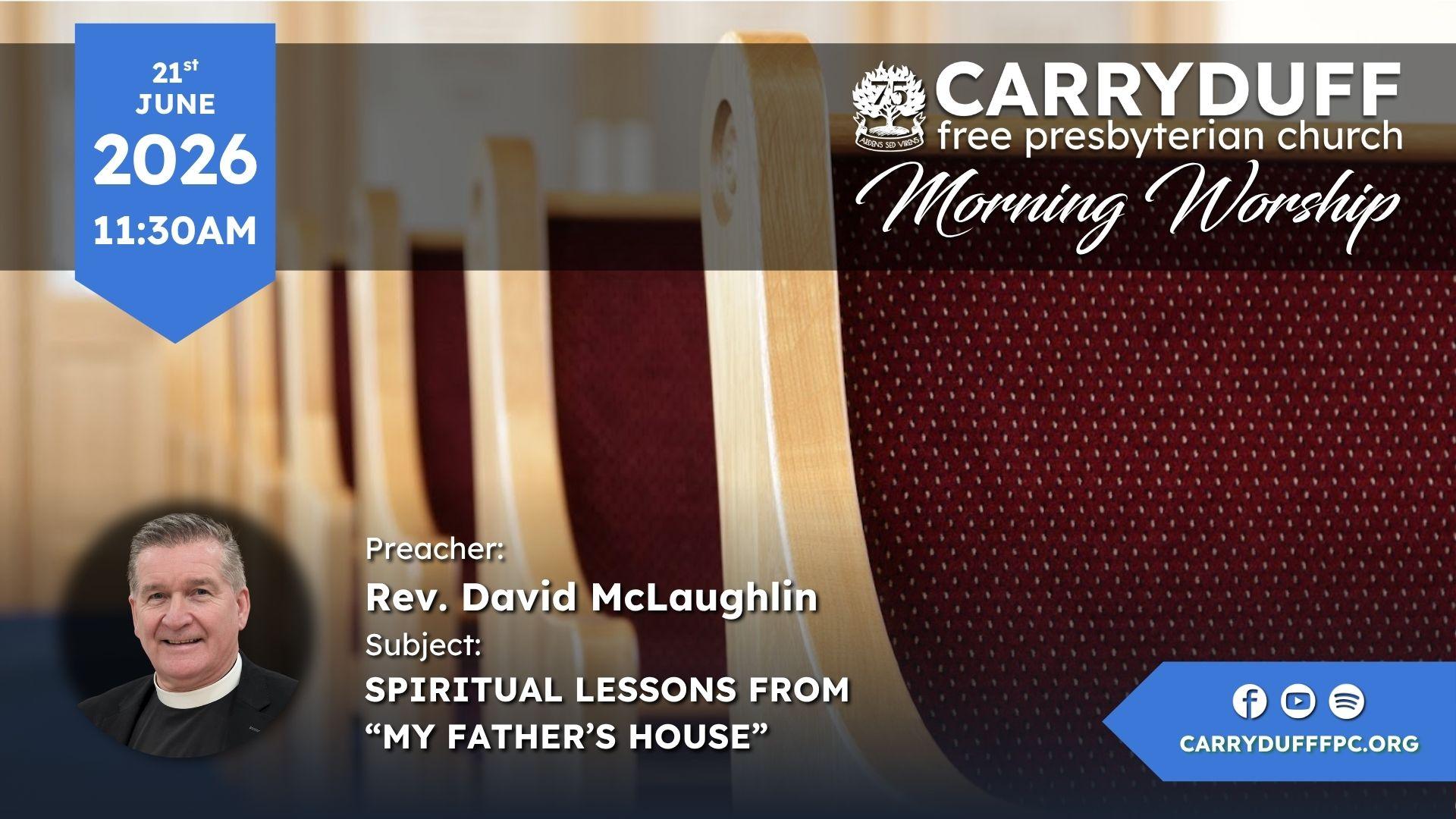

Date: SUN 11:30am 21st June 2026
Preacher: Rev. David McLaughlin
Bible Reference: John 14:2
Podcast
Sermon Summary
Text: John 14:2 — “In my Father’s house are many mansions: if it were not so, I would have told you. I go to prepare a place for you.”
Introduction and Context
The sermon opens by setting the scene in the Upper Room, one of the most emotionally charged moments in the entire earthly ministry of the Lord Jesus Christ. Several details establish the atmosphere of tension and sorrow:
- The Passover meal has just been eaten
- Judas has already departed into the darkness to betray the Son of God
- Peter has been told that before the cock crows twice, he will deny the Lord three times
- The disciples are confused and disturbed by Christ’s repeated references to His departure
- The shadow of Calvary stretches across the room — within hours Christ will be arrested, falsely accused, scourged, and nailed to the cross
The hearts of the disciples are overwhelmed. The word “troubled” in verse 1 (“Let not your heart be troubled”) carries the meaning of being agitated, disturbed, shaken, and distressed. Their world was falling apart. The One they had followed for more than three and a half years was about to leave them, and everything familiar seemed to be slipping away.
It was into this very atmosphere of uncertainty, fear, and sorrow that the Lord Jesus spoke some of the most comforting words in all of Scripture. How does He comfort them? Not with promises of wealth, ease, earthly success, power, or position. Instead, He purposefully lifts their eyes beyond this earthly world — beyond the cross, beyond the grave, beyond time itself — and points them to heaven.
The Unique Description of Heaven
The preacher draws attention to the deliberate and unique language the Lord uses. He could have said “in heaven,” “in paradise,” or “in the glory land” are many mansions. Instead, He specifically says “my Father’s house.”
The comfort is not merely that there exists a place called heaven — though that is included. The real comfort is that there is a Person in heaven whom the Lord Jesus calls my Father. For the child of God, heaven is not an unfamiliar destination; heaven is home. Heaven is the Father’s house.
Father’s Day Reflections
On this Father’s Day, the sermon acknowledges the varied experiences people have with earthly fathers:
- Some have been blessed with godly, good fathers who taught them the Scriptures, prayed with them and for them, disciplined them, guided them, and provided for them
- Some children have experienced neglect in Northern Ireland
- Some have memories of broken homes
- Some have suffered terrible abuse at the hands of fathers who were outside of Christ
- Some have godly fathers and grandfathers whom they miss deeply because they are already in heaven
Yet whether earthly fathers succeeded or failed in their role and responsibility, they point us to a greater reality: there is a Father in heaven. He is:
- A perfect Father
- A precious Father
- A priestly Father
- One who never abandons His children
- One who never forgets His promises to His children
- One who never changes His nature in relationship to His children
- One who never fails His children (“He faileth not”)
The Lord Jesus teaches that one day every redeemed child of God will dwell forever in His Father’s house. What a message for troubled hearts. The ungodly say this life is all there is — nothing beyond the grave. The sceptic says nobody really knows. The philosopher speculates. The scientist pontificates. But only the One who came from heaven really knows what heaven is like and can speak with absolute authority about eternity. And what does He tell us when He pulls back the curtains? Not only that heaven is a real place, but that in heaven there is a remarkable Person — and He calls that Person my Father.
Five Points from the Text
The sermon is structured around five observations drawn from John 14:2-3.
1. The Person That Is Referenced — “My Father”
The significance of these two words cannot be overstated. This is the first thing the Lord Jesus wanted His troubled disciples to know: before He speaks of mansions, preparation, or His return, He speaks of the Father.
In the context of John’s Gospel, “my Father” is a reference to God. The Lord Jesus specifically uses this terminology to express His spiritual relationship with God, and He distinguishes this relationship from that of His disciples. After His resurrection, in John 20:17, He states: “I ascend unto my Father, and your Father; and to my God, and your God.” The wording shows both a connection and a distinction. God is the Father of all believers — those who believe in the Lord Jesus Christ are the children of God. But when the Lord Jesus speaks of the Father as my Father, He does so in a unique sense.
Bible-believing Christianity teaches that Jesus Christ is the eternal Son of the everlasting Father, and that the Father is the first Person of the Holy Trinity. The Shorter Catechism teaches that there is but one only, the living and true God, and that this one God subsists in three distinct Persons — Father, Son, and Holy Spirit — the same in substance, equal in power and glory.
The words “my Father” disclose several truths about the Lord Jesus:
A Distinct Identity in Relationship to the Father
In verse 1, Christ says: “Ye believe in God, believe also in me.” He places faith in Himself alongside faith in the living and true God. No Jewish scholar would place himself as the object of faith alongside God unless he shared in a divine identity with God. This is reinforced in John 10:30: “I and my Father are one” — one in essence.
A Distinct Personality from the Father
Christ says “I go to prepare a place for you,” which fits with the doctrine of the Trinity — that the Father and Son are distinct divine Persons. John 1:18 states: “No man hath seen God at any time; the only begotten Son, which is in the bosom of the Father, he hath declared him.” John 10:38 adds: “The Father is in me, and I in him.”
A Shared Divine Authority
In this passage, what the Lord Jesus promises to do — prepare a place, come again, receive believers to Himself — is a role associated with kingly authority and salvation.
To summarise this point: the Lord Jesus has a distinct identity as the only begotten Son of the everlasting Father, a distinct unity with the Father (they are one), a distinct personality from the Father, and divine and distinct authority.
2. The Place That Is Relational — “My Father’s House”
He does not merely say “there is a house,” or “there is a kingdom,” or “there is a paradise.” He calls it my Father’s house. This means the place called heaven is relational — relational to the Father, to the Son, and to the Holy Spirit.
The glory of heaven is real, but it is not primarily the streets of gold, the gates of pearl, or the absence of sorrow. The real glory of heaven is God Himself as He exists as Father, Son, and Holy Spirit. Heaven is not just a beautiful place with golden streets, gates of pearl, angelic choirs, and perfect peace — all of that is true, but it is not the greatest attraction. The greatest attraction and the greatest glory of heaven is that God is there. He is Jehovah Shammah — the Lord is there.
The Father’s house is precious because the Father dwells there. David expressed this in Psalm 27:4: “One thing have I desired of the Lord, that will I seek after; that I may dwell in the house of the Lord all the days of my life, to behold the beauty of the Lord, and to inquire in his temple.” His great desire was not merely a location; he wanted communion and fellowship with God.
Revelation 21:3 declares: “The tabernacle of God is with men.” The wonder of heaven is that every redeemed sinner will enjoy the unveiled presence of God forever. Consider what this means:
- A place where faith gives way to sight
- A place where prayer becomes direct, face-to-face fellowship
- A place where every barrier caused by sin is removed forever
- A place where we will worship God without distraction, serve Him without weariness, love Him without sin, live without selfishness and pride
- A place where we will rejoice without any sorrow or trials
The Father’s house is where God is known perfectly and enjoyed eternally in a sinless state.
The Prodigal Son as Illustration
The preacher draws on Luke 15. The prodigal son left home seeking freedom, demanding his inheritance from his father. He spent his money in riotous living and ended up in poverty, feeding pigs in the far country. His deepest need was not food — the Bible says “he came to himself” and realised that life away from the father brought emptiness, misery, and despair. What drew him home was remembering the Father’s house. He resolved: “I will arise and go to my father.”
What drew him home was:
- The father’s love and embrace
- The father’s forgiveness and welcome
- The father’s gifts
- The joy of the father’s house — which was the father himself
He was not looking for the gifts; he was willing to become one of the father’s hired servants because he knew that even the servants in the father’s house were well looked after and well treated.
Yet how many today want to go to heaven but want heaven without God? They desire peace without a life of holiness, blessing from God without Christ in their life. But the true child of God does not merely long for what the Father gives — he longs for who the Father is. The Father’s house is precious because it is the dwelling place of the Father.
3. The Plenty That Is Remarkable — “Many Mansions”
The word many speaks of abundance. The preacher is emphatic in his defence of the King James Version’s rendering of “mansions” rather than “rooms” (as found in modern versions). A room speaks of something cramped; it diminishes the grandeur of the real meaning of the text. The faithful translators of the King James Bible chose the word mansions deliberately because it speaks of:
- Spacious dwellings
- Permanence — a lasting dwelling place
The preacher illustrates this with a personal anecdote about visiting a place in Pennsylvania called “Hundred Acre Wood,” where one hundred houses were built on one hundred acres — one acre for each house. That picture of spacious abundance captures the meaning here.
No child of God will discover that heaven is full. No saint will be turned away. No believer will find that there is no space for them or that the space is inadequate. One of the complaints about modern living is insufficient space, but the Father’s house is vast because the Father’s grace is vast.
Noah’s Ark as Illustration
Noah’s ark measured 300 cubits long, 50 cubits wide, and 30 cubits high — approximately 450 feet by 75 feet by 45 feet. Why build an ark that size? Because God designed it to be large enough for all whom He intended to save: Noah, his wife, his three sons and their wives, and all the animals. Not one animal was left outside because Noah had concluded there was no more room. Likewise, the Lord Jesus Christ — who is a picture of the ark — made a full and faithful provision for every one of His children. He said: “All that the Father giveth me shall come to me; and him that cometh to me I will in no wise cast out.”
The Parable of the Marriage Supper
The King wanted his house filled. When those first invited made excuses and refused to come, he sent servants into the highways and hedges to invite the lame, the blind, and the halt — that his house might be full. A multitude that no man could number.
Heaven is not a place of lonely little cottages or apartment blocks. It is a place of many mansions. Each mansion is a glorious family dwelling filled with redeemed sons and daughters. All that the Father chose will be there. All that the Son redeemed will be there. All that the Spirit regenerates will be there. Not one place shall remain unoccupied.
For those who have buried loved ones in Christ, there is comfort: when they left the scene of time and their earthly home, in a moment they were absent from the body and present with the Lord. They were called home — carried home. They belong there; they belong to the Father.
4. The Preparation That Is Real — “I Go to Prepare a Place for You”
Heaven is a real place. It is not a metaphor, wishful thinking, religious imagination, a mere state of mind, something the church has invented, or the stuff of fairy legend. It is a real place being prepared at this very moment by a real Saviour for a real redeemed people.
The preacher offers evidence of heaven’s reality:
- Elijah went there in a chariot of fire in the whirlwind
- The Lord Jesus ascended there (Acts 1:11: “This same Jesus, which is taken up from you into heaven, shall so come in like manner as ye have seen him go into heaven”)
- The first martyr Stephen saw heaven opened: “I see heavens opened”
- The Apostle Paul was caught up to the third heaven
- John saw it in Revelation
- One day every believer in Christ will enter in, sweeping through the gates of the New Jerusalem, washed in the blood of the Lamb
The preacher references the recent funeral service of the late Jean Greenfield, describing it as a tremendous service marked by God’s presence, a sense of victory and joy — because she died in Christ and died well.
Heaven is a prepared place for prepared people. The Lord Jesus guarantees its reality: “If it were not so, I would have told you.” Heaven is not based on human speculation but on divine revelation. The Son of God has spoken. A prepared place requires reality and existence, but it also requires truth. The Lord Jesus never comforted troubled hearts with fiction. He stakes His own truthfulness on the reality of the Father’s house — and He cannot lie.
How did He prepare this place? Not by constructing heavenly buildings, but by:
- His incarnation and virgin birth
- His sinless life
- His atoning death on the cross
- His bodily resurrection
- His intercession in heaven
It was by His cross work and His shed blood that He prepared the way for those who trust in Him by faith to be brought into this wonderful, precious place called my Father’s house.
5. The Promise That Is Receptive — “I Will Come Again, and Receive You”
Verse 3 contains the crowning promise: “And if I go and prepare a place for you, I will come again, and receive you unto myself; that where I am, there ye may be also.”
The arrival of believers in this prepared place is guaranteed. Hope does not rest in:
- Personal strength
- Religious duties
- Communicant membership
- Church membership
- Moral achievement
It rests on the promise of Christ — and the promise of Christ is the promise of hope. Christ will come personally to receive His people, either:
- At His second coming, or
- Personally in the hour of death, carrying them out of time and into eternity
The preacher shares a personal testimony about the death of Rosie’s mother on the 7th of September. At a few minutes past one in the afternoon, with Rosie cradling her mother in her arms, the Lord Jesus came and took her mother out of her arms and carried her all the way home to glory. For her, in an instant, it was absent from the body and present with the Lord.
Concluding Summary
The preacher draws the message together by recapitulating what the Father’s house represents:
- A place for the family — no stranger; this is for sons and daughters in Christ
- A place of fullness — many mansions, spacious in abundance, because God’s grace is spacious in abundance
- A place for fellowship — God is there as Father, Christ is there as the only begotten Son, the Spirit of God is there as the eternal Spirit
The congregation is encouraged to take these few words into their minds: my Father’s house. The five points to remember are:
- The Person that is referenced
- The Place that is relational
- The Plenty that is remarkable
- The Preparation that is real
- The Promise that is receptive
The message closes with a benediction and a word of thanks to the congregation for coming.