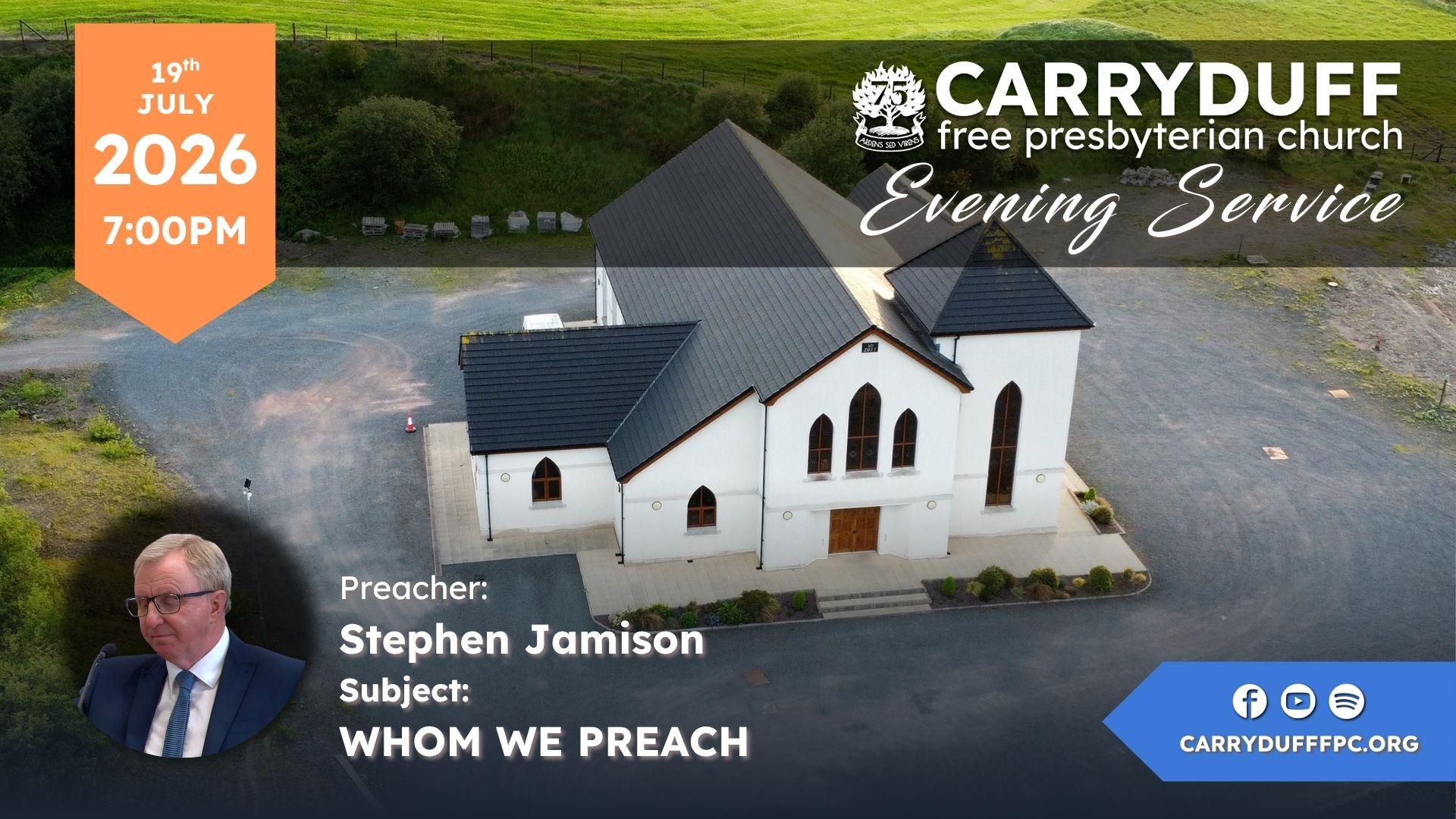

Date: SUN 7:00pm 19th July 2026
Preacher: Stephen Jamison
Bible Reference: Colossians 1:28
Podcast
Sermon Summary
Introduction: The Centrality of Christ in Apostolic Preaching
The sermon opens by establishing that the Apostle Paul’s message was utterly consistent across all his letters and preaching engagements. Whether writing to the church at Colossae, to the Corinthians, or to any other body of believers, Paul had one theme and one theme alone: the Lord Jesus Christ.
The preacher draws attention to three corroborating texts:
- 1 Corinthians 1:23 — “But we preach Christ crucified.”
- 2 Corinthians 4:5 — “For we preach not ourselves, but Christ Jesus the Lord; and ourselves your servants for Jesus’ sake.”
- The broader sweep of the New Testament, including the four Gospels, which all set forth Christ as the only one who can save, the only one who can lift the lost and fallen soul and bring them to God through the work of His cross.
The rhetorical question is posed: Why would we preach anything else? Nothing else will do. The apostle’s statement in Colossians 1:28 is not merely a declaration of what he preached but a model for all true Christian ministry. The verse continues: “Whom we preach, warning every man and teaching every man in all wisdom, that we may present every man perfect in Christ Jesus.” Preaching Christ encompasses both warning and teaching — the full counsel of the glorious gospel.
The sermon’s outline is drawn directly from the first chapter of Colossians and is structured around four aspects of Christ that must be preached: His Person, His Passion, His Power, and His Pardon.
Part One: We Preach His Person
The first and most extensive section addresses the person of the Lord Jesus Christ. The preacher notes that the church at Colossae was beset by heresies — specifically, a form of angel worship that denied Christ’s deity and reduced Him to the level of a mere angelic being. Paul’s epistle is a direct answer to that heresy, designed to build up believers in the experimental knowledge of who Christ truly is.
This is presented as thoroughly contemporary. All around, the preacher observes, there are those who deny who the Lord Jesus really is: the cults do it, the modernists do it, and indeed every human philosophy does it. But not the Bible, not the gospel, and not the true church of Jesus Christ. One of the marks of a true church is that it preaches Christ and His cross — and central to that is preaching His person.
Seven characteristics of Christ’s person are drawn from the chapter:
1. He Is the Image of the Invisible God (v. 15)
The preacher carefully distinguishes the biblical use of “image” from modern usage. Today, an image is a mere picture or portrait — a representation of someone absent. But when Paul writes that Christ is the image of the invisible God, he means something far more profound: Christ is God made visible. God, by His very nature, is invisible — “immortal, invisible, God only wise,” as the hymn declares. But Christ is God manifest in the flesh. He is fully God.
This is not to diminish His true humanity. He is Jesus of Nazareth, born in Bethlehem of Judea. He knew thirst, tiredness, sighing, and weeping. The preacher blesses God for the humanity of Christ. But the point is pressed home with force: He is fully God. The gospel does not ask anyone to put their trust in a mere man. Abraham, Jacob, Joseph, Moses, David, Daniel, Ezekiel — none of these ever said, “Put your faith in me.” Neither does the preacher. No mere man can solve every problem. The gospel calls sinners to trust in the God-man, the Lord Jesus Christ, the eternal Son of God who took to Himself human nature without sin and is God and man forever.
2. He Is the Firstborn of Every Creature (v. 15)
This phrase, the preacher explains, does not mean that Christ is a created being — He is rather the Creator, as the next verse makes plain. “Firstborn” here refers to rank and privilege, not to origin. He is first in order of precedence. Verse 18 confirms this: “that in all things he might have the preeminence.”
The heretics at Colossae were bringing Christ down to the level of an angel. But He is not on that level. The mighty angel Gabriel and the mighty angel Michael cannot save a soul. The preacher recounts a personal anecdote: he once saw an advertisement from a woman claiming she could introduce people to their guardian angel. He wrote away out of curiosity and received back the supposed name of his guardian angel, followed by a request for money to reveal what that angel said about his future. His response was blunt: he has God’s Word and needs no angel, and if the woman did know an angel, it was Lucifer. The point is reinforced — no one is being asked to trust in a mere man or even a mighty angel for eternity. Christ is the firstborn over all creation; He is above all.
3. He Is the Creator of All Things (v. 16)
The statement is simple and clinches the argument: “For by him were all things created.” If Christ were only a man, or even a mighty angel, He could not create. The preacher urges the congregation to note the recurring phrase “all things” throughout these verses. All things in heaven and earth, visible and invisible — including the very angelic orders the heretics were promoting — were created by Him and for Him.
Christ is the Creator. The gospel does not ask anyone to trust in a creature; it asks them to trust in the Creator.
The preacher then offers an extended illustration from human anatomy. Suffering from acid reflux (attributed to too many fish suppers over the years), he lay in bed one night and reflected on the design of the stomach. The stomach contains powerful acids necessary to break down food — acids strong enough to burn the stomach lining. Yet the stomach is protected by a layer of mucus that preserves it from that burning. Acid reflux occurs when the valve at the bottom of the gullet fails and acid escapes upward, causing the burning sensation known as heartburn — precisely because the gullet lacks that protective mucus.
The question that struck him: Which came first? Did the acid evolve first, or the mucus? A child could see that both must be present together, designed by God. The body is full of such examples of irreducible complexity — systems that had to exist simultaneously to function. The same principle applies throughout creation. The preacher holds up his watch: he knows it was designed. How much more the creation of God? It is designed by God, by the Lord Jesus Christ, the Creator of all things visible and invisible.
4. He Is Before All Things (v. 17)
If Christ is before all things, then He created all things. The logic is inescapable. His pre-existence establishes His deity.
5. By Him All Things Consist (v. 17)
Everything proceeds and is held together by the person of the Lord Jesus Christ. This is one reason a believer can go to bed at night and sleep: the Lord is looking after things. But there is also a sobering corollary. One day, the elements shall melt with fervent heat; the heavens shall pass away with a great noise. People speak of a “big bang” that began the universe — a big bang will end it in its present state. And all of this is ascribed in these verses to the person of the Lord Jesus Christ.
6. He Is the Head of the Body, the Church (v. 18)
Christ is the beginning, the firstborn from the dead, that in all things He might have the preeminence. His headship over the church is absolute.
7. In Him All Fullness Dwells (v. 19)
It pleased the Father that in Christ should all fullness dwell. He is God manifest in the flesh. This is the Saviour in whom sinners are called to trust — not a mere man, not a mighty angel, but God in Christ, the one who holds everything together, the head of all things, before all things, by whom all things consist.
Part Two: We Preach His Passion
The second section turns to the sufferings, blood, and death of the Lord Jesus Christ — what the preacher terms His passion.
Verse 20 declares: “And, having made peace through the blood of his cross, by him to reconcile all things unto himself.” The purpose for which Christ came from glory and from heaven was to go to that cross. He set His face as a flint toward Jerusalem. When the disciples resisted the teaching that He would be taken, crucified, and killed, the Lord Jesus had to rebuke Peter with the sharpest words: “Get thee behind me, Satan.” Satan himself sought to keep Christ from the cross, because the cross was the place of victory.
Through His cross, sinners can be saved. Christ Himself declared: “All manner of sin and blasphemy shall be forgiven unto men.” Whatever a person has done, whatever they have said, wherever they have been — the forgiveness of sins is offered freely by grace, received by faith alone, by believing on the Lord Jesus.
Verse 22 elaborates: “In the body of his flesh through death, to present you holy and unblameable and unreproveable in his sight.” Just as there was a lamb for the Passover night, there is the Lamb of God which taketh away the sin of the world. No wonder believers sing, “Only trust Him.”
The preacher then identifies a perennial strategy of Satan: to put something or someone between the sinner and Christ. It might be a church — the Roman Catholic Church or any church. It might be religion in general. It might be an organisation, a lodge, or an order. The preacher acknowledges attending such events annually but warns against trusting in them. How can anyone trust in anything other than this blessed One who is set forth in Scripture?
Christ crucified is central because on that cross He bore our sins in His own body on the tree, and the wrath of God was poured out upon Him. The preacher uses the illustration of a substitute in football: a player grows tired or injured, and someone on the sideline is ready to rush in and take his place. Thank God, the Lord Jesus was ready to rush in and take the sinner’s place. The question is pressed: Do you believe He has taken your place?
Part Three: We Preach His Power
The third aspect is Christ’s power. Verse 11 speaks of being “strengthened with all might, according to his glorious power.” Verse 13 declares that the Father “hath delivered us from the power of darkness.”
There is working power in Christ and in His blood. Paul writes elsewhere: “I am not ashamed of the gospel of Christ: for it is the power of God unto salvation to every one that believeth.” The preacher confesses there is very little power in himself — none, in fact, spiritually, except what the Lord gives. But the gospel itself is the power of God. When a believer gives someone the gospel and prays for God to bless it, the gospel will do its own work.
Part Four: We Preach His Pardon
The final aspect is pardon — the forgiveness of sins. Verse 20 speaks of “having made peace through the blood of his cross.” Romans 5:1 echoes: “Therefore being justified by faith, we have peace with God through our Lord Jesus Christ.”
The preacher states the matter plainly: if a person is not a Christian, not saved, they are God’s enemy. They are at enmity with God. That is the plain teaching of the Bible. But if they have trusted Christ, turned to Him as the only Saviour, the mighty Saviour, and believed that He died on the cross and shed His blood to cleanse them from all sin — then they can know pardon and the forgiveness of sins. Only through that are we reconciled to God and can have fellowship with God.
Conclusion: Preaching Christ, Not a System
The sermon closes with a personal word. The preacher identifies himself as an elder in the Free Presbyterian Church, an elder in a large congregation. But he is not preaching Free Presbyterianism. He is preaching Christ and Him crucified. He is the Saviour. The preacher thanks God that his church proclaims Christ, but the message is not “ourselves” — it is Christ Jesus the Lord.
The closing appeal is direct and evangelistic:
- Do you know Him?
- Do you know this blessed Saviour — the One who is God, the Creator of all things, who holds all things together and works all things according to His plan and will?
- Do you know His passion — His death on the cross, necessary so that you and I can be reconciled to God?
- Do you know His mighty power — power over demonic forces and Satan himself in this world?
- Do you know His pardon — that you can be forgiven of all your sins?
The preacher emphasises that no one needs to know the specifics of another’s sins, and no one needs to confess to any other person but to God. What matters is believing that what Christ did on that cross, He did for you.