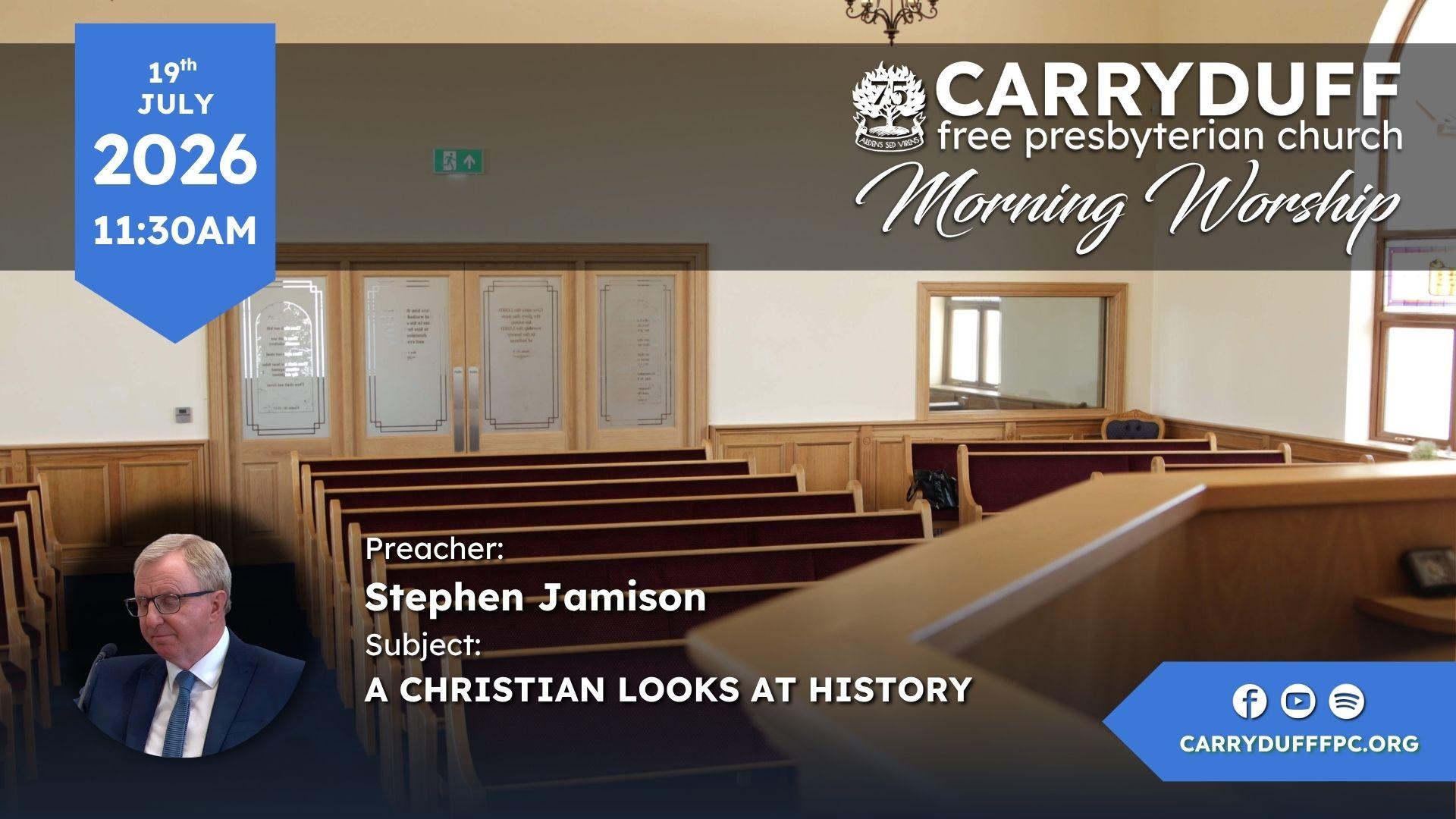

Date: SUN 11:30am 19th July 2026
Preacher: Stephen Jamison
Bible Reference: Acts 7
Podcast
Sermon Summary
Introduction: The Occasion and the Text
The sermon is based on Acts 7:1–29, in which Stephen stands before the Jewish court—the Sanhedrin—to give his defence against accusations levelled against him. The preacher notes that this chapter is one of many portions of Scripture, both Old and New Testament, that sets forth history. In Stephen’s case, it is the history of the Jewish nation and the Hebrew people, stretching from the call of Abraham through to Solomon and, by prophetic reference, even beyond to the Babylonian exile.
This becomes the springboard for the central question of the sermon: How should a Christian look at history? Not only Jewish history, but all history—personal history, national history, and world history. The preacher proposes to answer this by drawing out four governing principles from the text, principles that ought to shape the believer’s understanding of everything that unfolds in time.
First Principle: The Sovereignty of God Over All History
The sermon’s first and most foundational heading is drawn from Acts 7:2, where Stephen begins his address with the words:
“The God of glory appeared unto our father Abraham.”
The preacher seizes on that phrase, the God of glory appeared, and identifies it as the first principle of all true history: God is the one who rules over all.
God’s Sovereignty Declared
There are times, the preacher concedes, when personal circumstances and world events seem utterly confused—when we can make neither head nor tail of what is going on. Yet the believer must hold fast to this truth: the God of glory appeared, and He is sovereign. There is none equal to Him, and certainly none above Him. Quoting Isaiah, the preacher reminds the congregation that God “sitteth upon the circle of the earth” and that “the inhabitants thereof are as grasshoppers.” The nations, in His sight, are as “a drop in a bucket.”
Stephen’s history lesson begins with a divine act—God’s unilateral, unsolicited appearance to Abraham in Mesopotamia. That single act, thousands of years ago, set in motion a chain of consequences that reaches right down to the very day the congregation is gathered in their meeting house. The preacher’s point is plain: history is not a random sequence of events but the outworking of a sovereign divine will.
Scriptural Support for Sovereignty
To buttress this claim, the preacher takes the congregation on a brief tour of Scripture:
- Psalm 135:6 — “Whatsoever the Lord pleased, that did he in heaven, and in earth, and in the seas, and all deep places.” The preacher observes that what pleases the Lord may not please many others, but that is immaterial. What pleases Him, He does.
- Daniel 4:34–35 — Nebuchadnezzar, the pagan king, learned this truth through humbling affliction. After being reduced to the condition of a beast, he lifted his eyes to heaven and confessed that God’s “dominion is an everlasting dominion” and that “none can stay his hand, or say unto him, What doest thou?” The preacher remarks that it would be a great thing if kings, presidents, and prime ministers—including the one about to enter Downing Street the following day—would likewise recognise that they are accountable to the God of heaven.
- Ephesians 1:11 — The Apostle Paul writes that believers have been “predestinated according to the purpose of him who worketh all things after the counsel of his own will.” The preacher underscores the comprehensive scope of that phrase, all things.
God’s Providence and Timing
The preacher then invokes the language of the Larger Catechism, defining God’s works of providence as “his most holy, wise, and powerful preserving and governing all his creatures, ordering them and all their actions to his own glory.” This extends to mighty matters and minute ones alike: “a river turns at the behest of God.”
He contrasts this with the unbelieving mind, which sees only nature and natural processes. The example given is Sir David Attenborough, who—despite decades of studying the natural world—has not, by the preacher’s reckoning, perceived the God behind it.
Returning to Acts 7, the preacher draws attention to the repeated time-markers in the chapter:
- Verse 6: the 400 years of bondage
- Verse 17: “when the time of the promise drew nigh”
- Verse 20: the three months Moses was hidden
- Verse 23: “when he was full forty years old”
- Verse 30: “when forty years were expired”
These are not incidental details. They demonstrate that God has His own appointed times—times that draw nigh in personal life, in national life, and in the life of the world. There is a providential rule, an ordering, a divine timetable. The preacher’s own conversion in 1977, when “the God of glory appeared” to a seventeen-year-old lad in Newtownards who had not been brought up in a Christian home, serves as a personal illustration of the same principle.
The Inscrutable Will of God
The preacher then draws a vital distinction from Deuteronomy 29:29: “The secret things belong unto the Lord our God: but those things which are revealed belong unto us and to our children for ever, that we may do all the words of this law.”
The application is practical. There are matters in God’s will that are inscrutable—beyond our capacity to enter into, not revealed in Scripture, and therefore not our business. The preacher confesses that this verse taught him not to lie awake at night worrying about such things. Using an illustration from his forty years as a postman, he compares the inscrutable will of God to a sign reading “Beware of the dog—enter at your own risk.” Such signs, which he encountered many times (and was bitten more than once, along with being attacked by a goat and chased by geese), are there for a reason. God has posted a sign over His secret counsels: do not go there. Instead, the believer is to occupy himself with what God has revealed, which is more than enough for a lifetime of study.
Second Principle: The Fall and Human Sin Mark All History
The second major heading arises from Acts 7:39–43, where Stephen recounts the idolatry of the Israelites at Mount Sinai. While Moses was on the mount receiving the law, the people demanded that Aaron make them gods to go before them. They made a golden calf, offered sacrifice to the idol, and “rejoiced in the works of their own hands.” Stephen goes further, quoting the prophets to indict them for taking up “the tabernacle of Moloch” and “the star of your god Remphan.”
The preacher’s point is stark: all history is marked by the fall and by human sin. And behind human sin stands a personal devil and demonic activity, both of which the Bible plainly teaches and the preacher unhesitatingly affirms.
The Irony of Redeemed People Sinning
What makes the episode in Acts 7 so striking is that these were the very people redeemed by the blood of the Passover lamb out of Egypt. The preacher draws the obvious moral: “Let him that thinketh he standeth take heed lest he fall.” As Christians survey history—the history of the nations and the history of the church—they must reckon honestly with human sin. It is, the preacher says, a marvel that God can overrule it at all, yet He does so constantly.
A Personal Confession
The preacher turns the lens on himself: “I am aware of myself, and if I weren’t kept by God, I wouldn’t be kept.” The only explanation for his continuance in the faith is the keeping power of God through faith unto salvation. This is not false modesty but a sober application of the principle he is expounding.
The Demonic in History
The preacher introduces what he calls a “maybe controversial” observation, drawn from a documentary series on the Second World War (twenty episodes, produced in part by Tom Hanks, which he warmly recommends to those who cannot manage the weighty tomes on the subject). He is careful to preface his remarks: he is not speaking about the German and Japanese peoples of today. But in the history of that conflict, something more than ordinary human ambition was at work.
He quotes Martyn Lloyd-Jones, who in his sermons on Ephesians contrasted Napoleon with Hitler. Napoleon, Lloyd-Jones argued, was a great military mind, but Hitler had something of the demonic about him. When men set themselves up to be worshipped—as the Japanese Emperor was held to be divine—that is demonic in character. The preacher cites the atrocities committed by both nations: what the Nazis did to the Jews, what the Japanese did to the Chinese. These were not merely political or military acts; they were manifestations of human sin and satanic activity.
The origin of all this lies in Genesis 3, when our first parents disobeyed God, ate the forbidden fruit, and broke His holy law. That fall has left its mark on all subsequent history. And yet, the preacher insists, the wonder is that Almighty God can overrule all of it and bring everything to its appointed end.
Third Principle: Divine Intervention Throughout History
Though not presented as a separate numbered heading in the same way, the theme of divine intervention runs throughout the sermon and is drawn explicitly from the narrative of Acts 7. The preacher traces how God worked in and through successive individuals:
- Abraham — called out of Mesopotamia
- Joseph — sold into Egypt by envious brothers, yet God was with him and raised him to governorship
- Moses — preserved in infancy, learned in all the wisdom of the Egyptians, called at forty, then prepared for another forty years in Midian
- Joshua, David, Solomon — each a link in the chain of God’s purposes
God intervenes. That is the thread running through Stephen’s speech and through all history.
Two Kinds of Divine Intervention
The preacher identifies two primary forms divine intervention takes:
- God intervenes to deliver. His example is the evacuation of Dunkirk. Nearly 400,000 men of the British, French, and Belgian armies were trapped, being bombed from the air, with the Nazi army closing in. Had they been wiped out, Britain would have been left without an army. The Royal Navy vessels could not get close enough to shore because of the sandbanks, and the soldiers had to wade far out to reach them. A call went out for every small vessel—fishing boats, pleasure craft—to cross the Channel. The hope was to lift 30,000 men. In the end, 338,000 were brought home. The preacher’s verdict: that is divine intervention in my book.
- God intervenes to judge. This is the sobering counterpart. The preacher expresses his great fear that the nation is presently “flying in the face of God.” His specific illustration is abortion—”murdering children in the womb.” He points out the tragic irony: on one hand, thousands of children are killed in the womb; on the other, the nation laments a shortage of nurses, doctors, and surgeons. How many of those killed, he asks, could have filled those roles? It is, he says, a mark of human foolishness.
Fourth Principle: The Faithfulness of God
The final principle is drawn from the way Stephen’s speech begins and ends. It begins in verse 2 with “the God of glory appeared,” and it concludes in verses 54–56 with Stephen, “being full of the Holy Ghost,” looking steadfastly into heaven and seeing “the glory of God, and Jesus standing on the right hand of God.”
The bookends are deliberate: it started with the God of glory, and it ends with the glory of God. Through all human sin, through all satanic activity, through all the twists and turns of history, God is faithful.
Faithful to His Word
God is faithful to His word and His promises. He is faithful to His people. He brings all things to pass. The preacher acknowledges that he does not know why Donald Trump is president of the United States, why Putin is president of Russia, why Zelensky is president of Ukraine, or why Andy Burnham is about to become prime minister. But he knows this: God has a reason and a purpose for it all.
The Unchanging God
The attributes of God that have been traced through the sermon—sovereignty, providence, the power to intervene—are not relics of the biblical past. The preacher insists that the God who intervened in history can intervene today. He can send a great awakening. To those who despair at the state of society, he points to England before the Evangelical Awakening of the eighteenth century: drunkenness, immorality, and godlessness were rampant. Then the breath of God came through the preaching of the Wesleys and Whitefield, and the landscape was transformed.
Conclusion: History Is His Story
The sermon closes with a simple, memorable phrase: “History is His story.” The believer does not always understand it—more likely than not, he does not understand it—but God is God. He is immutable, He never changes, He is sovereign, He is the God of providence, and He is the God of interventions.
The God of glory appeared to Abraham. The God of glory appeared to Stephen at the moment of his martyrdom. And the God of glory, the preacher implies, is the God whose hand is upon every page of history, including the page being written today.