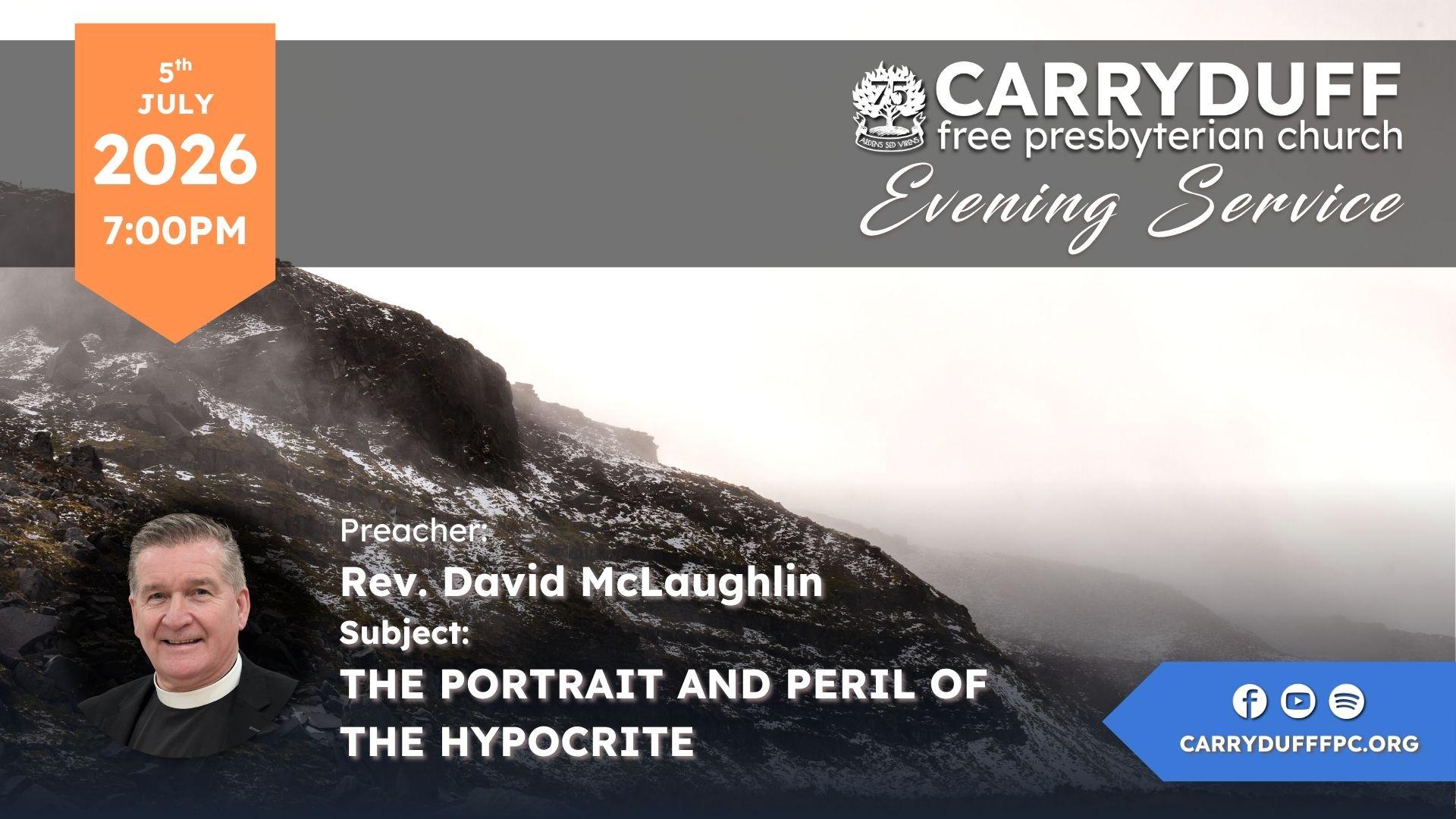

Date: SUN 7:00pm 5th July 2026
Preacher: Rev. David McLaughlin
Bible Reference: Job 8:13
Podcast
Sermon Summary
Introduction
The sermon takes as its text Job 8:13: “So are the paths of all that forget God, and the hypocrite’s hope shall perish.” The preacher acknowledges at the outset that some subjects in Scripture fill the heart with holy joy, whilst others fill it with holy dread. This text belongs to the latter category — it stands as a deadly warning to awaken the soul, coming with all the weight and authority of the living God.
The message is structured around four main observations drawn from the text:
- The person described — the hypocrite
- The premise discerned — the hypocrite’s hope
- The peril decreed — that hope shall perish
- The path displayed — forgetting God
Context: Bildad’s Mistaken Application, Yet True Principle
The words of Job 8:13 were spoken by Bildad the Shuhite, one of Job’s three comforters. The preacher is careful to note that Bildad was mistakenly applying these words to Job. Job was no hypocrite; Scripture itself declares in Job 1:1 that there was none like him in all the earth — a perfect (meaning fully committed, not sinless) and upright man who feared God and hated evil. Bildad wrongly assumed that Job’s suffering proved he was a secret sinner.
Yet whilst Bildad’s application was false, the principle he stated is true. The Holy Spirit preserved these words because they express an abiding biblical truth. Job himself echoes the sentiment in Job 27:8: “For what is the hope of the hypocrite, though he hath gained, when God taketh away his soul?” Scripture never contradicts itself. From Genesis to Revelation, false religion — every false cult, every false church — is exposed, rejected, and ends in destruction. And what is true of false religion corporately is true of the false professor individually.
The Person Described: The Hypocrite
The Meaning of the Word
The English word “hypocrite” derives from a Greek term meaning an actor upon a stage. In ancient theatres, actors wore masks that hid their true faces. They appeared to be something they were not. This is precisely what a hypocrite is: one who wears a spiritual mask.
Outwardly, the hypocrite appears:
- Religious
- Respectable
- Moral
- Zealous
- Pious
He attends church on Sunday, carries his Bible, talks a good talk, and puts on a great outward show. But inwardly he is unchanged. He has no new heart. He possesses “a form of godliness but denies the power thereof.” There is such a thing as:
- Religion without regeneration
- Profession without possession
- Respectability without reality
What a Hypocrite Is Not
The preacher draws a crucial distinction. A hypocrite is not a true Christian who falls into a particular sin. All believers sin in thought, word, and deed. The true Christian recognises his sin and grieves over it.
Biblical examples are offered:
- Noah became drunk
- Abraham lied about Sarah on multiple occasions
- David committed terrible sins against God
- Peter denied the Lord with cursing
Yet these men were heaven’s men — men of faith, not hypocrites in the biblical sense. Their sins were real and shameful, but they hated those sins, confessed them, mourned them, repented of them, and were restored by God’s grace.
The Contrast
The hypocrite, by contrast, lives a lie. His entire religion is about keeping up appearances. He might:
- Occasionally speak of Christ
- Pray eloquent prayers in the prayer meeting
- Stand in the pulpit and give testimony
- Attend every service
- Defend sound doctrine
- Say all the right things
And yet never be born again, never having received a new heart.
Christ’s Strongest Condemnations
The preacher notes a striking fact: the strongest condemnations the Lord Jesus ever uttered were not directed at harlots, drunkards, or the hated Roman soldiers, but at religious hypocrites. In Matthew 23, Christ pronounced seven woes beginning with “Woe unto you, scribes and Pharisees, hypocrites.”
Why such severe language? Because hypocrisy:
- Dishonours God whilst pretending to honour Him
- Is rebellion dressed in religious clothes
- Is the spirit of unbelief wearing the garment of faith
The scribes and Pharisees prayed in public, fasted twice weekly, tithed meticulously, knew the Scriptures, and were admired by the people. If anyone appeared to be on the road to heaven, it was they. Yet Christ declared in Matthew 5:20: “Except your righteousness shall exceed the righteousness of the scribes and Pharisees, ye shall in no case enter into the kingdom of heaven.”
Why? Because they had religion but not regeneration, profession without possession, respectability without reality. Their hearts were unchanged. Christ likened them to “whited sepulchres, which indeed appear beautiful outward, but are within full of dead men’s bones, and of all uncleanness” (Matthew 23:27).
Hypocrisy in Every Age
This problem is not confined to the first century. It is alive and well wherever the gospel is preached:
- There was a Judas among the twelve — none suspected him until the very end
- There was an Ananias and Sapphira in the early church (Acts 5)
- There was a Simon Magus in Acts 8
The visible church has always contained wheat and tares growing together. Even in a Christian home — a tremendous privilege — an individual may sit under faithful preaching, contend for the Protestant Reformed faith, love the doctrines of grace intellectually, and yet remain unregenerate, with a heart untouched by the grace and power of God.
It is not orthodoxy that saves. The devil himself possesses orthodoxy — he believes in God and is more intelligent than any atheist or agnostic — yet the devil is not saved. Saving faith is a gift of God, a faith that rests alone on Christ for salvation. The call of 2 Corinthians 13:5 is to “examine yourselves, whether ye be in the faith” — to conduct a careful inspection of one’s own life, beliefs, actions, and habits, seeking evidence of a visible and vocal transformation.
Varieties of Hypocrites
The preacher identifies several distinct categories of hypocrites:
1. The Religious Hypocrite
This individual mistakes outward connection to religion for inward possession of Christ. He talks about his baptism, his confirmation, his catechism — all wonderful privileges, yet none of them are the Saviour. Simon Magus believed and was baptised, yet Peter told him, “Thine heart is not right in the sight of God.” A man may be baptised and sit at the Lord’s table and still not be a true Christian.
2. The Reckless Hypocrite
This is the deliberate, knowing pretender. Judas Iscariot belonged to this class. For three and a half years he secretly loved money, not the Master; silver, not the Saviour. The preacher references Dr. Paisley’s sermon depicting Judas kissing the door of heaven whilst already destined for torment in hell.
3. The Righteous (Self-Deceived) Hypocrite
This individual is not born again because he mistakes his religious activity for real spiritual life. He has never experienced true conviction of sin or true conversion to the Saviour. On the last day, he will be found out.
4. The Respectable Hypocrite
This man’s confidence rests on his morality. He has avoided scandalous sins and thinks himself safe. The Pharisee in Luke 18:11-12 is the archetype — he thanked God he was not like other men (extortioners, the unjust, adulterers) and listed his religious credentials (fasting twice weekly, tithing). Yet he did not go home justified. His fatal flaw: he never saw himself as a sinner in need of Christ’s righteousness by faith.
5. The Rehearsed Hypocrite
This individual sits in a faithful gospel-preaching church, understands and can defend the doctrines of grace — election, justification by faith alone, the sovereignty of God — yet has never fled to the cross. His head is full of doctrine, but he has no new heart. He mistakes theological knowledge for true conversion and has never been truly humbled by the truth he claims to believe.
The Common Mark
Across all these varieties, the mark is the same: their heart loves something more than Christ. They want the blessing and benefit of true religion but know nothing of the new birth, the new life, the behaviour that flows from being found in Christ. They want:
- Heaven without holiness
- Remission of sins without repentance
- Christ as a friend, but not as Lord and Saviour
They wear the badge of being a Christian but bear nothing of the true cross.
The Premise Discerned: The Hypocrite’s Hope
The hypocrite possesses a false hope. It is entirely possible for a man or woman to be wholly confident they are right whilst being entirely wrong about their soul’s salvation. Proverbs 14:12 (repeated in Proverbs 16:25) states: “There is a way that seemeth right unto a man, but the end thereof are the ways of death.”
This false hope:
- Keeps the hypocrite perfectly calm
- Causes him to expect that all will be well in the end
- Leads him to anticipate heaven
- Persuades him that God will receive him
Yet it is built on a false foundation.
Categories of False Hope
The false hope of outward religion. A man believes he is safe because he is connected to the church, carries a Bible, attends worship, participates in ordinances, and speaks the language of Scripture — yet his heart is far from God (Matthew 15:8). Outward nearness to religion is not the same as union with Christ.
The false hope of personal morality. The respectable man who is honest in business, faithful in family duties, and generous to others — yet has never seen his righteousness as filthy rags in God’s sight (Romans 3:10: “There is none righteous, no, not one”). He trusts in his moral record, never having seen himself as a sinner.
The false hope of doctrinal knowledge. Many in Ulster understand and can defend Reformed doctrine, yet knowledge of the truth is not the same as possession of or submission to the truth. Religious learning is not saving knowledge.
The false hope of religious experience. Some rest in emotional moments, past convictions, or a decision made at a meeting. Like the stony ground hearer, they received the Word with joy but had no root, and when trial arose they withered away. They point to a past prayer or a past feeling, but the present reality shows no spiritual fruit.
The false hope of future repentance. The hypocrite does not deny the need for repentance — he simply postpones it. “Someday I’ll get right with God.” Yet Proverbs 27:1 warns: “Boast not thyself of tomorrow, for thou knowest not what a day may bring forth.”
The Peril Decreed: The Hypocrite’s Hope Shall Perish
This is the most sobering element of the text. The hypocrite does not abandon his hope — he carries it in his heart until the very day and hour of his death. He believes he is safe and may die in that belief, surrounded by religion, prayers, and assurances. But death has no respect for false confidence; in the day of death, it removes the mask.
The word “perish” carries finality that cannot be softened. It is not that the hope fades, becomes uncertain, or weakens — it perishes. It is the language of complete destruction. Something that once seemed strong, appeared reliable, and gave comfort is found at the end to be utterly worthless. It was strong enough for earth but not strong enough for eternity.
Proverbs 11:7 states: “When a wicked man dieth, his expectation shall perish.” That expectation is confident, settled, a firm persuasion — and yet it perishes. In the day his breath goes forth, his thoughts perish, because they were built on everything but Christ.
The Parable of the Two Builders (Matthew 7)
The Lord Jesus spoke of two men who built houses — one on solid rock, the other on sand. Both houses appeared lovely whilst the sun shone. The storm did not create the difference; it merely revealed it. The house on the rock stood firm; the house on the sand fell, and “great was the fall of it.”
The hypocrite’s house is like the house built on sand. It looks stable until the test comes — and the test is not merely suffering in this life, but the hour of death and the day of judgment.
The Surprise of the Rejected (Matthew 7:21-23)
The sermon’s most striking warning comes from Christ’s own words:
- “Not every one that saith unto me, Lord, Lord, shall enter into the kingdom of heaven.”
- Many will argue on that day: “Lord, Lord, have we not prophesied in thy name? and in thy name have cast out devils? and in thy name done many wonderful works?”
- Christ’s devastating reply: “I never knew you: depart from me, ye that work iniquity.”
These were not irreligious people. They were active in the work, gifted, and confident in their arguments. They were surprised — they were not expecting rejection. Yet their false hope perished.
The hypocrite is not losing his salvation; he never had it. He never knew the joy of God’s salvation. He was not regenerate. He thought he possessed true saving faith, but it was a counterfeit, a substitute faith, a spiritual illusion that dissolved when confronted with the reality of death.
The Path Displayed: Forgetting God
The text begins: “So are the paths of all that forget God.” Those who forget God are ignorant of Him and indifferent to Him. Their hope perished not because it was weak, but because it was built on a false foundation. They had not:
- Received Christ as Lord and Redeemer
- Been regenerated
- Received a new heart
- Renounced their own self-righteousness
Many speak of Christ and yet lean on their own righteousness. Many in Ulster have forgotten God, forsaken Him, left Him out of their lives, and are filled with an anti-God spirit.
The Alternative: Finding God
The opposite of forgetting God is finding Him. And where is God found? At the cross, through the Lord Jesus Christ, when one kneels and cries out like the publican: “God be merciful to me the sinner.”
The preacher closes with the solemn words of Hebrews 9:27: “It is appointed unto men once to die, but after this the judgment.” The question pressed upon the hearer is stark: How will you fare in that day of death? Will you be rejected or received?