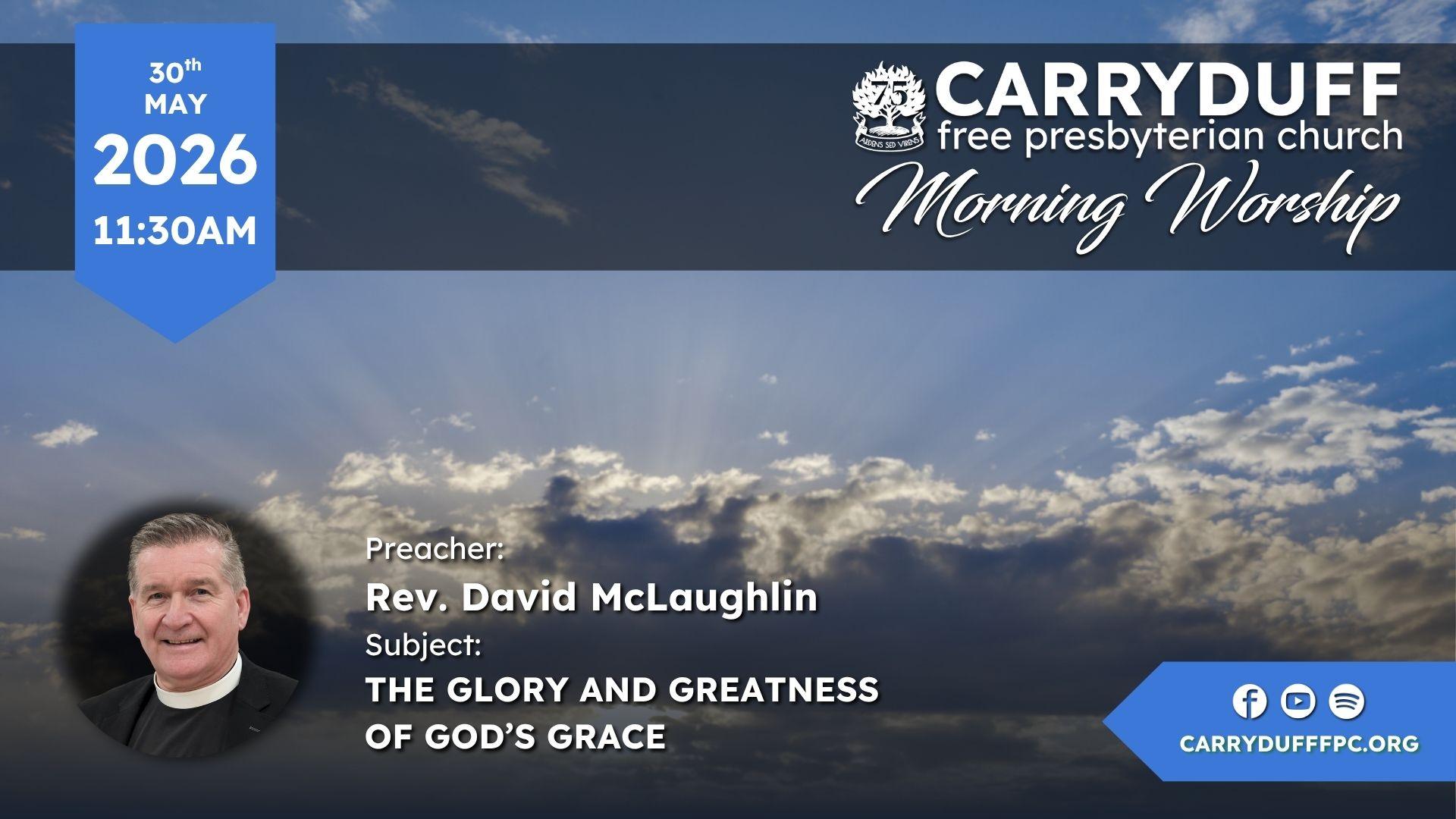

Date: SUN 11:30am 31st May 2026
Preacher: Rev. David McLaughlin
Bible Reference: 1 Thessalonians 5:28
Podcast
Sermon Summary
The Glory and Greatness of God’s Grace: A Summary of a Reformed Sermon on 1 Thessalonians 5:28
Introduction and Context
This sermon, the final instalment in an expository series through Paul’s first epistle to the Thessalonians, takes as its text the closing verse of the letter: “The grace of our Lord Jesus Christ be with you all. Amen.” (1 Thessalonians 5:28). The preacher sets out to expound what he terms “the glory and the greatness of God’s grace,” drawing together the themes of the entire epistle and presenting grace as the foundational reality of the Christian life from beginning to end.
The sermon situates itself within the context of a young, persecuted church. The Thessalonian believers faced significant opposition and carried deep questions about suffering, sanctification, church order, holiness of life, and the second coming of Christ. Throughout his letter, Paul addresses each of these concerns with pastoral care and doctrinal clarity. Yet, as the preacher observes, when Paul reaches his concluding words, he does not simply bid them farewell or offer a casual parting remark. Instead, he leaves them under what the preacher calls “the canopy of God’s grace.”
The immediate context of verse 28 is significant. Paul has just delivered a series of lofty, demanding commands: rejoice evermore, pray without ceasing, in everything give thanks, quench not the Spirit, despise not prophesying, prove all things, hold fast that which is good, abstain from all appearance of evil. These are, in the preacher’s words, “right and royal” commands—high, holy, and humanly impossible to fulfil in one’s own strength. The natural question arises: who is sufficient for these things? How can weak, fallible believers possibly live up to such a standard?
The answer, Paul declares, is found in the final verse. The epistle ends where the Christian life begins and is sustained: the amazing grace of God. The preacher emphasises that the Christian life is not sustained by human strength, natural ability, religious effort, or fleshly determination. It begins and continues solely by grace. Paul’s farewell is therefore not merely polite; it is a genuine, biblical benediction—a prayerful desire that the same grace which brought the Thessalonians into salvation would sustain them until glory.
The sermon is structured around three principal headings: the salutation that is addressed, the specifics that are announced, and the subject that is applied.
The Salutation That Is Addressed
The Person: Christ, the Fountainhead of Grace
The preacher begins by examining the precise wording of Paul’s benediction. He notes that Paul does not simply say “grace be with you” in an abstract or impersonal sense. He says, pointedly, “the grace of our Lord Jesus Christ.” This is deliberate and theologically weighty. Grace is not a mere doctrine, a disposition, a noble title, a musical note, or even a girl’s name—it is a declaration that flows from a Person. That Person is the Lord Jesus Christ.
Drawing from John 1:14 and John 1:16-17, the preacher establishes that Christ is described as being “full of grace and truth,” and that “of his fullness have all we received, and grace for grace.” The law came through Moses, but grace and truth came through Jesus Christ. Every stream of grace—whether sovereign, saving, sanctifying, serving, strengthening, sustaining, or succouring—flows from Christ alone. He is not merely a messenger of grace; He is the true Mediator of grace.
At this point, the preacher issues a sharp polemic against Roman Catholic sacramental theology. He rejects the doctrine of ex opere operato (Latin for “by virtue of the act”), which teaches that grace is dispensed through the sacraments by the very performance of the rite. The Pope is not the dispenser of grace, nor is the institutional church. There is only one source of true grace, and that is the Lord Jesus Christ alone.
The preacher employs a vivid illustration: imagine a village entirely dependent upon a single mountain spring. Every home receives its water from this one source. If the spring were to cease, the whole village would perish. So it is spiritually. Every blessing—pardon for sin, peace with God, perseverance in hardship, purity of heart and mind, power to live the Christian life—comes from this one fountainhead. He quotes John Calvin, who wrote in the Institutes that “Christ is the perpetual fountain from which all grace flows.” Grace is not an abstract force; it is communicated only through union with Christ.
The Provision: The Sovereign Saving Grace of God
The preacher then turns to the definite article: “the grace.” He argues that the Bible, from Genesis to Revelation, is fundamentally a book about the wonderful grace of God. He traces this thread through redemptive history:
- Sovereign grace planned salvation in the eternal council chambers of the Trinity before the world began.
- Grace uttered the first gospel promise of a Redeemer after the fall of Adam and Eve.
- Grace preserved Noah in the ark during the flood.
- Grace effectually called Abraham out of Ur of the Chaldees, away from idolatry, into a land flowing with milk and honey.
- Grace restored David after his grievous fall with Bathsheba.
- Grace restored Peter after his denial of Christ with oaths and cursings.
- Grace saved Saul of Tarsus on the Damascus Road.
- That same grace saved every believer who has ever lived.
The whole history of redemption is the history of the sovereign saving grace of God. When Paul writes “the grace of,” he is thinking primarily of this sovereign, saving grace.
The Principle: Undeserved, Unmerited Favour
What is grace? The preacher acknowledges the well-known acrostic—God’s Riches At Christ’s Expense—but insists there is more to it. Grace is the undeserved, unmerited favour of God towards wicked sinners and lawbreakers. It is not merited; it cannot be earned or worked for. Grace is God giving us what we do not deserve. What do we deserve? Wrath, eternal punishment, hell, and the lake of fire. In His free, sovereign, saving grace, God did not give us what we deserve. What did He give? He gave Christ.
Ephesians 2:8-9 is cited as the definitive statement: “For by grace are ye saved through faith; and that not of yourselves: it is the gift of God: not of works, lest any man should boast.” Salvation is not by works of righteousness, religious ceremonies, outward morality, or institutional association. It is all of God and all of grace. Jonah 2:9 is quoted—“Salvation is of the Lord”—a text inscribed behind the pulpit from which the sermon is delivered.
The preacher makes a crucial theological point about the order of salvation: the dead sinner must be regenerated, born again, before faith can be exercised. Regeneration comes first; faith follows. God in grace bestows His favour, shown in Christ, to spiritually resurrect the sinner. Only then does the sinner exercise faith. This is the classic Reformed ordo salutis: regeneration precedes faith.
Martin Luther’s fierce opposition to any notion of merited salvation is invoked. The Reformation solas are affirmed: salvation is by grace alone, through faith alone, in Christ alone, as revealed in Scripture alone, to the glory of God alone.
The Power: Grace That Transforms
Grace is not merely a theological concept; it is a transforming power. The Thessalonians themselves were trophies of grace. In 1 Thessalonians 1:9-10, we read that they turned from idols, served the living and true God, and waited for His Son from heaven. Only grace can effect such a transformation.
The preacher provides several biblical and historical examples:
- The thief on the cross: A dying criminal with no time for works, religious achievements, reformation, or church membership. He simply looked to Christ and said, “Lord, remember me when thou comest into thy kingdom.” The response was immediate: “Today shalt thou be with me in paradise.”
- The woman taken in adultery (John 8): Christ asked, “Where are thy accusers?” She replied, “I have none.” He said, “Neither do I condemn thee: go, and sin no more.”
- Saul of Tarsus: A blasphemer, persecutor, and violent enemy of Christ. Grace arrested him on the Damascus Road and transformed him utterly.
- John Newton: The slave trader who lived a wicked, rebellious life, cursing God. In a storm at sea, sovereign grace transformed him—not merely pardoning him but making him a preacher of the gospel.
Grace, the preacher concludes, specialises in sovereignly saving the undeserving.
The Specifics That Are Announced
If Jesus Christ is the fountainhead of all grace, then true, Bible-believing Christianity is unique among all religions. Neither Buddhism, Judaism, nor Islam is dependent solely upon the sovereign, saving grace of God. The preacher then unpacks several specific dimensions of grace.
Sovereign Grace and Salvation
God takes the initiative. He acts upon the unworthy, undeserving sinner. He sees nothing in the sinner to love; there is no spark of goodness that motivates or moves Him. Grace simply comes and arrests the soul. This is the doctrine of unconditional election and effectual calling.
Saving Grace
Though acknowledged as a vast subject worthy of its own sermon, saving grace is the grace that actually redeems. It is the application of Christ’s finished work to the individual sinner, bringing them from death to life.
Sanctifying Grace
Drawing on the language of verse 23—“And the very God of peace sanctify you wholly”—the preacher distinguishes between justification and sanctification. Quoting the Westminster Shorter Catechism, he notes that justification is an act of God’s free grace whereby He pardons all our sins and accepts us as righteous in His sight, only for the righteousness of Christ imputed to us and received by faith alone. Sanctification, by contrast, is the work of God’s free grace whereby we are renewed in the whole man after the image of God and are enabled more and more to die unto sin and live unto righteousness.
Justification is instantaneous; sanctification is progressive. Grace teaches us to say no to sin, to deny ungodliness, to resist temptation, and to pursue holiness. Titus 2:11-13 is quoted: “For the grace of God that bringeth salvation hath appeared to all men, teaching us that, denying ungodliness and worldly lusts, we should live soberly, righteously, and godly, in this present world.”
The preacher uses the image of a sculptor chipping away at rough marble until the beauty of the intended form appears. Sanctifying grace chips away at the believer, conforming them to the image of Christ—a painful, slow, often barely perceptible process. He quotes Calvin again: “Christ justifies no man whom he does not also sanctify.” Saving grace always manifests itself in sanctifying grace.
Succouring Grace
The word “succour” means to help in time of need. Believers constantly require helping grace. The Thessalonian church faced opposition and affliction; believers today face discouragement, temptation, unanswered prayer, bereavement, loneliness, and spiritual warfare. But there is grace for all of it.
Hebrews 4:16 is the key text: “Let us therefore come boldly unto the throne of grace, that we may obtain mercy, and find grace to help in time of need.” Paul himself experienced the thorn in the flesh and prayed for its removal. God said no, and gave instead this assurance: “My grace is sufficient for thee” (2 Corinthians 12:9).
To the weary, defeated, depressed, guilty believer, the preacher offers this message: there is a supply of grace that can never be exhausted, a supply that can never run dry. Christ, the Mediator of grace, possesses an infinite, non-limited fullness. He is full of grace and truth. His mercy, compassion, strength, and forgiveness cannot be depleted. John Bunyan, the old Baptist preacher from Bedford, is quoted: “There’s enough grace in Christ for ten thousand worlds, never mind just our world.”
The Subject That Is Applied
The preacher now moves from exposition to application, emphasising that Paul’s benediction is not merely a theological statement but something deeply personal and experimental—something for the hearer to take home in the here and now.
The grace of our Lord Jesus Christ is to be with the believer in every sphere of life:
- In the home: for mothers caring for babies, doing housework and dishes—hard work that requires grace.
- In the workplace: for the lone Christian facing mockery and insincere questions from colleagues.
- In the face of temptation: when the believer is tempted to sin against God, Christ, and conscience.
- In the face of persecution: when threatened with violence for praying, testifying, or reading the Bible.
- In suffering: when the body is racked with pain and the mind is overwhelmed.
- In worship: in the house of God.
- In the hour of death.
The Christian life begins by grace and finishes by grace. Philippians 1:6 is cited: “Being confident of this very thing, that he which hath begun a good work in you will perform it until the day of Jesus Christ.” That good work began on the basis of grace alone, and by grace alone it will be completed.
The preacher then presses the point further: this is not merely about receiving gifts from Christ but about Christ Himself being with His people. The believer has the assurance that Jesus is always present. He has promised, “Lo, I am with you always” (Matthew 28:20). From morning until night, and through the night, He watches over His own. He neither slumbers nor sleeps. The believer, adopted into God’s family, can sing, “I am His. This is my story, this is my song, this is my Saviour all the day long.”
The Amen
The sermon closes by focusing on the final word: “Amen.” This is not a mere formality, nor simply a signal that the sermon or letter has ended. “Amen” means so shall it be. Paul leaves this young, persecuted church not with earthly wealth, worldly ease, political power, or religious prestige, but with the greatest treasure imaginable: the grace of our Lord Jesus Christ.
The preacher applies this directly to the congregation:
- Do you need to be saved? Do you need to be brought to repentance and faith? It starts with sovereign grace that leads to saving grace.
- Do you need to be restored? Are you cold and backslidden in heart?
- Do you need to be strengthened because of trials and troubles?
- Do you need to be sanctified and separated unto Christ?
- Do you need to be sustained?
All of this, and much more, is found in Christ alone. He is the fountainhead. The invitation is urgent: come to Him, rest in Him, draw off His fullness. The Christian life is not one of self-sufficiency but of continual dependency upon the grace of our Lord Jesus Christ. That is the wellspring. That is the message. Jesus Christ is full of grace.
The sermon ends with a searching question: Have you come to Him? Have you received Him? Are you resting in Him? For only in Him—so shall it be. The benediction is at once a prayer, a promise, and a proclamation. May the grace of our Lord Jesus Christ be with you all. Amen.