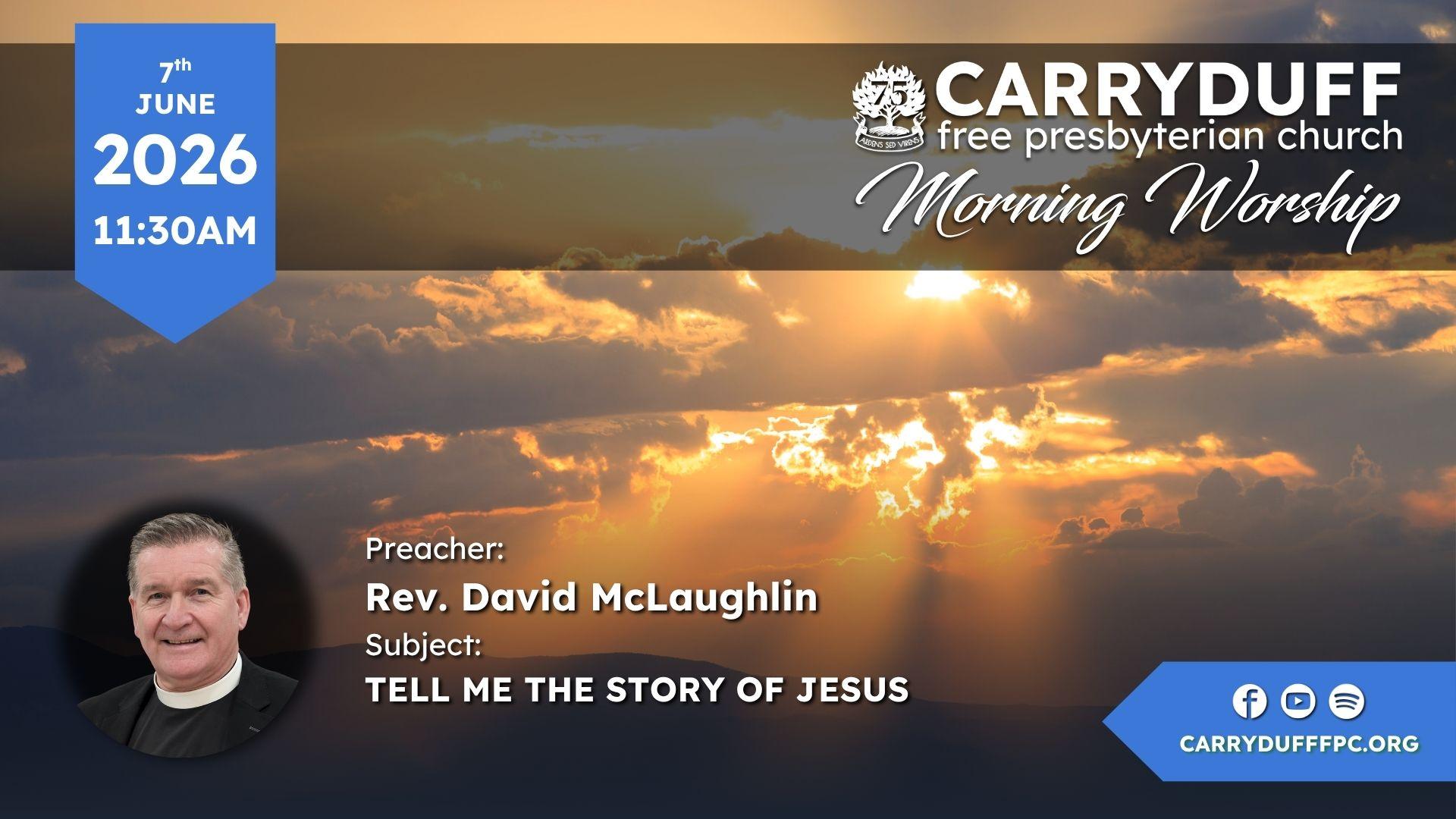

Date: SUN 11:30am 7th June 2026
Preacher: Rev. David McLaughlin
Bible Reference: John 21:24-25
Podcast
Sermon Summary
Introduction and Context
The sermon is based on the final two verses of John’s Gospel, John 21:24–25, which read (in the King James Version):
“This is the disciple which testifieth of these things, and wrote these things: and we know that his testimony is true. And there are also many other things which Jesus did, the which, if they should be written every one, I suppose that even the world itself could not contain the books that should be written. Amen.”
The preacher takes as his theme the phrase “Tell Me the Story of Jesus,” drawn from the well-known hymn written by Fanny Crosby in 1880, with music composed by her friend John Sweeney. The hymn, he explains, was not the product of theological debate or doctrinal dispute, but was born from a simple request made by a sick child who said to Crosby, “Tell me the story of Jesus.” That child’s plea—for comfort, for truth, for the old, old story—became the seed of a hymn that has echoed down through generations.
The preacher uses this background to frame the entire message: in a world saturated with information, competing voices, novel philosophies, and false religions, the deepest need of the human soul remains unchanged. It is the need to hear, receive, and be transformed by the factual, foundational story of Jesus Christ.
The News of the Story: It Is Factual
The first major section of the sermon addresses the question that must be asked of any story: Is it real? Is it true?
The preacher directly confronts the claim, once found in an old Russian dictionary, that Jesus Christ was a mythical figure who never existed. He dismisses this as “a big fat lie” and notes that no serious historian today would maintain such a position.
Internal Evidence: The Biblical Record
The Gospels, he argues, are not works of fiction but careful historical accounts. He cites two passages in particular:
- Luke 1:1–4 — Luke, a physician, writes to Theophilus “that thou mightest know the certainty of those things, wherein thou hast been instructed.” Luke explicitly states that he has “had perfect understanding of all things from the very first” and that his account is based on what was “delivered unto us” by “eyewitnesses and ministers of the word.”
- Acts 1:1–3 — The same author records that Jesus “showed himself alive after his passion by many infallible proofs, being seen of them forty days.” The phrase “infallible proofs” is emphasised: these were not vague spiritual experiences but verifiable, historical appearances.
The point is pressed home: the Gospel is not fictional but factual. Jesus was born in time, lived a righteous life, walked the earth, preached, performed miracles, ate, slept, spoke, suffered, died, and rose again. He is not a myth or a legend, but a figure of history.
The Impact of Christ on History
The preacher then moves to a broader argument from history itself:
- Jesus Christ has divided time. The entire Western calendar is structured around His coming: BC (Before Christ) and AD (Anno Domini, the year of our Lord).
- Great kingdoms and empires have risen and fallen—Babylon, Medo-Persia, Greece, Rome, the British Empire, the Ottoman Empire—yet the name of Jesus Christ survives and endures. Hebrews 13:8 is quoted: “Jesus Christ the same yesterday, and today, and forever.”
- Walk through any city, town, or village in the United Kingdom, the preacher says, and you will find a church (even if closed), a Bible that mentions Him, an old hymn book, or a notice board—all pointing back to Christ and urging people to remember and rediscover Him.
He issues a direct appeal to the people of Northern Ireland—nominal Protestant, Roman Catholic, dissenter, regardless of ethnicity—to return to the house of God on the Lord’s Day and to open their ears to hear about this person, Jesus.
External Evidence: Non-Biblical Sources
Addressing young people and students in particular, the preacher warns against the claims of “puffed up professors” at university who assert there is no evidence for Jesus outside the Bible. He names three non-Christian sources from antiquity who attest to Jesus as a historical figure:
- Tacitus, the Roman historian
- Suetonius, another Roman historian
- Flavius Josephus, the Jewish historian
All three, he states, mention Jesus and affirm the reality of His birth, life, and death.
Manuscript Evidence: A Comparison
The preacher then deploys a striking comparison to demonstrate the superior textual foundation for the New Testament compared to other accepted ancient works:
- Caesar’s Gallic Wars (58–50 BC): The oldest surviving copy dates from approximately AD 900—a gap of nearly 900 years. Only nine or ten copies remain.
- Tacitus’s writings (c. AD 100): The earliest copy dates from around AD 1100—a gap of 1,000 years. Only 20 copies survive.
- The History of Rome (59 BC–AD 17): The earliest copy dates from AD 900. Again, only 20 copies survive.
By contrast, the New Testament boasts:
- Over 5,000 Greek manuscripts, with some of the earliest fragments dating from AD 40–100, and the bulk of copies dating from AD 130–250.
- Over 10,000 Latin copies of the New Testament.
- Full manuscripts, not merely fragments.
The argument is pointed: no historian questions the existence of Julius Caesar or the reliability of Tacitus on the basis of such slender manuscript evidence, yet many of the same academics are willing to deny the existence of Jesus Christ. The preacher calls this inconsistency out as intellectual dishonesty. There is, he asserts, more evidence for the existence of Jesus Christ than for many of these other accepted historical figures and events.
The Nature of the Story: Who Is Jesus?
The second major section of the sermon turns from the question of the story’s truthfulness to the question of its subject. “Tell me the story of who?” The answer is Jesus—J-E-S-U-S.
The Person of Christ
The preacher draws on the Westminster Shorter Catechism, Question 21:
“Who is the Redeemer of God’s elect? The only Redeemer of God’s elect is the Lord Jesus Christ, who, being the eternal Son of God, became man, and so was, and continueth to be, God and man in two distinct natures, and one person, forever.”
This is the doctrine of the incarnation: Jesus is not merely a good man or a great moral teacher, but the God-man—God manifest in the flesh. The preacher states plainly that this doctrine is denied and denounced by liberals and modernists, and that there are ministers in pulpits today who do not believe it. He then notes that he could provide nine specific biblical references where Jesus is explicitly called God, citing in passing Isaiah 7:14, Isaiah 9:6–7, John 1:1–2, and 1 Timothy 3:16.
On the virgin birth, he quotes Luke 1:35: “The Holy Ghost shall come upon thee, and the power of the Highest shall overshadow thee: therefore also that holy thing which shall be born of thee shall be called the Son of God.” He also cites Galatians 4:4: “But when the fulness of the time was come, God sent forth his Son, made of a woman, made under the law.”
The preacher is emphatic: belief in the incarnation and the virgin birth is not optional. “If you do not believe in the doctrine of the incarnation and the virgin birth of Jesus Christ, you cannot be saved.” He illustrates the point with a historical anecdote about Leslie Weatherhead, a former president of the Methodist Union, who denied the virgin birth and suggested Mary had a physical relationship with a Roman soldier or with Zacharias the priest. The preacher notes that Dr. Ian Paisley famously challenged Weatherhead in Ballymena, calling him “Leslie Dunderhead” for his apostasy.
The Work of Christ
Using the letters of the name J-E-S-U-S as an acrostic, the preacher outlines the person of Christ:
- J — The Just One: He kept the law of God perfectly in all its precepts, every jot and tittle.
- E — The Eternal One: He is pre-eminent, standing head and shoulders above all.
- S — The Sinless One: He “did no sin” (1 Peter 2:22), “knew no sin” (2 Corinthians 5:21), and “in him is no sin” (1 John 3:5).
- U — The Unique One: His person is singular and unparalleled.
- S — The Saving One: Jesus saves.
The sermon then recounts what Jesus did, framed as an answer to a question once put to the preacher by a woman in Aberdeen: “What did Jesus ever do for me?”
- He was born for us: The angel’s announcement in Luke 2:10–11 is quoted—”For unto you is born this day in the city of David a Saviour, which is Christ the Lord.”
- He lived for us: He lived a sinless life on our behalf, keeping God’s law perfectly as our representative.
- He died for us: His death was an atoning death. He died as our substitute, our surety paying the debt to the broken law, our sacrifice (the Lamb of God who takes away sin), our sin-bearer (“wounded for our transgressions, bruised for our iniquities”), and our sin offering.
- He rose again bodily from the dead: The message of the empty tomb—”He is not here: for he is risen, as he said”—is the great message of Christianity. He is the risen Redeemer, the one true God and Saviour.
The preacher uses two vivid illustrations to drive home the point:
- A drowning man does not need a lecture on swimming technique; he needs a life jacket or a lifeline. Jesus is that lifeline.
- A man trapped in a burning building does not need a lecture on fire escape routes; he needs a ladder. Jesus Christ is the ladder.
The Need of the Story: Why We Must Hear It
The third and final section of the sermon addresses why this story is not merely interesting but absolutely necessary.
The Problem of Sin
The foundational problem is stated plainly from Romans 3:23: “For all have sinned, and come short of the glory of God.” Sin is defined as any want of conformity unto, or transgression of, the law of God. The preacher mentions sensual sins, secret sins, and straightforward sins—all are included.
The Reality of the Soul
Quoting Mark 8:36—”For what shall it profit a man, if he shall gain the whole world, and lose his own soul?”—the preacher asserts that the most important possession any person has is their immortal soul. This is not a secondary concern; it is the central issue of life.
The Exclusivity of Christ
Acts 4:12 is cited: “Neither is there salvation in any other: for there is none other name under heaven given among men, whereby we must be saved.” Salvation is not found in the church, in religiosity, in Christian fellowship, or in morality. It is found in Christ alone.
The Certainty of Death
Death is appointed. The preacher addresses those who have heard the story many times but have put off receiving Christ. He draws a sharp distinction between admiring Jesus and accepting Him, between recognising Him and receiving Him.
The Illustration of John Harper and the Titanic
The sermon closes with the account of John Harper, a widowed evangelist who had led thousands to Christ and was travelling to Chicago’s Moody Church aboard the RMS Titanic with his daughter.
When the ship struck the iceberg, Harper went up and down the decks proclaiming, “Believe on the Lord Jesus Christ, and thou shalt be saved.” After the ship sank and passengers were struggling in the freezing water, Harper continued to swim among the dying, repeating the same message.
He encountered a steward clinging to a piece of driftwood. Harper asked him, “Are you saved yet?” When the man replied that he was not, Harper said again, “Believe on the Lord Jesus Christ, and thou shalt be saved”—and then removed his own life jacket and gave it to the steward, saying, “You need it more than I do.”
That steward survived. He lived to testify that he was John Harper’s last convert. He recounted how he watched Harper go under the water three times, and each time Harper resurfaced he cried out the same words: “Believe on the Lord Jesus Christ, and thou shalt be saved.” The third time, he breathed his last with those words on his lips.
The Closing Appeal
The preacher turns the illustration back on the congregation with a searching question: Are you telling that story? Are you too busy, too distracted, too depressed, too forgetful of what God has done for you in Christ?
The greatest need in Ulster—for nominal Protestant, Roman Catholic, dissenter, and those of other ethnicities—is to hear the story of Jesus and the call to repent and believe. The Philippian jailer’s question, “What must I do to be saved?” receives the same answer: “Believe on the Lord Jesus Christ, and thou shalt be saved.”