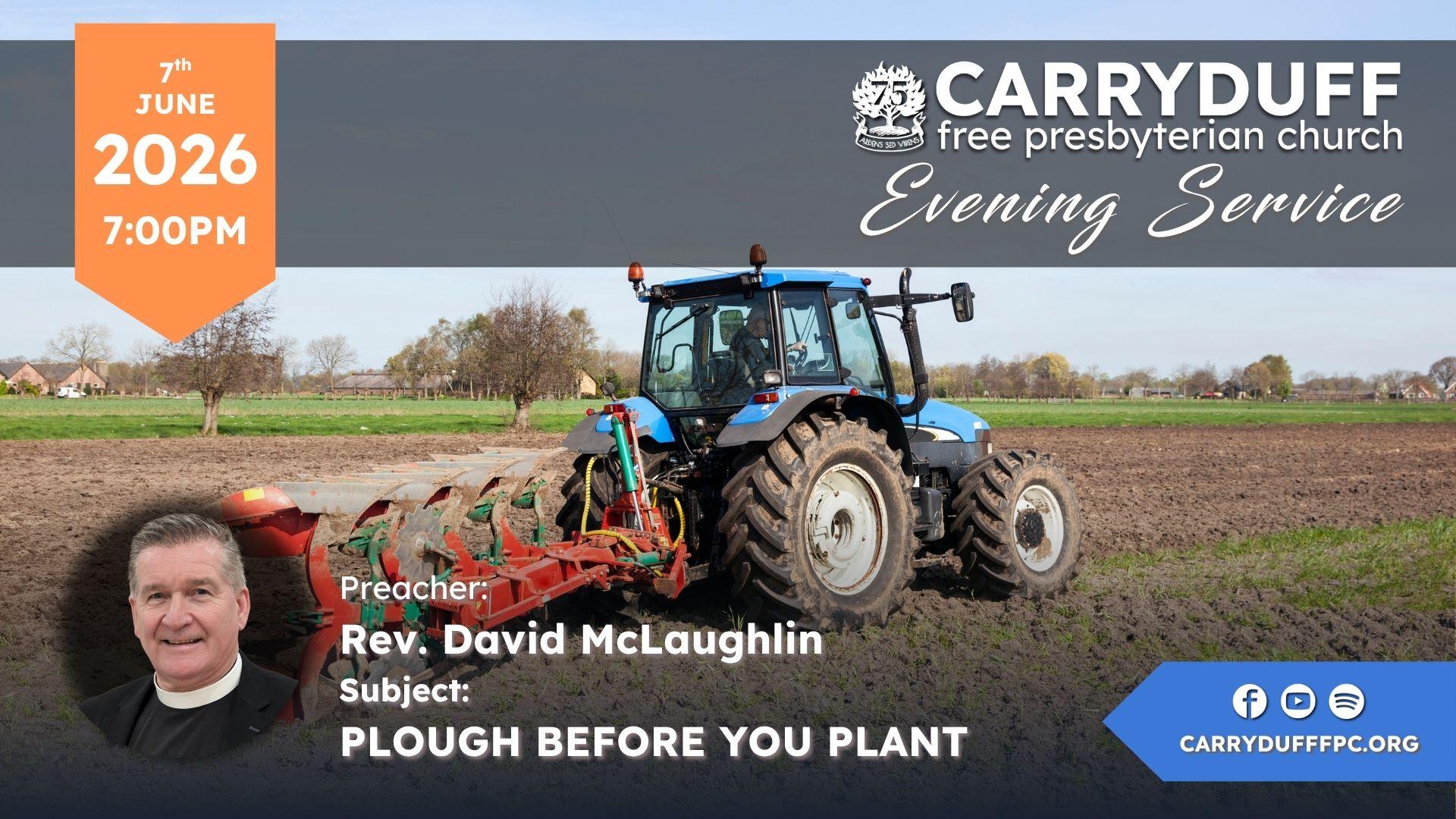

Date: SUN 7:00pm 7th June 2026
Preacher: Rev. David McLaughlin
Bible Reference: Jeremiah 4:3
Podcast
Sermon Summary
Introduction and Context
The sermon takes as its text Jeremiah chapter 4, verse 3, from the King James Bible: “For thus saith the Lord to the men of Judah and Jerusalem, Break up your fallow ground, and sow not among thorns.”
The preacher sets this message within the historical context of Jeremiah’s ministry. Jeremiah, known as the weeping prophet, preached during one of the darkest periods in Judah’s history. The Babylonian army under Nebuchadnezzar was advancing, poised to sack Jerusalem. Outward religion continued—the ceremonies, rites, sacrifices, and temple worship all carried on—but the inward reality of true godliness was absent. The hearts of the people, priests, prophets, and princes were hardened against God. They had not been regenerated by the Spirit; their lives remained unchanged.
The central thesis is drawn from an agricultural principle familiar to every farmer in Northern Ireland and throughout the United Kingdom: before seed can be sown, the ground must be ploughed. No wise farmer scatters precious seed onto hard, unbroken soil or among weeds and thorns and genuinely expects a harvest. What holds true in the physical realm holds especially true in the spiritual. The preacher contends that thousands of professing Christians desire God’s provision without God’s preparation—they want the comfort of the Gospel without its conviction, revival without repentance, and spiritual harvest without the hard work of blood, sweat, and tears.
Four main points structure the sermon:
I. The Condition Described: Fallow Ground
Fallow ground represents a field that was once cultivated but has since been neglected. Over time it becomes hard, crusted, and overgrown. It is soil baked under the sun, unbroken, its condition unfit for receiving seed.
The preacher illustrates this with a story of a vegetable gardener who purchased the finest seed from a reputable company, stored it properly over winter, yet failed to produce a good harvest. Consulting an expert, he discovered the problem lay not with the seed or the planter but with the soil itself. The soil was:
- Waterlogged due to poor drainage
- Nutrient deficient
- Contaminated with excessive herbicide residue
- Infested with hidden pests—microscopic worms, vine weevil grubs feeding on plant roots, crane fly larvae, and chafer grubs
The soil was being hindered by hidden influences beneath the surface. Pollutants and pressures had rendered it incapable of producing a harvest.
Spiritually, Judah possessed every advantage: the covenants, the title deed to the land given to Abraham in Genesis 15, the Holy Scriptures, the Old Testament sacrifices pointing to Christ, the Aaronic priesthood, and the prophets who forewarned and foretold. They had knowledge of the true and living God. Yet their hearts and minds were hard and baked like fallow ground.
The fallow ground, the preacher explains, represents three things:
- A neglected hard heart—one that has heard God speak multiple times but has met His voice with resistance and rejection
- A careless conscience—indifferent to conviction
- A cold formal religion—all outward show with no inward reality, fulfilling the words of Matthew 15:7-8: “This people draweth nigh unto me with their mouth, and honoureth me with their lips; but their heart is far from me”
The preacher illustrates further with the image of a well-worn path. Daily travellers compact the ground so thoroughly that even heavy rain cannot penetrate it; it would take weeks or months of sustained rain to break up such a path. Likewise, the soul left unattended and uncultivated, with a spirit of resistance to God’s Word, leads to hardness of heart—resistance to God’s voice, His truth, His conviction, and His compassion.
Psalm 95:8 warns: “Harden not your heart, as in the day of provocation.” Matthew Henry is quoted: “The heart of man is naturally fallow ground, and being long uncultivated is overgrown with weeds.”
Biblical examples of hardened hearts are cited:
- Pharaoh, who hardened his heart against God’s command
- King Saul, whose heart became rebellious
- The parable of the sower, where four soil types represent four responses to God’s Word—the wayside, the stony places, the thorny ground, and the good ground—yet only one produced a harvest of thirty, sixty, and a hundredfold
The neglected heart is not neutral; it is hard and fallow. The preacher expresses particular concern for many in Ulster, including within his own fraternity, who have hardened their hearts against God and His truth.
II. The Command Declared: Break Up Your Fallow Ground
The command to “break up” carries the idea of ploughing, tearing up, turning over the soil—hard, demanding work. After the plough comes the rotavator, then the harrow, then gathering stones with the link box, all long before any seed is ever sown.
This command is a call to deep and genuine repentance, not something superficial. The preacher identifies a significant problem in Ulster: too few real men occupy the pulpits preaching God’s Word. He describes many ministers as “old apostates and old compromisers” who treat the ministry as a career rather than a calling—concerned with money, career advancement, bigger churches, bigger houses, work-life balance, and being unavailable after five o’clock or during holidays.
Yet even among those striving to be faithful to “the blood and the booklet,” the preacher observes that so few are being saved. For two or three decades, only ones and twos have been converted despite faithful preaching and patient prayer. The reason, he argues, is that people are not broken. The seed is fighting with the condition of the soil—just as with the vegetable gardener, the problem is not the seed but the soil.
The preacher identifies several forces in Northern Ireland that create resistant, fallow-ground hearts:
Skepticism
In the universities and educational system, professors spew a message that creates a spirit of skepticism in young men and women, leading them to question God, the Bible, Jesus Christ, heaven, and hell. These professors are “full of unbelief themselves,” treating science as the new religion and man as his own god, denying Scripture as a book full of errors.
Atheism
Psalm 14:1 and Psalm 53:1 both declare: “The fool hath said in his heart, There is no God.” When God speaks something twice, the preacher notes, it demands attention.
The sermon traces a historical line: Karl Marx (born Karl Mordecai, a Jew whose parents converted to Christianity) once wrote an essay on evangelical conversion stating that “true happiness can only be found in the personal knowledge of Jesus Christ.” But a liberal theologian undermined his faith, denying the inspiration of Scripture, the virgin birth, the incarnation, and the miracles. Marx later sat in London with Engels and penned the Communist Manifesto, creating dialectical materialism and declaring there is no God.
Among those who followed was V.I. Lenin, who declared: “We have dealt with the gods of the earth… Now let us deal with the God of heaven. Let us tear him from his throne. Let us smash him to pulp with our fists.”
The result: churches were closed, believers put to death, pastors imprisoned. The legacy of atheism is a terrible one, enslaving thousands of young people to bitterness and bondage.
Hedonism
Young people grow up believing they can do their own thing, doing what is right in their own eyes—the spirit of Judges 21:25. They seek happiness in self rather than in the Saviour, forgetting that “happy is that people whose God is the Lord.”
Evolution
In the higher echelons of education, Genesis is denied as historical reality, dismissed as mythological legend. Yet Genesis is the book of beginnings:
- The beginning of the world, created by God in six twenty-four-hour days
- The beginning of man, created in God’s image, male and female—hence there are two genders and only two genders
- The beginning of marriage, instituted by God as a contract between man, woman, and God
- The beginning of the first gospel promise in Genesis 3:15
Satanism
The preacher points to the explosion of astrology, Ouija boards, tarot cards, horoscopes, and fortune tellers.
Jeremiah’s message is to break all of this up—the skepticism, atheism, hedonism, evolution, and satanism—because all of these things fight against the Word of God.
What True Repentance Involves
The plough does three things:
- Spiritual examination: The plough exposes what lies beneath the surface. The Word of God preached and the Spirit of God working shed light on the sinful state of the human heart until the individual cries out with David, “Search me, O God, and know my heart.”
- Scriptural conviction: Drawing from John 16:8, the Holy Spirit convicts the world of sin, righteousness, and judgment. The plough cuts deep; the blade goes deep intentionally. When the Word is preached and the Spirit works, pride is exposed and wounded, self-righteousness is shattered, and open and secret sins are laid bare. David’s cry in Psalm 51 exemplifies this: “Against thee, thee only, have I sinned… Behold, I was shapen in iniquity; and in sin did my mother conceive me.”
- Sincere repentance: Quoting the catechism, repentance unto life is “a saving grace, whereby a sinner, out of a true sense of his sin, and apprehension of the mercy of God in Christ, doth with grief and hatred of his sin turn from it unto God, with full purpose of and endeavour after new obedience.” The preacher emphasises that true repentance means being sorry enough to quit—not merely regretting consequences. Just as the farmer overturns the soil, so grace turns the sinner from sin. The Spirit works in regenerating power, bestows the gift of faith, and leads to genuine repentance. What Ulster people need is a new heart from God.
III. The Caution Disclosed: Sow Not Among Thorns
The preacher asks why this warning is added and answers: because ploughing is not enough. The soil can still be infested, just as the vegetable gardener discovered.
A heart experiencing conviction can still cherish sins. In the parable of the sower (Luke 8:14), the seed that fell among thorns represents those who hear the Word, go forth, but are “choked with cares and riches and pleasures of this life.”
Three categories of thorns are identified:
The Thorn of Worry
Many are consumed by worry—about jobs, health, family, future, old age, pensions, the end of the world, family problems, or the political future of Northern Ireland. Some are worried sick. Yet Scripture commands: “Casting all your care upon him; for he careth for you” (1 Peter 5:7) and “Be careful for nothing; but in every thing by prayer and supplication with thanksgiving let your requests be made known unto God. And the peace of God, which passeth all understanding, shall keep your hearts and minds through Christ Jesus” (Philippians 4:6-7). Worry is identified as a sin.
The Thorn of Wealth
Many are consumed by a desire for riches. The preacher references the radio lottery, the Saturday night lottery offering millions, and the big lottery offering over a hundred million. He recalls a sermon by the late John Douglas titled “Play Here, Not Pay,” noting that what began as a game now enslaves people hoping for financial gain, escape from debt, a different lifestyle, or a life-changing outcome. They forget the scriptural warnings against greed, covetousness, and the love of money as the root of all evil. Wealth, when it comes, should come by hard work, wise management of time and energy, and God’s providence. The Bible instructs: “Be content with such things as ye have” and “Godliness with contentment is great gain.”
The Thorn of Worldliness
This represents unrepentant sin, competing affections, divided loyalties. It manifests in disregarding the Lord’s Day, cheating the tax man, driving untaxed or uninsured cars. Christ and idols cannot reign together in the heart.
Two biblical examples illustrate the danger of cherished thorns:
- Herod: He heard John the Baptist gladly, admired him, but refused to part with Herodias—the one thorn in his life, the love for another man’s wife. He ended up beheading John, and when Jesus later stood before Herod, the Lord answered him not a word. By cutting off John’s head, Herod cut off the voice of God to his soul.
- The rich young ruler: Morally upright, seeking eternal life, he came to the right person with humility, knelt before the Saviour, asked the right question, and was told what to do. Yet one thorn remained—his love of riches. He went away sorrowful because he loved riches more than the Redeemer, silver more than the Saviour, gold more than God.
Thousands in Northern Ireland have heard the Gospel but are not saved because they are unwilling to forsake certain sins.
IV. The Cultivation Defined: Break and Sow
The purpose of ploughing is planting. God never breaks a soul merely to break; He always breaks to bless, humbles to heal, convicts in order to convert.
In the parable of the sower (Luke 8:11), the seed is the Word of God, and the soil represents the heart’s response. The good soil is ground that has been broken up—a prepared heart that receives the Gospel seed joyfully and gladly.
The preacher recalls historical revivals under Wesley, Whitefield, Jonathan Edwards, and Evan Roberts, where deep conviction of sin accompanied the preaching of the Gospel. There was examination of heart, the cry “Search me, O God,” conviction leading to genuine repentance.
No man can naturally break up his own heart. Only the Lord can do this by the power of the Spirit in the new birth. But this ploughing work must take place before the planting work that brings about production.
The Gospel of the cross of Jesus Christ is God’s greatest plough. At the cross one sees:
- The seriousness of sin
- The holiness of God
- The love of Jesus Christ
- The necessity of the blood atoning sacrifice
John Newton, the former slave trader turned preacher, said: “I saw one hanging on a tree in agonies and blood,” and the sight of that One and the sound of His voice broke him.
Application and Conclusion
The preacher closes with direct questions:
- Is your heart fallow?
- Have you known the plough of conviction pass over your soul?
- Are you cherishing the thorns of worry, wealth, or worldliness?
God’s word to every inhabitant of Ulster is: “Break up your fallow ground, and sow not among thorns.”
True repentance involves a change of lifestyle and transformation:
- No more pubs and clubs
- No more dancing the time away
- No more bookies’ shops and gambling
- No more fags
- No more drugs
Once a person accepts and appropriates the truth found in Christ, transformation follows: “If any man be in Christ, he is a new creature: old things are passed away; behold, all things are become new” (2 Corinthians 5:17). This is not sinless perfection—as the example of Noah demonstrates—but it is evidence of a life that loves Christ and wants to live for His honour and glory, not as the ground of salvation but as its evidence.