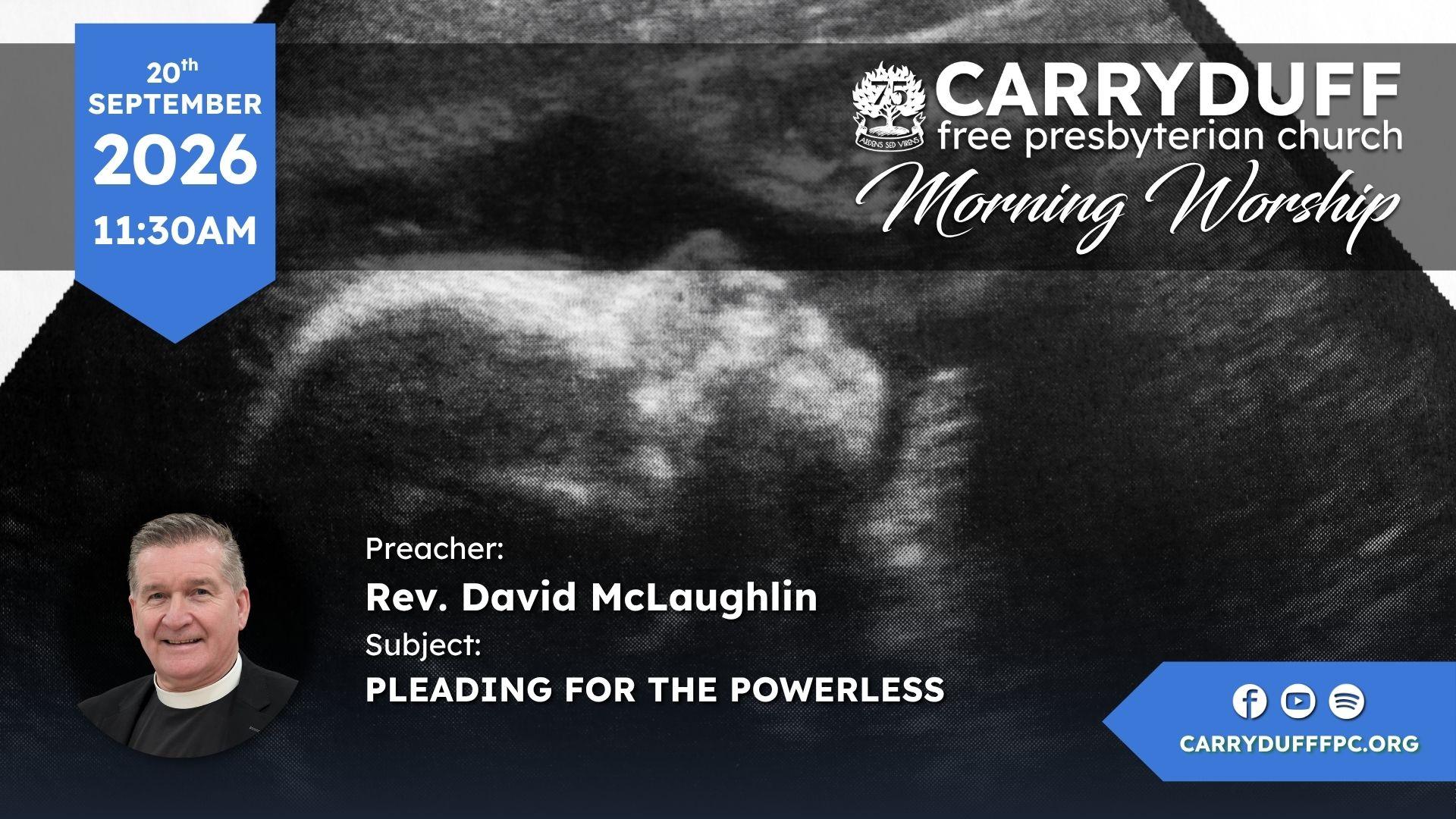

Service Details
Date: SUN 11:30am 20th September 2026
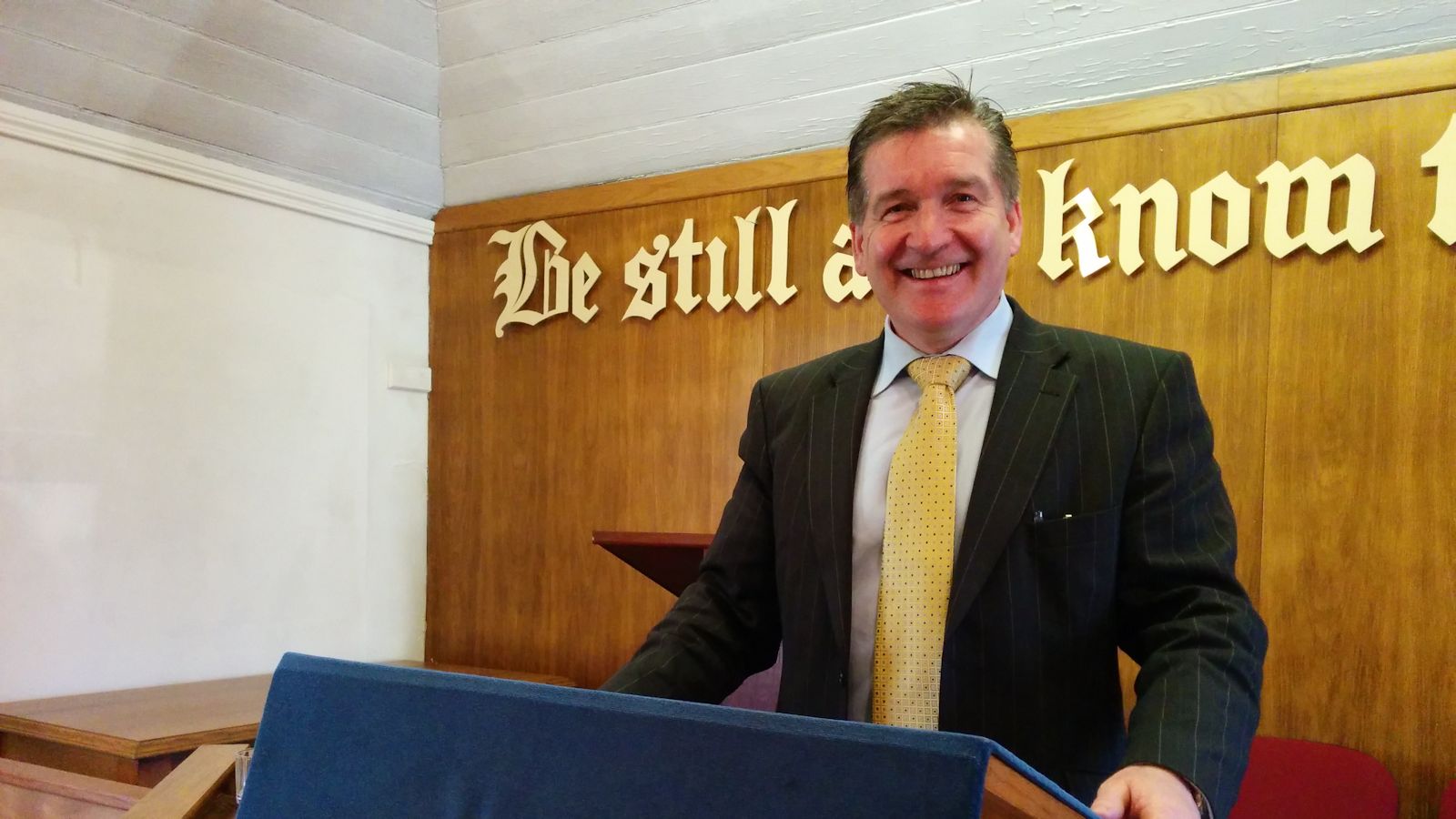
Preacher: Rev. David McLaughlin
Bible Reference: Proverbs 31:8-9
Podcast
Summary of the Sermon: “Pleading for the Powerless”
The sermon was preached from Proverbs chapter 31, verses 8 and 9, in the Authorized Version. The text reads: “Open thy mouth for the dumb in the cause of all such as are appointed to destruction. Open thy mouth, judge righteously, and plead the cause of the poor and needy.” The preacher explained that these verses form part of a prophecy delivered by King Lemuel’s mother — understood here as Solomon’s mother, Bathsheba — who instructed her son in the manner in which a king ought to live and rule. The message was titled “Pleading for the Powerless” and was structured around four features of the text: the person mentioned, the plea mentioned, the principle mentioned, and the proclamation mentioned.
The Context of the Text
The preacher noted that the prophecy begins at verse 1: “The words of King Lemuel, the prophecy that his mother taught him.” He observed that this mother first gave her son negative instruction, warning him against immorality with women and against the dangers of drunkenness. She then turned to positive instruction, telling him what a king ought to do. Verses 8 and 9 contain that positive charge.
The preacher stressed that a king is not given authority merely for his own comfort or for the welfare of his own family. Rather, authority is granted so that he might rule for the good of all his subjects. He cited Romans chapter 13 and verse 1 — “Let every soul be subject unto the higher powers: for there is no power but of God: the powers that be are ordained of God” — to establish that all true authority comes from God and is ordained by God. Consequently, the exercise of that authority by kings, queens, princes, and all who rule in any capacity must itself be governed by the Word of God.
The preacher drew out the logic of the passage: the mother tells her son that on the throne he will have a voice, power, authority, and influence. She charges him to use those things on behalf of those who have none. This, he said, is the heart of the text.
The Person Mentioned: “The Dumb”
The first division of the sermon examined the word “dumb.” The preacher explained that the term is not limited to those with a speech impediment, nor to those who cannot speak at all, nor even to those who are intellectually impaired or poorly educated — though he allowed that it includes all such persons. It means much more. It refers to all individuals who are unable to speak for themselves and unable to plead their own cause effectively.
He observed that many people in society have no voice at all, or are unable to use whatever voice they have effectively. He then set out the biblical principle that God has a particular concern for the vulnerable:
- Psalm 82 verse 3 — “Defend the poor and fatherless: do justice to the afflicted and needy.”
- Deuteronomy chapter 10 verse 18 — God “doth execute the judgment of the fatherless and widow, and loveth the stranger, in giving him food and raiment.”
- James chapter 1 verse 27 — “Pure religion and undefiled before God and the Father is this, To visit the fatherless and widows in their affliction, and to keep himself unspotted from the world.”
The preacher’s point was that as the Lord looks down from heaven, He sees the people whom the world overlooks — the vulnerable, the oppressed, the suffering, the falsely accused, the fatherless, the widow, and the stranger.
The Unborn as the Powerless
The preacher then applied this category to the unborn child. He acknowledged that the verse is not exclusively about the unborn and that abortion is not historically the subject of the verse, but he argued that the unborn are certainly included in the category Scripture calls “the dumb.” The principle of Proverbs, he said, applies powerfully to the unborn because unborn babies in the womb are the most vulnerable in society and the most powerless of human beings in today’s world.
He noted that the Free Presbyterian Church of Ulster has, from its inception seventy-five years ago, stood separated from ecumenical apostasy and has always been against abortion. Since the Abortion Act was introduced in the United Kingdom in 1967, the church has opposed it. The preacher clarified the chronology: the Act was passed in 1967 but did not come into effect until 27 April 1968.
He then presented figures drawn from the Right to Life website:
- Since 27 April 1968, 11,105,671 babies have been aborted in the United Kingdom.
- In England, for the year 2023 alone, the figure was 277,970.
- In Scotland, for 2024, the figure was 18,710.
- In Northern Ireland, for 2024, the figure was 2,599.
He described this as the great evil of the day — the murder of the unborn. He noted that the 1967 Act did not originally apply to Northern Ireland, but that after the campaign to repeal Article 8 of the Republic of Ireland’s Constitution, Northern Ireland moved from being the most conservative jurisdiction on abortion to the most liberal in a very short time. He stated that abortion is now available on demand and up to full term.
The preacher declared that he does not care what society says or what “the great and the good” say; his concern is what Scripture says.
The Unborn as Human Beings
The sermon then set out the case that the unborn are real human beings, not merely “a fetus” or “a clump of cells.” Several passages were cited:
- Psalm 139 verses 13–16 — “For thou hast possessed my reins: thou hast covered me in my mother’s womb. I will praise thee; for I am fearfully and wonderfully made… My substance was not hid from thee, when I was made in secret, and curiously wrought in the lowest parts of the earth. Thine eyes did see my substance, yet being unperfect; and in thy book all my members were written, which in continuance were fashioned, when as yet there was none of them.” The preacher identified this as David’s description of himself as a baby in his mother’s womb, and as proof that life begins at conception.
- Jeremiah chapter 1 verse 5 — “Before I formed thee in the belly I knew thee; and before thou camest forth out of the womb I sanctified thee, and I ordained thee a prophet unto the nations.” God had a relationship with Jeremiah before his conception and birth.
- Luke chapter 1 verses 41 and 44 — “the babe leaped in her womb.” The preacher underlined that the Holy Ghost calls John “a babe,” and the word is used twice. He stressed: a babe in the womb — not a fetus, not a clump of cells.
He then turned to biological argument. At the moment a human sperm penetrates a human egg, generally in the upper portion of the fallopian tube, new life comes into existence. The first cell formed at conception is called a zygote. That zygote has DNA absolutely unique to itself, different from any other human being who has ever existed, including its mother. It is comprised of a complete human DNA, so its nature is undeniably human. The DNA includes a complete design guiding not only early development but also hereditary traits that will appear later in childhood. It has a unique set of 46 chromosomes.
The preacher further argued that the human embryo is biologically alive, fulfilling the four criteria used to establish biological life:
- Metabolism
- Growth
- Reaction to stimuli
- Reproduction
He then gave a developmental timeline:
- Three weeks — a heartbeat can be detected. He added that detection has improved over time, but the heartbeat was always there from the moment of conception.
- Six weeks — the baby displays reflexes; it can grasp, roll over, and respond to touch.
- Twelve weeks — the baby has a unique fingerprint, fully formed, and can suck his thumb.
- Sixteen weeks — the baby reacts to the mother’s voice and to external sounds; all the organs are formed.
- Twenty-eight weeks — the baby can cry silently in the womb.
Beyond biology, the preacher grounded human dignity in the image of God, citing Genesis chapter 1 verse 27: “So God created man in his own image, in the image of God created he him; male and female created he them.” He asked where human dignity and the sanctity of human life come from, and answered that they do not come from wealth, influence, intelligence, social status, health, or age. The true foundation is the image of God. Every child is a miracle and a God-given gift. Abortion is wrong not merely because it attacks the vulnerable, but because the child is a human being made in the image of God.
The preacher returned to the text: the child in the womb cannot plead its own cause. It cannot say to the doctor, “O doctor, don’t kill me.” Yet in our day, 11.1 million babies since 27 April 1968 have been “appointed for destruction.” He asked who appointed them: the mother who is pro-choice, the lawmaker who agreed, the doctor, and everyone else belonging to the pro-choice lobby. He declared that God hates the hands that shed innocent blood, and that abortion is murder, not healthcare, and not mercy.
He made reference to the actress Anne Hathaway, who reportedly said that having multiple abortions was a mercy that furthered her career. The preacher responded that it is not mercy but murder.
He observed an inconsistency in society: there are special protections and rules for birds and animals, and it would be considered wrong to kill them wantonly, yet there is a greater slaughter of the innocent unborn — 11.1 million and growing. He cited the commandment “Thou shalt not kill” as prohibiting the unlawful taking of innocent human life.
The Argument Stated
The preacher summarised his argument as follows:
- The unborn is a real human baby.
- The unborn has unique human DNA, which makes it biologically human.
- The unborn is a real living soul made in the image of God; God has given it life, and that life is sacred.
- The intentional killing of an innocent human being is prohibited by God, who hates the hands that shed innocent blood.
- The baby is not like an animal to be put down.
- The deliberate, intentional killing of the innocent unborn is morally wrong.
He then addressed common justifications: that the baby is not wanted; that the baby has a disability the mother could not cope with; that the baby has a cleft palate or cleft lip; that the mother is too busy; that the pregnancy would damage her career. He stated plainly that such reasoning is morally wrong, and that he is against the doctors who are paid to perform abortions.
The Plea Mentioned: “Open Thy Mouth”
The second division concerned the plea. The phrase “open thy mouth” appears twice, in verses 8 and 9, and the preacher noted that it is repeated for emphasis. Literally, King Solomon was told by his mother that it was time to speak up. In context, it was the duty and right of the king; he had a direct responsibility to speak for the dumb and for all such as are appointed to destruction.
But the preacher drew out a broader principle. It applies to the king on the throne, but also to:
- The lawmaker in parliament
- The judge on the bench
- The magistrate
- The medical doctor
- The nurse
- The school teacher
- The pastor and preacher
- The elder and deacon
- The church member
- The parent
- The police
Lemuel’s mother says, “Open thy mouth.” The preacher stressed that this is not a vague wish — “I wish somebody would speak up” — nor a hope that someone might. It is a command, twice iterated. King Lemuel had a particular responsibility: you have a mouth, use it; use your influence, your knowledge, your authority, your power to speak up and speak out for the dumb. The king’s job is to protect what is good and right in society, to punish the evildoer, and to defend the innocent.
The preacher identified a great crime being committed in our day — 11.1 million since April 1968 — and added that there is a greater crime still: the church is silent. He thanked God that the Free Presbyterian Church has always taken a stand against abortion and always spoken against it, while conceding that it could have done more. He then issued a call:
- To every pastor and preacher — it is time to speak up.
- To the judge, the magistrate, the lawmaker, the great and the good, the doctors, the teachers, and the parents — it is not okay to murder the babies.
- To the lawmaker, the doctor, and the judge — this is not about pro-choice; it is about true death.
He returned to the account of John the Baptist in Luke chapter 1. When Mary came to Elizabeth and shared news of the promised Messiah, the babe leaped in Elizabeth’s womb for joy because he heard that news. The preacher’s conclusion was that this is not healthcare and not pro-choice: it is pro-death, it is not lawful according to the Word of God, it is not okay, and it is not Christian.
He then raised the matter of depopulation. He asserted that there is a view about depopulating the West, and that the policy of some today is that we need to get rid of people because there are too many. He named billionaires such as George Soros and others as advocates of abortion. He also recounted an anecdote about a man who, asked what the two biggest problems in the United States are, replied: “They don’t knows and they don’t cares.”
The church, he insisted, must not roll over and play dead; it must not be guilty of ignorance or of a lack of compassion. This concern should belong to the whole Christian church; it transcends denominations and political parties. Christians are salt and light. He stated his belief that it is a sin to do nothing, and asked what God wants His people to do: open your mouth. Every life matters.
He said the church has been silent for too long, and expressed gladness at having stood the previous day with the United Christian witness, thanking Sally Buchanan, her husband David, and the organisers. He observed that family values are under attack and church life is diminished, and that one thing believers can do more and better is to open their mouths for the unborn — by speech, by letter, or simply by standing in the open air. This, he said, is a call to accept responsibility and be faithful in the place where God has placed you: in your church, your home, your classroom, your farm, your factory, your office, and in this small province.
The Principle Mentioned: “Judge Righteously”
The third division addressed how we should speak. Verse 9 says, “Open thy mouth, judge righteously.” The preacher argued that the Bible is not against making judgments. He noted that people who do not know the Bible say, “You shouldn’t judge,” citing “Judge not, that ye be not judged.” But the Bible does not teach that; it teaches righteous judgment. It is not against making a judgment, and the objection “who are you to judge me” does not stand. We are to judge righteously.
He then set out practical implications:
- We are not to speak until we know all the facts.
- We should not deal in rumour or opinion; we should deal in facts.
- We should not accuse anyone before investigating a matter.
- After investigating, we should ask: Is this true? Is this kind? Is this the right thing to say? Is this the right time to say it?
He asked for prayer for preachers, noting that they need wisdom. He warned against being a busybody or meddling in other people’s affairs for the sake of it, and against being nosy. We must distinguish truth from error, and rumour from righteousness. He also warned against two errors:
- Saying “my friend is involved, so I will defend them whatever they say or do.”
- Saying “I don’t like them, so they deserve everything they get.”
The true church must speak the truth and speak righteousness; it must speak about right living according to the Word of God. He cited several passages:
- John chapter 17 verse 17 — “Sanctify them through thy truth: thy word is truth.”
- 2 Timothy chapter 3 verse 16 — “All scripture is given by inspiration of God, and is profitable for doctrine, for reproof, for correction, for instruction in righteousness.” He noted that “righteousness” here means right living as well as the righteousness which is by faith in Christ.
- Matthew chapter 4 verse 4 — “Man shall not live by bread alone, but by every word that proceedeth out of the mouth of God.”
- Proverbs chapter 18 verse 13 — “He that answereth a matter before he heareth it, it is folly and shame unto him.” We must hear before we utter judgment.
We must defend life because God is the giver of life. We must do so with courage and with compassion. The preacher added a further point: we must not hate the women facing a crisis pregnancy. We must not despise them. We must love them, pray for them, and offer to help — because the only voice the unborn have is our voice. We speak for the unborn, and we speak the gospel to those who are broken. Many women are guilt-ridden; many faced what was called an unwanted pregnancy and did not know what to do, and may sit today thinking, “What on earth have I done?” Therefore we must speak the gospel to the broken, and reach out with courage and compassion as a church.
The Proclamation Mentioned: “Plead the Cause of the Poor and Needy”
The final division turned to verse 9: “and plead the cause of the poor and needy.” The preacher asked whose cause we should plead, noting that many are looking for a cause today, and that the cause of the unborn is a very important particular cause to his heart. But then he asked the deeper question: who will plead my case?
He turned to the gospel. The hearer is a sinner who has broken the law of God: “For all have sinned, and come short of the glory of God.” By nature we fail to know God and fail to love Him with all our heart, soul, mind, and strength. We have a soul that needs to be saved. He cited the Lord Jesus: “What shall a man profit if he gain the whole world and lose his own soul? Or what shall a man give in exchange for his soul?” He illustrated the point: if someone offered you the position of the richest man in the world, a billionaire, on the condition that you lose your own soul, what would it profit you?
We have no righteousness of our own to plead. But there is a Saviour who has come into the world, who can save us from the guilt and penalty of sin — the Lord Jesus Christ, in His birth, His sinless life, His atoning death, and His bodily resurrection. He will not defend us by declaring that we are innocent; He will not deny that we have broken the law of God. Rather, He stands before His Father as the righteous advocate and says, “Father, I have fulfilled the law.” He does not ignore the principles of justice; He satisfied the justice of God.
The preacher cited Isaiah: “All we like sheep have gone astray; we have turned every one to his own way; and the Lord hath laid on him the iniquity of us all.” Christ took our place; He was our substitute, our surety, our sin-bearer, and our Saviour. He bore the guilt and punishment of our sin in His own body on the tree and provided righteousness. He is the end of the law for righteousness to everyone that believes.
He then cited 1 John: “My little children, these things write I unto you, that ye sin not. And if any man sin, we have an advocate with the Father, Jesus Christ the righteous.” Do you know Jesus Christ the righteous? He is the one who pleads the cause of the poor and needy in heaven. Is He pleading your cause today?
Conclusion
The preacher closed by recapitulating the four features of the text:
- The people that are mentioned — the dumb, the powerless, including the unborn.
- The plea that is mentioned — “open thy mouth,” repeated twice for emphasis.
- The principle that is mentioned — “judge righteously.”
- The proclamation that is mentioned — “plead the cause of the poor and needy.”
He concluded that before anyone has a cause to plead, they need to know that Christ is pleading their cause in heaven. He asked whether that is the hearer’s experience — whether they know Him as the righteous advocate — and prayed that the Lord would bless the message to the heart of all who heard it.
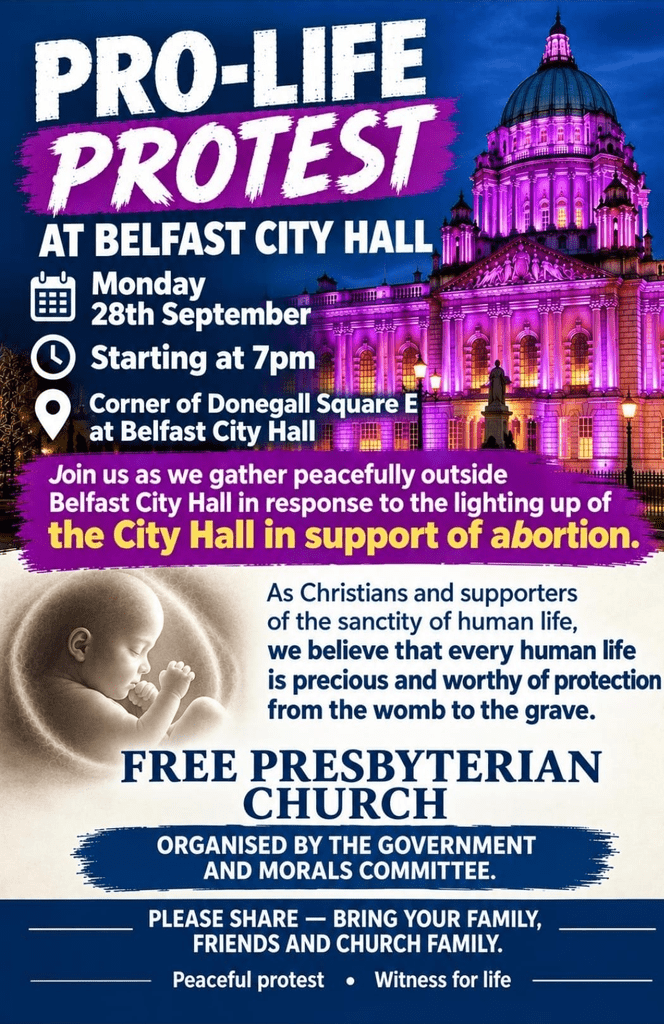
Planned Protest