
Service Details
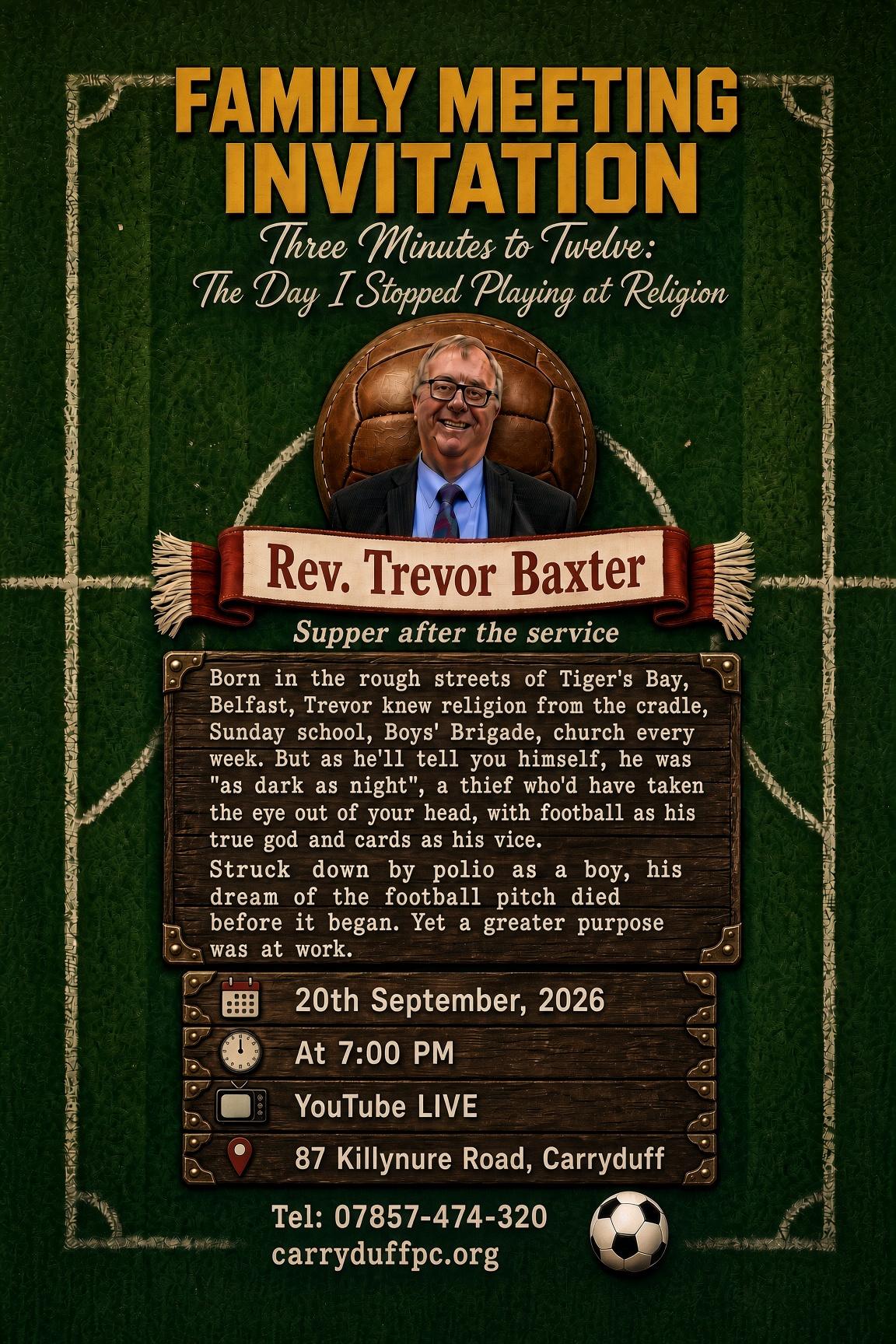
Date: SUN 7:00pm 20th September 2026
Testimony: Rev. Trevor Baxter
Bible Reference: Ephesians 2:5
Podcast
Testimony
Introduction
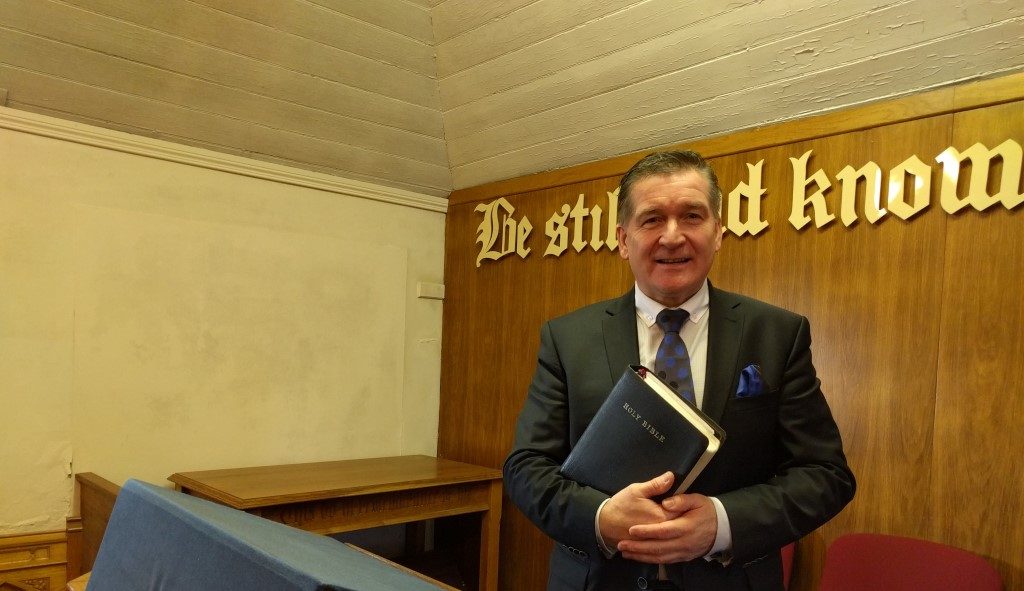
After a good-humoured struggle with a walking stick that would not stand on an uneven pulpit floor, he turned from himself to the Lord. What mattered was not what he had done — much of which he regretted and would not elaborate — but what the Lord had done. He divided the evening under three headings taken from Ephesians 2: his past by nature, his present by grace, and his prospect by faith.
Ephesians 2:5 supplied the keynote: even when we were dead in sins, God quickened us together with Christ; by grace ye are saved. Verse 7 looked forward: that in the ages to come He might show the exceeding riches of His grace. Between those poles Baxter set the story of a Belfast boy who had no gospel in his home, no interest in religion, and no thought of the ministry, yet who was converted at eighteen, drawn into the work of Martyrs Memorial, trained for the Free Presbyterian ministry, and spent a lifetime preaching Christ.
Past by Nature
Birth, place and early home
Baxter was born on 1 September 1948 and had just turned seventy-eight. He came from Tigers Bay, a small and intensely loyalist district of Belfast, distinct from the better-known Shankill Road and Sandy Row. Originally there were only about four streets; many later claimed the Bay who had not been born on those streets. He was. The home was stoutly Orange. From infancy he was cradled in the Institution. His father was lodge master for many years. On the Twelfth morning the men gathered at the house for the field — then Finaghy, not Shaw’s Bridge — and as soon as the boy could walk he helped to carry the strings of the banner. He was not ashamed of that upbringing, though he is no longer in the Orange Order, for reasons that had nothing to do with the Institution’s beliefs as such.
It was not an evangelical home. His parents were not then converted. They sent him to church, Sunday school, youth meetings, the Boys’ Brigade and the Life Boys, morning and night, but they did not take him. His mother gave him a few pence; he spent them on the way on penny chews, so the money was gone before he reached church. That habit, he said, summed up the nature with which he grew up.
Youth, cinema, sport and illness
Cinema ruled him. He went five nights a week, sometimes six. After 1966 he did not return to a picture house, except once for a colour film of England’s World Cup campaign at the Capital on the Antrim Road. He was careful not to brand every film-goer a great sinner; the point was the scale of the change. Cards and a little gambling featured too. Three football teams held him: Linfield, Liverpool and Glasgow Rangers. He lived for the game.
His father had played in the Irish League with two brothers and wanted his son to be a footballer. That hope was broken by poliomyelitis around 1949 to 1951. The child had walked on his first birthday. Before he was two his mother saw him drop to all fours to climb the footpath. Tests confirmed polio in one limb — not the leg that later required the stick. Two operations followed. At ten or eleven he was off school for about a year and a half, which he blamed, half in jest, for lost education. When the Lord calls a man to the ministry, he added, He does not first ask for brains. He asks for the heart.
Sin and spiritual darkness
In Tigers Bay he learned early how to look after himself. He called himself a thief without dwelling on it. He did not break into banks or rob old ladies, though he might have robbed his granny once or twice for picture money. He thanked God he did not enter paramilitary activity, though he came very close.
His father died at fifty. Dr Ian Paisley had led him to Christ not long before; the conversion was genuine and observed. His mother’s conversion he reserved for another telling. Throughout childhood he sat under church programmes yet could not recall anyone telling him of Christ, of the gospel, or of a boy’s need to be saved. He drank a little and tried smoking; smoking made him sick and he quit. In a Free Presbyterian pulpit he admitted he had never had any interest in religion. School had taught him Psalm 46; it meant nothing. Asked John 3:16, he could not answer.
He would not linger on the past, lest the devil be given praise. Yet he would not soften it. He was a sinner, though he would never have admitted the word. That was his past: dead in trespasses and sins, born that way — no Christ, no God, no hope, only sin.
Present by Grace
Drawn to Ravenhill
The change began, humanly speaking, in 1964. A shop in Divis Street displayed a small Irish tricolour. Ian Paisley told the police that if they did not take it down he would march and take it down himself. They removed it. Baxter saw the episode on the news. His Orange blood was stirred. He decided he must hear this man. It was not first the gospel that drew him to Ravenhill; it was Paisley. He thanked God for that, and said many could speak similarly of their own testimonies.
The church stood on the corner of Glentoran Street, a name that nearly put him off. He went nonetheless and was amazed. For the first time he heard the gospel with power and clarity: you are a sinner; Christ died for sinners; He died for you. From that day he was hooked — an ardent Paisleyite, and unashamed. Not one member of his family had any kindness for the decision. Providentially the whole family later turned when they saw that what the man stood for was right. That turning included his father’s conversion.
Almost a reformer, then converted
He did not come to Christ at once. Still ignorant of salvation, he bought a “Jesus Saves” badge, wore it, and tried to reform his life so that he might belong among the people he had seen. In that small church, before Martyrs Memorial was built and before the Ulster Hall was acquired, he noticed a different demeanour. Billy Hamilton’s praying astonished him. There were no song leaders; someone in the packed hall would start a hymn and the singing would rise before the meeting began. It spoke to him even while he remained oblivious to the truth.
He followed Paisley to every rally he could. One night in Ballymena three booklets were on sale. One was titled In These Last Days, written by two men from a brethren assembly who later came into the Free Church. He read them at once. About six months later, on Saturday 5 November 1966, he was eighteen, at home in his flat, planning to go out on the motorbike. He picked the booklet up again. Suddenly he knew that he did not understand all they described, but he was not ready. If Jesus came back that day he would not be ready to meet Him. The Lord spoke as immediately, he thought, as He had spoken to Nathanael under the fig tree. It was three minutes to twelve noon. He knelt at the seat and, with no Scripture to lean on, turned from his sin and asked the Lord Jesus to be his Saviour, to forgive his many sins, and to come into his heart. In that instant he was born again, saved by grace alone. His plea remained: Jesus died for sinful man, so He must have died for me.
Involvement at Martyrs Memorial
At first he was painfully shy. A veteran missionary, asked what had drawn him into the Lord’s work, answered with one word: involvement. Baxter took it. He began in the youth fellowship with the Reverend Ron Johnstone. After about a year an election left the two of them; Johnstone beat him by one vote. Baxter always maintained they cheated because Johnstone voted for himself. When Johnstone left for Bible college in America with WEC, Baxter led the fellowship. Young people from that group later entered the ministry and the mission field, or became Sunday school teachers. He taught Sunday school and then the Bible class.
When the congregation moved into the large church, blessing was visible. After Sunday Bible class he would run past the front doors towards home on the Ravenhill Road and find people already queuing for the evening service. He counselled those who responded to appeals. One night thirty-three people left their seats; each was counselled separately, which he believed was the proper way, and he could not find enough rooms. In the first few years some two thousand people passed through the inquiry room. Johnstone later recalled a hundred new members received at the Lord’s Table on one occasion. Baxter remembered a day when two hundred and fifty were brought into fellowship. It felt like revival.
He worked more than four years as visitation director of evangelism. For nine months, four days a week, he visited the Ballybeen estate and believed he covered it entire. Still he felt there was more he could do. The one thing he dreaded was the ministry.
Call, college, marriage and pastorates
Valerie Shaw, a missionary to the Jews and a dear friend, a woman who could preach as well as any man and better than some, kept telling him he was wasting his time and ought to be in the ministry. The more he heard Paisley preach the need of workers, the more convinced he became. For seven years the Lord spoke. Had he listened sooner he would have been spared four years at college and the struggle of Hebrew and Greek. Eventually he obeyed.
Not long before college he married, in 1971, the year his father died. They already had two children. S. B. Cooke warned that they were promised nothing: there might be no church at the end. He was set for three years; after the first year the presbytery added another. He was the only student in his year. Ten men had gone through the year before, among them John Greer, Leslie Curran and Alan Smiley. He later told the presbytery, more graciously than he first intended, that they had been wrong.
When it was time for a call, about seven churches were vacant and ministers were scarce. Names went forward for Dungannon and Newtownhamilton, where he had been happy as a student for nearly four years. Dr Paisley told Mrs Baxter that Trevor would not leave Newtownhamilton. Paisley was wrong. Baxter went to Dungannon and remained more than eighteen years. Leaving was one of the most heartbreaking decisions of his life. They then spent some sixteen years in Portadown. Thirteen years before the address they retired to Tandragee, joining an active congregation where volunteers were never hard to find.
Family and the fruit of the work
They had been married since 1971 — fifty-five years, the emerald anniversary. They had four children, eleven grandchildren, and one great-grandchild, with another expected at Christmas. The Lord, he insisted, had done it all. They conducted gospel missions every year of church work, sometimes two or three, once four, which he did not recommend. The Lord gave souls. He thought of those he had married, those he had buried, and those he had led to Christ. He would not exchange any of it for all the money in the world.
Prospect by Faith
Finally he turned to Ephesians 2:7: that in the ages to come God might show the exceeding riches of His grace. That is what God will do with him when he leaves this scene of time. He was more aware than ever of his mortality. He did not know how long he had, but he knew that at the end of the day he would be with Christ, which is far better. Much had been left out. The testimony reduced to a doxology: to God be the glory, great things He has done.
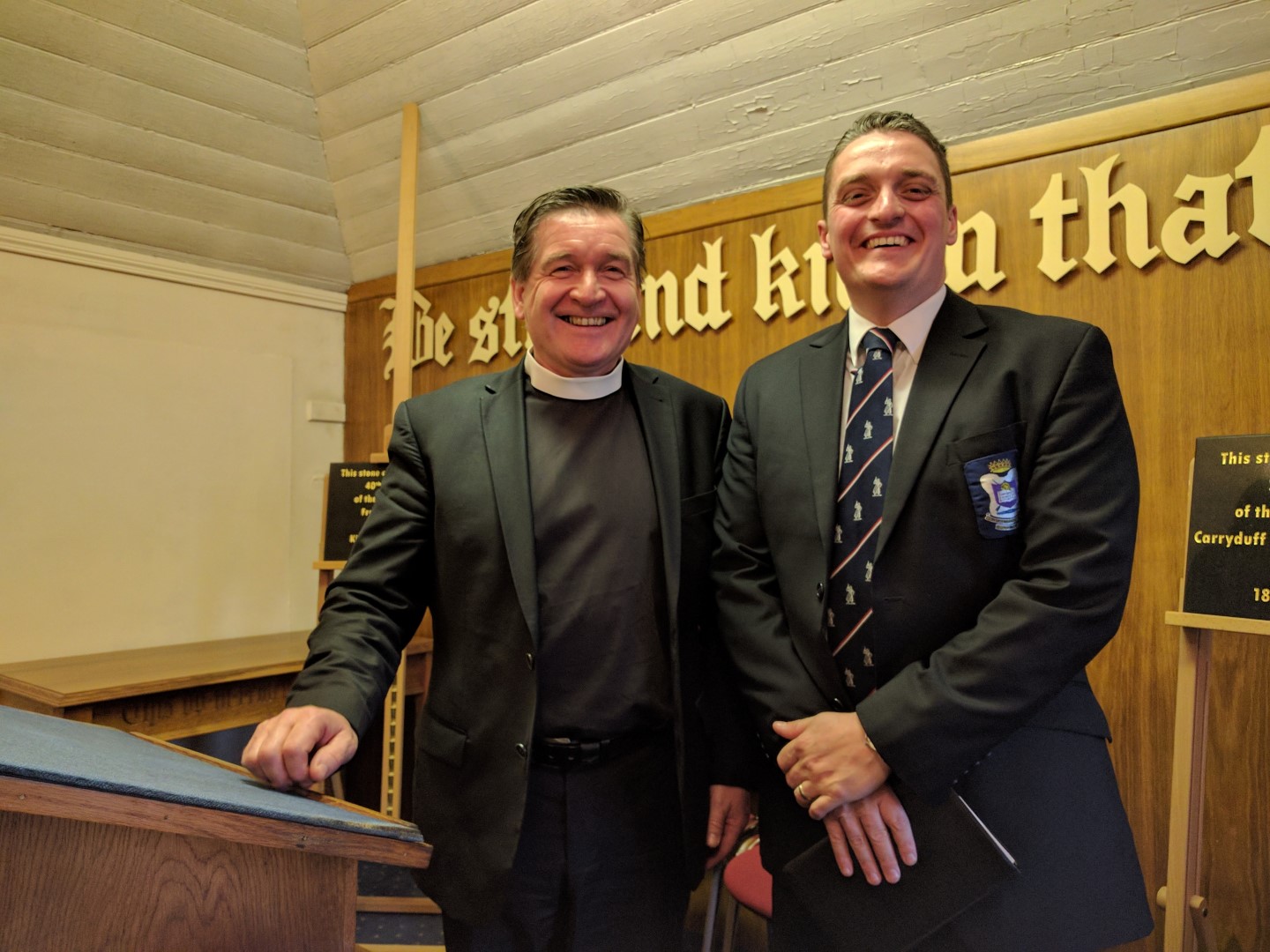
He closed with an appeal. If any present were not saved, they should not leave until they received the Saviour. They might speak with Mr McLaughlin or with himself. They had known the joy of leading people to Christ even at the pulpit. The unconverted needed help. They did not need the preacher as such, but he was willing to show them how they could be saved.
Mr McLaughlin thanked him for speaking of a past in guilt, a present in grace, and a prospect in glory. He recalled a dying man who asked that “far better” be written if “with Christ” could not be. Salvation, he said, is all of grace: God’s riches at Christ’s expense. To die well and to be with Christ a person must be found in Him, and the only way to be in Him is to receive Him.
Principal notes
Several Reformed notes run through the address.
- Spiritual death: the past is not mere weakness but being dead in trespasses and sins, without Christ, without God and without hope.
- Sovereign grace: the turning-point was not a badge or a resolution to reform, but the Lord speaking in a moment and quickening a man who had already tried self-improvement.
- Christ alone: the only plea is that Jesus died for sinful men and therefore died for him.
- The means of grace in a congregation: preaching, packed meetings, inquiry-room counselling done one by one, youth fellowship, Sunday school, visitation and gospel missions.
- The call to the ministry as a long, resisted work of God, confirmed by the church’s need and by mature counsel, not by self-confidence.
- The hope of glory as “far better”, grounded in union with Christ rather than in a catalogue of achievements.
Baxter’s story is local and particular — Tigers Bay, Divis Street, Ravenhill, Dungannon, Portadown, Tandragee — yet the pattern is that of Ephesians 2. A man dead in sins is made alive with Christ. The same grace that saved him at three minutes to noon on 5 November 1966 is the grace that will, in the ages to come, show its exceeding riches. The summary cannot recover every aside of the evening. It can set down the substance: nature, grace and glory; a sinner saved; a servant still pointing others to the same Saviour.