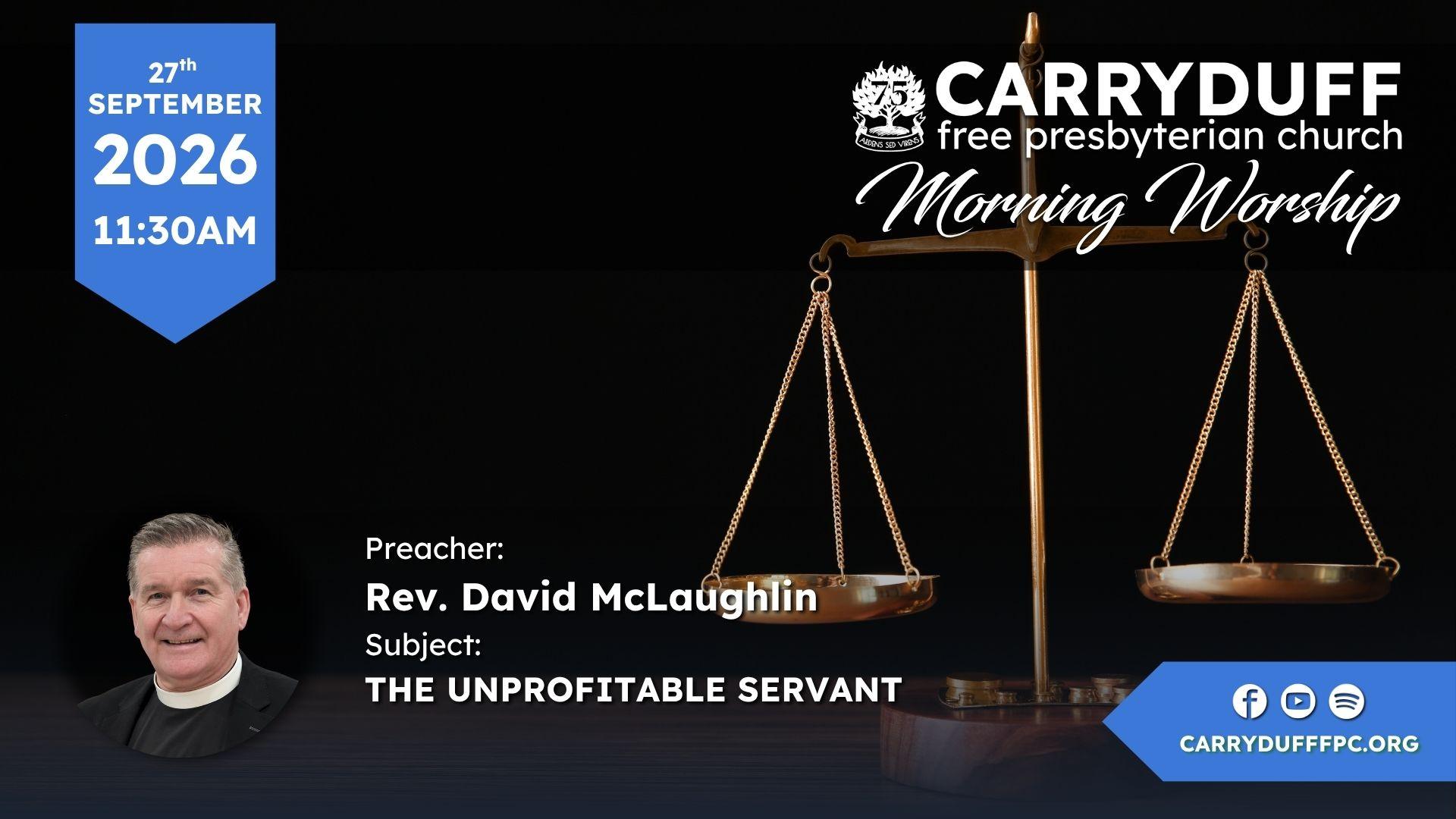

Service Details
Date: SUN 11:30am 27th September 2026
Preacher: Rev. David McLaughlin
Bible Reference: Matthew 25:30
Podcast
Sermon Summary
Introduction and Text
The sermon opens with the reading of Matthew chapter 25, verses 14 to 30, from the King James Bible—the Parable of the Talents. The preacher notes that he has been wrestling with this message since Monday evening and that this is a subject he has not previously attempted to preach. The text proper is taken from verse 30: “And cast ye the unprofitable servant into outer darkness: there shall be weeping and gnashing of teeth.” The message is entitled “The Truth About the Unprofitable Servant.”
The parable is set within Christ’s teaching on the Mount of Olives, where He prepared His followers for three things:
- His second coming
- Their responsibility during His absence
- The certainty of their personal accountability upon His return
This is tied to Romans 14:12—“Every one of us shall give an account of himself to God.” The preacher stresses that he will give an account, and so will every hearer.
The Parable Recounted
A man travelling into a far country entrusts his goods to three servants. One receives five talents, another two, and another one—each according to his ability. The first two servants trade with what they have been given and double it. The third digs in the earth and hides his master’s money.
Upon the master’s return:
- The servant with five talents presents ten and hears, “Well done, thou good and faithful servant… enter thou into the joy of thy Lord.”
- The servant with two talents presents four and receives the identical commendation.
- The third servant returns the same single talent, offering an excuse: “I knew thee that thou art a hard man, reaping where thou hast not sown, and gathering where thou hast not strawed: and I was afraid, and went and hid thy talent in the earth.”
The master calls him “wicked and slothful”, orders the talent taken from him and given to the servant with ten, and concludes with the terrifying sentence of verse 30.
The preacher argues that Christ is not merely telling a good story. He is warning about accountability and eternity, and this verse is, in his estimation, one of the most frightening sentences in the whole Bible.
The Factual Identity of the Unprofitable Servant
The first major heading concerns the identity of this man. The adjectives applied to him—wicked, slothful, unprofitable—are used to define who he truly is. Before establishing the positive teaching, the preacher devotes considerable time to dispelling myths.
Myth One: The Parable Teaches Salvation by Works
The preacher insists that the parable does not teach that a man is saved by producing enough good works. Such a reading contradicts:
- Romans 5:1—“Therefore being justified by faith, we have peace with God through our Lord Jesus Christ.”
- Ephesians 2:8–9—“For by grace are ye saved through faith… not of works, lest any man should boast.”
- Acts 4:12—“Neither is there salvation in any other.”
The biblical order is that believers are justified unto good works, not by them. Ephesians 2:10 is cited: “For we are his workmanship, created in Christ Jesus unto good works, which God hath before ordained that we should walk in them.” Saving faith and good works may be distinguished but must never be separated. Good works never constitute or contribute to the ground of justification. Christ’s blood and righteousness alone are that ground. A genuine state of justification will necessarily produce a life of holiness and sanctification, but justification is not because of good works—it produces them.
Myth Two: A Christian Can Lose His Salvation
Some hold that the wicked servant was a genuine born-again believer who lost his salvation at the judgment—that one may taste the grace of God yet be barred from heaven because of some sin or misuse of a spiritual gift. The preacher rejects this outright. A man genuinely born again of the Spirit, washed in the blood, resting in Christ by faith as Lord and Saviour, can never be lost and end up in hell. A true Christian cannot become an unprofitable servant and be cast into outer darkness.
Myth Three: The Parable Teaches Sinless Perfection
The preacher also denies that the parable demands a state of sinless perfection. Christians will never be perfect this side of eternity; they sin in thought, word, and deed and continually struggle against sin. It is not that one must produce enough fruit and holiness for God to accept and justify him. The preacher states he has rejected all forms of works-based righteousness for years. God saves sinners by grace alone, through faith in Christ alone, and that grace produces a life of obedience and perseverance.
The Westminster Confession of Faith, chapter 16, is invoked: good works are the fruits and evidences of a true and lively faith. Fruits and evidences are not the basis or ground of salvation. Believers are not saved by these fruits but by grace alone, through faith alone, in Christ alone. Yet the preacher adds a caution: far too often in the Protestant Reformed church, the place of good works in the life of a professing Christian has been minimised, and that is wrong. He clarifies that he is not teaching salvation by works, not teaching that one can be saved one day and lost the next, and not teaching sinless perfection.
The Meaning of the Unprofitable Servant
Having dispelled the myths, the preacher turns to the man’s identity positively. He was called a servant. He is not presented as:
- An atheist
- A pagan idolater
- A blasphemer
- A man living in open sin and rebellion against his master
Observe what is true of him:
- He knows his master exists
- He is found among his master’s servants
- He is in his master’s household
- He knows his master
- He has received something from his master
- He has been entrusted with his master’s property
- He knows the master will one day return
- He knows the master is generous
- He appears before his master with an explanation
Yet his actions demonstrate that he did not really know his master. His conduct and his conversation disclose that he was never a genuine servant. At the end he is revealed as unprofitable, wicked, and slothful.
The great warning is this: there is a vast difference between appearing to belong to Christ and actually belonging to Him; between possessing Christian privileges and possessing true saving faith. It is possible to profess to be a servant of Christ and not possess Him—outwardly connected, yet not inwardly converted, not genuinely born of the Spirit.
The preacher interjects a pastoral observation from his own recent experience, expressing heaviness of heart that many Protestant people in Northern Ireland can be described as “Protestant pagans”—people who do not know the God of the Bible as their ancestors did, who do not read the Scriptures and do not attend the house of God on the day of God. He recounts speaking with a secular Muslim man who challenged a woman from Northern Ireland about whether she knew God, went to church, or read her Bible—none of which was true of her life at the time.
The point is pressed home: it is possible to sit under the preaching of the gospel, carry a Bible, sing hymns, attend church, hear sermons, and speak the Christian language, and yet remain outside of Christ. Judas is the great example—he walked with the Lord Jesus, heard His preaching, saw His miracles, took part in prayer meetings, and was numbered among the twelve, yet was not born again. Christ said in John 6:70, “Have not I chosen you twelve, and one of you is a devil?”
The preacher draws a series of contrasts:
- Privileges are not the same as possessing Christ
- Opportunities are not the same as true conversion
- Responsibility is not the same as regeneration
- Similarity is not the same as sameness
James 1:22 is cited—“But be ye doers of the word, and not hearers only, deceiving your own selves.” There is a danger of self-deception. It is easy to deceive one’s neighbour, family, minister, and elder, but deceiving oneself about the state of one’s soul is a far graver matter. Second Corinthians 13:5 is quoted: “Examine yourselves, whether ye be in the faith; prove your own selves.” The challenge is put directly: do you really belong to Christ? And if so, where is the fruit and evidence? This man did not regard himself as wicked or slothful or unprofitable. He had a big excuse. But when the master came, the truth was revealed.
The Field Responsibility of the Unprofitable Servant
The second heading concerns responsibility. The servant’s great failure was not that he had only one talent. The differing amounts—five, two, and one—did not remove individual responsibility. His failure was that he did nothing with what he had received.
The master said: “Thou oughtest therefore to have put my money to the exchangers, and then at my coming I should have received mine own with usury.” The servant had received a talent, was accountable for it, and buried it. He did not lose it; the buried talent remained in his possession. The master did not ask him to produce what had not been entrusted to him.
Key principles are drawn out:
- The man with five was responsible for five
- The man with two was responsible for two
- The man with one was responsible for one
- The master does not require you to be somebody else
- The master does not hold you accountable for someone else’s gifts
- The master requires faithfulness with what He has entrusted to you
First Corinthians 4:2 is cited—“Moreover it is required in stewards, that a man be found faithful.” The servant with five was not to be jealous of the one, nor the one envious of the others. Do not compare yourself with another’s calling, commission, or gifts.
The “talent” is then applied broadly to the whole of life:
- Your time belongs to the Lord
- Your money, all of it, belongs to the Lord
- Your abilities to sing, paint, or cook belong to the Lord
- Your speaking opportunities to do good, especially to the household of faith, belong to the Lord
- Your knowledge of Scripture and of God
- Every spiritual gift
- A loving heart
- An act of random kindness
- A word here or there
- A card in the post
- A telephone message
- A smile
- Your position in the family
- Your responsibility in the church as elder or deacon
- Every witness displayed for Christ
The governing principle is that all these belong to the master. Verse 14—“he delivered unto them his goods”—is the foundation. Every privilege and every gift has been entrusted and carries responsibility and accountability.
The unprofitable servant’s mindset was: I will keep that which I have. I will not use it for my master. It is mine. That, says the preacher, is the essence of sin. James 4:17 is cited—“Therefore to him that knoweth to do good, and doeth it not, to him it is sin.” The man did not lose the talent, did not waste it, and there was no great scandal. He simply buried it. He failed to use it. His dangerous spiritual condition was not open rebellion but religious inactivity. The question is not merely what wrong have I done? but what good have I done with the master’s talents? He refused to do good—the sin of omission.
His excuse condemned him. He claimed the master was a hard man, reaping where he had not sown and gathering where he had not strawed. But if the master were indeed such a man, that should have driven him to greater diligence. He was making an excuse for disobedience, and this is the deceitfulness of sin—it causes a man to justify himself and blame somebody else. Adam blamed Eve, Eve blamed the serpent, Aaron blamed the people over the golden calf, and this servant blamed his master. But that excuse would not stand on the judgment day. He could not say he had no opportunity, no talent, or no responsibility.
The preacher then states the gospel plainly: the gospel is not make yourself profitable to Christ. The gospel is that Christ came and Christ has finished the work; you rest in Christ and receive Christ alone for salvation. But there is a call to every Christian to a life of faithfulness—using what God has given to serve Christ in witnessing, in prayer, giving all you can for the glory of God and the advancement of His work. This ties into loyalty to Christ, labour for Christ, love to Christ, and knowledge of God. It ties into reading and studying the Bible, raising children in the fear of God, encouraging the saints, visiting the sick and needy, supporting the work of the gospel, and faithful attendance at the house of God. Communicants especially are called to set the example. It is not about being famous; it is about being faithful.
The Frightening Tragedy of the Unprofitable Servant
The third heading concerns tragedy. He discovered the truth about himself—from the lips of the master he heard unprofitable, wicked, and slothful—but he discovered it too late. He had opportunity to serve during his master’s absence. The master returned, and the opportunity was gone and finished.
This ties into the doctrine of the second coming of Christ. The preacher affirms belief in the personal, visible, bodily return of Jesus Christ to this earth in power and glory, literally to the Mount of Olives from which He left. In light of that coming:
- The second coming is a certainty and is to be anticipated
- The master is coming
- The master sees you
- The master knows you
- When He comes, out of Christ there is no more opportunity to repent and believe the gospel
- There will be no more gospel invitations
- There will be no more saying “tomorrow” or “another time”
Proverbs is echoed—“Boast not thyself of to-morrow; for thou knowest not what a day may bring forth.” Not only is there no more opportunity to repent, there is no more opportunity to render good works and a life of loving obedience.
This servant may have thought he had plenty of time—someday I will do something with this talent—but that someday never came. Millions say, someday I will repent, someday I will get saved, someday I will serve Christ, someday I will read the Bible. But the Bible says, “Behold, now is the accepted time; behold, now is the day of salvation.” It is the only time guaranteed.
The preacher references a young man named Stephen Park, who went out to work and whose life was taken in an accident at work—called home because he was saved by the grace of God. He asks the young person: what if that had been you?
The unprofitable servant was not merely unproductive. His unproductiveness revealed the true condition of his heart. He did not really know, love, or trust his master. He did not truly fear his master, nor value his master’s honour. One day the master exposed what had been there all along. At the final judgment the books will be opened, and God will be perfectly just and righteous. He will not condemn innocent men; He will judge sinners according to the truth. The servant’s own words testified against him, his conduct in burying the talent, and his conversation revealed the true state of his heart.
The Final Destiny of the Unprofitable Servant
The words are repeated: “Cast ye the unprofitable servant into outer darkness: there shall be weeping and gnashing of teeth.”
Consider what is taught here:
- Outer darkness—a place of complete exclusion from the presence of God
- A place of conscious torment
- A place of weeping and gnashing of teeth
The Lord Jesus spoke plainly about hell. The preacher asserts that every time Christ mentioned heaven, He mentioned hell thirteen times, and asks the hearer to count the references in the Bible. Why? Because He wanted sinners to repent and believe the gospel and urged them to flee from the wrath to come.
An illustration is offered: a man with a deadly disease goes to the doctor, who says an operation is needed and the surgery will be painful. The doctor is not cruel for telling the truth; he is being faithful. Likewise the Lord Jesus is being faithful because He knows the reality of eternal judgment. The servant’s excuse did not save him. One day every excuse will disappear.
The preacher returns to the central question: Do you belong to Christ? Do you know Him? Have you rested in Him? Have you received Him as Lord and Saviour? John 1:12 is echoed—“But as many as received him, to them gave he power to become the sons of God, even to them that believe on his name.” Have the privileges of a Christian home and a Bible-believing church led you to repentance and faith in Christ? Matthew 7:21 is quoted: “Not every one that saith unto me, Lord, Lord, shall enter into the kingdom of heaven; but he that doeth the will of my Father which is in heaven.”
On the final destiny, the preacher is emphatic:
- This is eternal judgment
- There is no second opportunity
- This is not annihilation
- This is not purgatory
- This is not a place of purification for sin
- This is not temporal punishment followed by salvation
Matthew 25:46 is cited—“And these shall go away into everlasting punishment: but the righteous into life eternal.” There are two destinies: eternal punishment and eternal life. The question is where you will spend eternity.
Conclusion
The preacher closes by insisting that salvation is by grace alone, through faith alone, in Christ alone. It is God’s sovereign grace that saves; God’s Spirit regenerates and gives the gift of faith to rest in Christ and receive Him as He is offered in the gospel. In receiving Christ, He gives a new nature, and that new nature produces good works. Believers are not working to become children of God; they labour, loyal and loving, because they are the children of God. They work because they are His.
The sermon ends with a recapitulation of its four movements:
- The factual identity of the unprofitable servant—dealing with the myths
- The meaning of the unprofitable servant—outward profession without inward possession
- The field responsibility—he did not use what he had, and every hearer is responsible to use what God has given
- The frightening tragedy and final destiny—he discovered too late the true state of his heart and was cast into outer darkness
The final question is left with the hearer: Are you His?