
You are warmly invited to our Lord’s Day Services this Sunday at Carryduff Free Presbyterian Church on the Killynure Road.
Come and join us for worship, prayer, and the preaching of God’s Word.
All are warmly welcome.
Tea, coffee, and fellowship will follow after the evening service. We’d love you to stay and join us.
📍 Carryduff Free Presbyterian Church, Killynure Road
🕰️ Sunday at 11:30am & 7:00pm
🍵 Refreshments after evening worship
Service Details
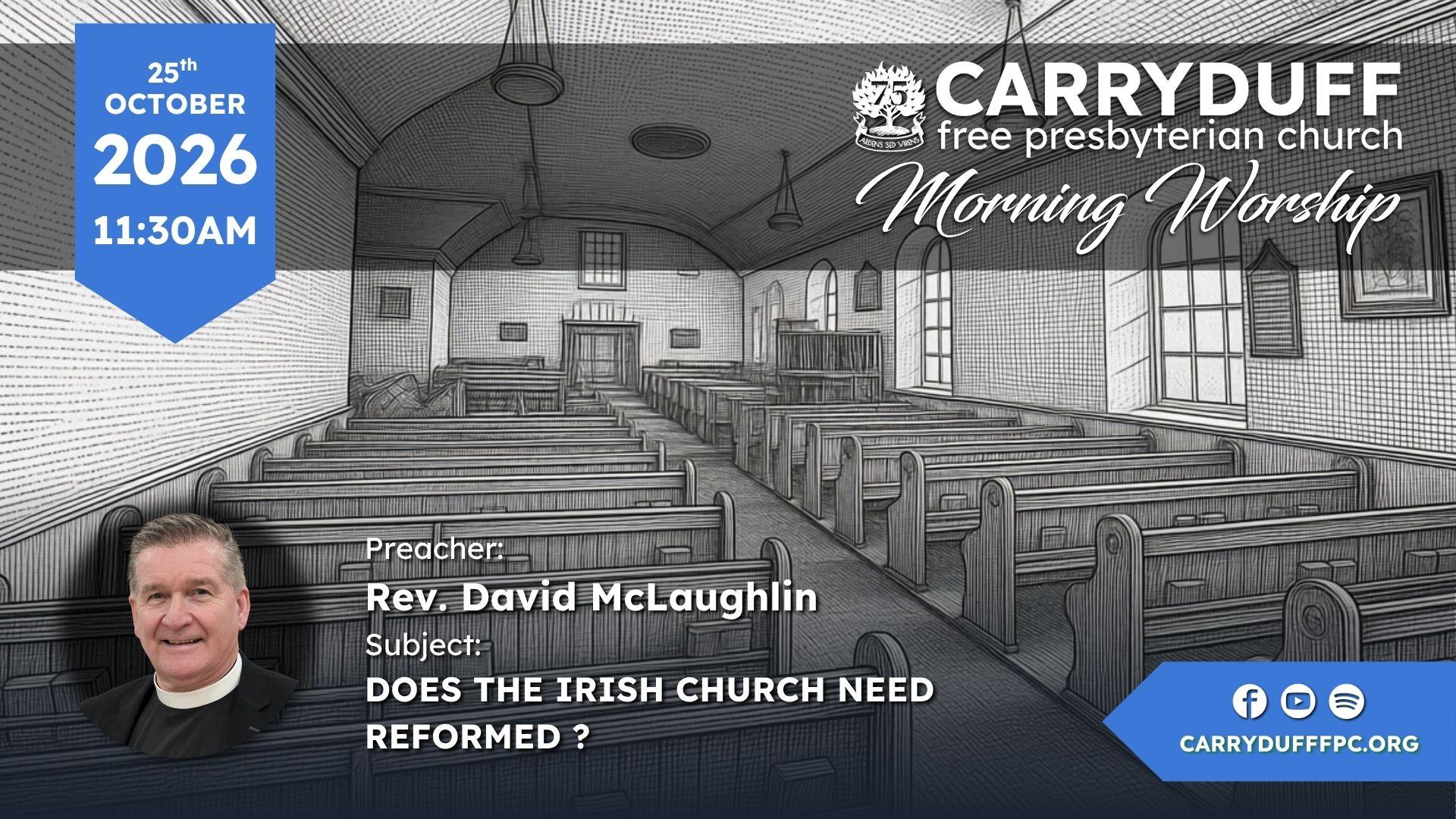
Date: SUN 11:30am 25th October 2026
Preacher: Rev. David McLaughlin
Bible Reference: Revelation 2:4-5
Podcast
Sermon Summary
Introduction
This is a sermon preached on Reformation Sunday, taking its text from Revelation chapter two, verses four and five, in the King James Bible. The scripture reads, “Nevertheless, I have somewhat against thee, because thou hast left thy first love. Remember therefore from whence thou art fallen and repent, and do the first works, or else I will come unto thee quickly, and will remove thy candlestick out of his place, except thou repent.”
The preacher explains that the sermon arises in response to a letter published in a newsletter on 28 January, titled “Irish Christianity has existed for nearly 2,000 years as dying and in desperate need of reform.” Two days later, the Reverend Foster replied, largely agreeing with the letter’s main thesis. The preacher recounts what he describes as divine leading toward this subject: two words coming to mind during prayer around 11 o’clock on a Tuesday night, then coming across a piece of artwork entitled “The Letter” by the late James Bingham, then reading Revelation chapter two after a Wednesday prayer meeting, and finally a reading from Acts chapter nine. He takes all of this as confirmation to address the question directly.
The sermon is framed around the seven letters to the churches in Asia Minor, focusing on the first, written to the church at Ephesus. This church is commended for many qualities, yet the Lord identifies a serious defect: it has left its first love.
The Central Question
The preacher poses a foundational question: can a church, regardless of its denominational name, retain its institution, traditions, buildings, religious activities and ministry, yet lose something of its spiritual life? His answer is a clear yes.
He argues that the real question is not whether the church is popular, influential or rich, but whether it is being faithful to the word of God and the Lord Jesus Christ in the fullness of his personal work. He acknowledges that Bible-believing Christianity has been present on the island of Ireland for nearly two thousand years, tracing its roots to the conversion of Saint Patrick at Mount Slemish, through the early Celtic church and the monastic settlements that followed, and through periods of revival in 1625, 1859 and the 1920s.
However, he insists that longevity alone is not proof of faithfulness. The church at Ephesus was only about forty years old when the Lord sent his letter. The word of God constantly calls individuals and institutions to examine themselves, to see whether Jesus Christ is in them by the new birth.
The question, therefore, is not whether Ireland needs the church, or whether Ireland has the church, but whether the Irish church is faithful to the blood of Christ and the book of God. He states his conviction plainly: the Irish church does not need reinvention, it needs biblical repentance. It does not need relevance in the twenty-first century, it needs revival. There is a vast difference between the two.
The Biblical Principle of Reformation
The preacher argues that reformation is not a modern invention, nor did it begin with Martin Luther nailing his ninety-five theses to the church door at Wittenberg on 31 October 1517. Rather, the Protestant Reformation was a rediscovery of the purest form of Christianity as taught by the Lord Jesus Christ, preached by the apostles and endorsed by the early church, and rediscovered by the godly reformers.
The Reformation is a principle clearly taught in the Bible itself. In the Old Testament, God repeatedly called the children of Israel to repent of sin and return to him. The Old Testament church had drifted into compromise, with idolatry prominent, pride and boasting pre-eminent, and a dead, cold formalism entering into the religious activity, worship, sacrifices and priesthood. Through the prophet Haggai, God said, “Thus saith the Lord of hosts, consider your ways.” They were called to repentance, return, renewal and revival.
Even the church established by the apostles, such as Ephesus, was warned of decline and departure. The preacher cites the apostle Paul at Miletus, speaking to the elders of the church of Ephesus, warning that after his departure grievous wolves would enter in among them, not sparing the flock, and that men would arise speaking perverse things to draw away disciples after them. Paul encouraged the church to stand, reminding them that they wrestle not against flesh and blood but against principalities and powers, and urged them to take the whole armour of God. He prayed that they would be filled with all the fullness of God and know the love of Christ which passeth knowledge.
Forty years later, the Lord came into that same church and said, “Nevertheless, I have somewhat against thee, thou hast left thy first love.”
The principle is this: every church must be and will be examined by the Lord Jesus Christ. Every church will give an account to God, as Romans chapter fourteen verse twelve states, “So then every one of us shall give an account of himself to God.” This is true individually and institutionally.
Biblical reform is not a rejection of all that has passed. At its heart, it is a return to the principle of loving Christ first and foremost, having the love of Christ shed abroad in the heart by the Holy Ghost. Where there is such love, there will be obedience to the word of God. The Lord Jesus said, “If you love me, keep my commandments.” The preacher cites First John chapter two, verse three: “And hereby we do know that we know him, if we keep his commandments.” Keeping the commandments is not the ground or basis of justification, but the evidence of it. As Samuel told King Saul, “To obey is better than sacrifice.”
The call to reform, therefore, is a call to return to sound biblical doctrine, to biblical holy living, and to genuine love for Christ and the things of God.
The Biblical Procedure of Reformation
The preacher identifies the danger the church faces: because it has left its first love for Christ, it is prone to elevating tradition above the Bible. He cites Mark chapter seven, verse thirteen, where the Lord Jesus warns against “making the word of God of none effect through your tradition.” The scribes and Pharisees, through their tradition, were making the word of God of none effect, not rightly applying it to their hearts and lives.
True reform requires that every belief, every practice, all church structures, programmes and activities be tested and grounded on the word of God, as Isaiah chapter eight verse twenty states. This applies across denominational lines, whether Presbyterian, Free Presbyterian, Methodist, Baptist, Pentecostal, Evangelical Presbyterian, or any independent evangelical church.
Dangers Identified
The preacher outlines several specific dangers facing the church:
- Tradition above Scripture: doing something simply because it is traditional, even if it is contrary to the word of God.
- Scripture replaced by scholarship: modern, critical thinking in the church, where human reasoning sits in judgment over the Bible. He recalls that the first thing the devil said to Eve in Eden was, “Yea, hath God said?” He takes issue with textual criticism and progressives who question the verbal and plenary inspiration of the Bible, arguing this has undermined the authority of scripture and led to disbelief of cardinal doctrines.
- Denial of core doctrines: men standing in pulpits and denying the eternal sonship, the incarnation, the virgin birth, the essential deity of Christ, his atonement, and his bodily resurrection. This has weakened gospel preaching, with many churches offering no call to repentance, no exposure of sin, no call to personal faith, and no mention of the wrath of God, heaven or hell.
- Cultural Christianity: a form of Christianity that is not Christ-centred. He insists that salvation is by grace alone, through faith alone, in Christ alone, as revealed in the Bible alone. Salvation is not inherited through family ties or blood, not bestowed by the hands of a man, and not by the will of man, but of God. He cites the account of Nicodemus, a very religious man, to whom the Lord Jesus said, “You must be born again.”
Four Things to Be Emphasised
The preacher lists four things that must be constantly emphasised from the pulpit:
- The necessity of regeneration by the Holy Ghost, where sinners receive a new heart, a new will and a new mind, for they are dead, blind and diseased, and only God the Holy Spirit can regenerate the dead sinner.
- True repentance, which involves a hatred for sin and a turning from it.
- True faith in Christ, requiring explanation of the nature, need and use of faith.
- Real evidence of a transformed life, for if any man be in Christ he is a new creature, and all things have passed away.
He laments that these things have not been preached in many pulpits that allegedly make up the Irish church.
Contemporary Controversies
The preacher moves to the cultural practices entering the churches, including debates about biblical authority. He recounts that some say, “That’s what those Free Presbyterians say. They’re entitled to their opinion, but don’t believe them, ’cause we don’t believe that.” He raises questions about human sexuality and gender roles in church and leadership, including women in the pulpit and women elders. He notes that some say, “You’ve gotta go with the times, Reverend,” but insists this is not a sign of the times or an adaptation of the times, but a direct, blatant contradiction of the word of God, a departure from the Bible.
He cites First Timothy chapter two, verse twelve, where Paul says, “But I suffer not a woman to teach.” He anticipates the objection that Paul was an ignorant pig or against women, and answers that this is a question of headship, because Adam was first formed, then Eve, and because Eve sinned. He argues the argument must be taken back to Eden. A church which begins to affirm what God condemns is not just fallen into error, but is in rebellion to God.
He also raises the debate about which version of the Bible to use, arguing that many churches have rejected the King James Bible to their own detriment, entering a rash of new versions far removed from the original Hebrew and Greek, which he calls a perversion.
He identifies further dangers:
- Theological liberalism
- Social progressive ideology
- The acceptance of LGBTQ plus
- Debates about adopting the ecumenical movement
- Charismatic confusion
He states that any church going down that road will have a word written above the door: Ichabod. Such a church may carry on religious activity, but the presence and power of God is missing, and Christ is outside. It may retain its buildings, numbers, elders, committee and academia, yet it has left its first love and lost the presence and power of God.
The Duty of Reformation
The preacher turns to how reform should be implemented. Reformation is not an innovation but a repentance and a return to the Lord. The church must return to its first principles, remember what has been lost, repent of what is wrong, and have the courage to admit that certain things are sin, whether pride, idolatry, or past failings and shortcomings. It must not defend these things, but return to faithful obedience.
He identifies three forms of reform:
- Doctrinal reform: the church must proclaim the gospel faithfully, preaching the necessity of the new birth, repentance, true faith and a transformed life, and return to biblical preaching with “thus saith the Lord.” He cites Second Timothy four, “Preach the word,” and insists on standing for the infallibility, inerrancy and authority of the Bible alone.
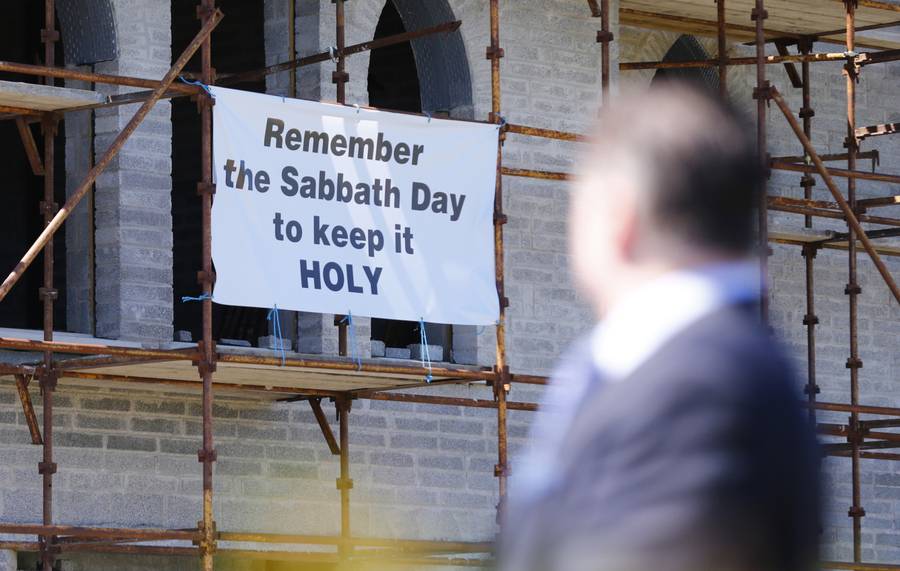
- Spiritual reform: the church’s aim should be to form disciples who live by the word of God. Out of love for Christ, the believer lives by the word, as man shall not live by bread alone but by every word that proceedeth out of the mouth of God. The believer will come to worship God, remembering the Sabbath day to keep it holy, aspire to be filled with love for Christ, and press on even in times of despair, looking to the Lord for grace, for “my grace is sufficient for you.”
- Moral reform: sin must be repented of, and this applies to the minister, the elders and the deacons. They must demonstrate integrity, accountability and credibility, both in the church and outside it. They must not compromise Christian convictions and must serve the Lord in fear and out of love, with a sense of compassion and justice.
He insists that reform must begin with the individual. Before asking what is wrong with the church as an institution, one should ask, “Lord, what’s wrong with me?” This applies to minister, elder and committee alike, concerning attitude, behaviour, work, witness and walk. When one starts with oneself, it makes a great difference.
The Biblical Properties of Reformation
In the final section, the preacher emphasises the properties the church must recover.
The Authority of Christ
The church must recover its stand for the authority of Christ, who walks in the midst of the lampstands. The church belongs to Christ, he is its sole head and only king, and every congregation is examined by, accountable to, and tested by him and the scriptures of truth. The church must ask whether it is allowing Christ to govern it through his word, rather than placing tradition or cultural Christianity above the Bible. The preacher warns that slippage has already begun in some Bible-believing churches, and the seeds of decay are being sown, citing women in the eldership and pulpit, the deliberate removal of the King James Bible from the pew, no stand taken for biblical head covering, contemporary worship devoid of biblical theology, and churches embracing liberalism, woke-ism and LGBT-ism. He names churches in Belfast that affirm these things.
Biblical Truth and the Christ-Centred Gospel
The church must recover its stand for biblical truth, for the battle for the Bible goes on in every age. It must recover its stand for the Christ-centred gospel: salvation by grace alone, through faith alone, in Christ alone, revealed in the Bible alone, to the glory of God alone. He affirms a full, free and forever justification, grounded always and only in the finished work of Christ, received by faith alone.
Prayer
The church must recover its stand for prayer, recalling that in Genesis chapter four men began to call on the name of the Lord. He asks where the prayer meetings are, and urges that if the church needs reform, the people should flock to the prayer meeting and cry to God to visit them, to return with power and with his presence.
Humility
The church must recover its stand for true humility and repent of pride. He asks what the church has to be proud of or boast in, noting the tendency of the human heart toward pride. The church must humble itself before the Lord and stop pretending it is wiser than or knows better than God, for all it has is in him and all it has is by grace, sovereign grace.
Love for Christ
The church must recover its love for Christ, a heart relationship with him, not forced or by personality, but by the Spirit, for “not by might nor by power, but by my Spirit, saith the Lord.”
Godly Leadership
The church must recover its stand for born-again, godly leadership, characterised by humility, honesty and holiness, with church leaders modelled on Christ. The preacher insists these are not secondary issues but doctrinal ruptures happening in the church, rooted in the question of biblical authority.
Biblical Holiness
The church must recover its commitment to biblical holiness, with the motto “holiness unto the Lord.” There must be clear teaching on sin, clear calls to separation from worldliness and apostasy, and pastors must have the courage to confront sin, error and immorality. He cites First Peter chapter one, verse fifteen, and Proverbs, “Righteousness exalteth a nation, but sin is a reproach to any people.”
The Great Commission
The church must recover its calling to the great commission, to go into all the world and preach the gospel, making disciples, as recorded in Matthew chapter twenty-eight, verses nineteen to twenty.
Separation and the Call to Repentance
The preacher addresses what happens if a church refuses to repent. In that case, he argues, there is a call to separate from it. This is not schism but biblical, citing Second Corinthians chapter six, verse seventeen. Separation is a big chance to Christ, staying in is a form of endorsement, and silence is complacency. He cites the birth of the Free Church in 1951, the Church of Scotland continuing, and the existence of the evangelical church in Northern Ireland, insisting these were not acts of pride or prejudice but of conviction and love for Christ.
He reflects on the symbol of the burning bush in the pulpit, which he says stands for fidelity to the word of God, endurance under conviction, refusal to compromise, separation from false doctrine, and confidence in the word of God and the personal word of Christ.
He acknowledges that the letter writer spoke of the Judeo-Christian world crumbling all around, but recalls that the Bible says, “If the foundations be destroyed, what can the righteous do?” Yet there is one foundation that cannot be destroyed: Jesus Christ. Another foundation that cannot be destroyed is the infallible word of God, for the scripture cannot be broken.
He asks how many deny what the burning bush represents, and how many have a form of godliness while denying the power of God. The church should aim to persevere in the authority of the Bible, stand for biblical preaching, maintain a male eldership, maintain holiness unto the Lord, and maintain prayer and a true mission to go into all the world and preach the gospel to every creature, all out of a heart that loves Christ.
Conclusion
The preacher concludes with a clear answer to the question. Yes, the Irish church needs reform. It needs this principle rediscovered, it must follow this procedure doctrinally, spiritually and morally, and it must embrace these properties, recovering them to the glory of God.
The sermon closes with a prayer, asking the Lord to take what has been of himself, to apply his word, and to help each person, before examining the church, to examine their own hearts and ask whether they genuinely and really love Jesus Christ. The preacher prays for the grace of the Lord Jesus Christ, the love of God, and the communion of the Holy Spirit to be upon the congregation both now and forevermore, and concludes with “Amen.”
Key Themes
- Biblical authority: the Bible alone is the standard of belief and behaviour, and must not be elevated above tradition, scholarship or cultural trends.
- First love: the central danger is leaving one’s first love for Christ, substituting religious activity for genuine spiritual devotion.
- Repentance and return: reformation is a return to first principles, not innovation or reinvention, and begins with the individual.
- Doctrinal fidelity: the church must stand for the gospel, the new birth, repentance, true faith and transformed lives.
- Separation: churches that refuse to repent must be separated from, as a biblical duty rather than an act of schism.
- Holiness and mission: the church must recover prayer, humility, godly leadership, holiness and the great commission.