
Service Details
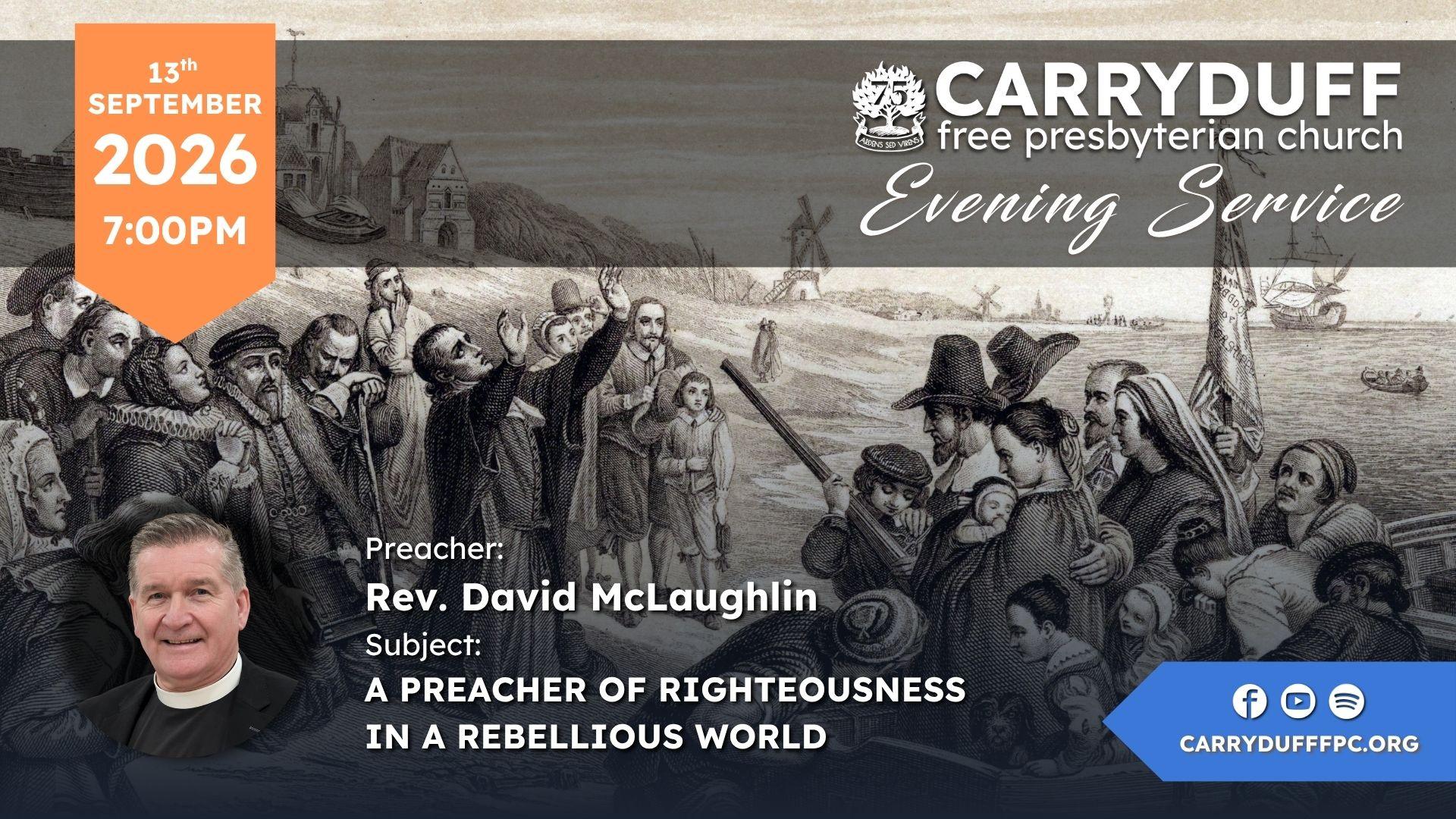
Date: SUN 7:00pm 13th September 2026
Preacher: Rev. David McLaughlin
Bible Reference: 2 Peter 2:5
Podcast
Sermon Summary
Introduction
This sermon is based on 2 Peter 2:1–13, with the central text taken from verse 2, which speaks of false teachers and the way in which “the way of truth shall be evil spoken of.” The preacher’s theme is drawn from verse 5, where Noah is described as “a preacher of righteousness,” and the message explores what it means to stand faithfully for God in a world that has rejected Him.
The opening reading establishes the context. Peter is warning the church about false teachers who will “privily”—secretly or stealthily—bring in “damnable heresies.” These teachers deny the Lord who bought them, reject the atonement of Christ, and dismiss the necessity of true conversion. Peter’s language is strong: he speaks of their “swift destruction” and declares that “their damnation slumbereth not.”
The preacher notes that Peter does not describe these false teachers as merely mistaken, nor does he suggest they hold one valid viewpoint among many. Instead, Peter condemns them outright. This, the preacher argues, is the language of the Holy Ghost—the language of God Himself.
The Question of Divine Delay
A key issue Peter addresses is the problem of God’s apparent delay in judgement. Many Christians are tempted to ask: if God really is going to judge sin and wickedness, why does He not do so now? Why do false teachers prosper, gaining millions of followers and great wealth, if they stand condemned before God?
Peter’s answer is to take his readers back through history, showing what God has already done:
- The angels who sinned were cast down to hell and reserved unto judgement.
- The old world was not spared, but destroyed by the flood.
- Sodom and Gomorrah were turned to ashes as an example to the ungodly.
- Yet righteous Lot was delivered.
The central lesson is this: God’s apparent delay is not the defeat of justice. His judgement is often delayed, but it is never denied. God’s patience must never be mistaken for powerlessness.
The State of the Old World
Peter takes his readers back to Genesis 6, to a civilisation so corrupt that “every imagination of the thoughts of his heart was only evil continually” (Genesis 6:5). This was not a world suffering from a few bad individuals; the whole of civilisation was corrupt. Violence filled the earth, sin was celebrated, God was forsaken, and truth was trampled underfoot.
Yet in the midst of that generation stood one man: Noah. His name means “rest” or “comfort,” and Peter gives him an extraordinary job description—he was a preacher of righteousness.
The Preacher That Is Mentioned
The sermon notes that this is the last reference to Noah in the Bible, which makes it significant. The preacher provides a summary (adapted from the notes of the late John Douglas) of the various references to Noah throughout Scripture:
- Genesis 6:8–9 — Noah walked with God. He found grace in the eyes of the Lord and was a just man, perfect in his generation.
- Isaiah 54:9–10 — The waters of Noah. The universal flood that changed the whole earth is described as “the waters of Noah.”
- Ezekiel 14:14 — The worth of Noah. He is mentioned alongside Daniel and Job, two other great Old Testament characters.
- Matthew 24:37 and Luke 17:26–27 — The witness of Noah. The Lord Jesus Christ Himself referenced Noah, saying that the days of the coming of the Son of Man would be as the days of Noah.
- Hebrews 11:7 — The warning of Noah. By faith, Noah was warned of God concerning things not yet seen, and built the ark to the saving of his house.
- 2 Peter 2:5 — The work of Noah. This final reference reveals new information not previously disclosed: Noah was a preacher of righteousness.
The preacher observes that six is the number of man, and Noah was a man called and commissioned by God. He was a saved man, a man who walked with God, a man of great worth, who lived in the fear of God and witnessed for God by his life and testimony.
Every piece of timber he placed in the ark and every nail he hammered home was itself a warning: flee from the wrath to come, repent and believe the gospel. Yet his life’s work is summed up in the final text that mentions him—he was a preacher of righteousness.
The Profession That Is Stated
The People He Preached To
Noah preached to the old world, the world of the ungodly. Peter begins with judgement: “spared not the old world.” The preacher emphasises that the Bible always explains God’s judgement by first beginning with God’s character.
God is holy, and God hates sin. His holiness and justice demand that sin be punished, for “the wages of sin is death.” Before the flood, the earth was “corrupt before God” and “filled with violence” (Genesis 6:11). The key point is that the earth was corrupt before God—men may hide their sin from their wives, their families, their friends, their neighbours, and even their pastor, but they cannot hide it from God.
The preacher cites Psalm 90:8: “Thou hast set our iniquities before thee, our secret sins in the light of thy countenance.” God has a book with every person’s name on it, and every sin and thought is recorded there. Nothing is hid from God.
The sermon addresses the modern tendency to deny sin, to view it as relative, and to ask, “Who are you to judge me?” But the absolute holiness of God and the absolute standard of His law remain. The flood was not an accident or a natural disaster—it was divine judgement. As Spurgeon said, God’s holiness cannot be separated from His love or His righteousness.
The preacher contrasts the God of the Bible with heathen deities. God is not defined by feeling, by the ideas of man, by university professors, or by what seems best to us. He is defined by His Word. As Psalm 145:17 declares, “The Lord is righteous in all his ways, and holy in all his works.”
The Practice He Performed
A preacher is a herald—someone appointed to announce publicly the message of the king. The preacher is not there to preach his own opinion but to preach faithfully what God says. The sermon laments the absence of such preaching in the present age and calls for a new generation of preachers who will:
- Stand in the pulpit and tell the truth, the whole truth, and nothing but the truth.
- Expound the Scriptures.
- Expose sin.
- Exalt the Saviour in His person and work.
- Explain the way of salvation.
Noah was not merely saved from judgement; he was sent into the midst of those under judgement. This was his calling. God gave him a message, and he preached it. Noah is too often associated only with building the ark, but in building the ark he was first and foremost a preacher.
The Principles He Preached
Noah preached righteousness—a word that goes to the heart of the gospel and embodies the whole counsel of God. His preaching covered several aspects:
- The righteousness of God — He preached that the Lord is righteous (Psalm 145:17).
- Right living — He declared that some things are right and others wrong, calling people to repent of sin.
- The righteousness of God in Christ — He preached the righteousness available through faith.
The preacher draws parallels with other biblical figures:
- David preached righteousness in the great congregation (Psalm 40:9).
- Paul reasoned of righteousness, temperance, and judgement to come before Felix, causing Felix to tremble (Acts 24:25).
- Paul described the righteousness “which is through the faith of Christ, the righteousness which is of God by faith” (Philippians 3:9).
Noah knew he could preach about the righteous God and His holy standard. But he also preached the righteousness of God by faith. In Noah’s day, salvation was found in the ark, which was a type of Christ. God is satisfied only with His own righteousness—our righteousness is as filthy rags (Isaiah 64:6). The best of man’s righteous acts are disqualified and far from any hope of acceptance.
The sermon emphasises justification by faith alone, citing Galatians 2:16. Noah told man about a righteousness adequate and acceptable to God, available through faith in Jesus Christ—through His birth, His sinless life, His atoning death, and His once-for-all sacrifice for sin. The preacher also cites 2 Corinthians 5:21: “For he hath made him to be sin for us, who knew no sin; that we might be made the righteousness of God in him.”
This righteousness is received in three ways:
- Infused righteousness in the new birth, as the righteous nature of God is implanted within.
- Imputed righteousness, as the righteousness of God is put to the believer’s account by faith.
- Imparted righteousness in sanctification, as the believer is compelled toward holy living.
The Period He Preached
Noah was about 600 years old when he entered the ark, and the Bible teaches that he spent 120 years building it. This means he began preaching at around 480 years of age. He was an old stalwart for God, labouring in the Lord’s name for 120 years as a preacher of righteousness.
Every word was about the righteousness of God. Every piece of timber, every nail, every hammer blow was a visible proclamation that judgement was coming, that God is holy and right, and that men must repent. In one hand he preached wrath, and in the other he preached mercy—and combining the two was the righteousness of God.
The Contemporary Application
The preacher draws a direct parallel between Noah’s world and the present day, citing the Lord’s own words: “as it was in the days of Noah, so shall it be in the days of the coming of the Son of Man.”
He lists the sins of the modern age:
- Abortion, which he calls murder.
- The advocacy of the LGBT+ agenda and the redefinition of biblical marriage.
- Those who cannot define what a woman is.
- The explosion of gambling, drunkenness, drug addiction, pornography, Sabbath-breaking, adultery, and fornication.
Those who promote such sin, he argues, have no place for God or His truth. When confronted with the Bible or the need for conversion, they reject it, saying they cannot and will not believe. Wickedness is embraced, and people are full of pride, convinced they are right. This, he notes, describes the majority—just as in Noah’s day.
The preacher poses a challenge: who is right—the Bible or the opinions of man? He recounts telling a young man that Jesus Christ is either Lord, lunatic, or liar, and he must choose one. The preacher’s own conviction is clear: Jesus Christ is Lord.
The Principle That Is Highlighted
Noah preached for 120 years, yet very few repented and believed. Only eight people were saved in the ark. He was in the minority; the majority did not enter.
Yet the principle highlighted is this: Noah faithfully continued. He faithfully preached and faithfully warned despite the apparent lack of response. Faithfulness to God is not measured by visible results. The preacher’s responsibility is faithfulness, not numerical success—it is God who gives the increase.
Noah could not awaken a single soul, regenerate a single sinner, or force anyone to repent. This stands in contrast to an age driven by results, where missions are measured by how many profess faith. The preacher insists it is not a matter of numbers but of faithfulness in an ungodly day.
Conclusion and Appeal
The sermon closes with the contrast at the heart of the text: “spared not the old world” (a multitude) but “saved Noah the eighth person” (one man, a preacher of righteousness). A saved man stood against a multitude, faithfully warning them to flee from the wrath to come.
The preacher then makes a direct appeal to the unconverted, asking why they have not come to faith in Christ. He urges them to repent, to get right with God, and to receive the Saviour. The Saviour is like an ark—an ark of salvation—and those who hear must receive Him and rest in Him, knowing the righteousness of God by which they may be accepted with the Father.