
Service Details
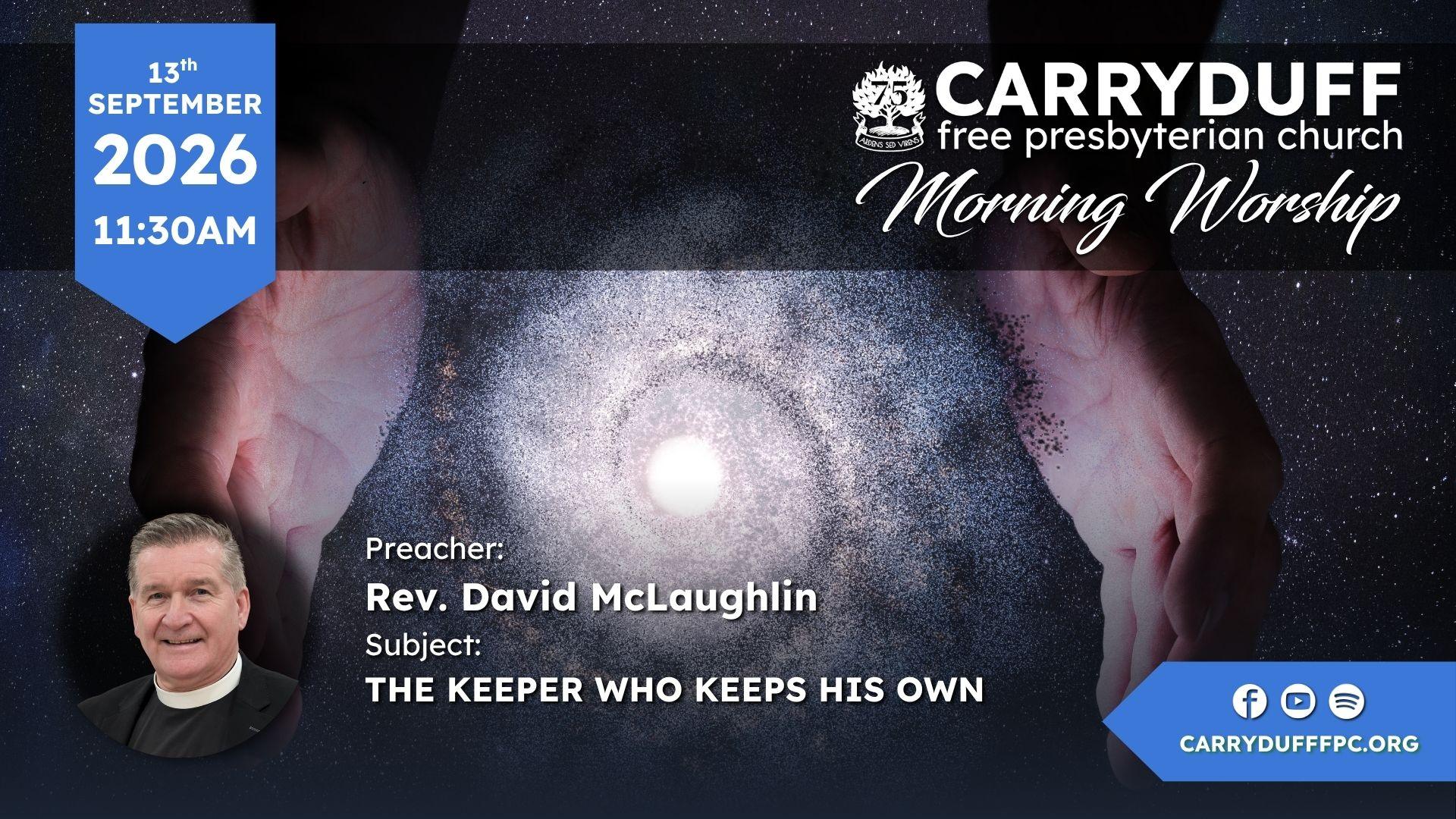
Date: SUN 11:30am 13th September 2026
Preacher: Rev. David McLaughlin
Bible Reference: Psalm 94:14-15
Podcast
Sermon Summary
Introduction and Reading
The sermon opens with a reading of Psalm 94 in its entirety, after which the preacher identifies his text as verses 14 and 15:
“For the Lord will not cast off his people, neither will he forsake his inheritance, but judgment shall return unto righteousness, and all the upright in heart shall follow it.”
The message is framed as one of a series of “miscellaneous messages” delivered as the Lord gives help, without a fixed expository programme. Its central theme is stated plainly: there is a sovereign keeper who keeps his own.
The Dark Atmosphere of the Psalm
The preacher begins by drawing attention to the striking contrast between the opening of the Psalm and the verses chosen as the text. The Psalm commences in what he describes as “a very different spiritual atmosphere.”
The Psalmist’s Cry
The preacher asks the congregation to picture the Psalmist in prayer, likely in a room in the palace, crying out:
“O Lord God, to whom vengeance belongeth… show thyself, lift up thyself, thou judge of the earth.”
He emphasises the raw emotion of that opening cry — the “O” wrenched from the heart — and the Psalmist’s desperate appeal to God as judge. The Psalmist’s problem is clear: he looks around and sees the wicked prospering, triumphant, boasting, and speaking arrogantly against the people of God.
The Mockery of the Wicked
The wicked are quoted as saying, “The Lord shall not see, neither shall the God of Jacob regard it” — in other words, their God is blind, indifferent, or absent. The righteous, meanwhile, are being afflicted:
- The wicked “break in pieces” God’s people
- They afflict God’s inheritance
- They slay the widow and the stranger
- They murder the fatherless
The mockery is pointed: the wicked tell the righteous they are foolish for trusting in God, mad for living a religious life, and that bearing testimony to God’s saving and keeping power is sheer folly.
Application to the Present Day
The preacher insists such things are said about believers today, and when they are, believers feel terrible. He acknowledges the honest emotions that arise:
- Sadness
- Bad feeling about what is said
- Anger
- The inward cry: “Lord, where are you? Have you forsaken me? Why don’t you confront this evil? Why are you silent?”
The Wickedness of the Age
The preacher broadens the application to the present generation, citing Isaiah’s warning from seven centuries before Christ:
“Woe unto them that call evil good and good evil, that put darkness for light and light for darkness.”
He observes that the wicked in our day, as in Isaiah’s and David’s day, have become more blatant, more bullish, and more boastful. Wickedness has been enshrined in legal code — a reference to verse 20 of the Psalm, which speaks of “the throne of iniquity” that “frameth mischief by a law.” The preacher notes that the ungodly are using the courts to promote sin and wickedness in the land.
A Spiritual War
Central to the sermon is the assertion that believers are engaged in a spiritual war. Quoting Ephesians 6:12, the preacher reminds the congregation that “we wrestle not against flesh and blood, but against principalities, against powers, against the rulers of the darkness of this world, against spiritual wickedness in high places.”
The church, he says, is in a life-and-death struggle against the devil and every minion of hell. Tragically, many men and women — the great and the good, the high and the low born — have allowed themselves to become tools of the devil, agents of Satan, busy promoting sin and wickedness.
The Folly of the Wicked
The tragedy, the preacher explains, is that the wicked have not only forsaken God but have forgotten God and his law. They mistake:
- God’s patience for partisanship
- God’s delay for defeat
David, however, knows better. He reminds himself in verses 8 and 9 that God sees and knows everything:
- He that planted the ear, shall he not hear?
- He that formed the eye, shall he not see?
- He that teaches man knowledge, shall he not know?
The conclusion is that God is not absent, not indifferent, not silent, and has not abdicated his throne. He is on the throne in absolute sovereign control.
The Certainty of the Keeper’s Power
The preacher now turns to the text itself, identifying several elements.
The Sovereign Person
The word “Lord” appears in capital letters, which — as he reminds the young people — denotes Jehovah, the covenant-keeping God of Israel. This connects deliberately to Psalm 121, sung earlier in the service, particularly verse 5: “The Lord is thy keeper.” The point is that the Bible teaches not only “the Lord is my shepherd” but also “the Lord is thy keeper.”
The Saved People
The people spoken of in the text are “his people” — a people in a particular relationship with God:
- A pardoned relationship — they are born again of the Spirit, born from above, washed in the precious blood of Christ by faith.
- A powerful relationship — they recognise God as their creator and maker, who holds their very breath in his hand. It is the hand of mercy that keeps all men alive, even keeping the wicked out of hell.
- A peculiar relationship — their motto is “holiness unto the Lord”; they put the Lord first and have discovered that man’s chief end is to glorify God and enjoy him forever.
The preacher is emphatic about how these people became his. It is not by:
- Their own birth
- Being brought up in a religious or Christian home
- Attendance at a particular church
- Merit or works-based righteousness
- Religious rites or ceremonies
Rather, they are his by the new birth, by the blood-mark placed upon them, by the love of God shed abroad in their hearts, and by sovereign choice — citing Ephesians 1:4, “he hath chosen us in him before the foundation of the world.”
The Secure Provision
The text does not say the Lord will “probably” not cast off his people, nor “might not,” nor “certainly will not if they perform.” It is emphatic: “the Lord will not cast off his people, neither will he forsake his inheritance.”
The preacher draws a crucial distinction:
- The believer’s confidence does not rest on their grip on God
- It rests on the strength of the Lord’s grip on them
The believer is not dangling at the end of a rope, holding on by the fingertips. Rather, they are in his hand. Quoting John 10:27–28, the preacher reminds the congregation that the sheep hear Christ’s voice, are known by him, follow him, receive eternal life, and “shall never perish, neither shall any man pluck them out of my hand.”
A Searching Question
The preacher pauses to apply the truth:
- Do you know him?
- Do you belong to him?
- Do you see yourself as his — one of his people, part of his inheritance?
He reminds the congregation that all are sinners with immortal souls, all need to be saved, all need to repent and put faith in Jesus Christ as Lord and Saviour, all need to rest on him, receive him, and rejoice in his work.
The Clarity of the Keeper’s Promise
The preacher now examines the specific words of the promise.
“Cast Off”
The word “cast off” means thrust forth, put away, or removed — but with a deeper nuance. It evokes the image of someone misbehaving in a restaurant or establishment, and a bouncer roughly handling them, grabbing them by the scruff of the neck, striking them, and throwing them out into the street.
The preacher illustrates this with a personal recollection of “Constable Love” in Coleraine many years ago — a large constable whose blows, delivered in a pub, would knock a man out onto the street. He recalls prison services at the Gilligan with Reverend Wesley Beadle, where the prisoners loved singing “Love Lifted Me” — not thinking of Christ, but of Constable Love lifting them down about Coleraine.
The clarity of the promise is this: the Lord will not do that. He will not:
- Remove someone from his family
- Throw them away
- Disown them
- Disregard them
- Thrust them out
“Forsake” and “Inheritance”
The word “forsake” is synonymous with “abandon” — the Lord will not abandon his inheritance. The preacher explains inheritance with the familiar image of a will being read and a gift bequeathed — a car, jewellery, money, a house, or land — which, through a legal process, becomes the rightful possession of the recipient.
In the same way, the Lord says of his people, young and old, rich or poor: “You belong to me. I have called thee by thy name. Thou art mine.”
The Emphatic Nature of the Promise
The preacher insists the inspired writer is being deliberately emphatic. Literally, under no circumstances will the Lord cast off or thrust out his people or abandon his inheritance.
Anticipating the objection — “What if they sin against him?” — the preacher responds with a truth he says he emphasised at Sadie Graham’s graveside service: there is no such thing as a perfect Christian. A Christian can be:
- Passionate
- Practical
- Prayerful
But never perfect this side of eternity. Believers still sin in thought, word, and deed, even though born again and washed in the blood. Quoting 1 John, he reminds them that if any man sin, “we have an advocate with the Father, Jesus Christ the righteous.” Daily cleansing is needed — not to be saved all over again, but to maintain fellowship.
The Example of Peter
Doubts will arise, fears will overcome the heart, there will be downcast times and despair, and faith will be weak. The preacher cites Peter, who denied the Lord three times with oaths and cursings. Yet the Lord never denied Peter. He looked at him, said nothing, and Peter wept. The Lord forgave and restored him.
He closes this section with Hebrews 13:5 — “I will never leave thee, nor forsake thee” — noting that in the Greek, the word “never” is so emphatic it is repeated five times: “I will never, never, never, never, never leave you.”
The Lord says:
- I am with you
- I am for you
- I am near you
- You belong to me
This is reinforced by Romans 8, from “who is he that condemneth?” through to the triumphant conclusion that nothing — tribulation, distress, persecution, famine, nakedness, peril, sword, death, life, angels, principalities, powers, things present or to come, height, depth, or any other creature — “shall be able to separate us from the love of God which is in Christ Jesus our Lord.”
The Chastening of the Keeper’s Purpose
The preacher places the promise in its context by looking at verse 12:
“Blessed is the man whom thou chastenest, O Lord, and teachest him out of thy law.”
A Remarkable Statement
He observes that this is not how the natural man thinks. We normally think of blessing as:
- Prosperity
- Comfort
- Plenty of money
- Pleasant circumstances
- A house, car, or holiday
Yet the Bible declares there is a blessing in God’s discipline. How can this be?
The Father’s Hand, Not the Executioner’s
The key is that God’s chastening is not the hand of an executioner punishing wrongdoing, but the chastening hand of a father. It is painful, but it is not the anger of an enemy — it is the discipline of a loving father. Quoting Hebrews 12:6, “whom the Lord loveth he chasteneth, and scourgeth every son whom he receiveth.”
The preacher addresses the lie that when something bad happens, God must be against us, must have stopped loving us, or does not care. The truth is that God is holy and hates sin, and may be against the sin we commit without being against us — because we belong to him.
Two Illustrations
- The gardener prunes the vine because he intends fruit in it.
- The surgeon cuts a patient because he intends healing. The patient in the hospital bed might think, “Why the knife, doctor? Do you intend to hurt me?” But the surgeon’s purpose is to heal, not to destroy.
The application is that God’s providence is infinitely wiser than a man’s surgery. Providences are painful, but they are not pointless.
The Example of Joseph
The preacher turns to Joseph, whose dark providence included:
- Being sold into slavery at seventeen
- False accusation by Potiphar’s wife
- Imprisonment for thirteen years
- The butler’s forgetfulness after Joseph interpreted his dream
The preacher wonders whether Joseph, in those prison walls as the door shut at night, thought God had forgotten him. But the prison was not the end of the story — the pit, the prison, and the slavery were all part of the story. Joseph could say at the end of his life, “Ye meant it for evil, but God meant it for good.”
The lesson is that God has a greater purpose in providence: “We see the fragments; God sees the whole. We see the threads; God sees the tapestry.”
The Care of the Keeper’s Provision
Looking at verse 13 — “that thou mayest give him rest from the days of adversity, until the pit be digged for the wicked” — the preacher addresses the reality of adversity.
No Trouble-Free Life
He asks whether anyone has been offered or promised a trouble-free life, reminding the congregation of Christ’s words: “In the world ye shall have tribulation, but be of good cheer; I have overcome the world.”
The child of God is attacked by the world, the flesh, and the devil — but is never abandoned. There is a crucial distinction between being attacked (which is certain) and being abandoned (which is impossible).
Through the Fire and the Flood
God promises to take his people often through the fire and the flood, but in them they are not alone: “Fear not, for I am with thee.” The example of Shadrach, Meshach, and Abednego is cited — God could have prevented their being thrown into the furnace, but allowed it so that others might see “four men loose, walking in the midst of the fire.”
In the Christian experience there is no deliverance from the valley experiences, but there is the shepherd’s presence in them. Quoting Psalm 23, the preacher notes that the assurance is not that we will be spared the valley, but that “thou art with me.”
A Word to the Suffering
To those going through something this morning, praying “Lord, let me out of this,” the answer may be: “No, child, I will not take you out of it, but I will be with you in it — so you can prove me, so you can trust me.”
The believer is urged to cast all care upon the Lord, for he careth for them, and never to let the devil say:
- That he does not care
- That he does not love
- That he has abandoned and forgotten
For he says, “I will not leave you comfortless: I will come to you.”
The Comfort of the Keeper’s Presence
Returning to verse 14, the preacher notes that the word “for” literally means “because” — because they are his. This is the foundation of the promise and the security of God’s people.
Whose Hold?
The security of the believer ultimately rests upon their Shepherd, not upon their own grip. The preacher returns to John 10, emphasising that Christ knows his sheep by name, and that “no man is able to pluck them out of my Father’s hand.” He declares his belief in the covenant-keeping God of Israel and the power of God’s preserving grace.
Believers do not persevere because they are strong in themselves, but because God is faithful and powerful enough to preserve them. They persevere amid all their faults, feelings, sins, and shortcomings because God perseveres in them.
The Work Begun and Finished
Quoting Philippians 1:6, the preacher notes that “he which hath begun a good work in you will perform it until the day of Jesus Christ.” The word “perform” means to finish. The questions follow:
- Who began the work? The Lord.
- Who continues the work? The Lord.
- Who will finish the work? The Lord.
The Christian life is one of free, sovereign grace:
- It commences by free sovereign grace
- It continues by free sovereign grace
- It is consummated in free sovereign grace
The closing line of this section is memorable: “The hand that saves you is the hand that keeps you.”
The Coming Day of Judgment
The preacher returns to verse 15 — “but judgment shall return unto righteousness, and all the upright in heart shall follow it.”
A World of Disorder
We live in a world where:
- The wicked prosper
- The wicked make laws contrary to the law of God
- The wicked mock the righteous
- Holiness is despised
- Truth is trampled in the street
He references Parliament’s vote against assisted dying the previous Tuesday, expressing surprise but delight.
The Day When All Is Set Right
But there is a day coming — the preacher urges the congregation to “listen carefully” — when:
- Every wrong will be made right
- Every secret will be revealed
- Every injustice will be fully judged by the judge of all the earth
- Every tear will be vindicated
- Every enemy will be silenced
At the end, the devil, all the minions of hell, every imp of hell, and all the wicked of the earth will bow the knee and declare that Jesus Christ is Lord.
Conclusion: Look to the Cross
The preacher closes by urging those going through something terrible, heartbreaking, or painful to remember the cross.
The cross is the greatest example of God working all things together for good, to the glory of his name and the well-being of his people. Even though evil was perpetrated there — Christ murdered, subjected to a horrible form of capital punishment — the cross became the greatest instrument of blessing and salvation.
The final exhortation is to look:
- At the death of Christ and his shed blood, without which there is no remission
- At the empty tomb
- At the risen Saviour
- At the throne room, where Christ sits at the right hand of God
- At all the promises of God
To those who feel forgotten or down, the preacher offers this assurance: you might be cast down, but you are not cast off. When prayer seems unanswered and the heart asks, “Where is God?”, the believer is urged to think of the cross, think of Christ, and remember:
“For the Lord will not cast off his people, neither will he forsake his inheritance.”
The sermon ends with an appeal: trust that you know him, trust him, and rejoice in him — for there is a keeper who keeps his own.