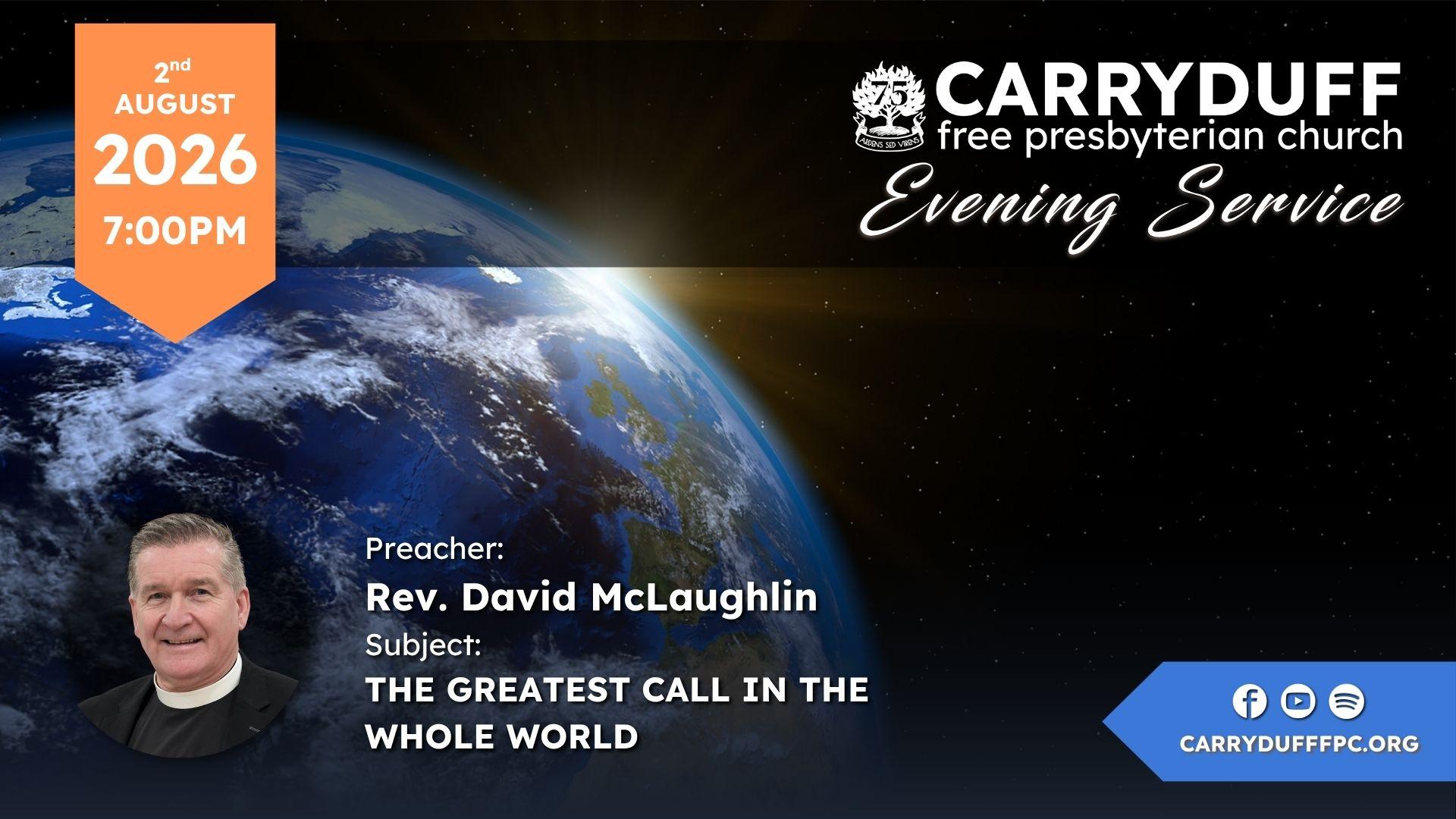

Date: SUN 7:00pm 2nd August 2026
Preacher: Rev. David McLaughlin
Bible Reference: Mark 1:15
Podcast
Sermon Summary
Preacher: Not named in the transcript Text: Mark 1:15 — “The time is fulfilled, and the kingdom of God is at hand: repent ye, and believe the gospel.” Context: The third in a weekend series, following sermons on “The Greatest Friend in the Whole World” and “The Greatest Advice in the Whole World”
Introduction: The Uniqueness of Christ’s First Sermon
The preacher opens by situating this text within the broader sweep of redemptive history. He notes that certain sermons recorded in Scripture stand out for their epochal significance:
- Jonah’s preaching at Nineveh — a sermon that altered an entire nation
- Jonathan Edwards in New England — sermons that awakened churches
- Peter at Pentecost — preaching that brought three thousand to Christ
- Philip and the Ethiopian eunuch — a sermon leading to a single soul’s conversion
Yet none of these, however mighty in their effects, can compare to the first public proclamation of the Lord Jesus Christ Himself. Mark’s Gospel is characteristically direct. Under the inspiration of the Holy Spirit, Mark dispenses with genealogies, omits the Bethlehem nativity account, and wastes no words. He brings the reader immediately to the Son of God’s inaugural sermon.
The preacher draws attention to the timing: John the Baptist has been cast into prison. His public ministry is brought to an abrupt halt, and he will eventually be beheaded. Yet God’s work cannot be stopped. When one servant is silenced, another voice is raised — and this time it is the voice of the Lord Himself. The preacher draws out an encouraging principle: God’s work does not depend upon any single man. When Moses died, Joshua was raised up. When Elijah was taken into heaven, Elisha received a double portion of the Spirit. When John was imprisoned, Christ began to preach. The gospel is greater than any one preacher.
Modern Christianity, the preacher laments, has placed its emphasis on entertainment, music, programmes, personalities, and emotional experiences. He expresses something between bafflement and shame at what transpires in some churches. By contrast, the Lord Jesus began His ministry not by displaying gifts or performing miracles, but by declaring the gospel. This is consistent with the divine method: “It pleased God by the foolishness of preaching to save them that believe” (1 Corinthians 1:21). Preaching is God’s appointed means of calling sinners to Himself.
Christ’s first sermon was not a debate, not a discussion, not a motivational talk. It was a royal proclamation — astonishingly brief, containing no amusing stories, no attempt to entertain. Every word carries the stamp of divine authority. Every phrase demands a response. Every sentence is connected to eternity.
The preacher then outlines his threefold structure, drawn from the text itself:
- The greatest proclamation ever heard
- The greatest precept ever heard
- The greatest promise ever heard
Part One: The Greatest Proclamation Ever Heard
The Source of the Proclamation
The question “Who is speaking?” yields an answer of staggering weight. The context of Mark 1:14-15 makes plain that the speaker is the Lord Jesus Christ. This is what elevates the gospel above mere advice or human opinion. The preacher elaborates on the identity of the Speaker:
- The eternal Son of God
- The promised Messiah
- The Saviour of the world
- The righteous Judge
- King of kings and Lord of lords
- Emmanuel, God with us
- A prophet greater than Moses
- The Lamb of God which taketh away the sin of the world
When the Lord Jesus speaks, God speaks. When He makes a promise, God is promising. When He commands, God Himself is commanding. The preacher recounts a conversation with a young man at City Hall in which he emphasised this very point: many, using human reasoning, regard Jesus as a good teacher, a moral example, a gracious leader — and He is all those things — but He is far more. He is God incarnate. The Christ who came preaching in Galilee is the same Christ who walked with Adam in the garden in the cool of the day, who appeared to Abraham, whom Isaiah saw in the temple. And He is the same Christ before whom every knee shall bow and every tongue confess that Jesus Christ is Lord — all sinful humanity, the devil and every demon in hell, and all that are in heaven.
The Subject of the Proclamation: “The Time Is Fulfilled”
These words, the preacher insists, are full of divine certainty. God is in control. God’s appointed hour has come. Everything promised through the Old Testament now reaches its appointed season. The entire history of redemption has been moving toward this precise moment.
From the very beginning, in Genesis 3:15, God made the first gospel promise: “I will put enmity between thee and the woman, and between thy seed and her seed; it shall bruise thy head, and thou shalt bruise his heel.” That promise became the golden thread running through the Old Testament:
- Abraham rejoiced to see Christ’s day and was glad
- Moses wrote of Him
- Isaiah prophesied of Him
- David sang of Him
- Micah foretold where He would be born
For four thousand years, believing saints waited. Every sacrifice pointed to Him. Every prophetic announcement spoke of Him. Every promise centred in Him. And now Christ stands among them and declares, “The time is fulfilled.” Not one day too early. Not one day too late. God’s clock has not lost a second. The preacher quotes Galatians 4:4 — “When the fulness of the time was come, God sent forth his Son, made of a woman, made under the law, to redeem them that were under the law.”
This yields a powerful application: history is not governed by kings, prime ministers, politicians, political parties, or empires. History is governed by Almighty God, who declares in Isaiah 46:10, “My counsel shall stand, and I will do all my pleasure.” Everything God has promised will come to pass. If Christ came exactly as the Father promised in His first coming, then Christ will come exactly as the Father has appointed in His second return. There can be no denials, no delays.
The Summons of the Proclamation: “The Kingdom of God Is at Hand”
The preacher acknowledges that these are among the most misunderstood and misinterpreted words in the Bible. He references a substantial work by George Eldon Ladd on the kingdom of God, recommended to him by the late Dr. Alan Kearns. He then clarifies what the kingdom of God is not:
- It is not a political kingdom
- It is not a geographical kingdom
- It is not a military kingdom — there was no attempt to overthrow Roman occupation
Rather, it is primarily a spiritual kingdom — a reference to God’s gracious reign and rule in the hearts and lives of those whom He saves. It is, first of all, a kingdom of grace now, with a kingdom of glory yet to be revealed. When Christ says the kingdom is “at hand,” He means the kingdom has drawn near because the King Himself has come. Where the King is present, the kingdom has drawn near.
One day this kingdom will be visibly manifested on earth when Christ returns as King of kings and Lord of lords in power and glory. But for now, the kingdom is announced, and the King demands submission. No one can remain in rebellion and claim allegiance to the King. Earthly kingdoms demand loyalty; the heavenly kingdom demands no less. The question is not whether one recognises Christ as King — He is King whether recognised or not. The question is: Have you bowed before the King?
The preacher cites Colossians 1:13 — God has “delivered us from the power of darkness, and hath translated us into the kingdom of his dear Son.” There are two kingdoms in this world: the kingdom of darkness and the kingdom of God’s dear Son. In the kingdom of darkness, deliverance was needed, and that deliverance came through being translated spiritually out of that kingdom and brought into the kingdom of God’s dear Son. God’s call always begins when a sinner bows the knee, repents of sin, and receives Christ as King.
Part Two: The Greatest Precept Ever Heard
The Command: “Repent Ye”
The preacher emphasises that this is a divine command — not an option, not a suggestion, not advice, not a recommendation. It is a royal command. Every sinner who hears the gospel is responsible before God to take heed. He cites Acts 17:30: “The times of this ignorance God winked at; but now commandeth all men every where to repent.”
The scope of this command is universal. It is not only for the drunkard, the adulterer, the fornicator, the homosexual, the blasphemer, the murderer, the thief. It is for all men everywhere, with no exceptions — the religious and the irreligious, the moral and the immoral, the respectable and the profane. Every son and daughter of Adam. Why? “For all have sinned, and come short of the glory of God” (Romans 3:23).
The preacher draws a sharp contrast between two types of lostness, using Luke 18:
- The Pharisee needed repentance as much as the publican, but could not see or recognise his sin
- The elder brother (Luke 15) is just as lost as the prodigal — one lost in immorality and iniquity, the other lost in self-righteousness
Both needed Christ. Both needed grace. Both needed to repent.
The Problem with Modern Evangelism
Here the preacher levels a pointed critique at contemporary evangelistic practice. Modern evangelism, he contends, has replaced the message of repentance with:
- Easy believism
- Shallow decisionism
- Emotionalism
People are told to repeat a prayer, sign a card, walk an aisle, put a hand up — but little or nothing is said about sin. Nothing is preached about the guilt and punishment of sin. Nothing is preached about the holiness of God, the wrath of God, or judgment to come. There is no mention of repentance.
Yet the Lord Jesus came preaching repentance in His very first sermon. He never separated repentance from faith. Neither did the apostles:
- John the Baptist preached repentance
- Peter preached repentance
- Paul preached repentance
When the gospel is faithfully preached, true repentance is never left out. The preacher quotes Dr. Martyn Lloyd-Jones: “The gospel must first bring a man to see he is lost, to see he is a guilty, hell-deserving sinner, before it brings and reveals the glory of Christ as the only Saviour of sinners.” Because of a superficial view of sin, there is a superficial view of salvation.
The Nature of Repentance
The preacher turns to the Shorter Catechism for what he considers the definitive definition. Repentance unto life is:
“A saving grace, whereby a sinner, out of a true sense of his sin, and apprehension of the mercy of God in Christ, doth with grief and hatred of his sin turn from it unto God, with full purpose of and endeavour after new obedience.”
He then unpacks this definition by clarifying what repentance is not:
- It is not merely feeling sorry for sin
- It has nothing to do with penance (which is Roman Catholicism)
- It is not attempting to make satisfaction for one’s own sin
Biblical repentance involves three faculties:
1. The Mind — A change in thinking about sin. The sinner no longer excuses sin but condemns it. He no longer attempts to justify himself but, like the publican, cries, “God be merciful to me, the sinner.” Where before there was no thought of Christ, now Christ is loved and precious. The prodigal “came to himself” (Luke 15:17) — he had a change of mind.
2. The Heart — Repentance impacts the seat of affections and emotions. It produces godly sorrow. The preacher distinguishes this sharply from worldly sorrow, citing 2 Corinthians 7:10: “Godly sorrow worketh repentance to salvation not to be repented of: but the sorrow of the world worketh death.” Judas had worldly sorrow — he regretted the consequences of sin but never saw its corruption. David, by contrast, saw in Psalm 51:4 that God was offended by his sin and that God’s law was broken. The Puritan Thomas Watson is quoted: “A sinner truly repentant is more troubled for the pollution of sin than just for the punishment of sin.”
3. The Will — Repentance involves action, a visible change in the direction and course of one’s life. The preacher cites 1 Thessalonians 1:9, where the Thessalonians “turned from idols to serve the living and true God.” Both elements are essential: a turning from and a turning to. A man cannot claim to have trusted Christ as Lord and Saviour while deliberately clinging to the very sins that helped crucify Him. While believers are never perfect in this life, they must passionately pursue holiness and do good works — not as the ground of salvation, but as the evidence of it (Ephesians 2:10).
The preacher recounts a pastoral visit in which he explained that when a person is born again of the Spirit, there is a new desire, a new direction, a new declaration. There is a new attitude to sin: no peace with sin, grief over sin, a fight against sin, a longing to be free from sin, confession of sin. He quotes John Owen: “Be killing sin, or sin will be killing you.”
The Need for Repentance
- God commands it — that alone is sufficient reason
- God’s holiness demands it — God cannot overlook sin
- The consequences of refusal are eternal — Luke 13:3, 5: “Except ye repent, ye shall all likewise perish.” It is not “except ye become more religious, or more moral, or improve your lifestyle.” It is “except ye repent.”
The preacher closes this section with a Puritan aphorism: “Till sin be bitter, Christ will never be sweet.” And a further summary: “No repentance, no salvation.” There is no saving faith where there is no genuine repentance.
Part Three: The Greatest Promise Ever Heard
“Believe the Gospel”
The Lord Jesus completes His gospel call by adding these words. Repentance is not an end in itself — Christ is the end. The Holy Ghost comes and convicts of sin in order to convert. He wounds with a sense of guilt and punishment in order to heal. He humbles before God in order to lift up and reconcile.
The preacher is careful to state what repentance cannot do:
- It cannot wash away sin
- It cannot atone for guilt
- It cannot satisfy divine justice
Only Christ and the power of His blood can do these things. Spurgeon is quoted: “Repentance is the empty hand of letting go of sin, and faith is the other empty hand receiving Christ.” Repentance turns from sin to God; faith turns to the Saviour.
The Object of Faith
The command is “believe the gospel” — not believe in advice, not believe in a religious self-help scheme, not believe in self-improvement. The gospel is good news. The preacher summarises the gospel using 1 Corinthians 15:3-4:
“For I delivered unto you first of all that which I also received, how that Christ died for our sins according to the scriptures; and that he was buried, and that he rose again the third day according to the scriptures.”
The gospel includes:
- A message from God
- A message made necessary because of sin
- A message that centres in Christ
- Authority rooted in the Scriptures — “Thus and thus saith the Lord”
- Faith as the instrumentality
- The empty tomb as the validity
The gospel is good news about:
- The birth of Christ
- Christ’s sinless life, keeping God’s law perfectly for His people
- Christ’s atoning death on the tree
- Christ’s bodily resurrection from the dead
The preacher quotes Isaiah 53:5: “He was wounded for our transgressions, he was bruised for our iniquities: the chastisement of our peace was upon him; and with his stripes we are healed.” God did not ignore sin — He punished it in Christ. Christ became the Substitute, the Surety, the Sin-bearer, the Sacrifice, the Sin-offering.
What Salvation Is Not
The preacher is emphatic about what does not save:
- Not religion
- Not a new morality
- Not church attendance (though he urges attendance because “faith cometh by hearing, and hearing by the word of God”)
- Not baptism
- Not the sacraments
He recounts being asked in Belfast, “Do you believe in the sacraments?” His reply: “No, I believe in the Saviour.” It is not the sacraments that save — it is the Saviour. Faith is to rest entirely on the work of Christ, as the hymn puts it: “Nothing in my hand I bring, simply to thy cross I cling.”
Conclusion: The Call and the Promise
The preacher turns to Isaiah 55:7 as the great evangelical invitation of the Old Testament:
“Let the wicked forsake his way, and the unrighteous man his thoughts: and let him return unto the LORD, and he will have mercy upon him; and to our God, for he will abundantly pardon.”
He then rehearses the biblical record of those who experienced this abundant pardon:
- David — an adulterer and murderer, pardoned
- Manasseh — one of the wickedest kings of Judah, pardoned
- The Ninevites — an entire city marked for judgment, pardoned
- The prodigal son — in the far country, welcomed home
- Saul of Tarsus — a blasphemer and persecutor, pardoned
All were abundantly pardoned despite the gravity of their sin — whether murder, adultery, lies, or theft. God is able to abundantly pardon.
The preacher laments that this message has been neglected and softened in many churches, where the language has shifted from rebellion against God to talk of a “broken spirit.” That, he insists, needs to change.
The sermon closes with a direct appeal, drawing together the threefold structure of the text: “The time is fulfilled, and the kingdom of God is at hand: repent ye, and believe the gospel.” The hearer is asked:
- Do you believe the gospel?
- Have you put your faith and trust entirely in Christ?
- Have you a testimony that He is your Lord and Saviour?
- Was there a time when you bowed the knee and crowned Him Lord of all?
The final word is the answer given to the Philippian jailer’s question, “What must I do to be saved?” — “Believe on the Lord Jesus Christ, and thou shalt be saved” (Acts 16:30-31). The Lord Jesus Christ is the sum and substance of the good news of the gospel. The preacher offers himself for further conversation and spiritual help, and commits the message to God, praying that the Lord would take these words and apply them to the hearts of the hearers — both the saved and those yet to believe.