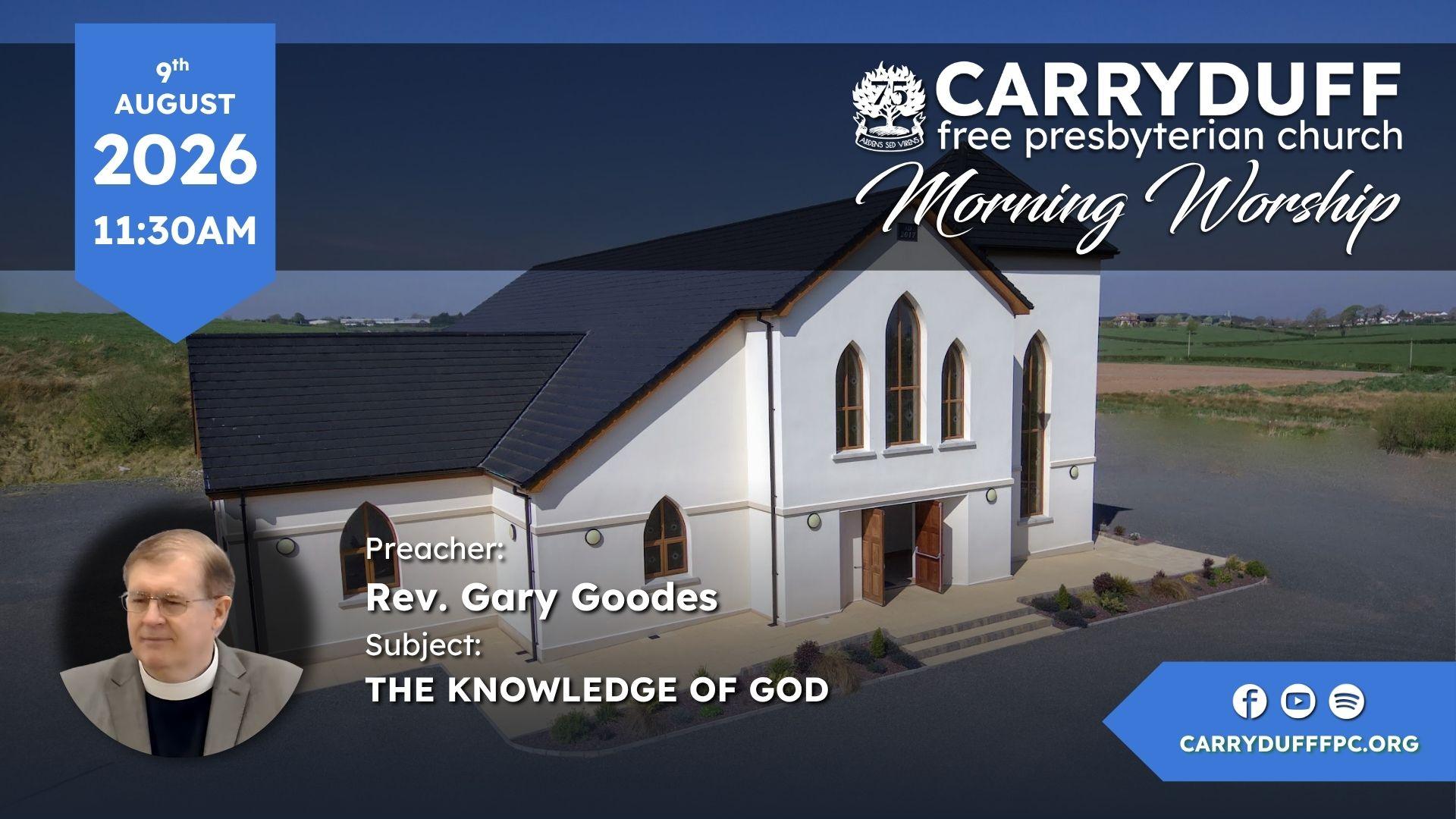

Date: SUN 11:30am 9th August 2026
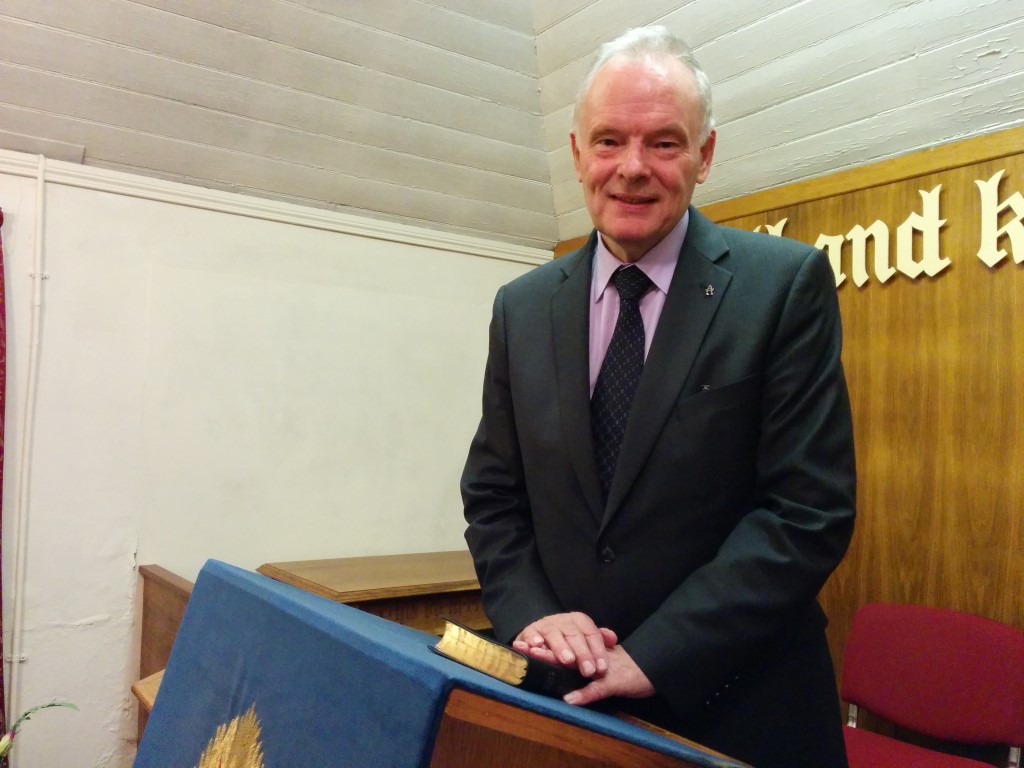
Preacher: Rev. Gary Goodes
Bible Reference: Acts 2:23
Podcast
The Foreknowledge of God: A Sermon Summary
Preached from Acts 2:1-28 and Psalm 139
Introduction: The Importance of Knowing God
The preacher opens with a reflection on a story about a little girl drawing a picture of God. When her teacher remarked that nobody knows what God looks like, she replied, “They will when I’m finished.” While we do not yet know what the Lord looks like, God has given us His Word precisely so that we may know Him.
Every believer can say they have been introduced to the Lord and that the Spirit of Christ indwells them from the moment of salvation. Yet the preacher poses a searching question: how many could genuinely stand and speak for half an hour about everything they know of God? It is, he argues, a personal and spiritual tragedy to lack the ambition to know the Lord better.
A quotation from an unnamed commentator frames the stakes:
“What comes into our minds when we think about God is the most important thing about us.”
He extends this further: no people has ever risen above its religion, and no religion has ever been greater than its idea of God. The subject, then, is of ultimate importance.
The text for the sermon is drawn from Acts 2:23, specifically the phrase:
“Him being delivered by the determinate counsel and foreknowledge of God.”
This introduces the central theme: God’s knowledge exceeds all human knowledge. It embraces the past, the present, and—wonderfully—the future. Nothing that will happen shall catch God unawares.
Part One: God’s Knowledge Is Flawless
The preacher develops three characteristics of divine knowledge.
Inherent Knowledge
God’s knowledge is inherent to His very nature. It is not something He has learned, been taught, or acquired through study and experience—unlike human knowledge, which expands through learning over a lifetime.
- From the moment we are born, we are constantly learning and being taught
- It takes time to get knowledge into our heads
- The Lord, by contrast, has never had to learn anything
Job asks rhetorically in Job 21:22, “Shall any teach God knowledge?” The implication is clear: no one can teach the Lord anything because He already knows it all. He is the Alpha and the Omega, the beginning and the end.
A humorous illustration underscores the point: a little girl with a sore tummy was told by her mother that her tummy was empty and she needed food. After eating, she felt better. Weeks later, when her mother complained of a headache, the girl confidently declared, “Mummy, you’ve got a sore head because your head’s empty.” Children learn by applying patterns—but God has never needed to learn patterns at all.
Infinite Knowledge
God’s knowledge is infinite. There is nothing the Lord does not know. The reason He cannot be taught anything is that there is already nothing He does not know.
The theological term is omniscience:
- Omni meaning “all”
- Science meaning “knowledge”
God is all-knowing. He possesses all knowledge.
To illustrate the limits of even the most brilliant human minds, the preacher recounts the remarkable story of William James Sidis, a man estimated to have had an IQ between 250 and 300. By comparison:
- The average person has an IQ between 85 and 115
- Only one per cent of people have an IQ over 135
Sidis’s achievements were staggering:
| Age | Accomplishment |
|---|---|
| 1 year | Learned to spell |
| 18 months | Reading The Times newspaper |
| 3 years | Learning to type |
| 4 years | Learned the Greek alphabet; reading Homer in original Greek |
| 6 years | Learned Russian, French, German, Hebrew, Turkish, and Armenian |
| 6 years (school) | Advanced from Primary 1 to Primary 3 in three days; graduated primary school after seven months |
| 8 years | Wrote four books—two on anatomy, two on astronomy |
| 7 years | Passed the medical school anatomy exam |
| 8 years | Passed the MIT entrance exam |
| 11 years | Youngest ever student enrolled at Harvard University |
| 16 years | Graduated from Harvard |
He could learn an entire language in a single day and was fluent in roughly 200 languages, translating between them instantly.
Yet for all his brilliance, Sidis did not possess infinite knowledge. Neither did Einstein. If one could sit down with either man, one could eventually find something they did not know. But with the Lord, there is nothing one could discuss that He does not already know completely.
The Psalmist captured this in Psalm 147:5:
“Great is the Lord and of great power: his understanding is infinite.”
As time progresses, man’s knowledge increases daily—but no matter how advanced humanity becomes, man will only ever possess imperfect knowledge. We worship a God whose knowledge is flawless.
Part Two: God Is Familiar with Each of Us
If God knows everything—past, present, and future—it follows that He knows every individual intimately. The preacher turns to Psalm 139 to develop this point.
Complete Knowledge of Our Ways
Psalm 139:2-3 declares:
“Thou knowest my downsitting and mine uprising, thou understandest my thought afar off. Thou compassest my path and my lying down, and art acquainted with all my ways.”
The Psalmist describes God’s complete knowledge of our lives across several dimensions:
- Our actions: From the moment we rise in the morning to the moment we lay our head down at night, God knows everything we do. Family and loved ones may claim to know us intimately, but they do not know absolutely everything. There may be secrets in our lives that no one else knows—but the Lord knows them all.
- Our thoughts: “Thou understandest my thought afar off.” God does not merely know what we do; He knows what we are thinking at this very moment. Every thought, every inner reflection, is open to Him.
- Our words: Psalm 139:4 states, “There is not a word in my tongue, but lo, O Lord, thou knowest it altogether.” Not a single word we speak escapes His hearing.
The preacher illustrates this with an anecdote about Franklin D. Roosevelt. Tired of meeting dignitaries who seemed not to listen to a word he said, Roosevelt decided to test them. As each person extended a hand to shake, he flashed a smile and said, “I murdered my grandmother this morning.” The responses were automatic and unhearing:
- One woman replied, “How lovely.”
- Another said, “Keep up the good work.”
- Only one person—a foreign diplomat—actually listened, pausing before responding, “Well, I’m sure she deserved it.”
People often do not listen. Congregations may nod off during sermons, counting bricks on the wall. But God is always watching, always listening. He knows everything we think, say, and do. He has complete knowledge of our ways.
Constant Knowledge of Our Ways
The phrase “afar off” in Psalm 139:2 carries significance. It speaks of that which is past and future—things that occurred long ago and things that may occur far into the future.
- Go back into your past, to events decades old: the Lord knows all about it.
- Look into the future, across decades yet to come: the Lord knows exactly what will happen.
He has constant, uninterrupted knowledge of our ways.
Yet despite knowing us at our worst—knowing every secret sin no one else knows anything about—the Lord still reaches out with mercy and says, “Come unto me, all ye that labour and are heavy laden, and I will give you rest.” There is nothing about us the Lord does not know, and there will never be a moment when He does not know everything about us.
1 John 3:20 confirms:
“For if our heart condemn us, God is greater than our heart, and knoweth all things.”
Part Three: God Knows Our Future
Returning to the sermon text in Acts 2:23, the preacher focuses on the term foreknowledge. This word appears only twice in Scripture:
- Acts 2:23 — “Him being delivered by the determinate counsel and foreknowledge of God”
- 1 Peter 1:2 — “Elect according to the foreknowledge of God the Father”
The word simply means to have knowledge beforehand—to know before something happens. The future is disclosed to the Lord. All things, even those yet to occur, are open and known to Him.
Prophecy as Evidence of Foreknowledge
One of the strongest demonstrations of God’s foreknowledge is the prophetic content of Scripture. The preacher shares his personal testimony: as an unsaved atheist in his twenties, it was prophecy that first drew his attention to the Bible. The fact that this book could tell him what was going to happen in the future was remarkable.
The Bible contains prophecies given centuries before their fulfilment, with precise and accurate detail. The reason God can make such prophecies is that He already knows what will happen. All prophecy is God’s foreknowledge of future events.
This means:
- There is nothing that will happen to you in the future that the Lord does not already know
- He knows every blessing you will enjoy
- He knows every burden you will experience
- He knows every joy and every sorrow yet to come
The Band Parade Analogy
Human perception of time is like watching a band parade:
- A parade may stretch for miles
- Sitting at the roadside, you see only one section at a time as it passes before you
- You cannot see what is coming further down the road
The Lord, however, is not bound by time—by past, present, or future. He sees the entire parade from beginning to end. He knows what has passed, He sees the present, and He knows what is to come.
God Is Active in Our Future
The preacher makes a crucial distinction: God’s knowledge of the future is only half the truth. The fuller truth is that God is active in our future. The future is not merely disclosed to the Lord—it is also determined by Him.
The commentator extends the parade analogy:
“Man’s acquisition of knowledge is like one watching a parade. He sees each unit as it passes before his view. But God created the marchers, He lines up the parade, He plans the course of the march, and then directs every moment.”
Isaiah 46:9-10 confirms this:
“Remember the former things of old: for I am God, and there is none else; I am God, and there is none like me, declaring the end from the beginning, and from ancient times the things that are not yet done, saying, My counsel shall stand, and I will do all my pleasure.”
In eternity past, God determined the end from the beginning—even the things that have not yet taken place. Whatever happens in the future is according to His pleasure and will.
The Cross as the Supreme Example
The crucifixion of Christ is the ultimate illustration. It was more than an angry mob putting Jesus to death. It was a divine event, planned and appointed by God before the foundation of the world.
- All through the Old Testament, God prophesied Calvary in tremendous detail
- He could do so because He knew the future
- More than that, He was the one who planned Calvary
When the devil threw his all against Christ at the cross, he thought he would defeat God—like the parable of the vineyard owner whose son was murdered by the tenants who thought they would then seize the inheritance. But all things worked together for good. The Lord overruled. The death of Christ was the greatest victory God had overseen: He defeated the devil openly, making a show of him upon the cross.
Application and Comfort
The preacher acknowledges that understanding how God both knows and controls the future is beyond our limited minds. Yet great comfort can be drawn from it:
- We need not be anxious about tomorrow. We do not know what tomorrow holds, but we know who holds tomorrow. Our tomorrow is in His hands, and nothing will enter our lives that is not according to His plan and purpose.
- Trials will still come. Troubles, tragedies, and sorrows are not eliminated by this truth. But the Lord has already anticipated them and made provision for us to cope with them.
- 1 Corinthians 10:13 promises: “There hath no temptation taken you but such as is common to man: but God is faithful, who will not suffer you to be tempted above that ye are able; but will with the temptation also make a way to escape, that ye may be able to bear it.”
The Present Age
We are living in rapidly changing times—the last days. The stage is being set for the rise of Antichrist. Even the unsaved world can see how rapidly things are changing, asking, “Where will it all end?”
The answer is found in this Book. The Lord will wrap up time. This world will not continue as it is forever. Yes, dark days lie ahead, but at the end, the Lord will return and bring all things into line with His perfect will.
Therefore believers are exhorted to cast all their cares upon Him, “for he careth for you.”
The Evangelistic Appeal
The sermon closes with a direct appeal:
- The Lord loves His people and reaches out in love to those who are not saved
- He desires to bless them, save them, pour His love into their hearts, and transform their lives
- He wants to give them the power of God to be the very best they can be by His grace
The searching question is posed: Will you put your life into the Lord’s hands? Have you put your future into His hands, or are you busy trying to work out your own future?
The day is coming when the Lord will either return or call for your soul. The Lord knows the future. He knows there is a heaven and a hell. He knows exactly which road you are on at this moment. If you are on the wrong road, He wants to divert you to Calvary—to get your eyes upon the cross, to see the great love demonstrated there, and to draw you to Himself.
The question remains: Will you let Him?
We do not always know the “why” of things that happen to us, but as Scripture says, “What I do thou knowest not now; but thou shalt know hereafter.” The ultimate question is: where will you be in the hereafter?
The invitation is to give your heart and life to Christ, to put your faith and trust in Him, and to know the joy of salvation and the peace of God that passeth all understanding.