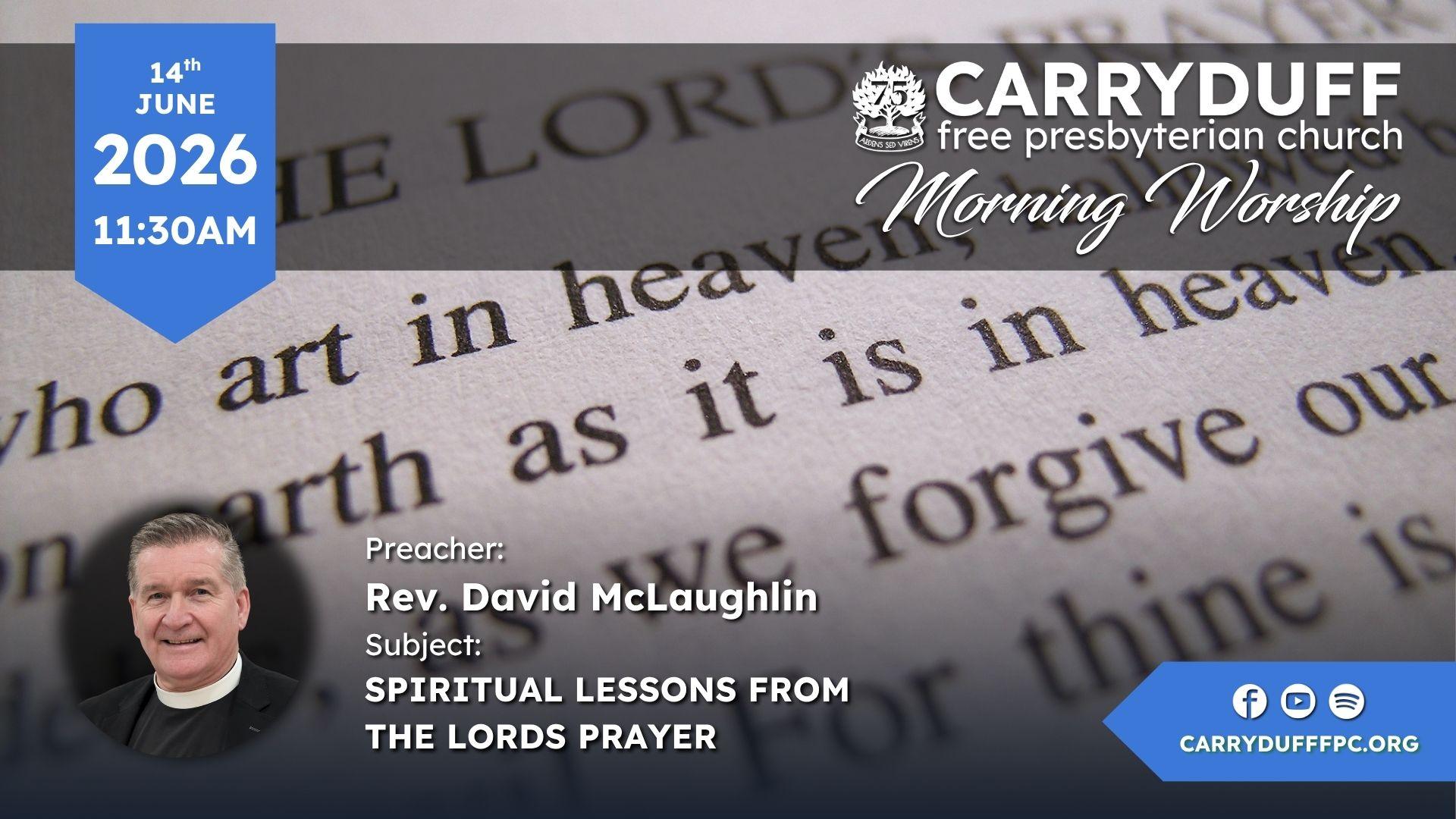

Date: SUN 11:30am 17th June 2026
Preacher: Rev. David McLaughlin
Bible Reference: Matthew 6:9-15
Podcast
Sermon Summary
Introduction and Context
The sermon takes as its text Matthew chapter 6, verses 9 through 15, and sets out to provide a broad overview of the Lord’s Prayer—not as a verse-by-verse exposition, but as a thematic exploration of what Christ teaches about true prayer.
The passage sits within the Sermon on the Mount, where Christ addresses three pillars of Jewish religious life: almsgiving, prayer, and fasting. In each case, He condemns the hypocrisy of the Pharisees, who had turned these sacred duties into what the preacher calls “religious theatre.” Their concern was not God’s approval but the applause of men; they wished to appear holy rather than to be holy. The Greek word for hypocrite refers to a stage actor who wore a mask, and Christ’s point is precisely that—these men wore a mask of devotion whilst their hearts remained far from God.
J.C. Ryle is quoted: “The heart is the principal thing that God looks at in our religion.”
The Lord Jesus introduces the prayer with the words, “After this manner therefore pray ye.” The preacher is careful to note that there is nothing wrong with reciting the Lord’s Prayer daily—he encourages the practice—but Christ is giving more than words to repeat mechanically. He is providing a pattern, a framework, a model for all prayer. Thomas Watson’s Body of Divinity is referenced as a work structured entirely around the Lord’s Prayer, demonstrating that everything necessary for the believer’s prayer life is contained within these verses.
The sermon then unfolds under six headings.
1. The Privilege of Prayer: “Our Father Which Art in Heaven”
Prayer begins with relationship. Christ does not teach us to address God as “our Creator”—though He is. Nor as “our Judge”—though that is also true. Nor even “our Provider.” He teaches us to pray “our Father,” because that is the language of adoption, of sonship, of belonging to a family.
The preacher draws a critical theological distinction here. By nature, God is not the redemptive Father of all men. All are born sinners; David confessed in Psalm 51, “Behold, I was shapen in iniquity, and in sin did my mother conceive me.” Christ told the unbelieving Jews in John 8:44, “Ye are of your father the devil.” Paul described the unconverted in Ephesians 2 as “children of wrath.”
The universal fatherhood of God and the universal brotherhood of man—a notion popular in many circles—is addressed directly. Malachi 2:10 is often cited in support: “Have we not all one father? Hath not one God created us?” But the context shows God speaking as Creator of Israel as a covenant nation, not as Father of all men in a saving sense. God is Creator of all, Judge of all, Provider and Sustainer of all—but He is Father only of those who are in Christ. Galatians 3:26 makes this explicit: “For ye are all the children of God by faith in Christ Jesus.”
John Calvin is quoted: “By the sweetness of this name, He frees us from all distrust.”
The phrase “which art in heaven” points to God’s transcendence, omnipotence, eternality, and holiness. He dwells in light unapproachable. Yet in Christ, believers may approach Him as Father. The Puritans emphasised maintaining a secret reverence—a holy dread combined with reassured confidence.
The preacher illustrates this with the image of a child in the presence of an earthly king. The child would naturally tremble. But if that king is the child’s father, the child would feel free to run into his arms, to speak with him, to sit on his knee. So the believer approaches God with holy reverence and yet with confident love.
2. The Priorities of Prayer: “Hallowed Be Thy Name, Thy Kingdom Come, Thy Will Be Done”
Before daily bread is mentioned, before forgiveness or personal needs, God comes first. The prayer is entirely God-centred. Matthew 6:33 provides the parallel: “Seek ye first the kingdom of God and His righteousness, and all these things shall be added unto you.”
The hypocrite says “look at me.” The true believer says “hallowed be Thy name.”
Hallowed be Thy name. To hallow God’s name means to regard Him as holy, to make His name holy in one’s heart and life, and to desire that others do likewise. It is a petition that God would glorify and sanctify Himself in and through the believer. The greatest purpose in prayer is not human happiness but God’s holiness. The flesh asks, “What do I want?” Faith asks, “What glorifies God?”
Thy kingdom come. This is a prayer for the reign and rule of Jesus Christ—in hearts, homes, churches, and nations. It encompasses prayer for the conversion of sinners, the growth of the true church, the spread of the gospel, and the final return of Christ in power and glory. Every missionary effort, every gospel witness, every tract distributed, every church planted, every sermon preached is part of the answer to this petition. Robert Murray M’Cheyne is quoted: “My greatest need in my pulpit and my pastoral work and preaching is my personal holiness before God.” A holy church is a church that advances the kingdom of Christ.
Thy will be done. This is perhaps the hardest petition for fallen sinners, because naturally we want our own will. True prayer teaches submission to God’s will. Christ Himself prayed in Gethsemane, “Not my will, but Thine be done.” Prayer is not twisting God’s arm to get things done; true prayer seeks things agreeable to His holy will. Matthew Henry said, “The will of God is the rule of holiness.”
The preacher uses the illustration of a ship crossing the ocean from Southampton to New York. How does it stay on course despite wind and waves? By compass—or today, by GPS. Prayer functions like that compass. It aligns the believer’s heart with the direction of God’s will. Prayer is not a tool to obtain earthly comforts; true prayer seeks eternal conformity to the will of God.
3. The Provision in Prayer: “Give Us This Day Our Daily Bread”
After God’s name, kingdom, and will comes the petition for daily necessities. This covers everything required to sustain physical life in the time allotted to us. It is a petition of complete dependence on God.
Every meal, every heartbeat, every breath, every friendship, the ability to work and to move—all of it comes from God. James 1:17 is cited: “Every good gift and every perfect gift is from above, and cometh down from the Father of lights, with whom is no variableness, neither shadow of turning.”
The wording is significant: “daily bread”—not yearly, not monthly, not even weekly. God is teaching a life of daily dependence. The great lesson Israel learnt in the wilderness is recalled: manna was provided one day at a time, and they had to trust God one day at a time.
The life of George Mueller, who cared for thousands of children in his Bristol orphanage, provides the illustration. Time after time, the children would rise in the morning to find the cupboards empty and the tables bare. Yet day after day, God supplied. On one particular morning, with bowls and spoons set out but no food, Mueller prayed and thanked God for the breakfast that was coming. As he prayed, there was a knock at the door. The bread and milk cart had broken down outside. Oat flour, milk, and bread were carried in. Mueller’s principle was this: “The beginning of anxiety is the end of faith.”
This petition teaches believers not to fret or fuss but to exercise faith in God. It concerns not only food but everything needed to sustain us physically on the journey.
4. The Pardon in Prayer: “Forgive Us Our Debts as We Forgive Our Debtors”
Sin is described here as a debt. Every sin is a transgression of God’s law, incurring guilt and creating an obligation. Outside of Christ, every sinner stands spiritually bankrupt.
This is not a prayer about salvation by works. Salvation is by grace alone, through faith alone, in Christ alone—Ephesians 2:8–9. At Calvary, the debt was paid in full. Second Corinthians 5:21 declares that God made Christ, who knew no sin, to be sin for us, that we might be made the righteousness of God in Him.
In Christ, believers have judicial forgiveness from condemnation—the penalty of sin has been dealt with. But they still need daily, paternal forgiveness to restore fellowship. David, after his backsliding, prayed in Psalm 51:12, “Restore unto me the joy of Thy salvation.” Believers grieve their loving Father through sin in thought, word, and deed, and prayer becomes the place of confession. First John 1:9 promises that if we confess our sins, He is faithful and just to forgive us and to cleanse us from all unrighteousness.
Crucially, a truly forgiven person will be a forgiving person. The prayer links divine forgiveness to human forgiveness: “as we forgive our debtors.” Verses 14 and 15 expand on this with a sobering condition—if we forgive men their trespasses, our heavenly Father will forgive us; if we do not, neither will He forgive us.
The preacher references the parable in Matthew 18 of the servant forgiven 10,000 talents who then refused to forgive a fellow servant 100 pence. His unforgiving spirit revealed that he had never truly understood or appreciated the mercy shown to him. Thomas Watson is quoted: “Many a man will go to hell for not forgiving as for not believing.” A spirit of bitterness is incompatible with gospel peace, gospel pardon, and gospel practice.
5. The Protection in Prayer: “Lead Us Not into Temptation, but Deliver Us from Evil”
The Christian life is not a playground; it is a spiritual battlefield. Believers are not only sons in a family but soldiers in a fight and servants in a field. Three enemies are faced: the world around, seeking to squeeze believers into its ungodly mould; the flesh within, the body of sin; and the devil, who is against them.
Prayer teaches that we are not strong enough to stand alone. Peter thought he was—”I’ll not deny You, Lord; I’ll go to prison for You; I’ll fight for You”—yet within hours he denied Christ three times with oaths and cursings. Self-confidence is dangerous. A life of holiness requires humility and dependence.
John Owen’s warning is cited: “Be killing sin, or sin will be killing you.” Believers should pray daily for guidance in righteousness, for protection, for preservation. Martin Luther, when feeling particularly pressed, would say, “I have so much to do today that I must spend the first three hours in prayer”—from 4 a.m. to 7 a.m.
The preacher offers two illustrations:
- A soldier on a battlefield without armour is courting disaster. Prayer is part of the believer’s armour.
- Neglecting prayer is like leaving the gates of a city open whilst the enemy approaches.
Christ’s command to “watch and pray, lest ye enter into temptation” is the watchword. “Lead us not into temptation” concerns trials and troubles; “deliver us from evil” is a reference to the devil himself. The petition acknowledges human weakness and seeks divine protection.
6. The Praise in Prayer: “For Thine Is the Kingdom, and the Power, and the Glory, Forever. Amen.”
The Lord’s Prayer begins with God and ends with God. Having brought petitions before the Lord, the believer does not end with self but with worship. True prayer is not merely a list of requests; it includes praise and thanksgiving.
The doxology confesses three things:
God’s sovereign rule. “Thine is the kingdom.” Earthly kingdoms rise and fall—Babylonian, Medo-Persian, Greek, Roman, British, Ottoman—all have come and gone. Kings die, governments change, nations crumble, but God’s kingdom remains forever. Daniel 4:34 records Nebuchadnezzar’s confession: “I blessed the Most High, and I praised and honoured Him that liveth forever, whose dominion is an everlasting dominion, and His kingdom is from generation to generation.” Nothing occurs outside God’s providence; nothing frustrates His divine purpose. The God to whom we pray is not struggling to control events—He is enthroned over all creation. The Heidelberg Catechism affirms that all things come not by chance but by His fatherly hand.
God’s supreme power. The word translated “power” is exousia, denoting authority—legal, rightful authority. His power is creative (the universe from nothing), sustaining (every atom moves by Him), and saving (power to raise the dead, save sinners, preserve saints, change lives). Jeremiah 32:17 declares, “There is nothing too hard for the Lord.” True prayer rests in that truth. Why pray if God lacks power to act? Every petition assumes divine power: He can provide daily bread, grant forgiveness, preserve and keep His people.
God’s eternal glory. All things exist for God’s glory—the universe, providence, redemption, the church, prayer itself. Revelation 4:11 declares, “Thou art worthy, O Lord, to receive glory and honour and power: for Thou hast created all things, and for Thy pleasure they are and were created.” Human glory fades—fame disappears, achievements are forgotten, monuments decay, nations vanish from history—but God’s glory remains forever. Jonathan Edwards said, “The great end of all of God’s works is the manifestation of God’s glory.”
The word “Amen” is not merely a signal that the prayer is over. It means “so shall it be.” It is the language of faith—a confident affirmation that God has heard, that God answers prayer, that the believer trusts in His character, His promises, and His wisdom.
Conclusion
The sermon closes by drawing the six threads together, urging the congregation not to treat the Lord’s Prayer as something mechanical but as an introduction to a life of communion and fellowship with God. The pattern is clear:
Begin with the privilege of addressing God as Father, yet with holy reverence.
Prioritise His name, His kingdom, and His will above all personal concerns.
Depend on Him daily for every provision.
Seek daily pardon whilst extending forgiveness to others.
Plead for protection from temptation and the evil one.