
Service Details
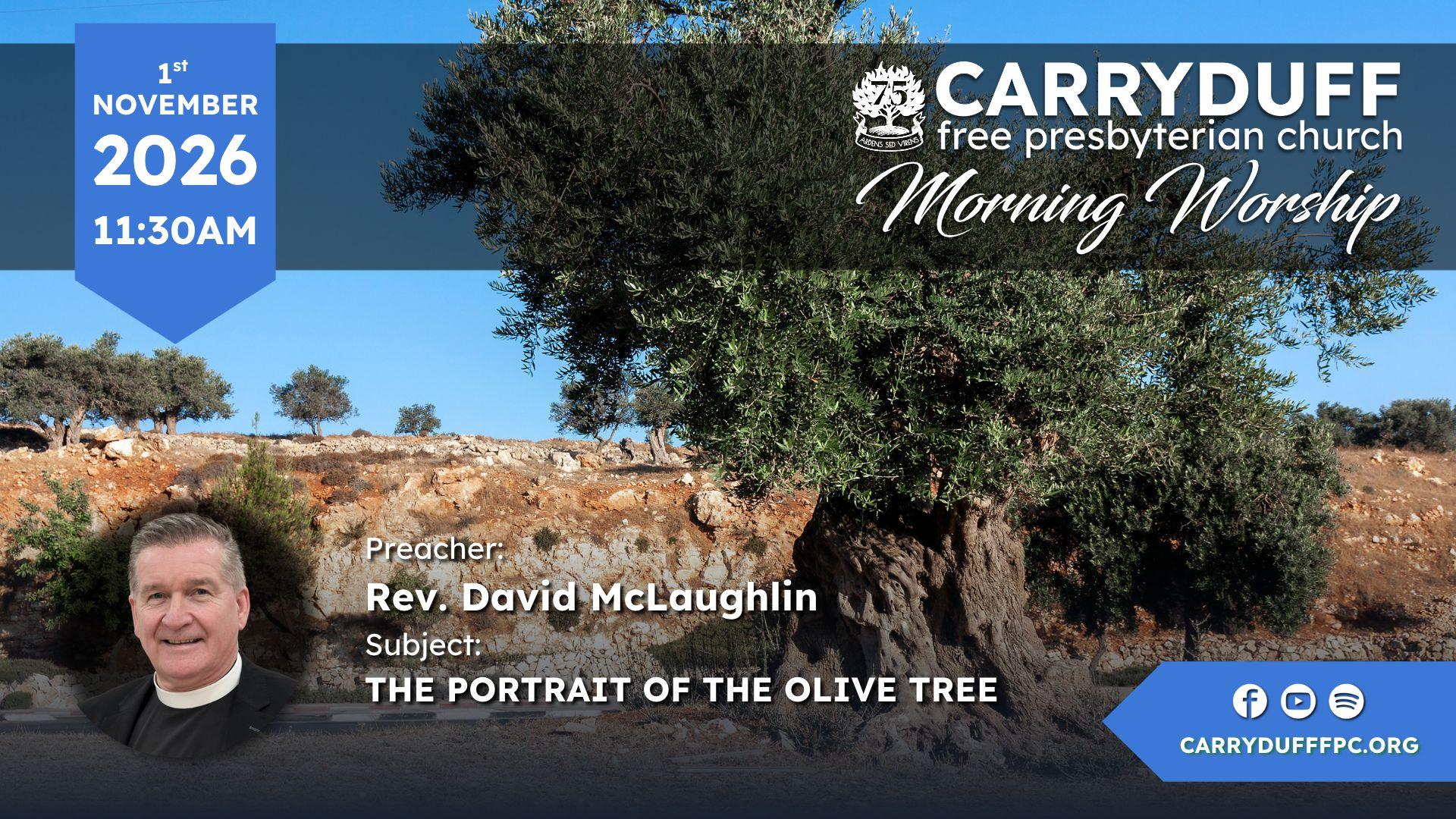
Date: SUN 11:30am 1st November 2026
Preacher: Rev. David McLaughlin
Bible Reference: Jeremiah 11:16
Podcast
Sermon Summary
Opening and Context
The preacher opens by reflecting on a gift he received the previous week, a coaster for his study, intended for a cup of tea or a glass of water. The coaster depicts an olive tree and bears the name “olive tree.” This prompts him to consider how frequently the phrase appears in Scripture. He notes that the olive tree is mentioned fourteen times across ten verses, from Deuteronomy 24:20 to Revelation 11:4, with four of those references appearing in Romans 11, the subject of the Wednesday night Bible study.
The sermon proper begins with a reading from Jeremiah 11, which recounts the covenant God made with Israel at the exodus from Egypt, the people’s repeated disobedience, and God’s pronouncement of judgment. Jeremiah is told not even to pray for the people, so serious is their apostasy. The key image is that of a green olive tree, fair and fruitful, upon which fire is kindled and whose branches are broken.
The preacher draws out the natural qualities of the olive tree: its longevity, its beauty, its evergreen branches, its desirable and valuable fruit, and the many uses of its oil, for nourishment, healing, illumination, and anointing. He recalls that in the Garden of Gethsemane some olive trees are a thousand years old. In Scripture the olive tree is associated with prosperity, peace, and plentifulness.
The Olive Tree as a Portrait of Great Privilege
The preacher develops his first main point: the olive tree is a portrait of great privilege, seen in the words “The Lord called thine name.”
He stresses that the olive tree does not name itself, plant itself, or cultivate itself. Its identity, its very existence, and every privilege it enjoys are the result of the Lord’s sovereign choice. Israel did not choose herself; God chose her. She was delivered from slavery in Egypt, brought into a land flowing with milk and honey, not because of her greatness, her numbers, or her inherent goodness, but because God loved her and kept His oath to the fathers.
He draws on Deuteronomy 7:7, which records that the Lord did not set His love upon Israel because she was more numerous than other peoples, for she was the fewest of all, but because the Lord loved her and would keep the oath sworn to her fathers.
There is, he adds, the privilege of divine planting (verse 17), “For the Lord of hosts that planted thee.” Israel had been given the Scriptures, the covenant promises, the patriarchs, the law, the priesthood, the prophets, and ultimately the Lord Jesus Christ Himself. He cites Romans 9:4, where Paul lists the adoption, the glory, the covenants, the giving of the law, the service of God, and the promises, all of which pertain to Israel, and from whom, concerning the flesh, Christ came.
He rehearses the mighty acts of God in Israel’s history: the exodus and redemption by the blood of the Lamb, forty years of wilderness wandering, the conquest of the land under Joshua, the era of the judges, the kings Saul, David, and Solomon, the division of the kingdoms, and the captivity in Babylon with its promise of return after seventy years.
The application is pointed at the congregation. Many have been brought up in Christian homes, attended Sunday school and children’s meetings, heard the gospel, sat under faithful preaching, know the hymns, and can quote Scripture. Yet the preacher warns that being familiar with the things of God is not the same as being in fellowship with God. There is a vast difference between knowing about Christ and knowing Him. Many young people are familiar with the things of God while their hearts are far from the living God, possessing tremendous privileges but lacking true saving faith.
He briefly turns to Romans 11, where Paul develops the olive tree image in the New Testament. Some natural branches were broken off because of unbelief, and Gentile believers were grafted in. The emphasis is that all boasting is excluded; salvation is entirely of God, by grace alone through faith alone in Christ alone. Gentile believers must never look down on the Jewish people, and the preacher condemns all forms of antisemitism. As the late Dr Paisley said, there is nothing to be proud of, neither faith, nor race, nor grace, for believers are accepted in the Beloved alone.
He quotes John Calvin, who at twenty three described the human heart as a perpetual factory of idols. Even a privileged, planted people were vulnerable to the power and pollution of sin. He offers the illustration of two gardens: one neglected and overgrown, the other well kept and cultivated. From the well kept garden much is expected; from the neglected one, little notice is taken. The greater the roots, the greater the responsibility. He urges his hearers to be thankful for gospel privileges, to rest in Christ alone, and not to boast in the garden but in the gardener who planted them there.
The Olive Tree as a Portrait of Great Prosperity
The second point concerns prosperity, drawn from the description of the tree as green, fair, and fruitful.
Green: the appearance of flourishing. Greenness is associated with life, vitality, and freshness. The olive tree was not a dead stump or a wild, barren plant. He cites Psalm 52:8, where David says, “I am like a green olive tree in the house of God.” David’s confidence was not in his outward position as king, nor in his own power and pomp, but in the mercy of God. Spiritual life does not come from ourselves, from religious activity, from natural talent, or from personality. It comes from union with Christ. He cites John 15:5, “I am the vine, ye are the branches: he that abideth in me, and I in him, the same bringeth forth much fruit: for without me ye can do nothing,” and 1 John 5:12, “He that hath the Son hath life.”
He warns against confusing activity with life. A person may be busy in the Christian life yet spiritually cold and barren, attending every meeting, occupying a prominent place in the church, possessing great knowledge, and yet having a heart far from God. He invokes Matthew 15, where Christ condemns those who honour God with their lips while their hearts are far from Him. The necessity is to be born again, to have a new heart, a life changed and transformed by grace.
Fair: the appearance of fairness. The olive tree is attractive and beautiful, and there is a beauty associated with Bible believing Christianity. He cites Psalm 90:17, “Let the beauty of the Lord our God be upon us,” and Psalm 27:4, where David desires to dwell in the house of the Lord to behold the beauty of the Lord. The beauty of the Christian life is the beauty of holiness, a life conformed to the image of Christ, marked by prayer, humble dependence, a spirit of forgiveness, redemption, and a meek and quiet spirit (1 Peter 3:4). The Christian should be recognised by his likeness to Christ, not merely by what he professes but by what he possesses in character.
Fruitful: the appearance of fruitfulness. He stresses the mention of “goodly fruit,” recalling Christ’s teaching, “By their fruits ye shall know them.” He lists the fruit of the Spirit: love, joy, peace, longsuffering, gentleness, goodness, faith, meekness, and temperance. Believers are not saved by producing fruit; they produce fruit because they have a new heart. Good works are not the root of salvation but the fruit of it. He notes that this is where Roman Catholicism goes astray, and where the Protestant Reformation got the balance right: justification is by faith alone in Christ alone, yet the faith that justifies is never alone, being evidenced by a life of sanctification.
He uses the illustration of an artificial Christmas tree, which has no life. Many in Ulster have a religious profession but no spiritual life, and their lives are therefore not changed and transformed. He asks searching questions: Is there a love for Christ? A hatred for sin? A desire for holiness? A willingness to forgive? A concern for the salvation of others? A concern for the work and house of God?
The Olive Tree as a Portrait of Great Presumption
The third and final point concerns presumption, as the language shifts dramatically from the beauty of the tree to judgment upon it, from green leaves to burning branches. The atmosphere changes with the words “tumult” and “fire.”
The danger of false security. The children of Israel believed that possessing the temple, the patriarchs, the prophets, and the Scriptures would shield them from judgment. Yet all their outward religion was no hiding place for overt rebellion in the heart. He cites Jeremiah 7:4, “Trust ye not in lying words, saying, The temple of the Lord, the temple of the Lord, the temple of the Lord.” Jeremiah warned them against trusting in the temple rather than in the living God. The preacher warns the church that neither an historic building, nor a denominational identity, nor a sound confession such as the Westminster Confession of Faith, nor a faithful minister, nor parents, nor baptism, nor church membership can save anyone. These are not substitutes for personal faith in Christ, and many are resting in a false security.
The danger of spiritual compromise. The people had forsaken the Lord and turned to idols. Idolatry is not merely bowing to an image, though it includes that; it is giving to anything the worship and devotion that belong to God alone. He cites Exodus 20:3, “Thou shalt have no other gods before me,” and returns to Calvin’s dictum that the human heart is an idol factory. He imagines a people bowing before a stone or a golden object, which his hearers would never do, yet warns against making money an idol, or material possessions, or human approval and reputation, or personal opinion, ambition, or pleasure. The age has become one that wants comfort and convenience. Even the church, religion, or the Protestant Reformed faith can become an idol. Anything that takes the place of God in the heart is an idol, which is why one must be born again and given a new heart.
The danger of divine judgment. The tumult and the fire kindled upon the tree are not an accidental forest fire but an act of divine judgment. The covenant people had broken their covenant, and God was bringing judgment upon them. God is merciful, gracious, patient, good, and kind, but He is also just, holy, and righteous. He hates sin and is in no wise indifferent towards it. He cites Romans 11:22, “Behold therefore the goodness and severity of God: on them which fell, severity; but toward thee, goodness, if thou continue in his goodness: otherwise thou also shalt be cut off.”
He offers the illustration of a beautiful house, adorned to perfection, yet built on sand without a foundation. It has a respectable exterior but no foundation, for the foundation is Jesus Christ and He has been rejected. This, he says, is what many lives are like. It is why Christ told Nicodemus, “Marvel not that I say unto thee, Ye must be born again.” Nicodemus, though respectable, a ruler, and a righteous man, could not presume upon the grace of God. The same God who planted the tree had power to punish the tree.
Conclusion
The preacher closes by drawing the threads together. The olive tree is a portrait of great privilege, for its name was chosen by God and it was planted by Him, and so have his hearers been privileged. It is a portrait of prosperity, being green, fair, and flourishing. But it is also a portrait of presumption, for the children of Israel presumed a false security, presumed that spiritual compromise would be acceptable, and presumed there would be no divine judgment, and judgment fell.
He leaves his hearers with searching questions. Are they enjoying privileges without possessing spiritual life, without being born again of the Spirit? Is there genuine fruit in their profession of faith, fruit of holiness, of loving obedience, of the Spirit? Where is their confidence? When the tumult comes, when they are tested by the fire, have they deep roots in Jesus Christ? Are they resting confidently upon His finished work? Is their hope anchored to the rock of ages? Only they can answer these questions; he is not accountable for their individual choice of Christ, but only for being faithful to point them to Him who is the Lamb of God. He trusts that the Lord will take these thoughts and bless them to the people.