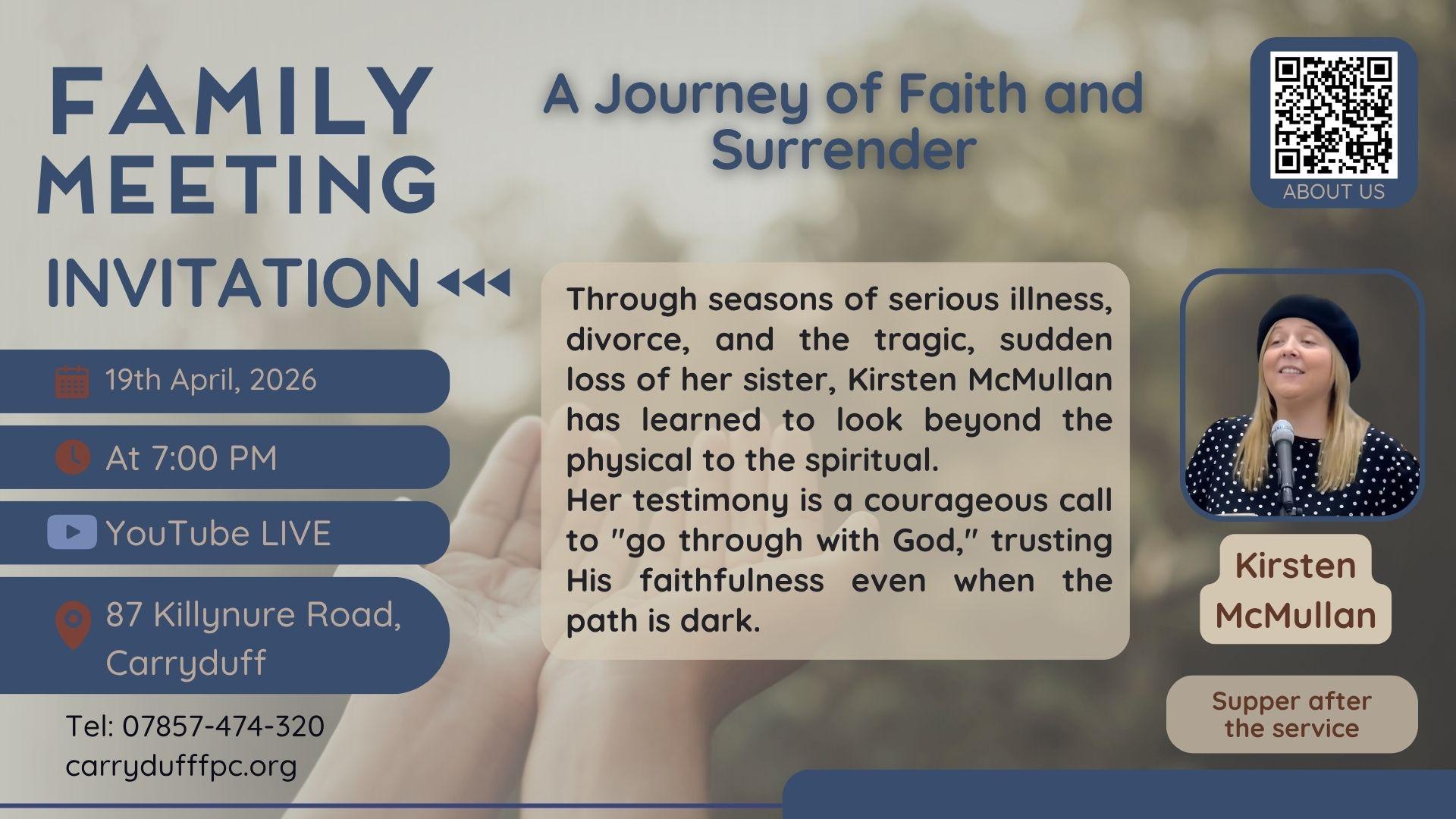

Date: SUN 7:00pm 19th April 2026
Testimony: Kirsten McMullan
Bible Reference: 2 Kings 6:17
Podcast
Testimony
It gives me great honour and privilege to welcome our sister, Kirsten, to our church this evening, not only to minister to us in song, but to come and share a word of personal testimony; and we thank God for her, and we pray that the Lord helps her this evening as she speaks to us. Thank you, Kirsten.
I just want to thank the Reverend McLaughlin for his kind invitation to come along. Tonight, I feel like he got two for one there, because sometimes I go places and I sing and sometimes I speak, but he was telling me that he was getting both out of me tonight. So, if you have your Bible with you, I just want to read a couple of verses with you in Daniel chapter 3. Daniel chapter 3, and we’re going to read from verses 14 down to 18, please.
📖 The Stand of the Three Hebrews
Daniel chapter 3, verse 14: “He shall be cast the same hour into the midst of a burning fiery furnace; and who is that God that shall deliver you out of my hands?”
Shadrach, Meshach, and Abednego answered and said to the king, “O Nebuchadnezzar, we are not careful to answer thee in this matter. If it be so, our God whom we serve is able to deliver us from the burning fiery furnace, and he will deliver us out of thine hand, O king. But if not, be it known unto thee, O king, that we will not serve thy gods nor worship the golden image which thou hast set up.”
Let’s just pray before I share my story. Father, we thank You for this opportunity even to be found in Your house tonight. Lord, I just pray You would now presence Yourself with us. Thank You for what has already gone before. Lord, would You still our hearts, would You even settle my nerves? And Lord, may tonight there be someone, Lord, that needs to hear this word—not just my story, Lord, but see You in that story. Lord, may it be a word of encouragement for some, or even a word of challenge for others; and Lord, for those maybe out of Christ, Lord, that that “still, small voice” would even speak to them. We ask these things in Jesus’ name. Amen.
The passage, or the few verses that I’ve read to you, are familiar, and I would imagine to nearly everyone. We read of this golden image that King Nebuchadnezzar has set up, really wanting to glorify his own greatness and his reign, and a proclamation was given out: when you hear the music played, you are to fall down and worship the golden image, and whoever doesn’t do that will immediately be cast into the midst of a blazing fire. It wasn’t a choice; it wasn’t optional; it was a command issued to all the people, and it’s in this place that we meet these three young Hebrew men who are forced to make a decision: bow or burn.
And you know, sometimes when we have heard this story over and over again, even from childhood, we don’t think about it in the context of what would it have been like to be there, to be faced with that decision. You know, sometimes we think of our own lives and a stand maybe that we would take for something, and how sure we are of wanting to stand on God’s Word, and how easy sometimes it can be to be the person that says, “I’m just not bowing in this moment,” and yet, look at the example that these three men are. They’d been captured and brought to Babylon as slaves, and yet had risen through the ranks of government, and as Jews, they knew that they could not worship this golden image.
When reported for their refusal, they were given another chance. If you look again at verse 15, it says, “But if ye worship not, ye shall be cast the same hour into the midst of a burning fiery furnace; and who is that God that shall deliver you out of my hands?” You know, often that’s a question that those who are unsaved ask when they see Christians try to trust the details of their lives to a sovereign God. That in the midst of chaos or loss or tragedy, people say, “You’re really going to trust God in this?”
That same question that Nebuchadnezzar asks of them: “Who is that God that shall deliver you out of my hands?” You know, when we can’t change the things that are happening in our lives, when we can’t change our circumstances, the only thing we can control is our attitude. And so, when faced with that ultimatum by Nebuchadnezzar, this was the response of Shadrach, Meshach, and Abednego in verses 17 and 18: “If it be so, our God whom we serve is able to deliver us from the burning fiery furnace, and he will deliver us out of thy hand, O king. But if not, be it known unto thee, O king, that we will not serve thy gods nor worship the golden image that thou hast set up.”
What an example these three Hebrew men are, and for me, it’s about this faith found in that verse 18, where it says, “But if not.” See, as I think tonight about my own journey with the Lord, I think about those three words, about that type of faith that says, “But if not.” We know that God is all-powerful, we know everything that He can do, but what if He doesn’t answer in the way you want Him to? What if your life doesn’t look the way you thought it would when you started out on the journey?
🛡️ Faith Through the Valleys
And you know, if you’re a Christian tonight, you’ll know that just being a Christian doesn’t mean that your life is going to fit very neatly into a tidy little box; it’s a journey with God through the valleys and the mountains. And for me, as I look at God’s hand in my life, and as I trace His faithfulness in my life, I see as well how it has been a story of stealing my song back from the enemy—and what I mean by that is, and I’ll talk about this after, but being saved as a child, the enemy knows he cannot have me, and yet he does everything that he can to make us powerless and useless and purposeless. He doesn’t want us to live victorious Christian lives, and so, as I trace God’s hand in my life, I can see that right from birth, God had His hand on me, and yet I can see how the enemy tried to steal my song.
I was born into a Christian home, two weeks earlier than expected, and at six weeks old, I contracted pneumonia and was sent to the Royal Victoria Hospital; and at one point, my mum and dad and my older siblings were told that they should come to say their goodbyes, that I wasn’t going to survive the night—and yet, confounding the doctors and nurses, I did. And you know, as an adult, I look at that and I can trace God’s hand in that. How is it that someone with pneumonia as a child, very ill and issues with their lungs, can belt out songs the way I can? Now, some of that might be due to my weight and the belly that I have more than my lungs, but I just look at that and say, “That’s God’s grace in my life,” that even at that young age, the enemy was seeking to steal my song.
I grew up on our family dairy farm—I don’t really know if you would class out here, looks like the countryside—I don’t know if you class Carryduff as the town or the country… Country people, okay, well then you’ll understand. Growing up on a family dairy farm in South Armagh; four girls and then finally a boy. Now, my dad always says it didn’t matter to him, he didn’t mind when the girls kept coming because, honestly, he treated us like wee fellas, the amount of work that he made us do. But our childhood revolved around family, farming, and faith, and going to church as a family was something we always did, regardless of what was needing to be done on the farm.
And so, from as far back as I can remember, I knew that the Bible teaches I was born with sin in my heart and that that sin separated me from God. I was taught faithfully that Jesus had shed His blood on Calvary for my sins so that I could be reconciled back to God. And after our children’s meeting at the age of six, the conviction of that sin moved me to trust Christ for salvation with my dad at my bedside. Now, I didn’t have any great knowledge of the Bible or of doctrine or theology, but I understood this, even as a child of six: if I ever wanted to be found in heaven, I could not go there as a sinner, and I had to accept God’s free gift of salvation for me, so that one day I could have the assurance that I would know where I was going.
And I have no doubt that night—I know some people, if you’re not a Christian or you’re not from a Christian background, sometimes people think that’s so strange, a six-year-old could know—and yet I’ve never doubted that in the last 30-plus years. You know, from that early age, and as I’ve journeyed this road with Him, I believe the Lord put a burden on my heart for others, and I started off with the person that I thought would be best to work my evangelism skills on, and that was my younger sister. And I don’t know that my methods were always biblical; I mostly tried to scare her into salvation! But I know that the Lord had put that on my heart for those in my family outside of Christ, and even for my friends at school.
⚖️ Resilience and Reality
And when I look at my childhood, I can look at that and see a very happy childhood, one that was filled with hard work, and that helped to develop resilience and a work ethic. But for me, personally, what it really developed was, “I need to get an education so I don’t have to stay here covered in cow dung for the rest of my life.” That was the most important thing to me; some of my siblings loved farming—that wasn’t me. But building our lives around those things—around family and farming and faith—created a very strong bond between us as siblings.
A lady at church once asked my mum what would she like us to be when we grew up—there are five of us, and between the four sisters there were two and a half years, and then between my youngest sister and my brother, six years—and so at church, they would say we looked like steps and stairs sitting in the pew, and my mum said, “I don’t care what they do, I would love them just to be best friends.” And you know, I think after years of growing up together and all the things that siblings do—you know, all the fighting that happens—and as well, that’s what we got: a very happy childhood.
But you know, it should be sort of noted to her, it’s something that I think about as well, that my parents didn’t always get everything right, even as Christians—and don’t worry, I’ve told them that too, it’s not a surprise to them—because sometimes growing up, Christianity felt like a list of “know this” and “know that,” and it felt like it was about following a set of rules. And for a rule-follower like me, I was actually okay with that; rules kept you safe. But actually, sometimes it gives us a false understanding of who God is—like, if I follow the rules, everything will be okay, rather than it’s all about my relationship with Christ. And in this journey for me, it’s been learning that just following the rules will not give you a close walk with God; it doesn’t spare you trials and temptations, but rather, it’s about seeking to know Him more and wanting to walk in intimate fellowship with Him.
We had a great Youth Fellowship in Mullaghglass growing up, and so I didn’t find my teens difficult to live for the Lord; the Youth Fellowship was great, with great opportunities for outreach and to go away together and to always be in Christian company. And I feel that even in my teenage years, all the friends that I had—even those outside of Christ—it wasn’t difficult for me to stand up for my faith and who I was in Christ because of that influence of the church and of Youth Fellowship. And I look at those teenagers and I see that they were very formative in laying the roots of my faith; roots that would eventually withstand the storms. And while I didn’t know it then, God was pouring in, preparing my heart and grounding me in His Word.
💔 Broken Pieces and Restoration
At 18, I went to Queen’s in Belfast to study English and history, wanting to be a teacher, and my life was progressing on merrily. I was involved in everything there was to be involved in in church: singing, speaking, a leader at Youth Fellowship, a Sunday School teacher, a children’s meeting worker. And then I qualified as an English teacher, and I’ve done that for the last 15 years. And at 24, I got married, and I suppose I had huge hopes of what our life might look like as we served God together, and I certainly had dreams for what my life would look like—dreams of having children and building a life together and being able to serve together. But by 28, the marriage had broken down, and at 30, I was divorced.
And you know, I can shy away from that part of the story sometimes; when I’m coming to tell my story, I think, “Was there any other way I could say that without saying it and leave it out?” And yet, the reality is that is part of my story. And you know, the more churches I’ve gone around, the more I see it’s a part of a whole lot of people’s story—and maybe not you directly, but maybe some family member, maybe somebody struggling with that pain—and it’s a hard road. And I think sometimes it’s hard because we don’t know what to say; there’s still some stigma with it, and obviously that’s not what anybody wants for their life, and yet, when it happens, how as a church do we respond?
You know, having been someone who was good at following the rules all my life, I struggled then with the questions: “Well, how has this happened to me? How could my life just fall apart at the seams?” You know, my own family, my church family, have been so good to me, and yet you carry the shame and the hurt of these things. And regardless of what happens, obviously we don’t advocate divorce, but we realize that not everything is always restored.
And I remember having a conversation with my brother-in-law—some of you might know him, the Reverend Simon Anderson—and he was dating my sister Lindsay from they were at school, so he had been around our house for a long time; he’s like an older brother to me. And I told him at that time I felt like I had no more purpose; I said, “I don’t feel like, you know, that’s something I can do—I can’t sing, I can’t be speaking.” I said, “Even growing up in this church, how would I ever be able to have opportunities to do anything? Maybe it would be better if I went somewhere else.” And he said to me, “You know, if there’s no place in the church for you, there’s no place for any of us; we might as well just shut the doors now and go on home.” And I can’t tell you the encouragement that was to me, and then for him to see that, because I felt like I don’t have a right to do any of those things anywhere; my life has all crumbled down and I’m left with all these broken pieces. And yet, even in that moment, him speaking that truth into my life to say that’s what church is supposed to be—it’s a place for broken people.
🎶 The Song of the Overcomer
And you know, I did struggle with the losses: a loss of what I thought were my dreams for my life or my future, a loss of trust, a loss of ministry; and certainly at that time, I found it very difficult to sing—couldn’t sing without crying—and could see in it how the enemy, even in that, had stolen my song. And a friend from church had recommended to me, “Why don’t you go to speak to a Christian counsellor?” And she found the number, and she was getting everything sorted for me to go to speak to this Christian counsellor, and my counsellor, Maggie—who’s actually here with me tonight, she comes with me sometimes when I’m going places to speak or sing—she shared with me a devotional from The Word for Today that day. And she didn’t know all of the ins and outs of my ministry, the things that I had been involved in before, and how even I’d lost all of that, and she shared this devotional with me, and a part of it read, “You will once again sing the song of the overcomer.”
Well, you know, in that season I wasn’t ready for that; I couldn’t see how I could ever be able to sing, and yet I closely and quietly held that promise until God came through. And you know, God opened doors of opportunity for me, different things to be involved in. For ten years now, every summer—because obviously I was working as a teacher—I would go and volunteer at an American Christian camp, and then He opened the door for me to be able to complete a diploma in Christian counselling, and then move into actually more biblical counselling, which is what I do now. And you know, God has been so faithful to me in the midst of all that, given me back my song.
And in the midst of all of that, as I’ve struggled with my health—in September 2022, I had to have a hysterectomy—and so at 36, I’m left with that decision of: this is the options, surgery or surgery. So for me, it was more loss, and that loss comes back to the things that you think you might have in your life, or being able to have a family one day, and knowing that that wasn’t something that was going to be possible. And yet, even in that, the Lord proved Himself faithful to me, because my quality of life improved dramatically since being able to have the surgery. And what I would say to you in that: I don’t know what struggles you’re sitting here with; maybe you’re one of those people that you actually don’t have any—and that’ll be brilliant—I really would doubt that! Maybe it’s relationship struggles, maybe it’s somebody in your family that’s hurting, maybe it’s to do with your health. And you know, when you’re in the middle of it, it’s so hard sometimes to be able to hear from God, and often it’s on the other side that you trace His faithfulness, that with hindsight you can see exactly what He was doing. So I would encourage you, if you’re in the middle of a trial, keep holding on.
🛣️ The Call to America
Back in May 2023, I was out speaking at a ladies’ meeting, and just as I was about to go out the door, the man who’s the director of the camp, the Christian camp in America, in Philadelphia, and he contacted me to say, “There’s a full-time ministry position at camp working with children and young people, and I was just wondering, would you prayerfully consider thinking about this position?” Well, even before I put my foot out through the door to go to the ladies’ meeting, my reaction was, “No way, I’m not interested in going to America!” And I was thinking about all the things that the Lord had restored over the years—singing, counselling, speaking, my teaching job—and I was thinking, “I’ve no desire to go whatsoever.”
But you know what? On the way home—and I can remember exactly where I was on the road—and after challenging those women about their walk with the Lord, I was really convicted: “Oh, you hypocrite! You’re telling all those women to go through with God, and here this has been presented to you and you’re not willing to consider it.” And so began a very convicting journey for me. I got no peace until I was willing to put all on the altar for Christ; scripture after scripture, conviction, restlessness, and wrestling with God. And by the end of June, I had talked to him, the principal at school, and told him that I felt the Lord was calling me out of teaching into His work. And I didn’t know if it was America or not, and I prayed, “Lord, shut the door to America if that’s not right, but I do believe You have a calling on my life.” And that was the place that I was in in June 2023.
And honestly, I thought I was doing big things; I was thinking, “Like, I’m really stepping out of my comfort zone here, giving up my teaching job and my career and a good pension, all the things that come with that,” and in this place of sacrifice and surrender, and it seemed like a difficult place to be in, stepping out into the unknown—and yet, I had a peace that this was God’s doing.
🕊️ The Loss of a Sister
And so, on the back of that, I really wasn’t prepared for what was to come, because at the end of July, I was in America on holidays when I received a phone call. I was driving down a highway to go on towards Virginia when my sister Judith’s friend phoned to say that there had been an accident; and she said, “There’s been an accident, and I don’t have anyone else from your house or your family’s number, only yours.” And she said, “Could you phone your mum and dad to tell them that Judith has been in an accident?”
And so, what seemed like for miles trying to get off those big highways—I don’t know if you’ve ever been in America before, but trying to find somewhere to get off seemed like forever—until we got pulled off the road and I phoned to tell my dad that my sister had been in an accident. And he said, “Okay, well, I’m just eating my tea here, I’ll go and get her now,” thinking that he was just going to gather her and her motorbike up; he went out to put the trailer on the back of the Jeep and my brother went with him. And then my mum phoned a couple of minutes later—I don’t remember this, obviously, I was upset when I was phoning him—and she phoned to say, “Oh, don’t be worrying; your dad and Robert, they’re away now to gather up, to get the bike and gather up.” And then I said to her, “No, I think you need to go too,” because her friend had said to me, “They’re administering CPR at the scene.”
And you know, then I just had to sit there and wait with my friend as time went on. I knew that my mum, as soon as she got there, if Judith had been okay, she would have phoned to say, “She’s alright, go you on about your holiday, don’t you be worrying, all’s good here.” And when that phone call didn’t come, I knew it wasn’t good. And you know, there was no big, long, eloquent prayer; it came down to two words: “Please, Lord.” That’s all I prayed, sitting on that road. And for what must have been just over an hour, I’d love to be able to say I prayed, “Your will be done, Lord,” but I didn’t; I wanted my will. You see, these are the “but if not” moments of our lives; God didn’t answer the way that I wanted.
And you know what happens then, when you’ve been plunged into a pain like that, a pain that I had escaped for 37 years? I’m left with the question, “Can I still trust Him?” You know, whenever my brother phoned to tell me that my sister Judith hadn’t made it, and I drove five hours to the nearest airport to get home, and in that moment now, again with hindsight, when I look back, I think, “Wow, imagine how the Lord actually had His hand on me in all of that,” because my friend couldn’t, the rental car, I was the only one that could drive, and we had to get back obviously by a certain time; and to be able to make that journey in that despair, I can trace God’s hand on that, and God’s people, and praying for me.
And during that plane journey home, I was distraught; but here’s the other thing that I was thinking: “Lord, You’ve just called me out of my teaching job—what am I going to do now? I can’t go to America, I’m never leaving my family ever again.” And these are the honest questions that sometimes we’ll have for the Lord: “What are You doing? I don’t understand this, Lord.” You see, in all of the losses, any other loss that I ever suffered personally paled into insignificance compared to this one, the loss of my sibling, two and a half years younger than me, but always the leader and somebody that I hollered with, and we did a lot of things together. And you’re left grappling in that grief, and loss is dark and hard. But you know, for me, I take great comfort in knowing where she is and that one day I’ll meet her again. The truth is, I’m not sad for her; I’m sad for myself and for my family.
⚓ Resolute in Grief
You know, in the days leading up to her funeral, my mind was in torment; I didn’t bring this up to, obviously, anybody else in my family, but my mind was in torment thinking, “Why has God called me out of teaching at the end of June when He knew this was going to happen?” That’s the question that I was grappling with, even as her funeral was approaching. And again, Simon, my brother-in-law, he took me aside after the funeral and he said, “I know you’re probably in torment about going to America and about the call of God that’s on your life; He said, ‘but there is a calling on your life, and it’s evident—don’t let the enemy keep you from God’s best.'”
You know, I went back to work in September—had a couple of months to fill—and sometimes my principal would come to me and say, “Do you want to just forget about all this? Do you want to just rip up the paper that says you’re going?” And I would have loved to have said, “Yes, I would just love to do that.” But here’s the thing: my circumstances had changed, but God’s Word to me hadn’t changed. And so, I knew that it was His will that I would have to go. And now I can look on that—I was there for just short of two years—the Lord had given me a word in Numbers 32, where it said, “If ye will do this thing… afterward ye shall return,” and I can see how the Lord even used it for a place for me to process my grief and to be able to give my parents space to process their grief. I probably would have tried to think, “I’ll be a great help to them, I would have to carry them,” and yet, you know yourself, if you’ve ever been there, everybody has to process it themselves, at their own pace and their own time.
And I can look back and see how God was equipping me for what I’m doing now. I’m now working with Foundation Ministries, a biblical counselling organization in Armagh, teaching a biblical counselling course and then counselling lots of different people. And you know, the thing that’s maybe surprising to people here is I would say probably just over half of the people that come to us are Free Presbyterians, and I think maybe somewhere in it all we’re getting better at realizing it’s okay to talk. You see, the answer is still this Book, the answer is still your relationship with the Lord, but some people are struggling, and their question is, “Well, how can you help me? Can you show me from this Book how the Lord can meet me in this thing that I’m struggling with and how He can help me?”
💡 Facing the Hard Questions
You know, this past or last summer at camp, there was a young girl who was working there for the summer called Hannah, and one night as I was dropping off others, she came over to the car, and I could see that she was a little bit tearful, and I put the window down to talk to her; and just as I went to say hello, she turned on her heels and walked off. And I thought, “I better go and check, is she okay?” And so I got out of the car and followed her, and I said, “Are you okay?” And she turned around and she said, “Aren’t you mad at Him?” And I was genuinely confused, and I said, “Mad at who?” And she said, “God! He let your sister die. I don’t get how you can be out here serving the Lord and telling us about Jesus and salvation and being happy when He let your sister die.”
You know, I wasn’t expecting anybody to say that, and definitely not an 18-year-old, and I started to cry. See, I hadn’t even been talking about Judith at camp, but she knew from the previous two years about what had happened. And you know, it was a great opportunity to be able to speak to her, but also for me to process my own heart. And I said, “No, Hannah, I’m not mad at God; God didn’t make my sister get on a motorbike. Her days here on earth were allotted to her, and I know where she is. I have unanswered questions, and I miss her every day, but no, I’m not mad at God.”
You see, how could I grow up in a Christian home, know from a child that I was saved, and go through all these trials and the ups and downs of life and then turn around and say, “I don’t trust God,” even in the worst of circumstances? How could I then blame Him? Death is as a result of our fallen world, and her death made me face this reality: “Do you really believe?” Even now, you know, I tell you, that’s something as Christians that we all must answer, because we all face loss and hardship, difficult seasons of our lives. Can He be trusted with it all? You know, can we honestly say that we trust Him in it all, or to only do that with the parts we give Him access to? You know, it’s an important question to consider.
👑 The Ultimate Achievement
The older I get, the more convinced I am that the greatest achievement any of us can have in this Christian journey is to be resolute about going through with God, like those three Hebrews. It’s a battle; it’s not an easy, plain-sailing being a Christian; it is a battle between faith and fear. When Shadrach, Meshach, and Abednego took their stand, they faced the king’s wrath; the furnace was to be heated seven times hotter, they were to be cast in bound. So hot was the fire that the soldiers who took them up and perished, and so fully clothed and bound, these three men fell to their apparent deaths.
And then comes the question, “Did not we cast three men into the midst of the fire?” “Lo, I see four men loose, walking in the midst of the fire, and they have no hurt!” When they were removed from the furnace, it was noted that the fire had had no effect on their bodies, nor was there hair singed, their clothes burned, nor even the smell of fire upon them. God had delivered them in the very worst of circumstances. These men knew God’s presence with them in the fire; they faced the trial, but Christ was with them in the minute. You know, their obedience in that trial changed the king’s heart. Do you really think that would have been possible if they had dropped on the first note of music to bow down to that golden image? Their obedience was rewarded with the change in the king’s heart.
You know, in light of my sister Judith’s death at 35, I’m reminded that it is only what is done for eternity that matters in the end. I remember as teenagers—I can’t remember who it was, but somebody came to speak at our Youth Fellowship in Mullaghglass, and they were talking about how, depending on what age you were then, you know, you might already have lived half your life—well, I never for a minute thought that at 17 and a half my sister had already lived half of her life! And so, when you consider those things, you realize how fleeting life really is—that’s what death teaches us: our days are numbered. And you know, sometimes I think about how I didn’t know that any of the things I was doing with Judith all through May and June and even into July of 2023 would be my last.
And you know, you’ve got to consider that if you’re not a Christian tonight: what if it was you? What if you just had your last weekend or your last Sunday dinner, or more importantly, your last opportunity to get right with the Lord? Are you ready? If I could encourage you to do one thing tonight, it would be to give your life over to Him and to go through with God. You know, that’s a statement that you can apply to your heart, whether you’re a believer, a backslider, or someone who has never come to know Christ as your own personal Saviour. Are you going through with God? What is it that gets us through our lives? It’s making the decision to go through with God—trusting Him for salvation firstly, and then clinging to Him even on, and especially on, the hard days. It’s ultimately being able to say with those three Hebrew men, “Our God whom we serve is able to deliver us, but if not, be it known unto thee, O king, that we will not serve any other.” Amen.