
Date: SUN 11:30am 24th May 2026
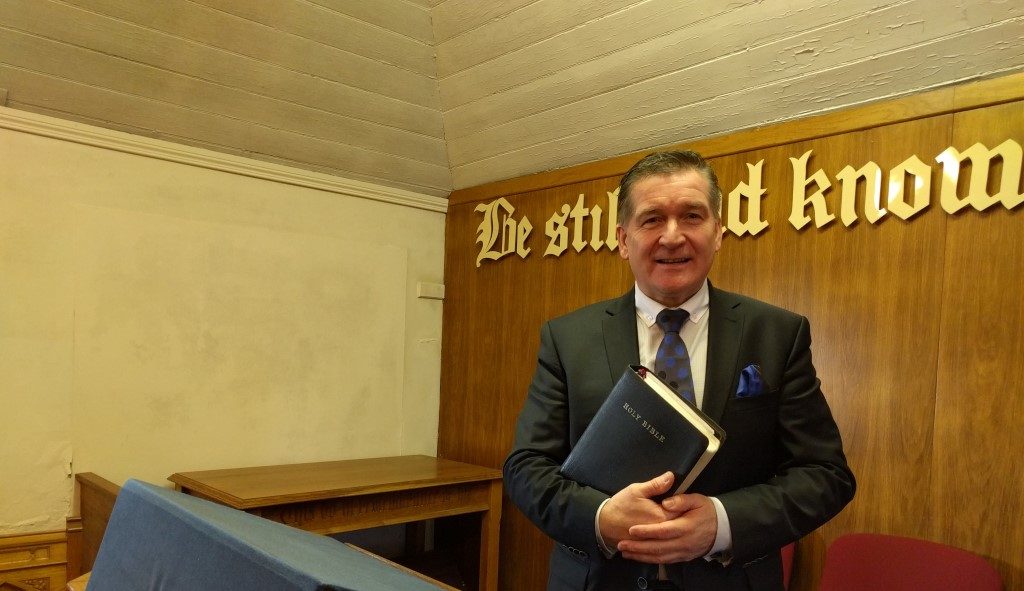
Preacher: Rev. David McLaughlin
Bible Reference: 1 Thessalonians 5:26-27
Podcast
Sermon Summary on 1 Thessalonians 5:26–27
The sermon, drawn from the closing verses of 1 Thessalonians, takes as its text two brief but theologically weighty verses: “Greet all the brethren with an holy kiss. I charge you by the Lord that this epistle be read unto all the holy brethren.” The preacher notes at the outset that these words, though they may appear incidental or merely cultural to the hurried reader, are in fact inspired Scripture on a par with John 3:16. They are profitable for doctrine, for reproof, for correction, and for instruction in righteousness. Even in these closing commands, the Holy Ghost is teaching profound truths about Christian affection, Christian unity, the public reading of the Scriptures, and the authority of the apostolic word. These verses, the preacher contends, reveal the true heart of a faithful, Bible-believing, Reformed and Protestant church: a Christ-centred, loving people gathered out of the world, gathered together in Christ through the gospel, and gathered under the power and preciousness of the Word of God.
The sermon is structured around three principal themes drawn from the text: sacred affection, solemn authority, and shared accessibility.
I. Sacred Affection
The preacher begins with verse 26: “Greet all the brethren with an holy kiss.” This was a customary form of affectionate greeting in the ancient world, particularly among family members and close friends. It signified a deep, close friendship. Yet the Apostle Paul invests this common practice with spiritual significance.
The Reality of Christian Brotherhood
The word “greet” carries more weight than a mere verbal salutation. It appears sixteen times in Romans chapter 16 alone and denotes a mark of affection, a gesture of deep respect, a drawing near to the person in question. It is the beginning of friendship, the establishing of a bond. The preacher references Romans 12:10—”Be kindly affectioned one to another with brotherly love; in honour preferring one another”—and notes that when Paul urges the Thessalonians to greet one another, he is asking them to do so on his behalf, as if he himself were present among them. Solomon’s words in Proverbs are brought to bear: “A friend loveth at all times, and a brother is born for adversity” (Proverbs 17:17), and “A man that hath friends must shew himself friendly: and there is a friend that sticketh closer than a brother” (Proverbs 18:24).
A Sign of Real Grace
Paul’s command extends to “all the brethren”—the rich and the poor, the sick and the healthy, the educated and the uneducated. The gospel creates a supernatural family of sinners born again by the Holy Spirit. Believers are united not by a bloodline but by a blood tie; not by social class but by a saving Christ; not by race but by the Redeemer. Galatians 3:26 is invoked: “For ye are all the children of God by faith in Christ Jesus.” Jews and Gentiles, servants and masters, rich and poor—all are addressed as brethren. The gospel demolishes pride and strips away every ground for boasting except Christ Jesus and His person and work. The preacher quotes Spurgeon: “There is no aristocracy in Christ’s Kingdom except the aristocracy of grace.”
The Requirement of the Brotherhood
Paul is not merely commending toleration; he is commanding deep, affectionate fellowship. The preacher addresses the reality that in every family—including the church family—there can be clashes of personality, people not speaking to one another, lingering offences. The remedy, Paul says, is to go and greet them, to greet them as if they were one’s closest friend. This is difficult, the preacher acknowledges, but grace can be sought in prayer. Some churches possess sound doctrine but have frozen hearts; people can come and go without anyone asking their name. True orthodoxy without true love degenerates into a cold, icy formalism. The early church was marked by a visible love that caused the ungodly to exclaim, “See how these Christians love one another.” Peter’s words in 1 Peter 5:14 are noted: “Greet ye one another with a kiss of charity.” In the pagan world of iniquity, idolatry, immorality, backstabbing, and backbiting, this kiss of loving affection was a powerful testimony.
The preacher uses the metaphor of a fire: the coals burn hottest and strongest when they are gathered together. Separate one coal from the rest, and it will smoke, cool, and eventually grow cold. So it is with believers: when out of fellowship with one another, they can grow spiritually cold very quickly. The doctrine of separation, he stresses, is not about isolation. Believers are separated unto God, but within that separation they must maintain loving fellowship with all who belong to the family of God.
The Regulation of the Brotherhood
Paul calls it a holy kiss. The adjective sanctifies the custom. This affection must be genuine, not sensual; it must be sanctified affection. The command forbids impurity, favouritism, hypocrisy, guilt, and pretended affection. Not every handshake, not every “hello, great to see you,” not every hug or embrace is holy, pure, and genuine.
The preacher illustrates this with a striking Old Testament narrative from 2 Samuel chapter 20. Joab, the commander of David’s army, approached Amasa. He dressed him in his own garment, provided him with a girdle and a sword, and then asked, “Art thou in health, my brother?” Joab took Amasa by the beard with his right hand to kiss him—a gesture of fraternal affection—but Amasa took no heed of the sword in Joab’s other hand. Joab smote him in the fifth rib, and Amasa died. This was pretended affection: the kiss not of a friend but of a foe, the kiss of murder and betrayal. The preacher draws the parallel to Judas Iscariot, who came to the Garden of Gethsemane with a mob and betrayed the Son of Man with a kiss. The Lord’s question—”Betrayest thou the Son of man with a kiss?”—exposes the hypocrisy. Judas kissed the door of heaven and went to hell.
The preacher is careful to clarify what this verse does not teach. It does not teach that churches are universally required to practise literal kissing. It does not teach that physical affection—whether a handshake or a hug—is inherently spiritual. It does not teach that the customary greeting becomes a permanent ordinance. What it does teach is a timeless principle: the form of the holy kiss may vary, but the abiding substance is mutual love, cordial salutation, and holy affection among all the true brethren. Whether it be a hug, a handshake, or a warm embrace, the greeting must be one of genuine love.
II. Solemn Authority
The sermon now turns to verse 27, where Paul’s tone shifts markedly from affectionate greeting to apostolic urgency. “I charge you by the Lord” is strong language—”I adjure you, I solemnly command you before God.” This is not a suggestion, not a piece of advice to be taken or left. It is a divine command connected to God’s own authority.
The Authority of the Apostolic Word
Paul understood that his writings—he penned fourteen of the twenty-seven books of the New Testament, including this letter to the Thessalonians—were not his own opinions, not the imaginations of his mind, not even his own words. What Paul wrote were the very words of God. The preacher points to 1 Thessalonians 2:13, where Paul commends the Thessalonians because “when ye received the word of God which ye heard of us, ye received it not as the word of men, but as it is in truth, the word of God.” Likewise, Paul wrote to Timothy that “all scripture is given by inspiration of God, and is profitable for doctrine, for reproof, for correction, for instruction in righteousness: that the man of God may be perfect, throughly furnished unto all good works.”
This, the preacher declares, destroys the heresy of modern liberalism and modernism. The Bible is not to be treated as a mere human reflection of the mind or mouth of a man. When the Apostles spoke, they spoke under the anointing and superintendence of the Holy Ghost. When they wrote the words of Christ, they wrote under the supervision and power of the Spirit. Therefore the words are powerful, alive, pure, precious, and preserved.
The Spirituality of the Command
Paul writes with urgency: “that this epistle be read.” Why such a command? Because the neglect of the Word of God is spiritually deadly. A starving man needs bread, and as Christ said in Matthew 4:4, “Man shall not live by bread alone, but by every word that proceedeth out of the mouth of God.” A sinner needs to discover the Bread of Life. A church without an emphasis on reading the Word of God is a church that is weak, worldly, woolly, and woke.
The preacher recalls the Protestant Reformation, when the pulpit was brought to the centre of the church and the Word of God was placed central to the people. In the early days of the Reformation in England, there was the practice of the Chained Bible—the Bible was chained to the pulpit, not to hide it from the people but to honour it and preserve the precious copy. Men and women travelled miles on foot, on horseback, on donkeys and carts, to hear the Scripture read publicly. In those days, as in the days of Samuel, the Word of God was rare—and therefore precious.
Today, the preacher observes, many people possess multiple Bibles, but the question is not whether we have a Bible but whether we read it. He fears that many Bibles in the homes of nominal Protestant people are never opened, never read. Yet the Scripture commands attention to reading. Paul does not point to human tradition, to mystical experiences, to ecclesiastical hierarchy, to charismatic personalities, to celebrity leaders, to the charm of the preacher, to emotional manipulation, to popular opinion, or to religious ceremony. He directs us to the purity and power of the Word of God. The preacher quotes John MacArthur: “Power in the ministry is not in man; it is in the Word of God.” Authority rests in the inspired Word.
III. Shared Accessibility
The third major theme concerns the words “unto all the holy brethren.” The adjective “holy” describes those who are in Christ—not only full, free, and forever justified, but also living a sanctified, holy life unto God.
The Contrast with Rome
The preacher draws a sharp historical contrast with the Church of Rome. From the fifth century to the 1500s, Rome restricted the Scriptures from the common people. The Bible existed in Latin—the Latin Vulgate, translated by Jerome—but the common people, who did not speak Latin and were not educated, could not understand a single word that was read. For a thousand years, Rome refused to translate the Scriptures into the language of the people.
In stark contrast stands the Apostle Paul, writing to the young church at Thessalonica, commanding that his letter be read—not merely by the elders or the leadership, but by all the holy brethren, all the churches in Asia Minor and beyond. Apostolic Christianity shared the Scriptures; it spread them publicly among the people. The Word of God is not the preserve of the elite or the scholars. It is not just for the priests, the Pope, the pastor, or the intellectuals. It belongs to every true believer—even the boys and the girls, even the babies in the house of God.
The Example of Timothy and the Jewish Tradition
The preacher recalls Paul’s words to Timothy in 2 Timothy 3:15: “From a child thou hast known the holy scriptures, which are able to make thee wise unto salvation through faith which is in Christ Jesus.” To take a baby on one’s knee—even a baby still in nappies—and to read the Word of God to that baby, to whisper John 3:16 into its ear, is one of the greatest things one could do.
He also recalls the ancient Jewish practice: when families gathered to read the Scriptures, the grandfather or father would take the little baby’s hand, dip the baby’s finger in a bit of honey on the table, dab it on the corner of the Bible, and then put the baby’s finger into the honey at the corner of the Bible. The baby learned that there was goodness there and would constantly reach out for the corner of the Scriptures.
The Primacy of Public Reading
Paul commands the public reading of the Word of God, and this is fundamental and foundational to Christian worship. He told Timothy in 1 Timothy 4:13, “Give attendance to reading.” Revelation 1:3 pronounces a blessing: “Blessed is he that readeth, and they that hear the words of this prophecy, and keep those things which are written therein: for the time is at hand.” The preacher notes that seven times in the book of Revelation, John pronounces a blessing upon God’s people, all connected to the reading of the Word. That blessing involves listening, accepting, keeping, and applying the Word of God.
The public reading of Scripture is not a filler, not something to be disposed of or done with during the service. It is an integral part of worship. God speaks to His people through His Word. Many churches today, the preacher laments, minimize the public reading of Holy Scripture; they maximize other things while minimizing the reading of the Word. But in Reformed worship—and this is true in every Free Presbyterian Church—the praise is shaped by the Scriptures, the praying is shaped by the Scriptures, the readings are governed and shaped by the Scriptures, and the preaching is the same.
Hearing, Receiving, and Obeying
Public reading is not enough, however. The Word that is heard must be received, kept, and obeyed. The preacher turns to Psalm 119: “Wherewithal shall a young man cleanse his way? By taking heed thereto according to thy word.” Not merely hearing—that is right and proper—but taking heed. David said, “Thy word have I hid in mine heart, that I might not sin against thee.” The Word that is heard must be received by faith and then lived out in practice.
The preacher poses a searching question: how many hear sermons, how many even read the Scriptures, and yet live and perish in unbelief? The Word can be a savour of life unto life, but the same Word can be a savour of death unto death if it is not mixed with true faith. He offers the illustration: the sun that melts the wax hardens the clay.
He then recounts a striking cultural observation. He heard a popular song on the radio—he is not advocating the programme, he notes—with the line “Run from the sun like Dracula.” Dracula, a mythological figure, could not stand the light; when the sun arose, he hid his face and ran to the darkness. The preacher applies this spiritually: thousands in Northern Ireland are running from the Sun of Righteousness, running from the Scriptures of truth, running from the only One who can help them. Christ is the answer. Ulster needs the power of the written Word—the Word of God must be read to the whole congregation—and it needs the power of the illuminating Spirit.
Conclusion: The Centrality of the Word
The sermon draws to a close by emphasising that Paul does not point to human tradition, mystical experiences, ecclesiastical hierarchy, charismatic personalities, celebrity leaders, the charm of the preacher, emotional manipulation, popular opinion, or religious ceremony. He directs the church to the purity and power of the Word of God. As the Word of God is read, the voice of God is heard.
The inspired Word must not be sidelined. In the Free Church, the Word of God must be kept central. The Word that is read accomplishes three things:
First, it proclaims the gospel: “Go ye into all the world, and preach the gospel to every creature. Preach the word.”
Second, it protects the gospel: when the Bible is read before all the congregation, error is exposed, and believers are anchored in the truth. The church holds to sola scriptura—as Martin Luther declared, the Word of God shall establish the articles of faith. The primacy and sufficiency of the Scriptures must be maintained.
Third, it professes the gospel: when the Word is heard, God has spoken. To get a word from God excites, encourages, and helps the believer through the week and through all the troubles faced. The Psalmist said, “O how love I thy law!”
The preacher closes with a challenge to his own heart and to the congregation: Ulster’s great crisis is not political, not merely societal or cultural, not even methodological. The crisis is spiritual. There has been a forsaking and an abandonment of the Word of God. The only thing that will proclaim the gospel and protect the gospel is the Word of God clearly read, as revealed in the King James Bible. The purity of the gospel must be maintained. The closing question lingers: have we this sacred affection? Have we heard this solemn authority? Have we this shared accessibility to the Word of God?