
INTRODUCTION
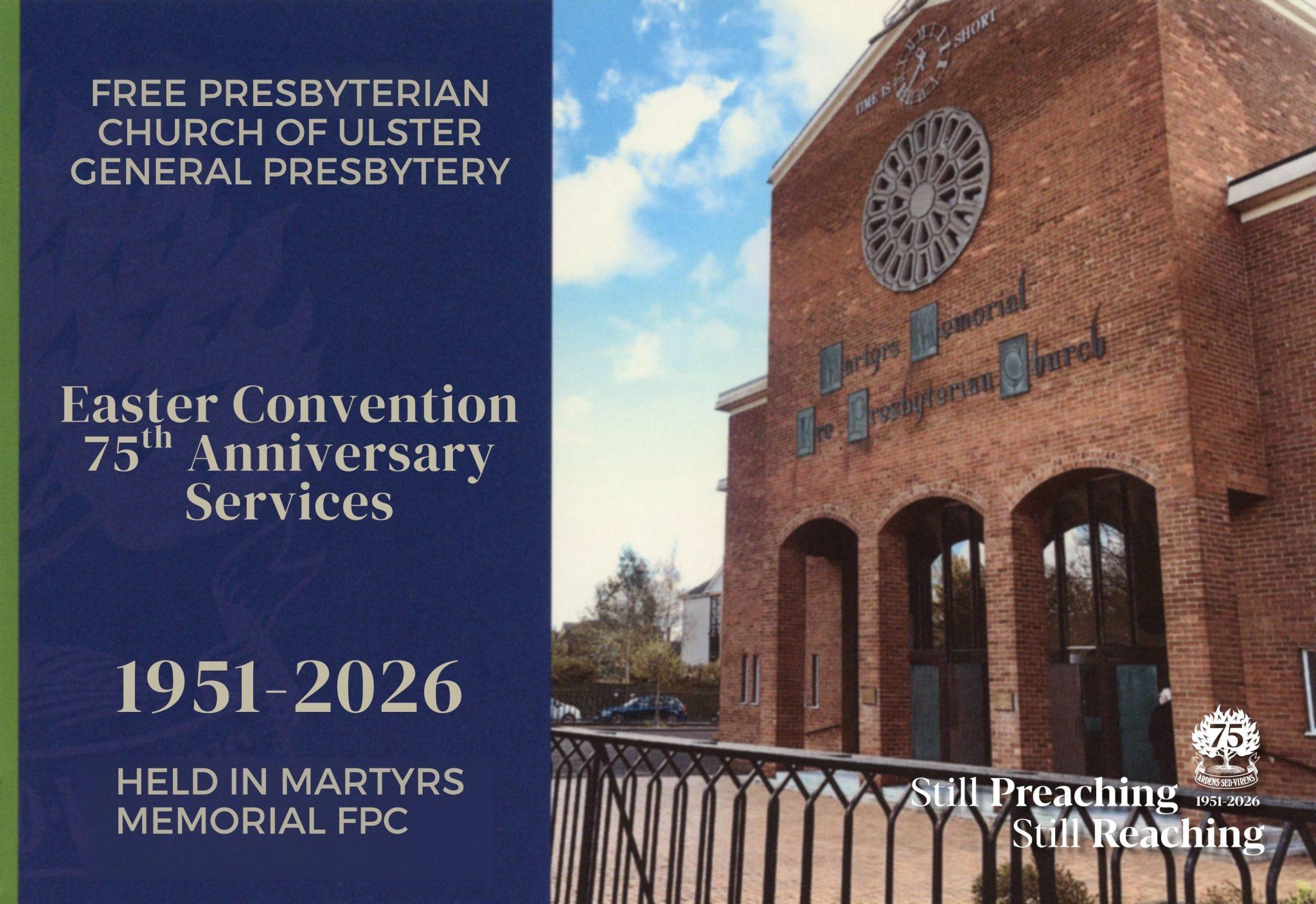
These special meetings, held in Martyrs Memorial Free Presbyterian Church, Belfast, bring together congregations from across the province and beyond for a weekend of thanksgiving, praise, and spiritual challenge.
Here you can watch or listen again to all three full broadcasts from the Convention and read a concise summary report from each night’s service. From heartfelt worship and prayer, to stirring messages from God’s Word, the anniversary convention celebrated the faithfulness of Christ over seventy‑five years and renewed the Church’s call to go forward in His name.
RELATED POSTS
Friday Youth Rally
Report: Friday Night – 75th Anniversary Easter Convention
Venue: Martyrs Memorial Free Presbyterian Church, Belfast
Occasion: 75th Anniversary Convention of the Free Presbyterian Church of Ulster – Easter 2026
Speaker: The Rev. Ryan McKee (Deputy Moderator, Minister of Magherafelt Free Presbyterian Church)
Subject: Numbers 14 – “Going Forward with God”
Opening of the Service
The opening meeting of the Easter Convention marked the beginning of the denomination’s 75th–anniversary celebrations. The service commenced with congregational praise led by the Youth Council President, the Rev. Julian Patterson. Classic hymns were sung, including “Man of Sorrows, What a Name” and “Crown Him with Many Crowns.” A spirit of rejoicing and reverence pervaded the meeting, with Mr Patterson quoting that these hymns exalted “a victorious Christ—the reason why we have a hope for glory.”
Prayer was offered by the Rev. Paul Foster of Kilkeel FPC, who gave thanks for seventy‑five years of gospel witness and pleaded earnestly that Christ would be present in blessing throughout the weekend’s convention. He recalled that the denomination had been founded to be free to preach Christ, free to love Christ, free to believe in Christ.
Scripture Reading and Testimonies
Brother Andrew Irwin read the Scriptures from Numbers 13:17‑33, recounting the sending forth of the twelve spies into the land of Canaan and the contrasting reports of faith and unbelief which they returned. Two Whitfield College students then participated.
- Marcus Wenlock testified to the privileges of being reared under the sound of the gospel within the Free Presbyterian Church, the constant exposure to Scripture in a Christ‑centred home, and the blessing of godly instruction and prayerful parents. He challenged young people not to rest in outward privilege but to be personally converted and surrendered to the Lord’s will.
- John McNeill gave a detailed report of missionary assistance in the outreach work at Williams Lake, British Columbia, describing the small but dedicated congregation there and urging young people to serve wherever God calls, whether locally or abroad.
A combined choir then sang powerfully on “The Blood of Jesus” and “My Father Planned It All.” The congregation responded with deep appreciation, the Rev. Patterson remarking that it was moving to hear, after seventy‑five years, the church still singing about the redeeming blood of Christ—the theme that remains central to heaven’s worship.
Further reports followed from the Rev. John Greer, who reviewed the early decades of youth ministry within the denomination, especially under Dr Alan Cairns, recounting the founding of the Youth Council in 1974, the Truth for Youth magazine (1973), and other initiatives such as Let the Bible Speak. The Youth Council President closed the presbyterial section with extensive announcements regarding upcoming outreach work in the province, on the British mainland, and overseas.
Reading and Sermon by the Rev. Ryan McKee
The Rev. Ryan McKee took Numbers 14:1‑10 as his text, continuing the account read earlier. He titled his message “Go Forward with God”, drawing lessons for both individuals and the denomination as it stands at its seventy‑fifth year.
1. Introductory Perspective
Rev. McKee reminded the gathered congregation that seventy‑five years marks a pivotal moment: the founders of the Free Presbyterian Church are passing off the scene, and the next significant milestone, the centenary in 2051, will be reached without most of the original witnesses. Looking back with gratitude, he enumerated God’s “mighty acts” in saving souls, raising ministers and missionaries, and establishing congregations both at home and abroad. Quoting Psalm 115:1, he affirmed that the glory belonged not to men but to the Lord: “Not unto us, O Lord, not unto us, but unto thy name give glory.”
2. Call to Go Forward
Transitioning from reflection to responsibility, he posed the question: “What is God’s will for His Church now?” The answer, he said, could only be that the Church must go forward, as Israel was bidden to do at the Red Sea: “Speak unto the children of Israel, that they go forward.”
For a twenty‑first‑century Church, going forward involves deliberate engagement in the divine strategy ordained for every generation—preaching and prayer.
- Through preaching, the Church must lift up Christ in all His perfection, sounding forth both promise and warning: calling sinners to repentance and believers to holiness.
- Through prayer, it must labour for the outpouring of the Spirit, for the raising of workers, for the turning of society’s tide of wickedness, and for genuine revival.
He reminded the congregation that the Free Presbyterian Church was born in prayer, grew through prayer, and will only go forward in prayer.
3. Lessons from Israel’s Failure to Advance
From Numbers 14 he drew three chief hindrances which forfeited Israel’s progress and which, if unrecognised, could hinder the modern Church.
(i) A Greater Focus on Man’s Opinion than on God’s Word
Two million Israelites, who once sang in triumph at the Red Sea, now wept in fear. Ten men’s pessimistic report had eclipsed faith in God’s promise. Rev. McKee stated that when the Word of God ceases to be central, instability and fear always follow.
He described the present age as likewise dominated by fear—stoked by the media’s continual alarmism—and contrasted it with the believer’s hope rooted in God’s unchanging Word: “Fear thou not; for I am with thee.”
He emphasised that God never promised a trouble‑free life, but He did promise His abiding presence through trial. The Christian’s peace derives from the victory of Christ: “Be of good cheer; I have overcome the world.”
When the Church abandons its confidence in Scripture and listens instead to human opinion, it loses spiritual stability and direction. He illustrated this with the story of David Livingstone, who, forced to discard many volumes during his trek across Africa, kept one indispensable book—the Bible. Likewise, the Church must discard dependence on the wisdom of men and cling solely to Scripture.
(ii) Murmuring against God’s Servants
Rev. McKee next identified the sin of murmuring as the second great hindrance. Verse 2 records that “all the children of Israel murmured against Moses and Aaron.” What began as fear quickly degenerated into complaint and accusation. Though Moses and Aaron were God’s appointed leaders, they became targets of frustration.
The preacher explained that murmuring literally means to grumble or dwell upon discontent until it dominates the heart and speech. In the wilderness, such murmuring had begun immediately after the Red Sea victory and had continued for two years. When men and women lose sight of God, they soon begin finding fault with His servants.
He issued a solemn warning: be careful what you wish for, reminding the people that God answered Israel “according to their words.” Verse 28 records the chilling judgement: “Your carcasses shall fall in this wilderness.” God takes murmuring personally; it is nothing less than rebellion against His will.
Rev. McKee quoted: “God’s greatest judgment is to let people have their own way.” He exhorted everyone to guard the heart and tongue, praying with David, “Let the words of my mouth, and the meditation of my heart, be acceptable in thy sight, O Lord.” He urged the Church to emulate Paul’s admonition to the Philippians: “Do all things without murmurings and disputings.” A critical and complaining spirit, he said, will arrest any believer’s progress and quench the Spirit’s blessing.
(iii) Longing to Return to Egypt
Although the third point was only beginning as the transcript closed, its outline was clear. Rev. McKee observed that Israel’s disobedience culminated in a desire to return to Egypt, that is, to retreat to the world from which they had been redeemed. This mindset epitomised unbelief—preferring the familiarity of bondage to the risk of conquering by faith. He warned that churches and Christians today face the same temptation: to look back nostalgically at worldly security instead of pressing forward in trust and obedience.
4. Wider Application
Throughout his message Rev. McKee constantly drew parallels between ancient Israel and modern Ulster Protestantism. He cautioned against institutional complacency: anniversaries should not be monuments to the past but springboards for renewed consecration.
He stressed that the Free Presbyterian witness must not rely on reputation or tradition but remain actively evangelistic, prayerful, and separated unto God.
The purpose of such occasions, he concluded, is not historical celebration alone but spiritual examination—whether as individuals or as a denomination we are truly going forward with God or simply standing still in unbelief.
Closing Emphasis
The preacher finished with an appeal that each listener should personally “go through with God.” Every life, he said, ought to count for eternity; every young believer should be willing to lay aside fear, silence murmuring, and obey the divine command to move forward in faith. Only thus would future generations—those who will gather for the 100th anniversary—find a Church still faithful to its founding principles and fruitful in its witness.
Summary
The first night of the 75th Anniversary Easter Convention at Martyrs Memorial was characterised by gratitude for past blessings, inspiration from the testimonies of young men preparing for ministry, and a searching challenge from Scripture. Rev. McKee’s exposition of Numbers 14 called the Free Presbyterian Church to maintain unswerving confidence in the Word of God, unity under God‑appointed leadership, and steadfast separation from the world. His recurring theme echoed through the vast congregation: “Speak unto the children of Israel, that they go forward.”
Live Broadcast
Saturday Night – 75th Anniversary Easter Convention
Venue: Martyrs Memorial Free Presbyterian Church, Belfast
Occasion: Easter Convention 2026 – 75th Anniversary of the Free Presbyterian Church of Ulster
Speaker: Rev. Alejandro Bernabeu (Cortíjos Nuevos, Spain)
Theme: “Philip the Evangelist – A Model for Today’s Church”
Chairman: Rev. Julian Patterson
Setting and Opening
The second night of the 75th Anniversary Convention focused on the missionary vision of the Free Presbyterian Church. The meeting opened in the same spirit of vibrant praise that characterised the previous evening, with the large congregation joining heartily in hymns that proclaimed the victory and sufficiency of Christ. Psalm 118 and 1 Peter 2 were referenced in the offering hymn, reminding the people that Christ is the chief cornerstone of His Church.
The evening’s offering was dedicated to the missionary and outreach ministries of the denomination, a warm welcome was given to Rev. Alejandro Bernabeu, the denomination’s missionary in Spain, commending him and his family for their faithfulness in a spiritually barren land.
Mission Report from Spain
Rev. Bernabeu began by expressing heartfelt gratitude for the opportunity to address the Convention. He spoke first of the work in Cortíjos Nuevos, a rural district in southern Spain where the Free Presbyterian witness is the only evangelical congregation in the entire region.
He recounted that he had studied at the Whitfield College of the Bible in Belfast before returning to Spain in October 2020 to succeed the Rev. Lyle Boyd, who had laboured there for more than three decades. The congregation continues to serve a scattered region often devoid of gospel light.
The missionary reported with joy that last year had brought several conversions:
- A man who attended church faithfully for twenty‑five years was gloriously saved.
- Another man, with almost no church background, came to faith.
- Two young men and a formerly devout Roman Catholic couple also professed salvation.
Baptisms for these converts are planned for June 2026, a tremendous encouragement to the small congregation.
Youth and Family Work:
The church organises an annual youth camp, now in its fourth year, expected to welcome over sixty‑five young people from across Spain. The theme for this year—Christian Service—reflects a desire to train believers for practical gospel work. A family camp, held in August with other churches across the nation, further strengthens fellowship among believers scattered throughout Spain.
Bible College Vision:
A major development lies ahead: together with likeminded churches, the mission is preparing to open a Bible college in Spain to train future pastors, elders, and Christian workers. A launch conference is scheduled for April, with classes planned for September 2026.
Rev. Bernabeu urged prayer for a spiritual awakening and for the Lord to raise faithful ministers in a vast land that remains largely unreached. He thanked the Ulster churches for their sacrificial support, affirming that every blessing in Spain is shared by those who pray and give.
The Sermon – “Philip the Evangelist”
Turning to Acts 8 and briefly Acts 21, Rev. Bernabeu took as his text:
“We entered into the house of Philip the Evangelist” (Acts 21:8).
Even twenty years after Acts 8, Philip remained known by that title—an “evangelist.” The preacher declared that this simple description should mark every believer.
1. The Meaning of “Evangelist”
The Greek root, he explained, combines eu (good) and angelos (messenger). An evangelist brings good news—the Gospel of Christ. In early history the term described messengers announcing military victory; so too Christians proclaim Christ’s triumph over sin and death.
Ephesians 4 and 2 Timothy 4 show that evangelists were God’s gift to the Church to extend Christ’s kingdom. Yet, he stressed, evangelism is not the exclusive task of ordained ministers—every believer is called to bear this message. Acts 8:4 records that ordinary believers, not apostles, “went everywhere preaching the word.” So must the Church today.
The Three Marks of an Evangelist
I. An Evangelist Must Love the Gospel
The preacher read from 1 Corinthians 15, defining the gospel as the death, burial and resurrection of Christ “according to the Scriptures.” The gospel is not man‑made nor merely theoretical; it is the eternal plan of God for the redemption of sinners.
Rev. Bernabeu urged Christians to recapture amazement at its message. Many fail to witness because “the gospel no longer excites them.” If believers truly loved the gospel, they would speak of it with joy, as Philip did in Samaria and later to the Ethiopian eunuch.
Philip’s whole ministry was fuelled by love for Christ. He obeyed divine direction without hesitation, even when commanded to leave a thriving revival in Samaria and go into the desert. Love for the Gospel led him to obedience, sacrifice, and joyful service.
Rev. Bernabeu cautioned against prideful evangelism focused on personal success rather than Christ’s glory. True evangelists delight in the message itself, not in their own reputation. They love Christ more than ministry.
II. An Evangelist Must Come Alongside the Unbeliever
From Acts 8:29 the Spirit said, “Go near, and join thyself to this chariot.” Philip obeyed, ran, and engaged the Ethiopian personally. The preacher emphasised that effective evangelism requires proximity and compassion—coming near to those without Christ.
Philip cast aside prejudice, first preaching in hated Samaria and then to a foreign Ethiopian. The gospel breaks every racial and social barrier. Christians must likewise overcome excuses and fear, trusting that God has prepared hearts even among those who appear disinterested or powerful.
Rev. Bernabeu observed that the Ethiopian was already reading Scripture—Isaiah 53—possibly the clearest prophecy of Christ’s suffering. When we obey the command “Go near,” we often discover God has already been at work.
To come alongside means identifying with people, meeting them at their level, and caring for their souls. Philip began the conversation with the disarming question, “Do you understand what you read?”
The preacher warned, however, that drawing near is not compromising: believers must never become unequally yoked or entangled in sin. Using Jude 22‑23, he said we rescue others “pulling them out of the fire, hating even the garment spotted by the flesh.”
He urged practical compassion—inviting unbelievers for conversation, coffee, and hospitality, not to socialise aimlessly but to open the door for speaking of Christ. Like Philip, we must eventually “open our mouth” (v 35). Lifestyle witness alone is not enough; the gospel must be spoken.
III. An Evangelist Must Seek Real Conversions
Philip’s goal was not numbers or shallow decisions, but true conversion. Starting from Isaiah 53, he “preached unto him Jesus.” He unfolded the full message—sin, atonement, resurrection, obedience. When the eunuch requested baptism, Philip replied, “If thou believest with all thine heart, thou mayest.” Genuine faith preceded the outward act.
Rev. Bernabeu asserted that baptism does not save, yet it is commanded. Obedience in baptism and continued joy serve as clear fruits of conversion: “He went on his way rejoicing.” Where the Holy Spirit works, joy follows.
He warned against manipulation and emotionalism that produce false conversions, stressing that the evangelist is simply a messenger delivering God’s truth—responsible for faithfulness, not results.
Finally, he reminded the congregation that Philip’s first mission field was his home. Twenty years later we read of his four daughters, virgins, which did prophesy. His evangelism began within his own family; he did not sacrifice them for public ministry. Real evangelists carry the gospel first to their homes and then to the world.
Appeal and Closing Prayer
Rev. Bernabeu closed with heartfelt petitions:
- That believers would love the gospel deeply and proclaim it gladly.
- That they would compassionately draw near to the lost.
- That God would grant true conversions across towns and nations.
His final prayer asked that the Lord would “raise up many more evangelists in our churches.”
Conclusion of the Service
The meeting closed with the hymn “Send the Light”, sung in antiphonal style—gentlemen on the second verse, ladies on the third, all together on the fourth. The words captured the evening’s theme of gospel urgency.
The Chairman of the Mission Board then concluded in prayer, thanking God for the challenge to “shine the light brightly in the darkness of our towns and cities,” praying for renewed zeal in evangelism both in foreign lands and on the home front, and expressing gratitude for every labourer faithful to the Great Commission.
The congregation left rejoicing in fellowship, stirred by Rev. Bernabeu’s message that every believer—at home or abroad—must indeed be Philip the Evangelist, taking the good news of Christ to a world in need.
Live Broadcast
Easter Monday Evening – 75th Anniversary Convention (2026)
Free Presbyterian Church of Ulster
Martyrs Memorial Free Presbyterian Church, Belfast
Introduction
The closing meeting of the 75th Anniversary Easter Convention marked a solemn and stirring culmination to a historic weekend in the life of the Free Presbyterian Church of Ulster. Gathering in Martyrs Memorial—long associated with the denomination’s founding witness—the congregation assembled with thanksgiving for the Lord’s faithfulness since 1951, and with a renewed burden for the future.
The service combined reverent worship, historical reflection, missionary vision, and searching preaching from the Word of God. Above all, it directed hearts upward—to Christ, the unchanging Head of the Church—and forward, to the ongoing call: “still preaching, still reaching.”
Opening Elements of Worship
The service commenced with the public reading of Holy Scripture from Isaiah 52:13 through Isaiah 53, a passage central to the Gospel message. The reading set the tone for the entire evening, presenting Christ as the suffering Servant:
“He was wounded for our transgressions, he was bruised for our iniquities… and with his stripes we are healed.” (Isaiah 53:5, KJV)
This Christ-centred foundation was reinforced throughout the meeting.
A presentation from the Missionary Council followed, outlining the structured and sustained efforts of the Church in supporting gospel work at home and abroad. The report highlighted:
- Ongoing missionary support across multiple continents
- Prayer mobilisation through regular updates and calendars
- Financial provision for both active and retired missionaries
- Practical involvement in global outreach projects
The emphasis was clear: the Free Presbyterian Church remains a missionary church, committed to the Great Commission.
Historical Reflection and Testimony
A retrospective video presentation traced the Church’s development from its founding in Crossgar (1951) through decades of opposition, growth, and global outreach.
Key themes included:
- The centrality of preaching Christ crucified
- A commitment to Biblical separation and doctrinal purity
- The sacrificial stand of early leaders, including imprisonment in 1966
- Expansion into worldwide missionary labour
- Continued use of modern means (radio, internet, literature) to spread the Gospel
The testimony of those present in earlier decades added weight and authenticity. The message was unmistakable:
“This is the Lord’s doing; it is marvellous in our eyes.” (Psalm 118:23)
Congregational Praise and Participation
The service featured robust congregational singing, characteristic of the denomination’s tradition. Hymns such as “I’m Not Ashamed to Own My Lord” and “God Be With You Till We Meet Again” were sung with conviction.
A choir presentation reinforced key Gospel truths:
- The enduring power of the Word
- The sufficiency of Christ’s blood
- The certainty of Christ’s reign
Children also participated, presenting Scripture and singing, emphasising the importance of raising a new generation grounded in truth.
Introduction: The Absolute Necessity of Christ in Preaching
Sermon by Moderator of the Free Presbyterian Church, Dr. Ian Brown.
The sermon opened with a deeply instructive reminder: no sermon has value unless it leads to Christ. It is entirely possible, the preacher noted, to deliver a message that is intellectually sound, logically structured, and even emotionally engaging—yet still be spiritually empty. Why? Because Christ is absent.
The point was pressed home with clarity. Scripture is not a collection of disconnected ideas or moral lessons. It is a unified revelation that points, in every part, to the Person and work of the Lord Jesus Christ. Whether one is in the Law, the Prophets, the Psalms, or the New Testament, there is always a pathway that leads to Him.
Isaiah 53 is one of the clearest examples of this truth. Here, the “arm of the LORD” is not an abstract concept, but a living Person—the suffering Servant, the Redeemer, the Lord Jesus Christ Himself. The entire message, therefore, centred on Christ as the power of God revealed to men.
I. The Arm of the LORD Described – The Nature of Divine Power
The preacher first unfolded what is meant by “the arm of the LORD.” In Scripture, the arm represents strength in action—power not merely possessed, but exercised. When applied to God, it speaks of His ability to act decisively in creation, redemption, and judgement.
He then carefully expanded the nature of this divine power.
God’s power is inherent. That is, it belongs to Him alone. Unlike man, who depends on external sources—whether physical strength, resources, or assistance—God depends on nothing and no one. All power originates in Him. This truth humbles man completely. It reminds the Church that it cannot produce spiritual results through effort or organisation. If anything is to be accomplished for eternity, it must come from God.
Closely connected to this is the fact that God’s power is inclusive. It is not limited to certain areas or situations. It extends over all creation—heaven and earth alike. Every force, every event, every circumstance ultimately falls under His authority. Christ Himself declared, “All power is given unto me in heaven and in earth.” There is no competing power that can rival Him.
The preacher then emphasised that this power is infinite. There are no limits to what God can do. No sinner is too hardened. No situation is too complex. No church is too far gone. The tendency of human nature is to look at circumstances and conclude that nothing can change. But Scripture declares otherwise: “With God nothing shall be impossible.” The barrier is never divine ability—it is human unbelief.
Furthermore, this power is irresistible. When God acts, no one can prevent Him. Kingdoms may oppose Him, individuals may resist Him, but ultimately His will is accomplished. This brings both comfort and warning. It comforts the believer, because God’s purposes cannot fail. It warns the sinner, because resistance to God is ultimately futile.
Finally, the preacher stressed that God’s power is immutable—it does not change. Time does not weaken Him. Generations passing do not diminish His strength. The same God who moved in past revivals is the God who reigns today. Christ remains “the same yesterday, and to day, and for ever.” Therefore, any absence of revival cannot be attributed to a lack of power in God.
II. The Arm of the LORD Displayed – The Exercise of Divine Power
Having described the nature of God’s power, the preacher then demonstrated where this power has been clearly revealed.
He began with creation. The universe stands as a constant witness to divine power. God did not shape pre-existing materials—He created all things out of nothing. By His word alone, order came from chaos, light from darkness, and life from lifelessness. This same power is still active. The God who created the universe is fully able to work in the most difficult spiritual circumstances.
From creation, the message moved to redemption, the greatest display of God’s power. At Calvary, the arm of the LORD was revealed in a way that surpasses all other demonstrations. There, Christ bore sin, satisfied divine justice, defeated Satan, and secured eternal salvation for His people. What no man could do, Christ accomplished fully.
The preacher emphasised that conversion is not a minor or natural process—it is a miracle of divine power. A sinner is brought from death to life, from blindness to sight, from guilt to justification. This is not achieved through persuasion or human effort, but through the sovereign work of God.
He then turned to the solemn reality of judgement. The same arm that saves also judges. The Flood, the destruction of Sodom, and the plagues upon Egypt all testify to God’s power against sin. These are not merely historical events—they are warnings. They reveal that God is not indifferent to sin, and that judgement is certain.
This produced a serious and necessary application. Those who are saved ought to be deeply thankful, recognising that they have been spared. At the same time, there must be a burden for those who remain outside of Christ. If God’s judgement is real—and Scripture declares that it is—then indifference toward the lost is inexcusable.
Finally, the preacher reflected on past revival blessing, particularly within the history of the Free Presbyterian Church. There were times when the arm of the LORD was clearly revealed—when churches were filled, sinners were converted, and the Gospel advanced with power. These seasons were not the result of human planning, but of divine intervention.
III. The Arm of the LORD Desired – The Present Need of Revival
This section formed the most searching part of the sermon. The preacher turned from past displays of power to the present condition of the Church.
He spoke plainly and without exaggeration. There is, broadly speaking, a decline in spiritual power. Many churches have drifted doctrinally. Worldliness has increased. Spiritual fervour has diminished. Even among those who hold to truth, there can be coldness and formality.
The conclusion was unavoidable: the arm of the LORD is not being widely revealed today as it once was.
Yet the preacher refused to accept defeatism. He reminded the congregation that history tells a different story. The greatest revivals often came in the darkest times. The Reformation emerged out of deep corruption. The Great Awakenings arose in periods of spiritual deadness. God has repeatedly demonstrated His ability to act when circumstances appear hopeless.
Therefore, present conditions are not a barrier to revival—they may well be the very setting in which God chooses to work.
The focus then shifted to responsibility. Revival is not produced by new methods, modern strategies, or organisational changes. It comes when God’s people return to Him. The well-known promise of 2 Chronicles 7:14 was brought to the forefront: humility, prayer, seeking God’s face, and turning from sin are the pathway to blessing.
The preacher made this intensely personal. Revival does not begin in denominations or movements—it begins in individual hearts. Each believer must ask: am I right with God? Am I seeking Him earnestly? Am I willing to be used?
The illustration of drawing a circle and praying for revival to begin within it captured this truth simply but powerfully. The need is not to look outward first, but inward.
At the same time, there is a corporate dimension. Churches must unite in prayer. There must be a shared burden for God to work. Without this, there will be no widespread movement of the Spirit.
IV. Final Challenge and Appeal
The sermon closed by returning to the central question:
“To whom is the arm of the LORD revealed?”
This was not left as a theoretical question. It was directed personally to every hearer.
Will God’s power be seen in our lives? In our churches? In our generation?
The preacher called for a wholehearted response:
- A renewed faith in God’s power
- A deeper commitment to prayer
- A full surrender to the will of God
There was also a clear emphasis on active service. The Church is not called to wait passively, but to labour faithfully—preaching the Gospel, reaching the lost, and trusting God for results.
The message ended with both urgency and hope. The same God who worked in the past is able to work again. The question is not whether He can—but whether His people are prepared.
Conclusion
This sermon was marked by clarity, conviction, and direct application. It brought together doctrine and duty, theology and practice, truth and challenge.
Its message can be summarised simply:
- God’s power is unchanged
- God’s works in the past prove what He can do
- The present need is revival
- The responsibility lies with God’s people
And above all:
Christ—the arm of the LORD—is still able to save, to revive, and to reign. :::
Conclusion and Final Appeal
The service concluded with the traditional singing of “God Be With You Till We Meet Again,” accompanied by the symbolic waving of handkerchiefs—a gesture rooted in missionary farewell and Christian fellowship.
This was more than tradition. It was a visible reminder:
- The Church is a sending people
- Every believer is called to serve and witness
- The Gospel must go forward
The closing prayer pleaded for:
- The salvation of souls
- Revival across the churches
- Faithfulness in the days ahead
Summary
The final night of the 75th Anniversary Convention was marked by:
- Gratitude for God’s past faithfulness
- Clarity in Gospel proclamation
- Sobriety concerning present spiritual need
- Urgency in the call to prayer and revival
The enduring message of the evening can be distilled into one pressing question:
“To whom is the arm of the LORD revealed?”
And one necessary response:
That it might be revealed in us, through us, and among us—
for the glory of Christ and the salvation of souls. :::