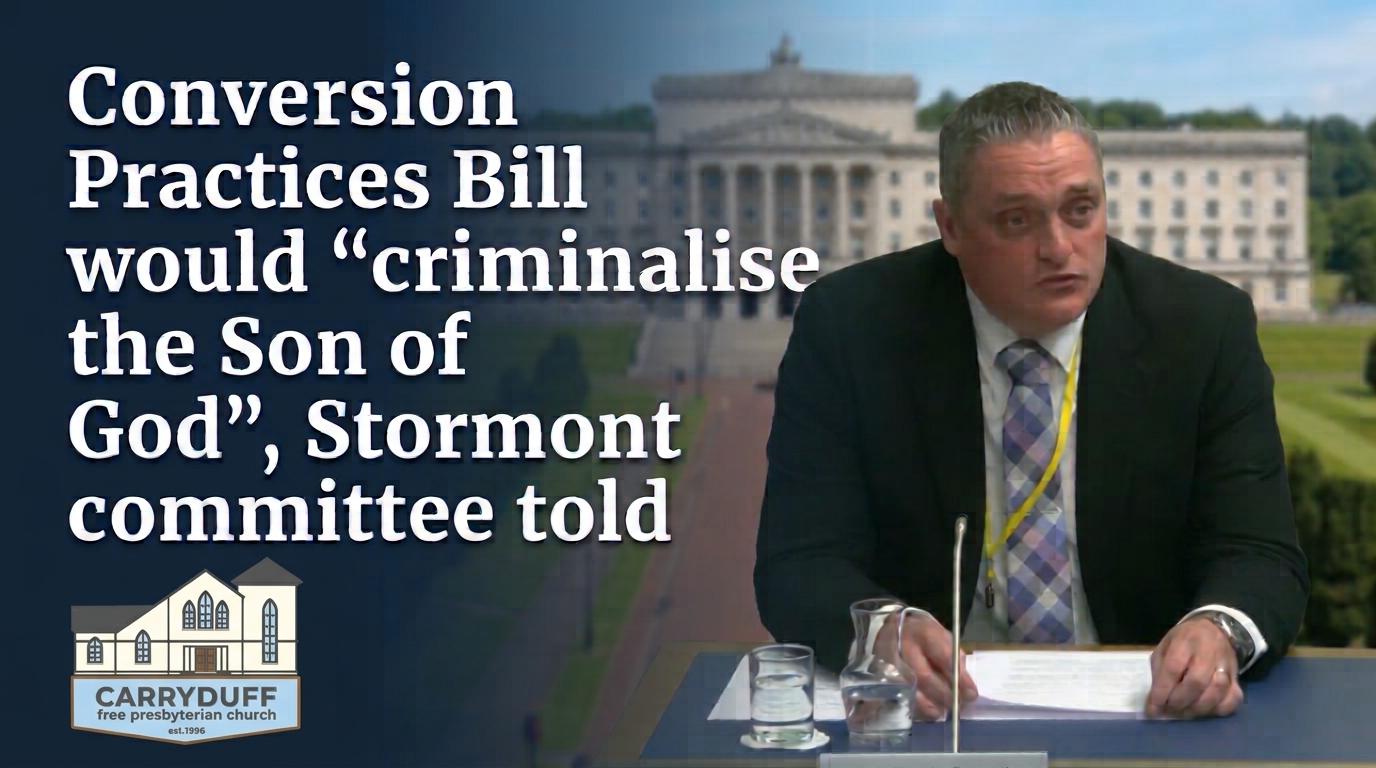

Rev Timothy Ormerod, convener of the Government and Morals Committee of the Free Presbyterian Church, told the Committee for Communities on Wednesday 25 November 2026 that the Bill reaches past abuse and into the ordinary preaching, pastoral care and parenting of Christian households.
The Background
The Conversion Practices Bill is a private member’s bill before the Northern Ireland Assembly, currently at committee stage before the Committee for Communities. It creates new criminal offences aimed at what it calls conversion practices, meaning conduct intended to change or suppress another person’s sexual orientation or gender identity. On the evidence heard so far, five features of the drafting matter most to ordinary church members:
- Consent is expressly excluded as a defence under clauses 1, 2 and 3, so a person who freely asks for help cannot in law consent to receiving it.
- “Conversion therapy” is defined to include instruction and coaching under clause 4, with nothing in the definition requiring it to resemble therapy in any clinical sense.
- “Coercive behaviour” is lifted from domestic abuse law under clause 5, capturing the regulation of a person’s day to day activities and restrictions on their freedom of action, and the offence can be made out on conduct occurring on only two occasions.
- “Psychological harm” is defined to include fear, alarm or distress under clause 8, and the only route out is a defence of reasonableness on which the defendant carries the burden. The right to elect trial by jury is removed.
- Key terms, including suppression, change and gender identity, are left undefined, so the boundary of the criminal law is left to be settled case by case after the fact.
That is the substance of the objection put by every church witness on the day. Not that abuse should be lawful, but that a law drawn this widely cannot reliably tell the difference between coercion and ordinary Christian ministry.
The Statement
Rev. Timothy Ormerod gave evidence at Stormont alongside representatives of the Christian Institute, the Evangelical Alliance, the Presbyterian Church in Ireland and the 68 Church. In a statement of just over five minutes he set out his concerns as a Christian, a father and a minister of the gospel, and closed by putting seven direct questions to members.
Scripture cited in the statement
- “Repent ye therefore, and be converted, that your sins may be blotted out, when the times of refreshing shall come from the presence of the Lord.” (Acts 3:19)
- “To open their eyes, and to turn them from darkness to light, and from the power of Satan unto God, that they may receive forgiveness of sins, and inheritance among them which are sanctified by faith that is in me.” (Acts 26:18)
- “And such were some of you: but ye are washed, but ye are sanctified, but ye are justified in the name of the Lord Jesus, and by the Spirit of our God.” (1 Corinthians 6:11)
- “She said, No man, Lord. And Jesus said unto her, Neither do I condemn thee: go, and sin no more.” (John 8:11)
- “Jesus answered and said unto him, Verily, verily, I say unto thee, Except a man be born again, he cannot see the kingdom of God.” (John 3:3)
The statement in full, lightly edited from the official record for spelling and clarity.
Mr Chairman and members of the committee, thank you for the opportunity, the invitation to come and to speak to you today. My name is Reverend Timothy Ormerod and I am here today as a Christian, as a father and as a minister of the gospel with great and grave concerns about this conversion bill. This is a bill which has the very real potential of criminalising me as a father and as a minister if either my own children or a member of my congregation seeks guidance and counsel on matters around conversion.
It is important to emphasise that as a Christian and as a minister of a church we believe and we preach the gospel of Jesus Christ, that we believe in conversions. The gospel is a message that anyone from any background can be changed or converted by the power of God. The gospel calls for conversion: “Repent ye therefore, and be converted, that your sins may be blotted out” (Acts 3:19). This was a message that Peter and John preached at the temple, and in response to their preaching 5,000 people were changed or converted to Christ.
Spiritual conversion is not a human work or practice. It is the work of God through his Holy Spirit. But we as ministers do have a part to play in that. When the apostle Paul was saved on the road to Damascus, he recounts in Acts 26:18 that God made it very clear that Paul was to be involved in the work of spiritual conversions. He was told “to open their eyes, and to turn them from darkness to light, and from the power of Satan unto God, that they may receive forgiveness of sins” (Acts 26:18). Whenever it says “turn them”, in the original Greek that can be translated “convert”.
The power of God in the gospel can change anyone. This is clear in the writings of the apostle Paul to the church in Corinth, where in 1 Corinthians 6 he lists several sins including drunkenness, theft, adultery and homosexuality, and then says to the Christians who were now in the church: “And such were some of you: but ye are washed, but ye are sanctified, but ye are justified in the name of the Lord Jesus, and by the Spirit of our God” (1 Corinthians 6:11). We believe that people can be changed. In John chapter 8, a woman was caught in adultery. Jesus spoke to her and said, “Neither do I condemn thee: go, and sin no more” (John 8:11). Jesus called her to change.
Let me state that this conversion bill, if it is passed into law as it currently is, would actually criminalise the Son of God himself if he lived in Northern Ireland. For not only did he tell the adulterous woman to convert her lifestyle, but he even told the nominally religious Nicodemus in John chapter 3, “Verily, verily, I say unto thee, Except a man be born again, he cannot see the kingdom of God” (John 3:3). In other words, conversion.
Gospel preaching and pastoral work is always seeking a change in people. The desire of every minister in our churches is that every individual would live in accordance with God’s word. We cannot and we do not force anyone to believe the Bible. This is an impossibility. We are not coercive, but we are compelling. And importantly, we are fulfilling our God-given duty to direct people to Jesus Christ. We point or direct people to Jesus, to believe in him and to follow him.
This law would seek to stop us from pastoring and preaching to our congregations and our communities the gospel message as it is found in the scriptures and as it has been preached and presented for thousands of years. It is an attack against the gospel and against Christian churches. It is an attack which is extremely unpopular in Northern Ireland. The latest consultation saw 93.55% opposed to it. The Scottish government has already been compelled to shelve it as unworkable and have handed it back to Westminster, where it has already lost its main supporter in Baroness Cass. It is a bill which in its various forms across the world struggles to be implemented by various governments because of its complex nature, because they recognise that it leaves all parents and churches open to criminal proceedings.
But if we bring it back to Northern Ireland, a number of questions I leave with you.
- Where is the evidence base that indicates that this new law is needed?
- Is it not obvious that the laws which are currently in place are sufficient, since no one has yet been able to demonstrate a harmful practice that is not illegal?
- Where is the public clamour and appetite in the community for this, because we do not see it?
- Who is the actual target of the bill?
- What behaviour is out there right now which cannot be corrected by the rules already in place?
- What are the court cases right now that show us that this bill is actually needed to fill in some alleged gap in legislation?
- If we truly believe in freedom of expression, should we not campaign for the right of someone who feels caught in an unwanted LGBT plus lifestyle to work towards their own chosen goals through their chosen form of discussion or counselling?
And finally, as evidenced by multiple testimonies online, many people have travelled in the direction from sexual sins to biblical Christianity. Will such people receive and be able to speak freely, and even to have their points of view put across, in this bill going forward? Thank you.
Closing word
His questions go to the heart of the scrutiny case: an evidence base for a new offence, the sufficiency of existing law, public appetite, the intended target, the conduct not already covered, and the one-directional nature of the proposal. Members continue taking evidence into the New Year, with the Equality Commission session rescheduled and an updated timetable for committee stage circulated in the meeting papers.
Carryduff Free Presbyterian Church encourages members to read the full record of the evidence session and to make their views known to their MLAs while the committee stage remains open.