
Service Details
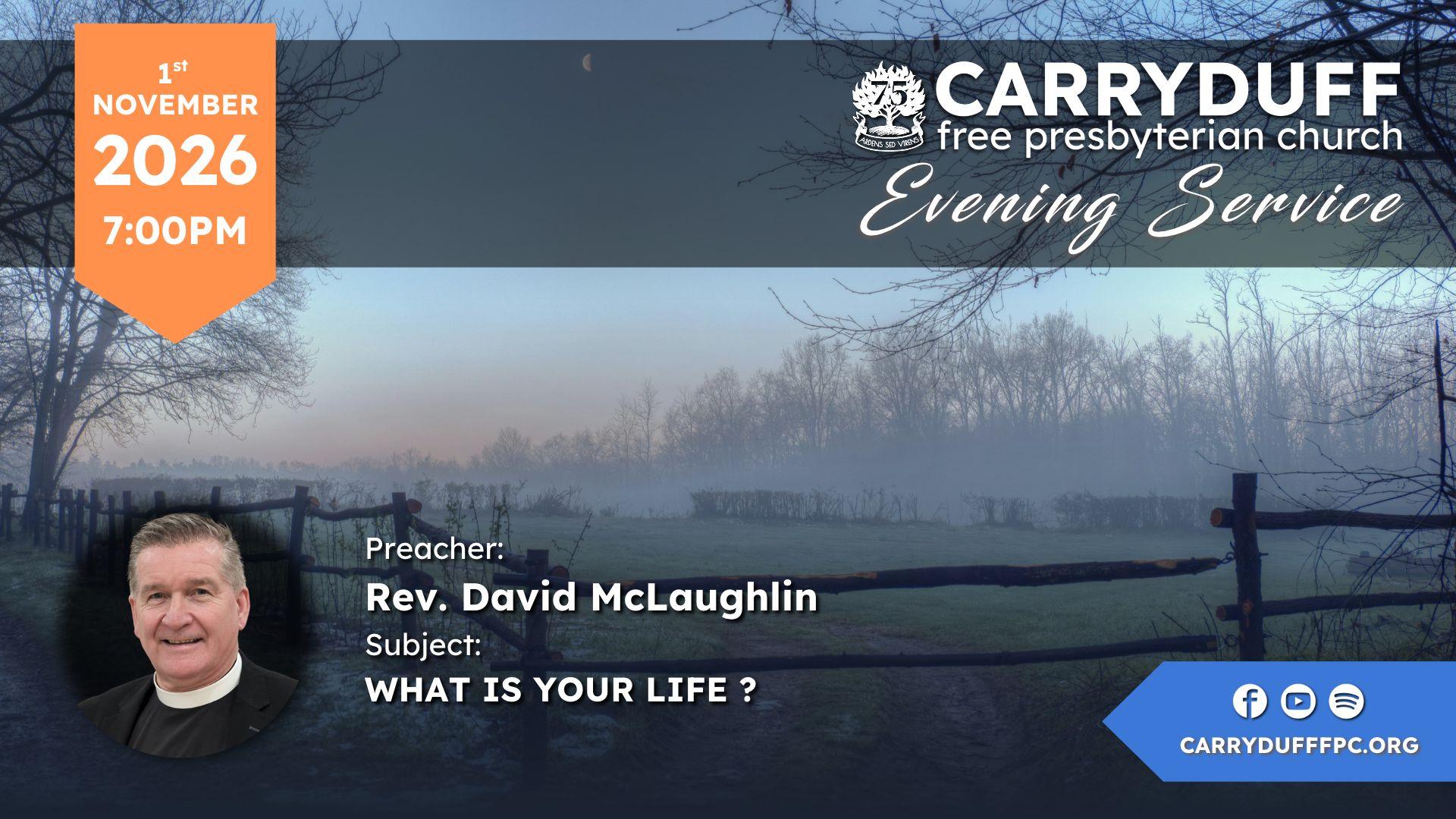
Date: SUN 7:00pm 1st November 2026
Preacher: Rev. David McLaughlin
Bible Reference: James 4:14
Podcast
Sermon Summary
Introduction
The sermon opens with a reading from James chapter 4, verses 8 to 17, in the Authorised Version. The preacher draws attention to verse 14 as his text: “For what is your life? It is even a vapour, that appeareth for a little time, and then vanisheth away.” He entitles the message simply, “What is your life?”
The preacher observes that on the journey of life there are questions we cannot answer. Many things happen that must be left to the sovereign will and wisdom of God, whether at a personal, family, congregational, communal or national level. However, there are some questions we cannot ignore, and this is one of them. Inspired by the Holy Spirit, James asks this searching question, and the preacher insists it demands our attention, our personal response and an honest answer, especially in light of eternity.
The sermon is structured around four main points: the purpose of life, the peril of life, the presumptions of life, and the passing of life.
1. The Purpose of Life
The preacher notes that James does not ask about bank balance, occupation, social status, educational qualifications, property portfolio or personal achievements. The question is about your life, and it applies to everyone: the young and the old, the rich and the poor, the high and the low, the religious and the irreligious, the person of ninety and the person of nine. Nobody can escape this question, and it cannot be postponed indefinitely. The preacher quotes Proverbs 27:1: “Boast not thyself of tomorrow; for thou knowest not what a day may bring forth.” Tomorrow is not promised.
The context matters. James is writing to professing Christians who have been scattered abroad because of opposition and persecution. As he writes, he confronts them with a spirit of arrogance, worldliness and self-sufficiency that he knows is in their hearts. He addresses those who say, “Today or tomorrow we will go into such a city, and continue there a year, and buy and sell, and get gain.” These people were busy making plans, and there is nothing wrong with planning in itself. It is a diligent, wise and responsible thing to do. The problem was not their planning but that they were planning as if God did not exist. They had left God out of the picture. They planned as though tomorrow and the rest of the year were guaranteed. They planned as if they were masters of their own destiny.
The merchants in the church had their itineraries, their business strategies, their financial objectives and their expectations. They knew where they were going, what they would do, how long they would stay and what they hoped to achieve. But they had overlooked one thing: they had left the living and true God out, and they had forgotten that tomorrow was not promised. The preacher observes that many behave exactly the same way today. They have their money but have forgotten their mortality. They calculate their profits but have forgotten the price of their soul.
James answers his own rhetorical question. Life is even a vapour. The preacher uses the illustration of steam coming out of a kettle: it appears for a little time, rises four or five or six inches into the air, and then it disappears. That, he says, is how God describes our earthly existence.
The purpose of life, according to the catechism, is that man’s chief end is to glorify God and enjoy him forever. This means bringing the Lord into the heart and centre of your life and remembering that tomorrow is not promised. The purpose of life is to know Jesus Christ as Lord and Saviour. Christ said, “I am come that they might have life, and that they might have it more abundantly.” The Son of God has come and given us an understanding that we may know him, the true God, and eternal life.
The preacher poses a striking scenario: imagine an angel came to you and told you that you had one full block of twenty-four hours left to live. What preparation would you make to go out and meet God? What would you regret? Would you regret past mistakes, missed opportunities, or a life of sin? He quotes the hymn line that sin will take you further than you want to go, keep you longer than you want to stay, and cost you more than you want to pay. Would you regret that you did not repent of your sin and get right with God, because you missed the purpose of life and left God out willfully and deliberately?
2. The Peril of Life
The second point concerns the peril of life. The preacher asks whether this applies to many in Ulster tonight, and sums up their condition in one word: Christless. He quotes Ephesians 2:12, where Paul says that at that time they were without Christ, being aliens from the commonwealth of Israel and strangers from the covenants of promise, having no hope and without God in the world.
Many, even though they are Christianised, are not truly converted. They attend church occasionally, they know certain Bible verses, they profess to have had a good Christian upbringing, and they are decent, honest, upright citizens. In their minds they say, “I am as good as the next person.” But the real question is whether they are born again. Have they personally trusted in Jesus Christ as Lord and Saviour? Have they repented of their sin and rested in Christ alone and his finished work?
The preacher warns that thousands in the country confuse familiarity with God and the things of God with fellowship with God. They confuse church attendance with true conversion. They confuse knowing about Christ with knowing Christ, and there is a world of difference.
This verse can be used to warn sinners of the urgent need to repent and get right with God. To all who are Christless, there is danger ahead. The preacher speaks of the callous soul, like Gallio in the New Testament, who cared for none of these things. There are many such people, and not only callous but careless souls.
He asks his listeners whether they ever think about the brevity of life, the certainty of death and the reality of God’s eternity. He quotes Hebrews 9:27: “It is appointed unto men once to die, but after this the judgment.” Returning to the visitation of the angel, he says that death will not be the end of existence, because there is a heaven above and a hell beneath. You know the gospel, you know you are a sinner, you know you have a soul, you know you need to be saved, and you know that Jesus Christ is the only Lord and Saviour. You know that whosoever shall call upon the name of the Lord shall be saved. You know that tomorrow may not come.
You can dismiss this truth, scoff at it or ignore it, but that does not cancel out its reality. You will never cancel out the judgment that is coming. You will never prevent your death day, and you will never prevent standing before God to give an account. He quotes Romans 14:12: “So then every one of us shall give account of himself to God.”
To the Christless he asks: what will you do with your popularity, your position and your professional achievements, because one thing you will not do is negotiate your way out at the judgment seat? Your greatest problem is not finances, lack of education or family background. Your greatest problem is sin, for all have sinned and come short of the glory of God. He quotes Isaiah 59:2: “Your iniquities have separated between you and your God, and your sins have hid his face from you.”
What you need is to have your sin dealt with and forgiven, and that is where the gospel comes in. The blood of Jesus Christ his Son cleanseth us from all sin. He quotes John 3:36: “He that believeth on the Son hath everlasting life: and he that believeth not the Son shall not see life; but the wrath of God abideth on him.”
Many say they are too young to become a Christian, or too old, or that they still have plenty of time and will become a Christian one day, but not today. The preacher asks who will guarantee another birthday, another Christmas Day, or another opportunity to hear the gospel. Many young people have made plans that never materialised. We might see next Lord’s Day, we might even see tomorrow, but for some they may not even reach retirement. The devil is very happy if you have a religious intention, as long as you put it off to another day. Tomorrow is not promised. Tomorrow may never come. Do not play games with eternity, do not gamble with your soul. The Bible says, “Today if ye will hear his voice, harden not your hearts.” It is not about being respectable; it is about being reconciled to God. If your life is Christless, be reconciled to God. Go to God with the guilt and punishment of your sin and cry out, “God be merciful to me a sinner.” It is not about a good life; it is about being found in Christ.
3. The Presumptions of Life
Thirdly, the preacher considers the presumptions of life. In this question to the merchant Christians he sees presumption. In Ulster there are not only many callous souls but many careless souls, thousands of professing individuals who presume that they are saved. This text is a rebuke to the careless as well as the callous.
The careless presume that life is about possessions. This is a common mistake. They amass toys, cars, jewellery, clothes, shoes, bags and houses, and think life is about obtaining these things. Others judge success by what they possess. The preacher quotes Mark 8:36: “For what shall it profit a man, if he shall gain the whole world, and lose his own soul?” A man’s life, as Christ taught in Luke 12:15, does not consist in the abundance of the things he possesses. Temporal possessions are not the most important thing. The danger is that so many are consumed and controlled by the things of this life that these push out the great message and mission of life to the margins. The main priority becomes not God and his kingdom. He quotes Matthew 6:33: “Seek ye first the kingdom of God, and his righteousness; and all these things shall be added unto you.”
We can be busy with things but not spiritual, active but not godly, successful in the things of this life but missing out in relation to the things of God. He asks what we have time for. Many have time for entertainment but not for scripture exposition or evangelism. Many have time for scrolling through social media but no time to read the scriptures. Many have time for holidays and hobbies but not for holiness, being lovers of pleasure more than lovers of God, as Paul says in 2 Timothy 3:4.
Others presume that life is about profit. The preacher turns to the rich young ruler, who boasted that he had kept all the commandments but really had not. Christ showed him that he had broken the first commandment, to have no other gods before him. As John Calvin discovered, the human heart is a factory of idol making. This young ruler’s biggest idol was his money; his god was his money, and he let it become the most important thing in his life rather than God.
The preacher asks what will happen to all your money when you leave this scene of time. He lets the Bible speak. You leave it all behind. There are no pockets on a shroud and no trailer on a hearse. At funerals he is often asked how much the deceased left, and the answer is that they left it all. Even if money were put into the coffin, they could not take it with them, and somebody would dig it up in the dead of night. You come into the world with nothing and go out with nothing. Not only do you leave it all behind, but somebody else will spend it, all the things you scrimped and saved and squirrelled away for a rainy day.
He quotes Solomon, the greatest, wisest and wealthiest man who ever lived, from Ecclesiastes 2:18: “Yea, I hated all my labour which I had taken under the sun: because I should leave it unto the man that shall be after me.” And who knows whether he will be a wise man or a fool? Yet he shall have rule over all your labour. This also is vanity. How many young men have been left fortunes by their fathers, or young women by their mothers, and have squandered them?
It will also decay. He quotes Matthew 6:19: “Lay not up for yourselves treasures upon earth, where moth and rust doth corrupt, and where thieves break through and steal.” Moth and rust corrupt, and one day it will all be destroyed. He recalls a visit to a house in Mount Sandal belonging to a man called Mr John Morrison, who showed them into a big beautiful room. When asked what he thought, Morrison said it was all for the fire, and the owner overheard and put them out. But how true it was. You leave it all behind, somebody else will spend it, and it will decay.
What ought you to do? Lay up treasure in heaven. Spend your life well and wisely, give generously to the work of God, and invest in things that matter to God. Laying up treasure in heaven means voluntary and sacrificial giving, giving yourself, your time and your talent to the work and witness of God, showing love, mercy, forgiveness and help to others, and putting God first, not allowing wealth to become the centre of your life.
Many also presume upon pleasures, not just possessions and profit. Paul spoke of lovers of pleasure more than lovers of God. How many are enthusiastic for entertainment? He thinks of the capital city, the drink, the dance, the drugs and the disco. But no matter what they do, where they go, what they have, or how often they are there, they know it does not satisfy. The Bible speaks of the pleasures of sin for a season, because in their heart there is a void that only God can fill. Augustine said the little season does not last. There is a day of sowing and a day of reaping. Sin will take you further than you want to go, keep you longer than you want to stay, and cost you more than you want to pay, because there is a day of sowing to the flesh and a day of reaping of the flesh.
Many presume upon pronouncements. We live in a day when people are excited about the fads of communism, socialism, liberalism and modernism, but these are only theories of men. People hold to them and would almost go to the death for them, yet they are not true. The preacher tells a story from County Armagh, on the Moi Road at the old Drum Sale, now the headquarters of a construction company. Before the year 2000, a preacher from New Zealand (whose name he cannot remember) preached that in the year 2000 all the computers in the world would crash and plunge the world into economic decline and disaster. He encouraged people to take their money out of the bank and to buy loads of toilet roll, which they could trade with others to buy other things. But it was not true; it did not happen. How many are listening and reading and consumed with strange theories, the weapons of the devil, that are not true? What is as true as this: Jesus said, “Sanctify them through thy truth: thy word is truth.” Do not believe fiction. The kingdom of God and the gospel is the greatest knowledge in the world. Through the gospel, the good news of Jesus Christ and his personal work, you can know God personally, wonderfully, intimately and savingly, and you can know that you have eternal life.
James was rebuking these people seriously and personally because he wanted them to ponder this question.
4. The Passing of Life
Finally, the preacher deals with the passing of life, life’s frailty and brevity. James asks, “What is your life?” and answers, “It is even a vapour, that appeareth for a little time, and then vanisheth away.” Our holding on to life is very slender and tenuous. We think we are in control. We make appointments, arrange schedules, and organise our plans and finances for the future, but we forget that our hold on life is fragile.
What are we guaranteed? We are not guaranteed another heartbeat, a minute, an hour or a day. We are not guaranteed sunrise. We are not guaranteed breath. Life is a gift from God, and every moment we enjoy is an expression of his grace, love and mercy. We should view life as a very precious gift and remember how quickly things can change. Young men can go out to work and not come home in the same way they went out. The preacher recalls the devastation and heartache of the McVeigh family and the Park family a few weeks earlier, who had young sons who went out to work and did not make it home. You could go to bed and not wake up in the morning. We can make plans for the future, but little do we know the journey could be almost over. We are such frail creatures. The psalmist said, “So teach us to number our days, that we may apply our hearts unto wisdom.” Life does not belong to us. We must live conscious of eternity, a heartbeat from eternity.
Life is also extremely brief. James is not merely saying life is uncertain, though that is true. He is saying more: it is short, it is brief, it is a vapour that appears for a little time and then is gone. A child of six or seven coming into the church looks at the preacher and thinks he is ancient. A teenager thinks old age is away in the distance. But in light of eternity, life is short. What does it matter where we have travelled, what we have done or what we have gained? Our chief concern should be how we have responded to the will of God. What does God want? Repent and believe the gospel, come to know him, trust him, love him and serve him.
The preacher asks what motivates us. This was a corrective to human arrogance, pride and self-sufficiency. James knew that our approach to life should not be with self-confidence but with a God-confidence and a God-consciousness. The chief business in life is not to please ourselves but to please the Saviour, not to play with sin but to profit in salvation.
Conclusion
The preacher closes with an appeal. If you are out of Christ tonight, he pleads with you to come to Christ and discover life’s purpose. Remember its peril: you could die in an instant, die in your sins and be lost. Reject all presumptions, whether upon possessions, profit, pleasures or the pronouncements of man. Remember that the chief purpose will be to hear the well done of God: “Well done, thou good and faithful servant: enter thou into the joy of thy Lord.”
If you profess to be saved, you should show on that last day that your life mattered, that you did not squander or waste it. He asks whether we are satisfied with how we live, with our prayer life, with our love for Christ, and with our commitment to his service, because all of these things are bound up in the passing of life. He closes by praying that the Lord would take his word and apply it to us this evening.