
Service Details
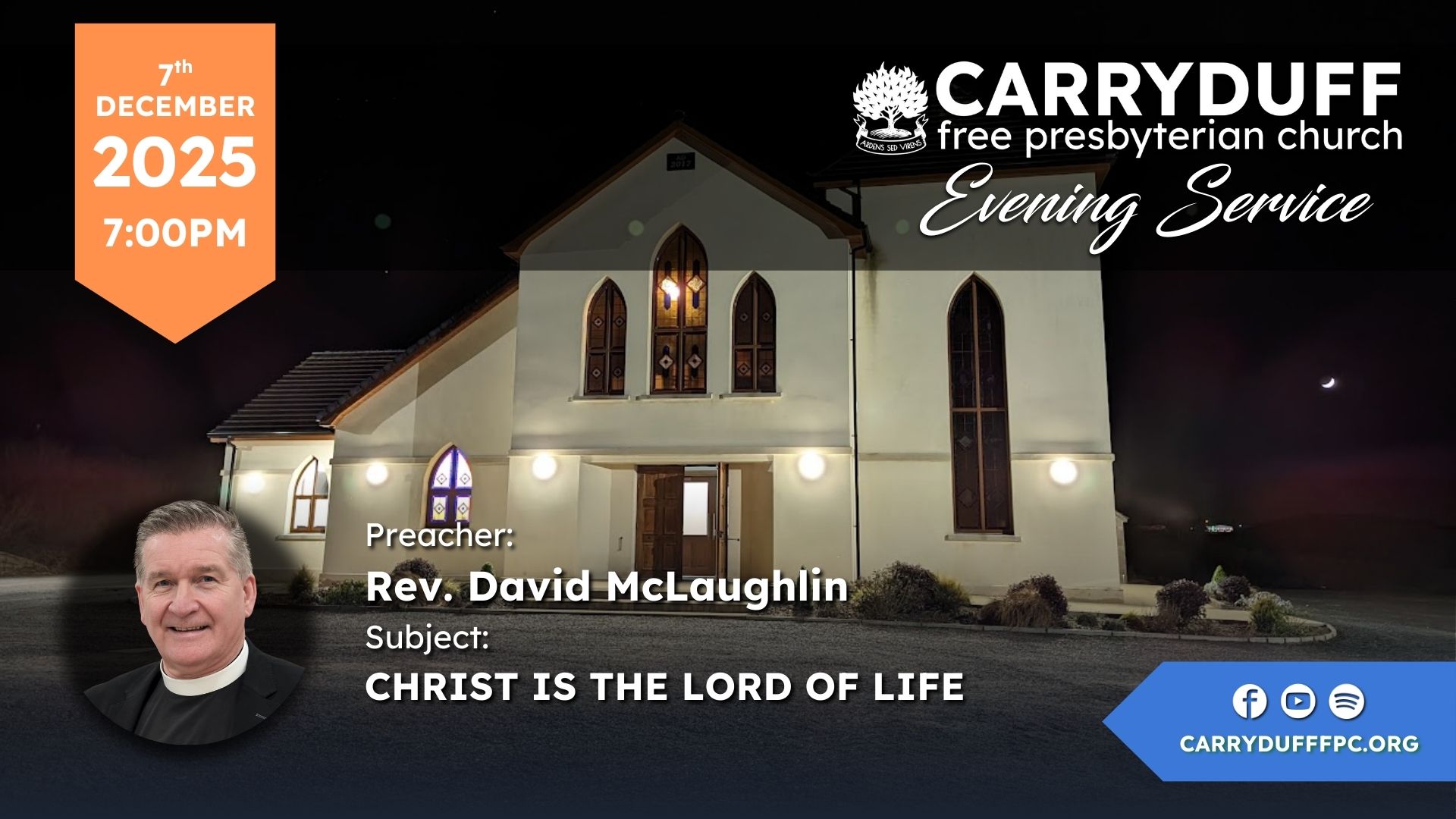
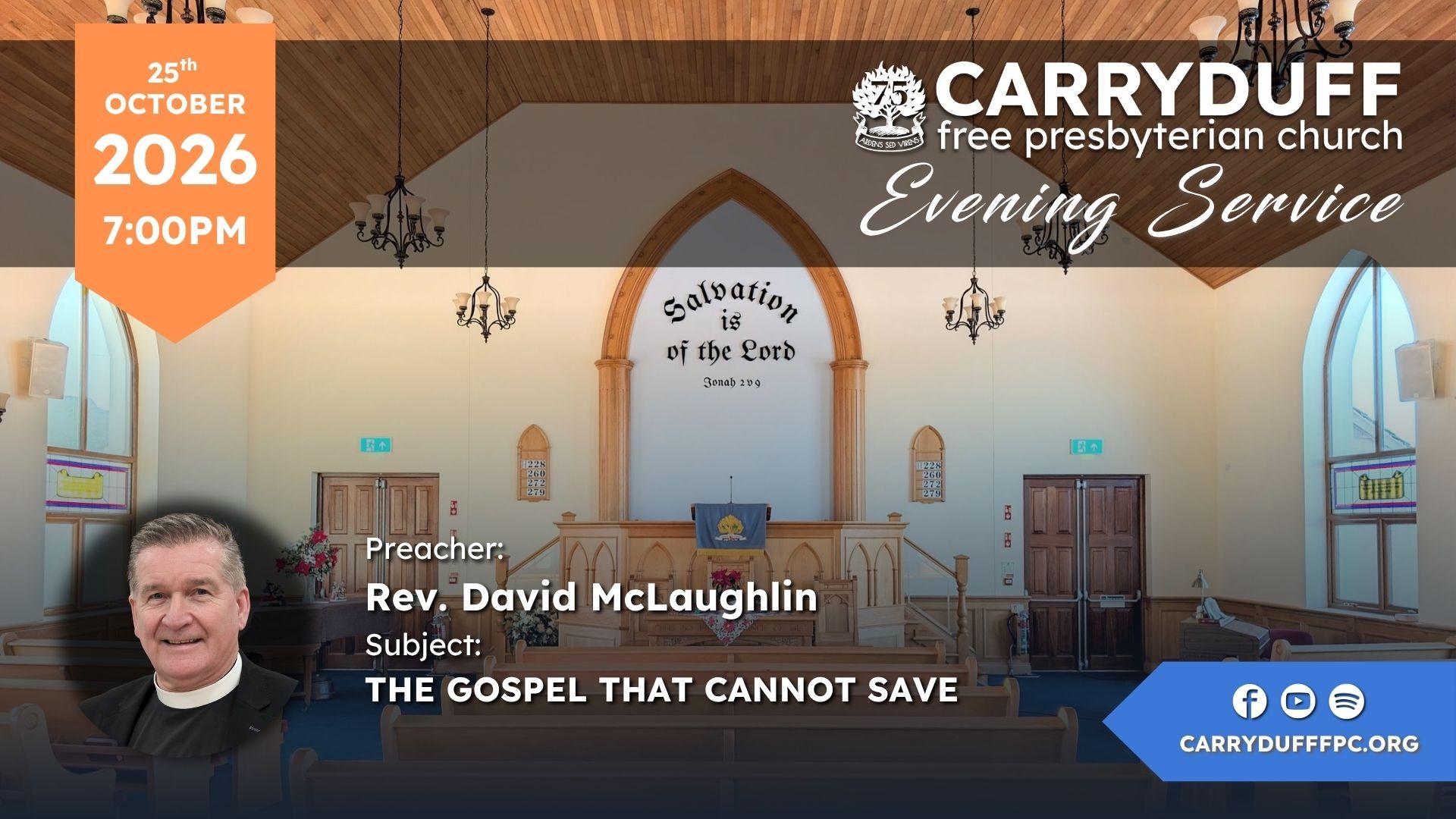
Date: SUN 7:00pm 25th October 2026
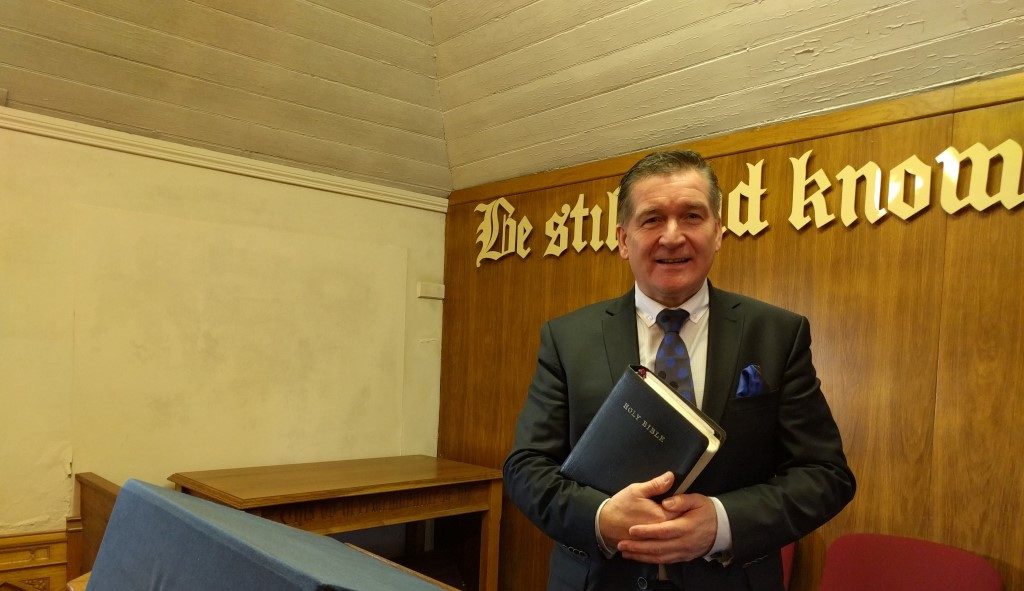
Preacher: Rev. David McLaughlin
Bible Reference: 2 Samuel 23:15-17
Podcast
Sermon Summary
This is a Reformed evangelical sermon based on Galatians 1:6-9, preached by a Northern Irish pastor to a congregation that includes online listeners. The central thesis is that the greatest spiritual danger is not open rejection of Christianity but the embrace of a counterfeit version of it. The preacher argues that a false gospel can look convincing, use biblical language, and come from sincere preachers, yet still fail to save because it adds something to the finished work of Christ.
The Text and Its Setting
The sermon opens with a reading of Galatians 1:1-12, in which Paul expresses astonishment that the Galatian believers have so quickly turned away from the grace of Christ to “another gospel.” Paul pronounces a solemn curse, or anathema, on anyone, even an angel from heaven, who preaches a different gospel from the one he originally delivered.
The preacher describes Galatians as an emergency epistle, written to address a crisis in the early church. False teachers had entered the Galatian congregations and taught that faith in Jesus was necessary but not sufficient. They insisted that believers also needed to be circumcised and keep the law of Moses. The real issue was not whether holiness mattered but what formed the true ground of a sinner’s justification before God. Paul’s answer is uncompromising: a person is justified by faith in Christ alone, not by works of the law.
The Peril of Deserting the Gospel
The first major point concerns the danger of abandoning the true gospel. The Greek word Paul uses for “marvel” denotes astonishment. Significantly, Paul was not startled by persecution, hostility, opposition, or suffering. What astonished him was that believers had turned away from the gospel of God’s grace so soon after professing to embrace it.
The preacher draws several lessons from this. First, hearing the truth does not make a person immune to deception. A religious profession offers no automatic protection against error. Second, the gospel originates with God, not with human effort. It is not the product of a man’s mind or a system of self-improvement. It begins with God’s gracious, effectual call to the sinner, who is dead in trespasses, blind in understanding, and diseased in affection. The sinner needs regeneration, the new birth, before anything else.
The preacher stresses that Jesus did not merely make salvation possible but came to accomplish eternal redemption. He cites the angel Gabriel’s words that Jesus “shall save his people from their sins” and Paul’s declaration in Acts that there is no other name under heaven by which people must be saved. The gospel is not something a man discovers through philosophy or merit; it is a message from God centred on the person and work of Jesus Christ.
The Nature of Grace
The preacher offers a fuller definition of grace than the common acrostic “God’s riches at Christ’s expense.” While he accepts this as a useful starting point, he argues that it does not go far enough. Grace is the undeserved, unmerited favour shown to lawbreakers and criminals who have broken God’s law and deserve judgment. He quotes Romans 3:23, that all have sinned and come short of the glory of God, and Romans 3:24, that believers are justified freely by grace through the redemption that is in Christ Jesus.
God does not justify sinners because they deserve it or because he has discovered sufficient merit in them. He has found none. The sinner stands legally guilty in God’s courtroom. Sin is not ignored, and repentance is not unnecessary. God accepts sinners only on the ground of Christ’s finished work. The preacher quotes Ephesians 2:8-9, that salvation is by grace through faith, a gift of God, not of works, lest anyone should boast.
The Standard of the Gospel
The sermon then examines what Paul means by “another gospel, which is not another.” A false gospel does not necessarily abandon religion or even abandon Christ. Instead, it turns salvation into a different message. The preacher’s central image here is that false teachers use the same vocabulary but a different dictionary. They change the meaning of the words.
He engages with the argument of the late R.C. Sproul, who pointed out that it is inaccurate to say Roman Catholicism teaches salvation by works alone. The Church of Rome has always taught that salvation comes through God’s grace in Jesus Christ. The Reformation controversy was not about whether grace is necessary, whether Christ is the Saviour, or whether good works matter. The real dispute concerned the true ground of justification.
The Church of Rome, the preacher argues, teaches the necessity of faith and grace but not grace alone, faith alone, or Christ alone. It incorporates inward righteousness, sacramental means, and human cooperation into the ground of justification. The Reformed and Protestant position is that the ground of justification rests on Christ alone, received through faith alone, with his righteousness imputed to the believer. The standard for this is the Word of God, which Jesus said cannot be broken.
The preacher offers a vivid illustration of a drowning man being told that the lifeboat will only be launched if he first proves he can swim to shore. This defeats the purpose of the rescue. Sinners are spiritually dead and cannot contribute to their own regeneration.
The Perversion of the Gospel
The second major point concerns how false teaching perverts the gospel. Paul calls it “another gospel” but immediately clarifies that it is not really another; it is a counterfeit, a perversion of the true message, incapable of saving the soul. There is only one true gospel.
A false gospel can change the message of Christ. It can present God’s love in a way that ignores his holiness and justice, or it can displace Christ from the centre. The preacher notes that the gospel does contain a message about God’s love, but that love is holy and just and is displayed supremely in the life and death of Jesus on the cross. He quotes Romans 5:8, that God demonstrated his love in that Christ died for us while we were yet sinners, and 1 Corinthians 15, that Christ died for our sins, was buried, and rose again the third day. These are not optional extras but the very heart of the gospel.
A preacher can talk about finding fulfilment, discovering personal destiny, or adopting positive thinking, and these subjects may be legitimate in themselves. But if any subject displaces or obscures Christ and him crucified, then the gospel has been changed.
False Gospels in the Modern Day
The sermon identifies several contemporary false gospels that retain biblical language while altering its meaning.
The first is the prosperity gospel, exemplified by Joel Osteen. This teaching presents God as a means of obtaining earthly wealth and health, requiring sufficient faith, positive confession, and financial giving, with the promise of multiplied returns. The preacher contrasts this with Paul, who preached Christ crucified and never promised a life free from suffering, poverty, persecution, or martyrdom. He quotes 2 Timothy 3:12, that all who live godly in Christ Jesus will suffer persecution. The Christian hope is not a guarantee of prosperity but is centred on Christ, who redeems his people and brings them to heaven.
The second false gospel is that of human merit. The preacher observes that many people, in both Protestant and Roman Catholic circles, believe that if their good deeds outweigh their bad deeds at the end of life, God will accept them. This is a works-based righteousness. He is careful to say that belonging to a church, praying, giving, and reading the Bible are not wrong in themselves. The key question is why a person does them. If they are done out of love for Christ, that is right. But if they are done to accumulate merit and earn acceptance with God, that is a works-based righteousness that distorts the gospel, compromises the sole sufficiency of Christ, and adds to his righteousness. If a sinner could reach heaven by his own deeds, there would have been no need for Christ to come and die.
The third false gospel is that of human morality, a gospel without a call to repentance or biblical holiness, and without the evidence of a changed life. The preacher insists that a profession is not a possession. If anyone is in Christ, he is a new creature. Faith in Christ is inseparable from repentance and a loving desire to obey him. He quotes Titus 2:11-12, that the grace of God teaches believers to deny ungodliness and worldly lusts and to live soberly, righteously, and godly in the present world.
How a False Gospel Troubles Souls
The preacher notes the words “that trouble you” in the text. A false gospel troubles souls by giving people contradictory messages. One person is told to look to Christ alone; another is told to look inward and accumulate religious merit; another is told to secure a particular emotional spiritual experience. This causes confusion and anxiety. The only true foundation is Christ. He quotes 1 Corinthians 3:11, that no other foundation can be laid than Jesus Christ, and Romans 8:1, that there is therefore no condemnation for those who are in Christ Jesus. Many people have a false peace because they have been troubled by preachers who pointed them not to Christ but to themselves, to the church, or to some mystical experience.
The Proof of Denying the Gospel
The third major point concerns the authority of scripture. Paul’s startling declaration is that even if an angel from heaven preaches a different gospel, that messenger must be rejected. No preacher and no angel stands above the scriptures. The preacher applies this to Islam, noting that Muhammad claimed an angel came to him in a cave in the seventh century with a message. The test of any message is whether it accords with God’s revealed word. If it does not speak according to this word, there is no light in it.
Paul does not exempt himself from this standard. The vital principle is that only the scriptures have final authority. The preacher recounts that Dr Martyn Lloyd-Jones declined to chair major Billy Graham evangelistic congresses unless Graham agreed to two conditions. The first was to stop seeking the sponsorship of theological liberal churches and Roman Catholic churches, which do not hold to the essential truth of the biblical gospel or the authority of scripture alone. The second was to abandon the altar call invitation system. Lloyd-Jones told Graham that the church is not the master of the Word of God but stands under its authority, called to preach the Word and call sinners to repent and believe.
This principle, the preacher insists, should apply to every pulpit, every Bible college, and every school of learning. He quotes the saying that the religion of the Protestant is the Bible alone, and he commends the Bereans of Acts 17, who received the Word with readiness of mind yet searched the scriptures daily to verify what they heard. They did not accept a message merely because a sincere preacher delivered it; they checked whether it was true to the book.
No spiritual experience, no church, no tradition, no religious leader, and no council has the authority to change the gospel. No extraordinary experience carries greater authority than the revealed Word of God. A person who claims a word of knowledge, a vision, or a dream from God cannot be legitimate if what they say contradicts the gospel. The preacher quotes Matthew 4:4, that man shall not live by bread alone but by every word that proceeds from the mouth of God.
The true gospel must be preached in all its fullness, encompassing the incarnation, the virgin birth, the sinless life, the substitutionary death, the bodily resurrection, the ascension, the intercession, and the second coming of Christ. It must also include the holiness of God, the sinfulness of man, the need for the new birth, repentance, faith, the transforming work of the Spirit, and the call to discipleship. The preacher quotes John 6:37, that all the Father gives to Christ will come to him, and Christ will in no way cast them out. No man can reinvent the gospel.
The Pronouncement of Judgment
The final point concerns the word “accursed,” which appears at the end of both verse 8 and verse 9. This is a message of divine judgment. There is a seriousness to proclaiming a message that perverts God’s way of salvation. The curse means, in the preacher’s words, letting the false teacher go to the lowest hell. This judgment is real and is not a matter of mere personal difference or sincerity. Not all religions lead to God. Jesus said, “I am the way, the truth, and the life. No man cometh unto the Father but by me.”
The preacher stresses that the stakes are eternal. Another gospel is not a harmless alternative. He insists he is not being arrogant or cruel but sober, compassionate, and urgent, because this concerns eternity. The warning begins with the preacher himself, who quotes J.C. Ryle’s words, “Woe is me if I preach not the gospel.” Ryle had the word “not” chiselled into his new pulpit in Liverpool as a reminder of this duty.
The Call to Look to Christ Alone
The sermon concludes by asking whether hearers understand the gospel and are willing to stand for it. The preacher restates the five solas of the Reformation: salvation is by grace alone, through faith alone, in Christ alone, as revealed in the scriptures alone, to the glory of God alone. He quotes Romans 5:1, that being justified by faith, believers have peace with God through the Lord Jesus Christ, and Romans 8:34, that it is Christ who died, rose again, is at the right hand of God, and makes intercession for believers. This is the ground of hope.
He issues a final call to both Roman Catholics and Protestants to look to Christ alone. No tradition, religious activity, or experience can take the place of Jesus Christ. The message of the sermon is that there is a gospel that does not save, and it has been preached in Northern Ireland. Believers must be awake and aware, resting on Christ and Christ alone.
Overall Assessment
The sermon is a clear, forceful exposition of the Reformed doctrine of justification by faith alone. Its greatest strength is its careful distinction between a gospel that is merely altered in emphasis and one that changes the ground of salvation. The preacher’s insistence that false teachers use the same vocabulary but a different dictionary is a memorable and theologically precise observation. The structure is logical, moving from the peril of deserting the gospel, through the perversion of destroying it, to the proof of denying it and the pronouncement of judgment upon it.
The use of illustrations, such as the drowning man and the counterfeit currency, makes the argument accessible. The engagement with figures such as R.C. Sproul, Martyn Lloyd-Jones, and Billy Graham grounds the sermon in the history of Reformed evangelicalism and gives it practical application to contemporary debates about ecumenism and the prosperity gospel. This sermon is a serious and consistent statement of a historic Christian position, delivered with pastoral urgency and a concern for the eternal welfare of its hearers.