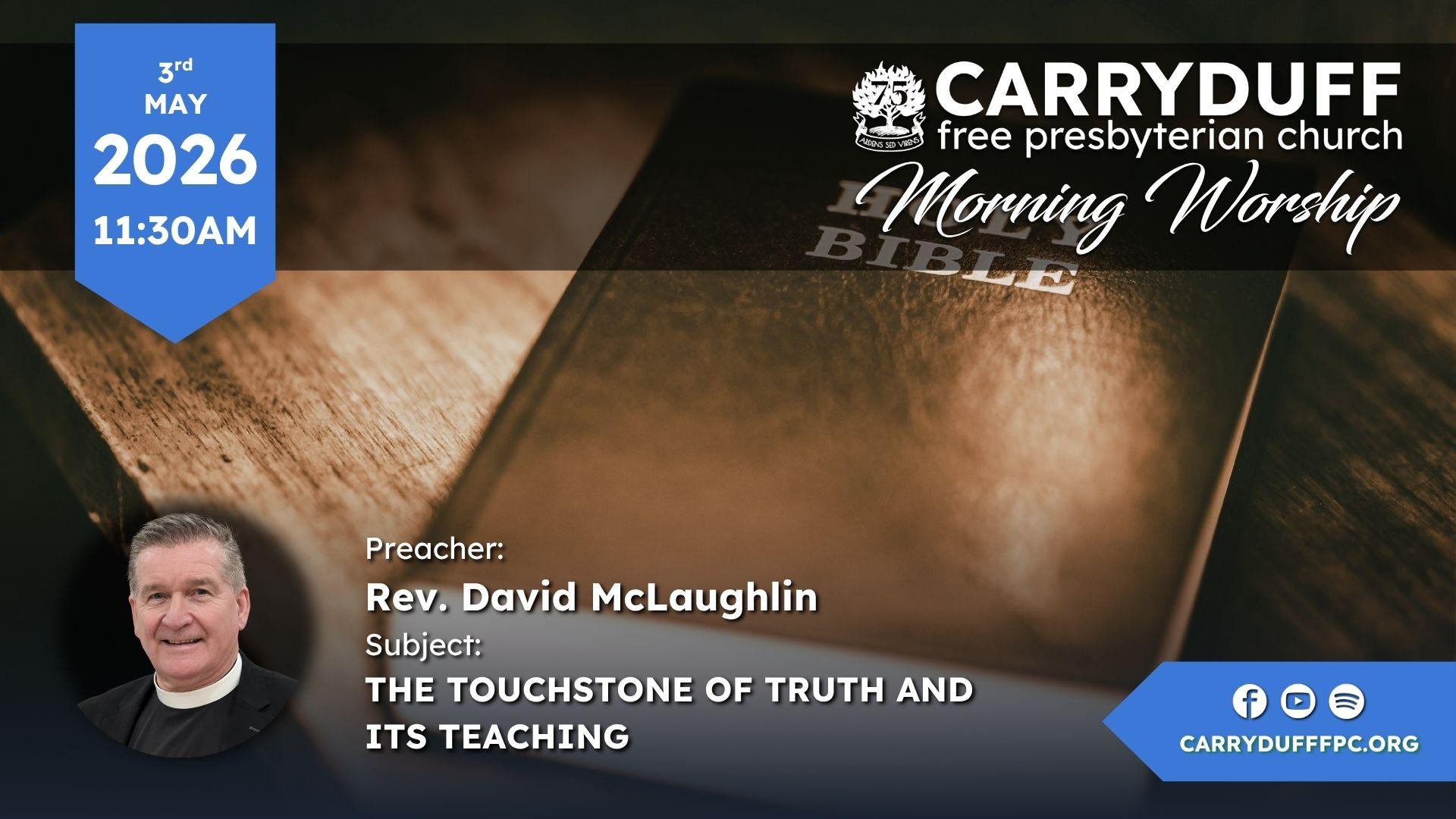

Date: SUN 11:30am 3rd May 2026
Preacher: Rev. David McLaughlin
Bible Reference: I Thessalonians 5:20-22
Podcast
Sermon Summary
The Sovereignty of the Word and the Mandate of Discernment
In the Reformed tradition, the Church is understood as ecclesia semper reformanda est—the church always being reformed according to the Word of God. This principle is not a license for innovation but a mandate for constant purification. The sermon on 1 Thessalonians 5:16–22 serves as a stark reminder that the primary tool for this purification is the exercise of biblical discernment. In an era often characterised by subjective experience, charismatic emotionalism, and a drift toward cultural accommodation, the Apostle Paul’s royal commands to the Thessalonians remain the definitive blueprint for the Christian life.
Discernment, as the sermon correctly identifies, is not merely a spiritual luxury for the academic or the clergy; it is the essential oxygen of the soul. Without it, the church becomes a vulnerable entity, susceptible to the winds of doctrine and the subtle, serpentine deceptions of the adversary. To understand this task from a Reformed perspective, one must first establish the nature of the “touchstone” by which all things must be tested.
The Sufficiency of Scripture and the Cessation of Sign Gifts
Central to the Reformed understanding is the doctrine of Sola Scriptura. The Bible is not merely one source of truth among many; it is the sole, infallible, and sufficient rule for faith and practice. The sermon’s insistence on the cessation of the foundational sign gifts—prophecy, tongues, and direct revelatory knowledge—is a cornerstone of classical Reformed theology.
This position is grounded in the historical and redemptive-historical purpose of these gifts. During the Apostolic age, the canon of Scripture was yet incomplete. God granted these extraordinary, temporary sign gifts to authenticate the ministry of the Apostles and to provide revelation until the final, inscripturated Word was complete. To claim that these gifts continue in the same revelatory capacity today is to imply that the biblical canon is insufficient, or that new revelation is necessary to supplement the finished work of Christ.
From this perspective, the modern “charismatic” emphasis on direct, ongoing revelation is a fundamental category error. When an individual claims, “The Lord told me,” they are placing their own subjective impression on the same level as the objective, canonical Word of God. The sermon highlights the tragic case of the false prophecy given to John Piper—a cautionary tale of how even well-meaning believers can be led into profound anguish by placing confidence in subjective claims rather than the cold, hard assurance of the written Word. The Reformed response to such claims is not to test their “sincerity” but to test them against the only standard that cannot be broken: the Scriptures. If a claim does not align with the Law and the Testimony, it must be rejected, regardless of the piety of the claimant.
The Fool’s Gold of Spiritual Fraud
The sermon’s illustration of Abend Johnson’s $83 million investment in fake diamonds is a poignant metaphor for the state of the modern church. Throughout church history, the “counterfeit” has always been a constant threat. Satan does not usually present error as something overtly evil; he presents it as an “angel of light.” He uses the language of Scripture, the appearance of piety, and the promise of experiential power to lure the sheep away from the green pastures of sound doctrine.
The Reformed perspective emphasizes that spiritual deception is often a judgment upon a people who have lost their appetite for the truth. When a congregation prefers “sermonettes”—short, entertaining, and non-confrontational messages—over the robust exposition of the whole counsel of God, they invite a spiritual famine. The “spiritual con artists” mentioned in the sermon thrive in an environment where the congregation is biblically illiterate.
The bank teller analogy—learning to identify a counterfeit by knowing the genuine article intimately—is at the heart of the Reformed call to study. We do not combat error by studying every heresy that appears on the internet; we combat error by being so saturated in the doctrines of grace, the sovereignty of God, and the sufficiency of Christ’s work that we can instinctively identify when a teaching deviates from the truth. The responsibility to “prove all things” is a call to intellectual and spiritual maturity, requiring the believer to engage with the text of Scripture with the diligence of the Bereans.
The Danger of Contemporary Innovations
A hallmark of the Reformed faith is a deep, historical continuity with the Church of all ages. This is why the sermon expresses such sharp critique toward modern movements like Alpha, Hillsong, and Bethel. These movements are frequently criticized from a Reformed viewpoint because they represent a shift from objective, declarative preaching to subjective, man-centred experience.
When the worship service is transformed into a performance, or when the sermon is replaced by a motivational speech designed to make the listener “comfortable,” the focus shifts from the objective glory of God to the subjective feelings of the human subject. The Reformed perspective holds that the Gospel should, in fact, be uncomfortable. It should confront the sinner with the reality of their depravity and the necessity of Christ’s substitutionary atonement. To “despise prophesyings” is to turn away from this uncomfortable, necessary confrontation. If we grow bitter toward the preaching of the law, or if we harbor a critical spirit toward the faithful messenger, we are not merely struggling with a personality; we are actively resisting the voice of God.
Holding Fast in the Face of Cultural Pressure
“Hold fast that which is good” is a command that implies active resistance. In the 21st century, the pressure to compromise is immense. The world demands that the church adjust its theology of marriage, gender, and morality to align with the shifting sands of secular consensus. The Reformed believer, however, recognizes that the Truth is not a negotiable asset.
To “hold fast” means to maintain the form of sound words, as Paul instructed Timothy. It requires a refusal to dilute the Gospel for the sake of relevance. The sermon reminds us that truth has been challenged in every generation, but our hearts remain uniquely prone to wander toward the novel, the trendy, and the culturally acceptable. The devil’s subtlety lies in his ability to make compromise look like “love” or “inclusion.” The Reformed response is to stand firmly upon the covenantal theology of the Scriptures, recognizing that we do not own the truth—it owns us. We are stewards of a sacred deposit, and we are not at liberty to sell it for the fleeting approval of the world.
The Practicality of Holiness: Abstaining from Evil
The command to “abstain from all appearance of evil” is the final, practical outworking of discernment. Reformed theology has always been characterized by a high view of sanctification. We are not saved by our good works, but we are saved for them. The “appearance of evil” refers to the entire sphere of conduct that might suggest a lack of devotion to Christ.
This is not a retreat into legalism, where one creates a list of man-made rules to appear “holy.” Rather, it is the pursuit of genuine inward and outward conformity to the character of God. The sermon’s metaphor of the cliff face is perfect: the discerning Christian does not see how close they can walk to the precipice of sin without falling; they see how far they can stay away from it to ensure safety. This is a life motivated by the fear of God and the love of Christ. It is a life that recognizes that our witness to the world is at stake. When the church adopts the world’s music, the world’s methods, and the world’s values, it loses its distinctiveness and, consequently, its power to call men to repentance.
Conclusion: A Call to Awakening
The sermon concludes with a call for a grassroots awakening within the Protestant and Reformed communities. This is a sobering recognition that revival does not start with a conference or a new program; it starts with repentance. It starts in the individual heart, in the local pulpit, and in the family home.
The “touchstone of truth” is the Word of God, and it remains perfectly sufficient for everything the church needs to be faithful today. We do not need a new revelation; we need a new commitment to the old revelation. We do not need better marketing; we need better preaching. We do not need to be more “relevant” to the world; we need to be more consistent with the truth.
The urgency of these commands—rejoicing evermore, praying without ceasing, giving thanks in everything—is predicated upon a life that is firmly rooted in the Word. If the church in Northern Ireland, or anywhere else in the world, is to stand against the rising tide of secularism, Islam, and the various cults that are flourishing, it must return to the foundational commitment of the Apostles. It must stop despising the preaching of the Word, it must begin the hard work of proving all things, it must hold fast to the objective truths of the Gospel, and it must live with a practical, visible, and uncompromising holiness.