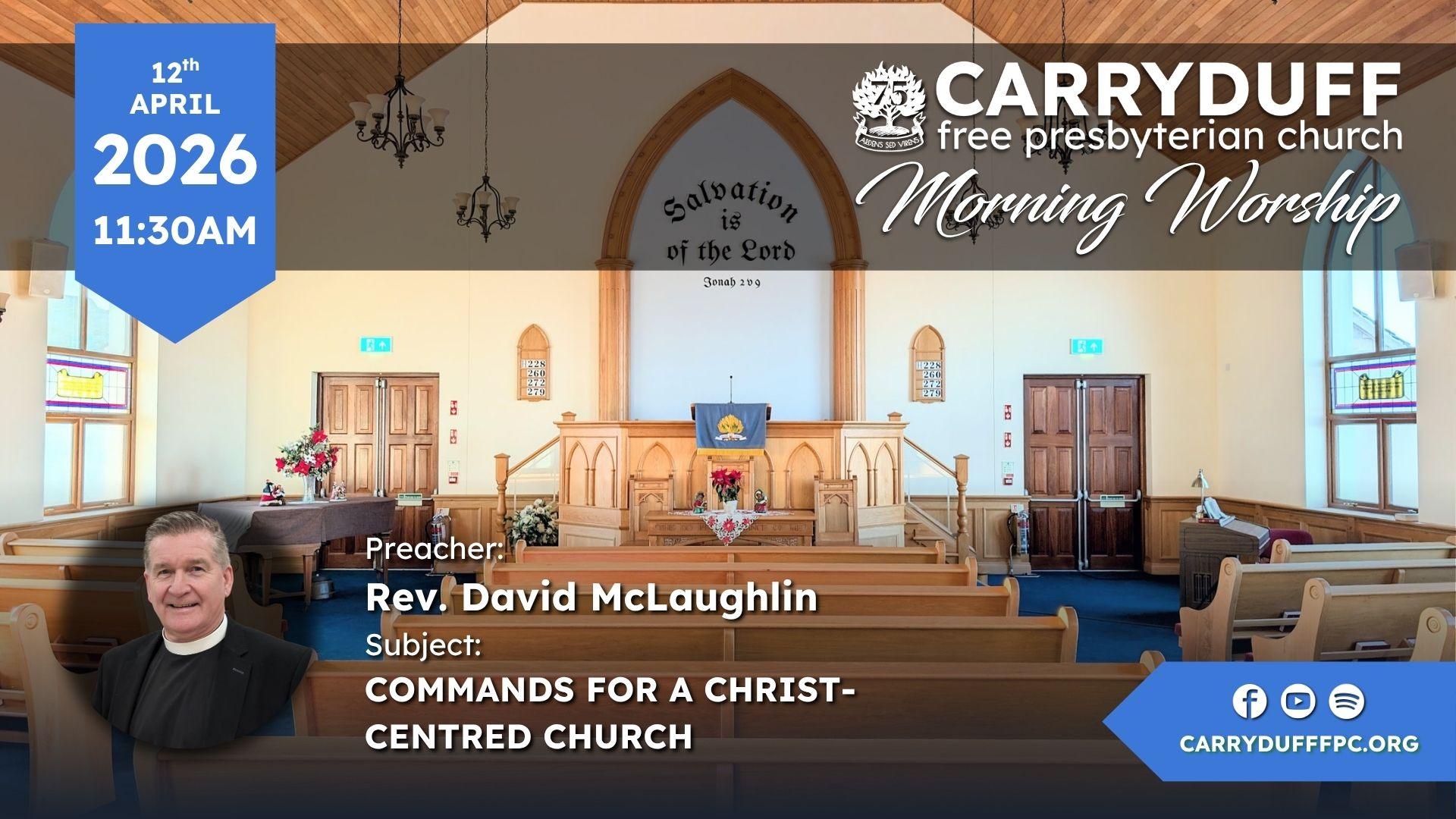

Date: SUN 11:30am 12th April 2026
Preacher: Rev. David McLaughlin
Bible Reference: 1 Thessalonians 5:16–18
Podcast
Sermon Summary
The apostle Paul, writing under the divine inspiration of the Holy Spirit to a young church beset by persecution and opposition, concludes his first epistle to the Thessalonians with a series of succinct yet weighty exhortations. These instructions, found in 1 Thessalonians 5:16-18, serve as the defining marks of the ordinary Christian life. They are not merely suggestions for the spiritually elite, nor are they reserved for the clergy; rather, they are righteous, spirit-filled commands binding upon every born-again believer. They constitute the practical outworking of a life in saving union with Jesus Christ.
The Reformed tradition has long held that true faith is never alone; it is always evidenced by a life of practical godliness. As John Calvin observed, God requires not merely the obedience of our hands, but the inward affection of the heart. These divine commands penetrate beyond outward conduct to the very disposition of the soul. They are rooted not in human strength, but in the sovereign grace of God and the finished work of Christ.
The Command to Perpetually Rejoice
The command to rejoice evermore, found in verse 16, is one of the shortest verses in the Greek New Testament. To rejoice evermore is to be perpetually rejoicing. This is not a call to a superficial, happy-clappy lifestyle, nor is it a mandate to feign happiness when the soul is burdened. The Scriptures do not demand that the believer deny reality, nor do they suggest that sadness, grief, or tears are sinful. Our Lord Jesus Christ himself was a man of sorrows, acquainted with grief, and the apostle Paul, though always rejoicing, frequently described himself as sorrowful.
Biblical joy is not contingent upon circumstances but is anchored in Christ. It is a covenantal, spiritual joy enabled by the Holy Spirit. When the believer is mistreated, facing hardship, or suffering under the weight of trials, the choice is not between happiness and despair, but between self-pity and heavenward dependence. The secret to rejoicing evermore is found in focusing upon the riches we possess in Christ: our full and free justification, our adoption into the family of God, the indwelling of the Holy Spirit, and the promise of eternal life.
There are three pillars that support this attitude of contentment. First, one must focus on the riches of Christ rather than the rottenness of temporal circumstances. Second, one must rely on the fruit of the Spirit, recognising that joy is not chained by irons or external suffering, but is realised by the Holy Spirit. Third, one must fill the heart and mind with thoughts of the future—specifically the reality of heaven and our home with the Lord. As the psalmist found when crying out for help, by fixing our eyes upon who the Lord is and what He has done, we are able to maintain a conscious attitude of contentment that transcends our temporal situation.
The Command to Persistently Pray
The command to pray without ceasing in verse 17 is often misunderstood as a requirement for uninterrupted verbal prayer twenty-four hours a day. This interpretation is a source of unnecessary discouragement. Rather, it signifies a life of constant dependence upon the Lord. Much like a chronic cough or an army that retreats to regroup and then attacks again, the believer’s life is marked by frequent, persistent, and passionate communion with God.
When Saul of Tarsus was converted on the Damascus Road, the Lord declared of him, “Behold, he prayeth.” This is the immediate mark of grace: the creation of a desire to seek after God. True prayer is the sincere, affectionate pouring out of the soul to the Lord. It is the language of trust and is grounded firmly in the Word of God. We are to plead the promises of God, reminding Him of what He has spoken in His infallible Word.
Prayerlessness is a sin that stems from a failure to recognise our own insufficiency and our total dependence on God’s power and provision. It is a confession that we believe our needs can only be met by God’s sovereign intervention. By withdrawing to pray privately and engaging in corporate prayer, the believer follows the example of Christ, who understood the necessity of maintaining fellowship with His Heavenly Father. The historical witness of the church, from the prayers of John Knox for Scotland to the great revivals of the nineteenth and twentieth centuries, confirms that prayer is a weapon ordained by God to accomplish His sovereign purposes. Where there is a lack of prayer, there is a lack of power; where there is a felt need, there is a spontaneous cry to the throne of grace.
The Command to Profoundly Give Thanks
The third command, to give thanks in everything, is found in verse 18: “In every thing give thanks: for this is the will of God in Christ Jesus concerning you.” The scope of this command is absolute. It applies to days of prosperity and poverty, sickness and health, joy and sorrow. This is the revealed will of God for the believer’s life.
To give thanks in everything requires a profound understanding of the sovereignty and holiness of God. We must believe the truth of Romans 8:28, that all things work together for good to them that love God, to them who are the called according to His purpose. While we may not understand the terrible things that come into our lives, we rest in the knowledge that God’s providential care is absolute. Thankfulness is the work of heaven and the beginning of heaven in the soul.
It involves refusing the temptation to murmur, grumble, or complain about our lot in life, and instead submitting to God’s providence. The story of John Wesley encountering a destitute porter who, despite having no coat, no food, and no bed, thanked God for his life and his salvation, serves as a poignant reminder of what it means to possess a thankful heart. When we know God, place our lives in His hands, and refuse to complain, we leave ourselves in the care of a sovereign God who knows the end from the beginning.
Conclusion: The Source in Christ Jesus
These three commands—to rejoice evermore, to pray without ceasing, and in everything to give thanks—are impossible to fulfil apart from the new birth. They are the fruit of the grace of God and the indwelling of the Holy Spirit. They are grounded entirely in our union with Christ, who is made unto us wisdom, righteousness, sanctification, and redemption.