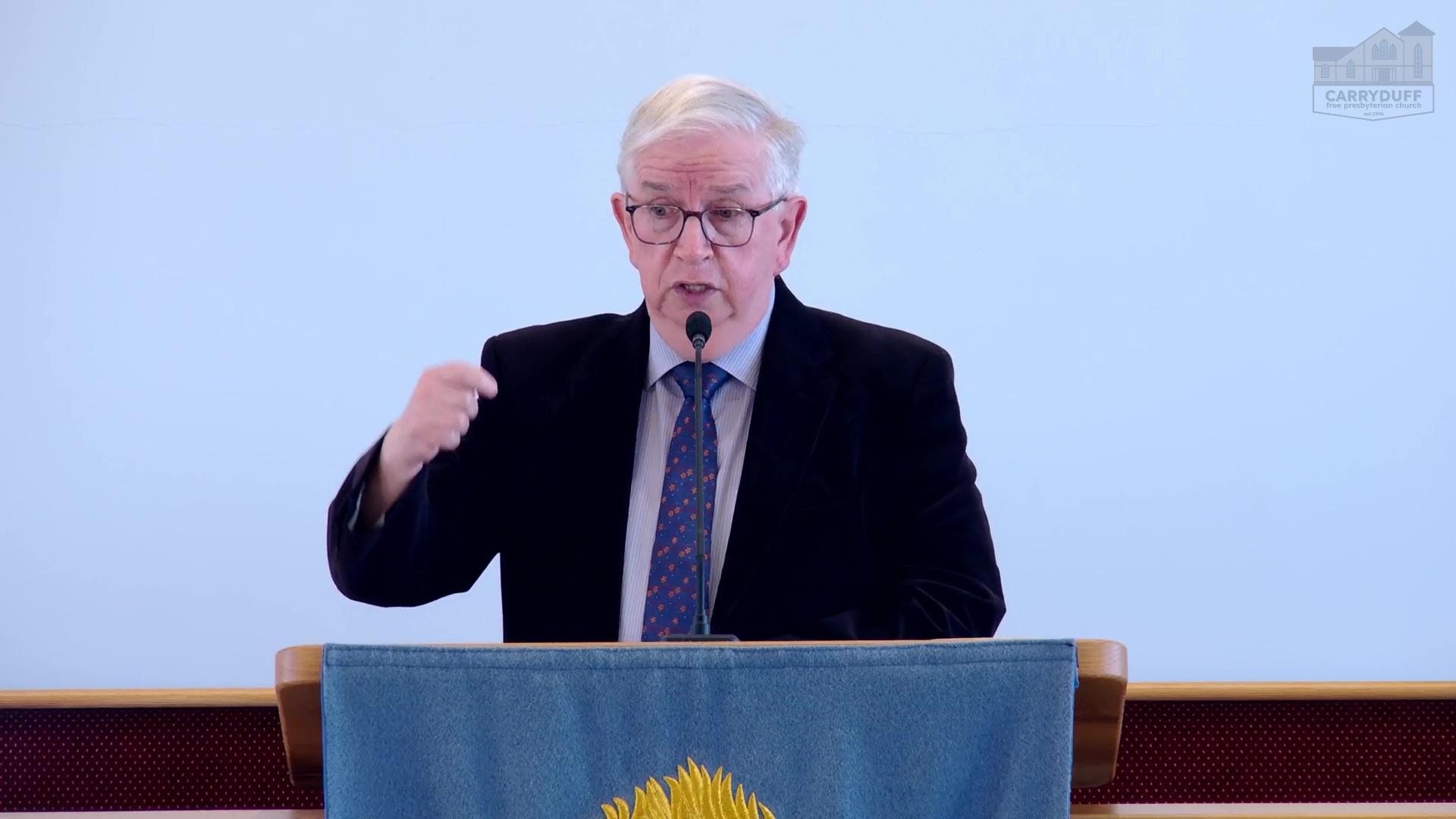

Session 3 — Rev Ian Harris, Annalong Free Presbyterian Church
“Why We Are Free Presbyterian — Worship, Sabbath and Conviction”
“God is a Spirit: and they that worship Him must worship Him in spirit and in truth.” — John 4:24
“This is the way, walk ye in it.” — Isaiah 30:21
Introduction — Returning to the Sanctuary
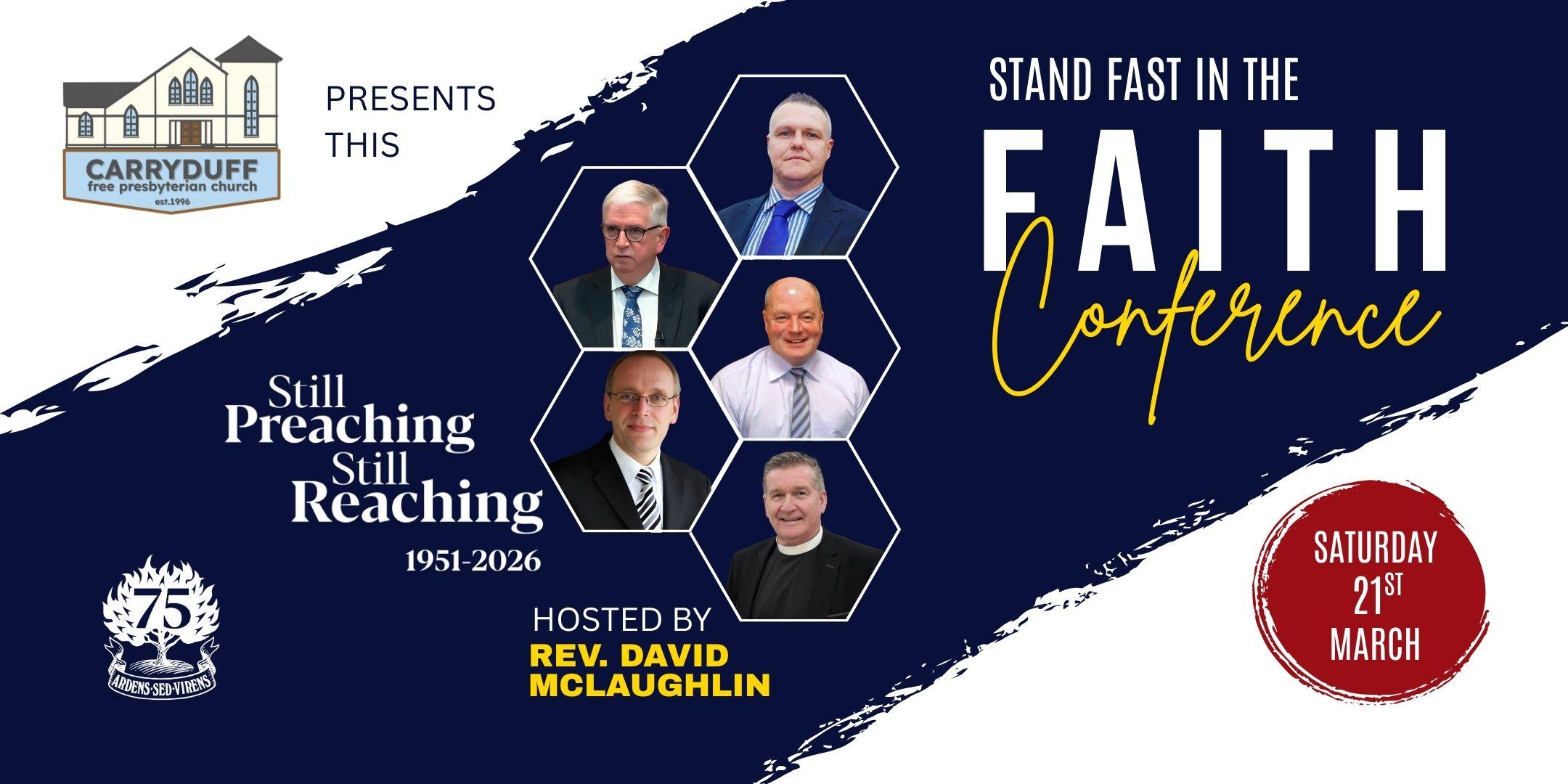
After lunch and fellowship in the Luther Hall, the congregation returned to the Carryduff Free Presbyterian sanctuary around 2 p.m. Rev Ian Harris, minister of Annalong Free Presbyterian Church, announced his subject: “The Worship and Witness of a Separated Church — Why We Are Free Presbyterian (Worship, Sabbath and Conviction).”
He thanked Rev David McLaughlin, minister of Carryduff FPC and host for the day, and noted that the first two sessions had presented the foundation and the walk of the Christian life. “Now,” he said, “we come to see how those truths are expressed in the life and the worship of the Church.”
His sermon unfolded in three main sections covering worship, the Sabbath, and denominational convictions.
1. The Foundation of Worship
Reading aloud from John 4:19‑24, Rev Harris set the direction for the entire message.
“The hour cometh, and now is, when the true worshippers shall worship the Father in spirit and in truth: for the Father seeketh such to worship Him.”
He explained that worship’s essence transcends location and ceremony. “It is not the building but the believer that God looks for, not the service but the spirit in which it is offered.” He linked this to Genesis 4, contrasting Abel’s accepted offering with Cain’s rejected one. “Abel came God’s way — by blood and by obedience — and God respected the offering.”
He summarised the divine principles as:
- Reality — Worship must rise from the regenerate heart.
- Reverence — It must exalt the Lord and humble self.
- Regulation — It must remain within the bounds of the revealed Word.
“God is not flattered by novelty,” he said, “He is glorified by obedience.”
2. Reverent, Simple, and Scriptural
Turning to Acts 2:42, he observed that the early Church “continued steadfastly in the apostles’ doctrine, fellowship, in breaking of bread, and in prayers.” He called these “the four planks of apostolic worship — Scripture, fellowship, communion, and prayer.”
He began with the Word preached, affirming that preaching is central because “faith cometh by hearing” (Romans 10:17). Then he added the often‑forgotten second element — fellowship, which he described as “the worship of shared life.”
“Our fellowship,” he said, “is not social convenience but spiritual communion — saints rejoicing together in the same Saviour (Ephesians 4:3). When believers meet in love for Christ and speak of the things of Christ, that itself is worship.”
He proceeded to the breaking of bread, reading 1 Corinthians 11:23‑26 and affirming, “This is not a sacrament that conveys grace; it is a memorial that proclaims grace.”
He explained that the Lord’s Supper proclaims the death of Christ until He comes, when received by cleansed hearts and obedient faith. “It is preaching for the eye as preaching from the pulpit is for the ear,” he said. Free Presbyterian practice, he noted, emphasises reverence and preparation: “Better to come seldom and sincerely than regularly and carelessly.”
Next he reached prayer, asserting that it is the breath of worship. He read from Matthew 6:9‑13, the Lord’s own pattern:
“After this manner therefore pray ye: Our Father which art in heaven, Hallowed be Thy name.”
This prayer, he explained, balances intimacy and awe — addressing God as Father while hallowing His name. “It teaches us that prayer in public worship must neither be flippant nor fearful but filial — spoken with reverence and confidence.”
Citing Psalm 96:9, he urged, “O worship the Lord in the beauty of holiness.” “Holiness,” he said, “is the beauty that God beholds in His people.”
He quoted the Westminster Confession 21.1: “The acceptable way of worshipping the true God is instituted by Himself, and so limited by His own revealed will.” “That,” he commented, “draws the line between obedience and invention.”
He concluded, “The pulpit is not a stage, and the pew is not a theatre seat. The Church gathers not to be entertained but to be edified, not to perform but to meet with God.”
3. The Sabbath — A Testimony in Time
Rev Harris turned to Exodus 20:8‑11 and Mark 2:27‑28 to show the Sabbath’s permanence. “It is no Jewish relic,” he said. “It is a creation ordinance — blessed, hallowed, and designed for man’s good (Genesis 2:3).”
He explained that the Lord’s Day bears witness to Christ’s resurrection and proclaims His lordship over time. “It reminds society that man is creature, not creator; steward, not sovereign.”
From Isaiah 58:13‑14 he read: “If thou turn away thy foot from the Sabbath… then shalt thou delight thyself in the Lord.” “The Sabbath is not slavery but sanity,” he remarked. “It restores perspective and rekindles praise.”
He lamented that modern life has traded the Lord’s Day for leisure and commerce. “Shops are open, but hearts are shut. It is the Christian’s duty to show the difference.”
He encouraged families to spend the day in worship, rest, reading, and acts of mercy. “When this day is kept rightly,” he said, “the other six will fall into place.”
4. Why We Are Free Presbyterian
He then addressed the key clause of his title: Why We Are Free Presbyterian.
Free from the control of the State. “The Church must obey Christ rather than Caesar (Acts 5:29),” he said. “No monarch, no minister, no council governs the Gospel, for Christ alone is Head (Ephesians 1:22).”
Free from ecumenical compromise. “We cannot compromise fundamental doctrine for a handshake of unity,” he declared. “Light and darkness have no fellowship (2 Corinthians 6:14).”
Free to preach the whole counsel of God. Quoting Acts 20:27, he read, “For I have not shunned to declare unto you all the counsel of God.” “That,” he said, “is the liberty we cherish most — the freedom of an open Bible.”
He recalled the founding figures of the denomination — Paisley, Wylie, Douglas, Cairns — men who, he said, “believed that faithfulness to Christ’s crown rights was worth every cost.” “These foundations,” he insisted, “will stand so long as we love the truth more than tradition and conscience more than comfort.”
“Our separation,” he added, “is not an act of arrogance but of obedience. We stand apart because we stand for the honour of Christ.”
5. Guarding Against the Drift
Here the tone softened into warning. “Error rarely kicks the door in; it seeps through cracks of complacency.” Reading Revelation 2:4, he reminded that the church of Ephesus lost its first love.
He named three perils of decline:
- Complacency — truth without tenderness. “Orthodoxy becomes ice when love grows cold.”
- Conformity — truth without distinction. “Be not conformed to this world” (Romans 12:2). Harris said that churches seeking popularity always pay by losing power.
- Confusion — truth without courage. “Woe unto them that call evil good, and good evil” (Isaiah 5:20). He observed that many now apologise for Scripture instead of applying it.
He illustrated with examples of once‑sound bodies that drifted from Scripture into cultural imitation. “When the Church changes her music, her message soon follows,” he warned. “The devil is content for us to sing about Christ so long as we stop submitting to Him.”
Harris called for self‑examination instead of nostalgia: “Revival begins not with remembering yesterday but with repenting today.” Quoting Jeremiah 6:16, he urged: “Stand ye in the ways, and see, and ask for the old paths… and ye shall find rest for your souls.”
He appealed especially to young people: “Do not apologise for principle. The world may ridicule, but heaven records.” And to older saints he said, “Hand the torch to those who come after; do not hand them ashes.”
6. The Worshipping Church as a Witnessing Church
Returning to Psalm 96:2‑3, Rev Harris declared,
“Sing unto the Lord, bless His name; shew forth His salvation from day to day. Declare His glory among the heathen.”
He explained that pure worship is persuasive witness. “When the Church bows before God in obedience, she preaches louder than when she tries to sound like the world.”
Each Lord’s Day, he reminded, congregations all over the land bear visible testimony just by gathering for reverent, Word‑centred worship. “The unsaved may never read Scripture,” he said, “but they read the Church.”
He summarised his whole argument in a sentence that drew quiet assent: “When the Church worships God aright, she preaches without speaking.”
Conclusion — Encouragement and Benediction
As the clock neared 3 p.m., sunlight filled the Carryduff sanctuary. Rev Harris concluded by reading 1 Samuel 2:30: “Them that honour Me I will honour,” and 1 Corinthians 15:58, calling believers to “be steadfast, unmovable, always abounding in the work of the Lord.”
He closed in prayer, giving thanks for the truths heard and asking that reverent worship and holy living might continue to mark the Church. On completion, Rev David McLaughlin, the host minister, rose to thank him warmly for “a doctrinal and devotional message that has reminded us why we are what we are,” and invited attendees to remain for the conference’s closing address.
Reflection
By day’s end the message order was complete:
- Session 1 (Dr Ian Brown) — Scripture’s authority.
- Session 2 (Rev Colin Mercer) — Holiness in life.
- Session 3 (Rev Ian Harris) — Worship and Witness in truth.
As the congregation dispersed, one phrase lingered among departing conversations — the central truth of the day:
“When the Church worships God aright, she preaches without speaking.”
It captured perfectly the purpose of the conference — to stand fast in the faith by worshipping the Lord in Spirit and in truth.