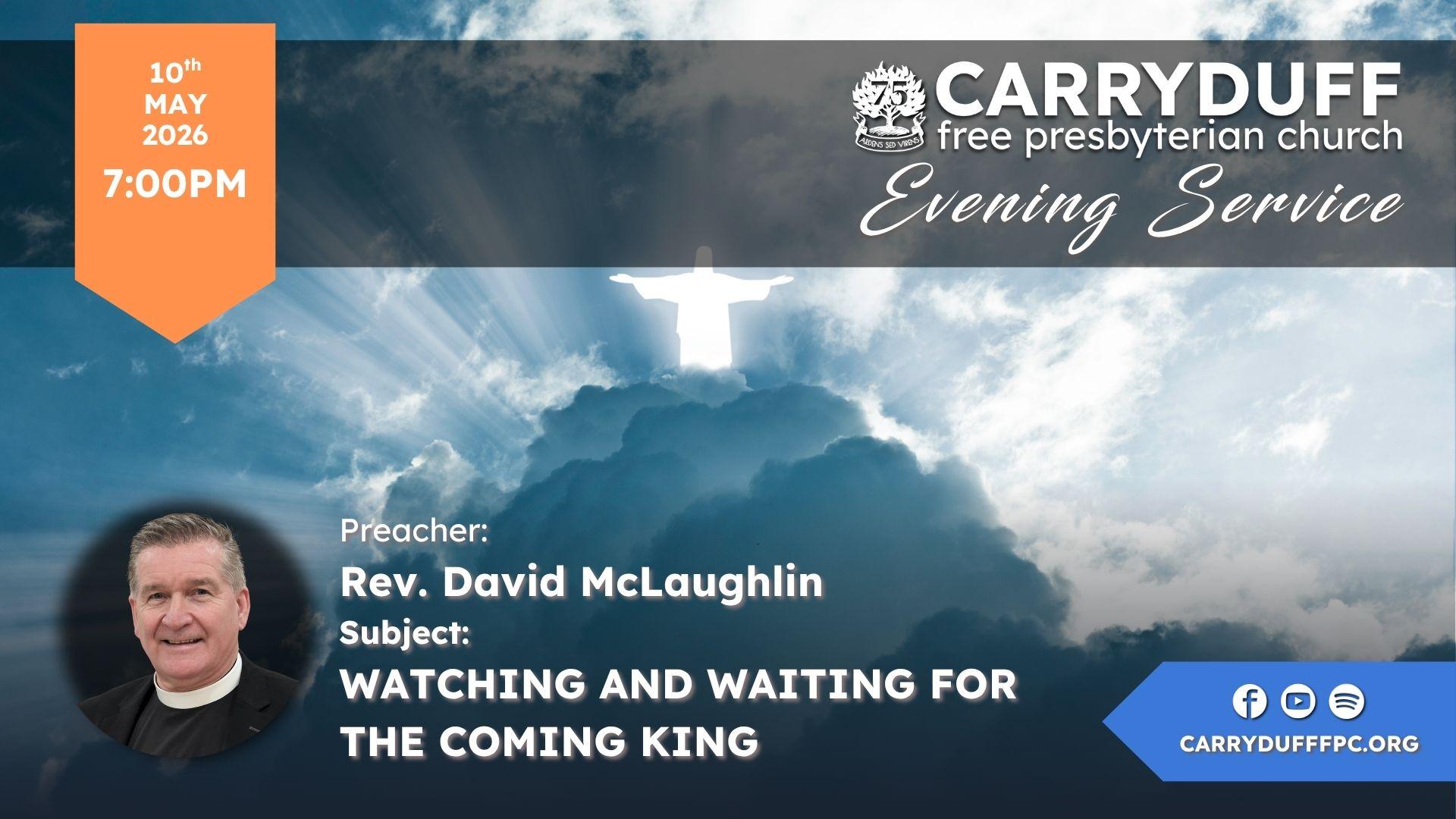

Date: SUN 7:00pm 10th May 2026
Preacher: Rev. David McLaughlin
Bible Reference: Luke 12:37-40
Podcast
Sermon Summary
The modern church has largely abandoned one of the most vital themes of the New Testament: the personal, visible, and bodily return of the Lord Jesus Christ. In an age preoccupied with personal improvement, material accumulation, and the pursuit of comfort, the urgent, sobering, and glorious reality of the King’s return is frequently relegated to the fringes of theological discourse. Yet, for the first-century believers, this was not merely an abstract doctrine; it was a defining reality that shaped their worship, their witness, and their endurance under persecution. They lived with a holy expectancy, greeting one another with the cry, Maranatha—our Lord comes.
To live in light of eternity is to live as a stranger and a pilgrim in this present, fallen world. It is a call to reject the drowsiness of our age—an age that has been lulled into a spiritual stupor by the anti-Christian currents of entertainment, ambition, and material possession. The Lord Jesus Christ did not call His church to speculate on calendars or to engage in the foolishness of date-setting. Instead, He commanded His people to watch.
The Identity of the Watching Servant
In the twelfth chapter of the Gospel of Luke, the Saviour speaks directly to the necessity of readiness. He calls His followers to consider the ravens and the lilies, urging them to seek first the Kingdom of God and to lay up treasure in Heaven. It is in this context of stewardship and eternal priority that He presents the command to be ready for His return.
The servants described in this passage are defined by specific characteristics:
- Covenant Relationship: They are those who belong to their Master, having been born again by the Holy Spirit.
- Submission to Lordship: They have savingly joined to Jesus Christ, bowing the knee in true repentance and faith.
- Rejection of False Gospels: They recognise that one cannot claim Jesus as Saviour while rejecting His sovereign rule as Lord.
- Sincerity of Love: They watch for His return because they love their Master in truth and sincerity.
We live in a world that clamours for a Saviour without a Sovereign. Many modern preachers present a truncated gospel, inviting sinners to trust Jesus while rejecting His rightful rule over their hearts and habits. This is a false gospel. The Scripture is clear: believe on the Lord Jesus Christ and thou shalt be saved. His deity, His humanity, and His ministry are inseparable. The true servant watches because he loves his Master, and he loves his Master because he has been redeemed by Him. To the ungodly, the return of Christ is a dreadful threat, but to the true believer, it is the blessed hope.
The Spiritual Alertness of the Faithful
The surety of Christ’s return is affirmed throughout the New Testament, and it demands a corresponding spiritual alertness. To watch is to live with spiritual discernment. It is the active guarding of the heart and mind against the encroachments of the world, the flesh, and the devil.
The hallmarks of this spiritual alertness include:
- Discernment: Living with a clear understanding of the spiritual realities behind the physical world.
- Faithfulness in Prayer: Remaining diligent in both private devotion and public worship.
- Perseverance in Holiness: Pursuing a life of sanctification as the necessary fruit of salvation, not the ground of it.
- Longing for Christ: Daily looking and longing for the appearing of the Saviour.
- Adherence to Truth: Holding fast to the form of sound words and the infallible promises of God.
In ancient times, a watchman upon the city walls had a duty of life or death. Should he sleep, the city was left vulnerable to the approaching enemy or remained oblivious to the dawn of a new day. A sleeping watchman was a useless watchman. So too, the Christian who loses sight of the return of Christ inevitably loses his spiritual edge.
Readiness Over Reckless Speculation
The passage in Luke 12:38 speaks of the Lord coming in the second or third watch—the deep, difficult hours of the night when exhaustion is greatest and vigilance is hardest. This is a crucial instruction for our 21st-century context. As the time of His return appears to the eyes of man to be delayed, the temptation to grow weary, careless, and drowsy is immense.
Many churches have fallen into this trap, succumbing to the spirit of the age. They have allowed the scoffers of our time to dictate the tempo of their faith, questioning the promise of His coming. Yet, the delay is not a denial. God’s clock is not calibrated to human expectations.
Furthermore, this passage serves as an absolute rebuke to prophetic sensationalism. When the Lord speaks of the Son of Man coming at an hour when we think not, He dismantles the obsession with date-setting and speculative nonsense. The dangers of such behaviour are clear:
- Recklessness: It prioritises the sensational over the scriptural.
- Destruction of Credibility: Failed predictions bring reproach upon the name of Christ.
- Distraction: It shifts the focus from cultivating holiness to calculating a calendar.
The task of the church is not to calculate a calendar, but to cultivate holiness. As the Bishop J.C. Ryle once noted, the highest style of a Christian is the one who lives ready for the Lord’s return.
We must address the mystery of the Saviour’s own words in Mark 13:32, where He declares that of that day and hour knoweth no man, neither the angels, nor the Son, but the Father. Some have wrongly inferred from this that Christ is not fully God. This is a denial of the mystery of godliness. Christ is truly and fully God, yet in His incarnation, He took upon Himself a true human nature. In that nature, He experienced hunger, tiredness, and human limitation. He lived in perfect dependence upon the Father. When He speaks of not knowing the hour, He speaks from His position of voluntary human limitation, maintaining His reliance upon the Father’s sovereign timing.
The Steadfastness of the Steward
The command of the Lord is simple: Be ye therefore ready. This is not a call to panic, but a call to perseverance. The believer remains steadfast because he understands the uncertainty of life. We are but a heartbeat away from eternity. This perspective promotes a life of true sanctification. A church that loses sight of eternity inevitably becomes worldly and woke, trading the glory of the Gospel for the transient approval of society.
Faithfulness in stewardship means doing the Master’s work while He is away. The faithful steward is marked by:
- Duty: Doing what the Master commanded, not what the world suggests.
- Activity: Engaging in the Great Commission, preaching the Gospel to every creature.
- Hope: Living with the certainty that Jesus will return to reign in power.
- Sanctification: Purifying himself as He is pure.
We must hunger after Christ until the day He appears. This readiness is comprised of repentance, faith, holiness, and hope. It is a certain hope, confirmed by the angels who promised that this same Jesus who was taken up into Heaven shall so come in like manner as He was seen to go. When He returns, the suffering of the saints will end. Sin, the great blight upon this creation, will cease. Death will be no more. The King will reign in power, and the kingdom will be established in truth.
The Surprise of Grace
Perhaps the most astonishing truth in this portion of Scripture is found in verse 37: Christ shall gird Himself, make His servants sit down to meat, and come forth to serve them. This is the mystery of the servant-King. In the glory of the marriage supper of the Lamb, the Lord of all creation will serve His redeemed people.
This is not a reward earned by worthy servants, but the outpouring of grace upon unworthy sinners. Our watching, our waiting, and our working do not merit salvation; they are the evidence of the genuine working of God’s grace within us. We do not work to earn Heaven; we work because we are bound for our true home to be with Christ, who is the fountain of all happiness.
Conclusion
As we reflect upon these truths, we must ask ourselves the most pressing questions of our time:
- Are you prepared for the return of Christ, or have you allowed yourself to fall into a state of spiritual slumber?
- Are you weary in waiting, discouraged by the trials of this life, forgetting that He who shall come will come and will not tarry?
- Are you living faithfully in the light of His return, or will you be ashamed at His appearing because of misspent opportunities and sinful habits?
Imagine for a moment that you were informed that a king was coming to visit your home tomorrow. You would not spend your time in idleness. You would prepare. You would tidy your house, set things in order, and wait with expectancy. How much more should we, who know that the King of Kings is returning, seek to put away every sinful encumbrance and live in a state of holy readiness?