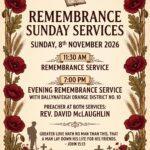
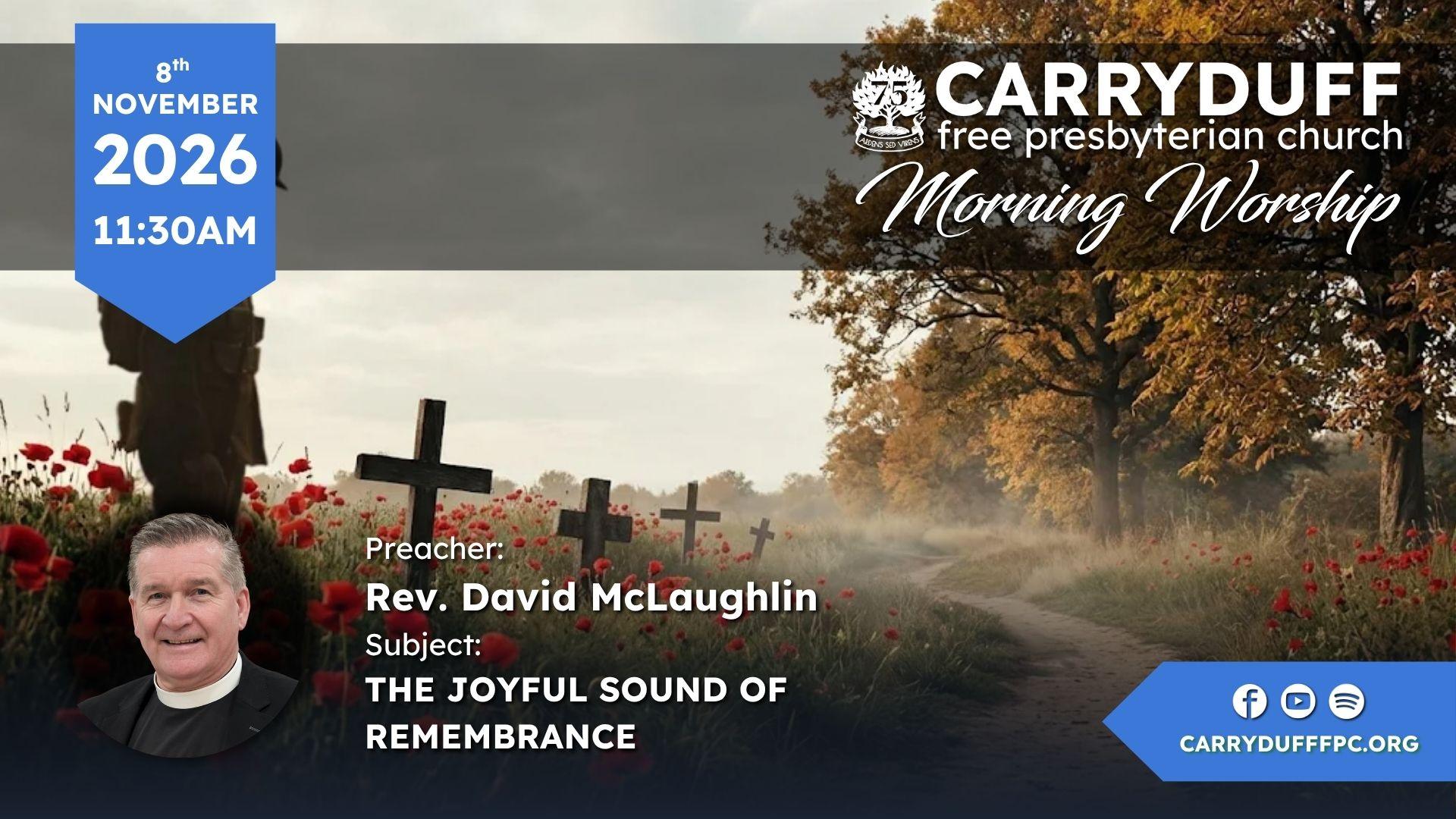

You are warmly invited to join with us at Carryduff Free Presbyterian Church for our annual Remembrance Sunday services as we remember the sacrifices made for our freedom and sit under the ministry of God’s Word.
A time of fellowship and refreshments will be served in the church hall following the evening service.
“Greater love hath no man than this, that a man lay down his life for his friends.” — John 15:13
A warm Christian welcome is extended to all friends, families, visitors, and members of the local community. We look forward to welcoming you.
📍 Carryduff Free Presbyterian Church, Killynure Road
🕰️ Sunday at 11:30am & 7:00pm
🍵 Refreshments after evening worship
Service Details
Date: SUN 11:30am 8th November 2026
Preacher: Rev. David McLaughlin
Bible Reference: Numbers 10:9-10
An act of remembrance will be part of the service.
Podcast
Sermon Summary
Introduction and Text
The sermon, entitled “The Joyful Sound of Remembrance,” is delivered on Remembrance Sunday, which falls on the second Sunday in November. The preacher takes his text from Numbers chapter 10, verses 9 and 10, from the King James Bible.
The reading describes God’s instruction to Moses to make two silver trumpets, to be used for calling the assembly, for the journeying of the camps, and for sounding alarms. The key verses read:
“And if you go to war in your land against the enemy that oppresseth you, then ye shall blow an alarm with the trumpets; and ye shall be remembered before the Lord your God, and ye shall be saved from your enemies. Also in the day of your gladness, and in your solemn days, and in the beginning of your months, ye shall blow with the trumpets over your burnt offerings, and over the sacrifices of your peace offerings, that they may be to you for a memorial before your God: I am the Lord your God.”
The preacher states that the trumpets were to sound an alarm in the day of battle and in the day of worship, whether in solemn or spiritual occasions. The sound was associated with the sword, with singing, with the scriptures, and with sacrifices. The purpose of these sounds was to remind the people that they belonged to the Lord. The word “memorial” means “remembered,” and God was teaching his people not to forget him, while assuring them that when the trumpets sounded, whatever the context, they would be remembered.
The sermon is structured around three main points: the trumpet sound as a call to recognise the past, a call to respond in the present, and a call to rest in our protector.
Why We Remember
The sermon begins by asking why we gather for this solemn occasion and decorate the meeting house. Remembrance Sunday holds an important place in the life and witness of the congregation, as it does across the province of Ulster and the wider nation. On this day, there is an act of remembrance, pausing amid the business of life to solemnly remember those who gave their lives in the service of the United Kingdom.
The preacher reflects on the fallen in the Great War, World War II from 1939 to 1945, and subsequent conflicts including Northern Ireland, the Falklands, Iraq, and Afghanistan. He asks his hearers to think of the brave young men who left shores, home, family, friends, places of work, and communities, many of whom never returned. He emphasises that they are not merely names on a memorial stone but someone’s loved one, with hopes, ambitions, dreams, and plans for the future that were cut short by war and conflict.
Providing historical context, the sermon notes statistics from the Northern Ireland conflict, commonly referred to as the Troubles, from 1969 to 2001. According to the Cairns Sutton Index, there were 3,532 total deaths. Of these, 417 were in the British Army, 55 were members of the Royal Ulster Constabulary (with this being the 25th anniversary of the RUC’s disbandment), and eight were members of the UDR. The sermon claims that the IRA murdered 2,058 people, while so-called loyalist paramilitary groups murdered 1,027. It also remembers 344 individuals connected to the Orange Order in the province of Ulster.
The answer given to the question “why do we remember?” is that forgetfulness is a real danger and a big threat. A generation that forgets the cost of its freedom becomes complacent toward that freedom and shows blatant disregard toward the commemoration and commitment of it.
A Scriptural Reason
The sermon insists that remembrance is not merely a patriotic excuse or an opportunity to wear a poppy to annoy the enemy. There is a deeper, scriptural reason for remembrance.
The Word of God calls us to remember. The preacher notes that there are 210 references to the word “remember” in the Bible, from Genesis 9:15 (the first) to Revelation 3:3 (the last), with 53 further references in related forms of the word “remembrance,” totalling 263. The Bible repeatedly calls on us to remember.
The children of Israel were commanded to remember their deliverance out of Egypt, their covenant with God, the mighty acts of the Lord, and his covenant faithfulness. Even the Apostle Paul used the theme of remembrance in 2 Timothy 2:8, remembering that Jesus Christ was of the seed of David, using the theme to remember the personal work of Christ.
Numbers 10 verses 9 and 10 is one of those remembrance texts, where God gives instruction to Moses concerning the use of the two silver trumpets.
The Trumpet as a Call to Recognise the Past
The first main point considers verse 9: “And if you go to war in your land against the enemy that oppresseth you, then ye shall blow an alarm with the trumpets; and ye shall be remembered before the Lord your God.”
The Reality of Conflict
Notice the word “war.” God does not ignore the reality of conflict. Israel was a covenant nation, and there would be times when war and conflict would arise, when they would have to face the enemy. In that context of warfare, they would experience bloodshed, death, hardship, horror, and fear. God told Moses that on the day the people would go to war, they were to blow an alarm with the trumpets, and the promise was that they would be remembered before the Lord.
The Nature of the Trumpets
These were no ordinary trumpets. They were made of silver, not brass, not copper, not even gold. There were two of them, made from one whole piece. They were used for three things: calling the assembly, journeying (when the children of Israel needed to know when to pack up their tents and move, whether after a day, a month, or a year), and gathering for war when the enemy invaded the land.
Covenant Relationship
The children of Israel were not an independent people; they were in a covenant relationship with the Lord. The text ends, “I am the Lord your God.” They were redeemed, brought out of Egypt by the blood of the Lamb. Their identity, security, future prosperity, and perseverance were all based on that relationship. The trumpet was a reminder that they were the Lord’s, that he had not forgotten them, and that they were not to forget him.
Not Forgotten
The past must not be forgotten. The sermon cites Deuteronomy chapter 8, where God says, “Thou shalt remember all the way which the Lord thy God led thee these forty years in the wilderness, to humble thee, and to prove thee, to know what was in thine heart, whether thou wouldest keep his commandment or no.” God asks who led them through that great and terrible wilderness, with fiery serpents, scorpions, and drought, who brought water out of the rock of flint, who fed them with manna. The warning is that the people might say in their hearts, “My power and the might of mine hand hath gotten me this wealth,” but verse 18 says, “Thou shalt remember the Lord thy God: for it is he that giveth thee power to get wealth.”
The Feeling of Being Forgotten
The preacher addresses those who feel forgotten and abandoned, especially when the church faces opposition and persecution, when hearing the taunts of the enemy, “Where is thy God?” In the day when the enemy is at the gate and the battle rages fiercely, we feel forgotten and abandoned, that the devil’s crowd is winning, that God has forgotten us.
The encouragement is that it is impossible for God to forget us.
The Silver Trumpet Speaks of Redemption
The silver trumpet speaks of redemption. Peter wrote that we are not redeemed with corruptible things as silver and gold, but with the precious blood of Christ, as of a lamb without blemish and without spot. Like the children of Israel who were once slaves in Egypt, we are slaves to sin and Satan, in bondage and spiritual darkness. But through repentance and faith, we have been redeemed by the blood of the Lamb. That sound of redemption rings constantly, daily, confidently in the ears of Jehovah, and when the Lord hears that sound, it acts as a constant reminder that they are his people, the redeemed ones.
Psalm 89 verse 15 says, “Blessed is the people that know the joyful sound: O Lord, they shall walk in the light of thy countenance.” The children of Israel were comforted in knowing that the sound had reached the ears of Jehovah; they had not been forgotten or abandoned.
The Pain Must Not Be Forgotten
There is a warning about the fear of forgetfulness. When things are difficult and we are inclined to complain, we are prone to forget, as were the children of Israel. Not only was the past not to be forgotten, but the pain must not be forgotten.
Today we are accustomed to privilege, prosperity, peace, and planting. We enjoy freedoms such as free civil and religious liberty, the right to the open Bible, free assembly, freedom of conscience, freedom of speech, freedom of the press, freedom of the judiciary from political interference, and a constitutional democracy. Yet we often fail to see the cost of those freedoms.
The sermon gives historical detail of the Great War: 62,000 Ulster men enlisted during the First World War, with around 30,000 Ulster volunteers in the British Army. On the first day of July 1916, the Battle of the Somme, 2,069 were killed in action with 5,029 casualties; by the second day the total dead from the Ulster volunteers was around 5,500. The total British Army dead for the Somme alone was 95,000. The Battle of the Somme ran from 1 July to 18 November. Behind every statistic was a human being; behind every one of the 420,000 casualties there is a story: a mother’s son, someone’s husband, some child’s dad, a dear friend, and whole communities were permanently changed.
The sermon references the horrors of trench warfare and tanks, the mud, the rats, the water, the bombs, and the death of comrades. It recalls visiting the Somme and thinking of re Robert Quigg from Bush Mills, and young McFadgen from Lurgan, who threw himself on a hand grenade that had been thrown into a trench, sacrificing himself to save his comrades.
Remembrance Day is an opportunity for reflection, humility, and gratitude. We are the benefactors of that sacrifice and service for our freedom. There is a responsibility to preserve what is good, to defend what is right, and to ensure that the next generation knows the value of these freedoms.
The Trumpet as a Call to Respond in the Present
The second main point is that the trumpet sound calls us to respond in the present. With the sound reaching the ears of the Lord so that he remembered the people, there was something key they had to acknowledge.
Acknowledge God
The danger is that we remember the sacrifice of men and forget the sovereignty of our master and maker; remember the fallen and forget the Father who gives life to all; remember the conflicts but forget the character of the living and true God; remember the war but forget the Word of the living God.
Who controls history? The word “history” is “his story.” History is not controlled by politicians, generals, or emperors in the seat of power. God is on the throne and governs all, governing the rise and fall of kingdoms and governments, ordering events according to his perfect will and wisdom.
Why is there war, suffering, bloodshed, murder, and mayhem? Because we live in a fallen world. War is terrible, the scourge of every nation, to be avoided at all costs. James 4:1 asks, “From whence come wars and fightings among you? Come they not hence, even of your own lusts that war in your members?” War is really a heart problem. The roots of every conflict lie in the human heart: pride, greed, power, hatred, ambition, envy, and the desire for control and dominance, bringing untold misery to thousands.
Announce Gratitude
Remembrance should fill us with gratitude. The poppies and various sights should fill us with a deep sense of sympathy and thankfulness. Psalm 103 verse 4 says, “Be thankful unto him, and bless his name.” Psalm 105 verse 1 says, “O give thanks unto the Lord.” First Thessalonians 5:18 says, “In every thing give thanks: for this is the will of God in Christ Jesus concerning you.”
We are blessed and enjoy the privileges of freedom, which are priceless. The heart of this spirit is not merely gratitude for national identity, history, military might, constitutional monarchy, or democratic system. The heart should be full of thankfulness and praise to Almighty God. Lamentations says, “It is of the Lord’s mercies that we are not consumed, because his compassions fail not. They are new every morning: great is thy faithfulness.”
Aspire to Godliness
The act of remembrance must lead to a firm and inspired godliness. The true Christian is never filled with a spirit of revenge or hate or fighting for the sake of hatred. Romans 12:18 says, “If it be possible, as much as lieth in you, live peaceably with all men.”
This spirit of godliness will be seen in knowing God in a personal and practical way. The text says, “I am the Lord your God.” The preacher suggests taking out the word “your” and putting in one’s own name, having trusted him and knowing him as Lord and Redeemer, maker and provider, and judge. Because of that knowledge we should aspire to live a life of holiness and godliness, hating sin and pursuing righteousness.
We should pray for those in authority, for those who serve in the armed forces, for those whose loved ones were killed in action, murdered, or injured, and for those with physical and psychological scars. We should pray that the Lord will restrain evil and wicked men, because only the Lord is able to make wars to cease (Psalm 46:9). He alone has the power to intervene and bring it all to nothing.
The Trumpet as a Call to Rest in Our Protector
The third main point is that the trumpet sound is a call to rest in our protector. When the children of Israel heard the sound of the trumpet the first time, they gathered for warfare; the second time, they were to gather for worship.
Verse 10 speaks of the days of gladness, solemn days, and the beginnings of months, blowing the trumpets over burnt offerings and peace offerings. As they blew the trumpet for worship, they were to rest and rejoice in God’s grace.
Rest and Rejoice in God’s Grace
These offerings had to do with atonement and sacrifice. The people remembered that they were in a relationship with the Lord on the basis of a blood atonement, rooted in his greatest provision. They had been redeemed out of Egypt by the blood of the Lamb, led into the wilderness, preserved and provided for every step, receiving all the covenant promises, all pointing to God’s infinite grace and goodness.
In a day of worship, we should rest and rejoice in God’s grace, remembering our God who has been faithful to us, taking to heart the words “I am the Lord your God.” In that covenant relationship, God is sending a message: “You belong to me; thou art mine.” The encouragement is that he has not forgotten or forsaken us; he remembers us.
The Offerings Point to Christ
These burnt offerings and peace offerings all point to Christ, because every sacrifice in the Old Testament, all those types and shadows, point forward to Christ the Redeemer. Hebrews 10:4 says, “For it is not possible that the blood of bulls and of goats should take away sin.” Hebrews 10:12 says, “But this man, after he had offered one sacrifice for sins for ever, sat down on the right hand of God.”
All these Old Testament sacrifices point forward to Christ, and the sacrifice of the fallen, those who gave up their lives unto death, reminds us to point forward to the greatest sacrifice of all, the greatest soldier to come into the world, the Lord Jesus Christ. Isaiah 53:5 says, “He was wounded for our transgressions, he was bruised for our iniquities: the chastisement of our peace was upon him; and with his stripes we are healed.”
Jesus Christ offered the greatest sacrifice in human history, giving himself, the just for the unjust. He is the sinless, spotless Lamb of God, the second Adam, the only begotten Son of God. On the cross, when he died and gave up his life, there was the death of the greatest soldier ever, taking on sin and Satan and the powers of darkness, and he won. He died voluntarily, vicariously, substitutionarily, and gladly, making an atonement for sin. Second Corinthians 5:21 says, “For he hath made him to be sin for us, who knew no sin; that we might be made the righteousness of God in him.”
The Two Trumpets and the Gospel
The sermon concludes by noting how many trumpets there were: two, made of silver, and this is described as “a gospel message in itself.” The two trumpets had the same sound and consistency; there were no sorrow notes, and the sound was heard in heaven. They were announcing that the people needed God’s help and divine intervention because they had no power or ability to save themselves from the enemy.
The text says, “And ye shall be saved from your enemies.” The saviour from the enemy is none other than the Lord himself. The gospel makes an announcement: we cannot save ourselves. It is not a message of human achievement or salvation by self-effort, not a works-based righteousness tied to religion and good deeds. Salvation is of the Lord (Jonah 2:9). It is all of grace and all of God. The gospel announces that by grace we are saved through faith, and that not of ourselves; it is the gift of God, not of works, lest any man should boast.
This ties into the Lord Jesus Christ, who gave himself as a once and for all sacrifice for sin, through his birth, life, death, and resurrection. That is the heart of the gospel.
Closing Challenge
The preacher closes by asking if his hearers are saved, whether they have heard the announcement that they are remembered in heaven, that the Lord says they belong to him. He urges them not to forget the sacrifices of the past, not to forget the privileges of the present, and not to forget the purchase of salvation. For by grace we are saved through faith, and that not of ourselves; it is the gift of God, not of works, lest any man should boast. While we rejoice and rest in God’s grace, we must rejoice and rest in the gospel.
Live Broadcast
Photos