
Service Details
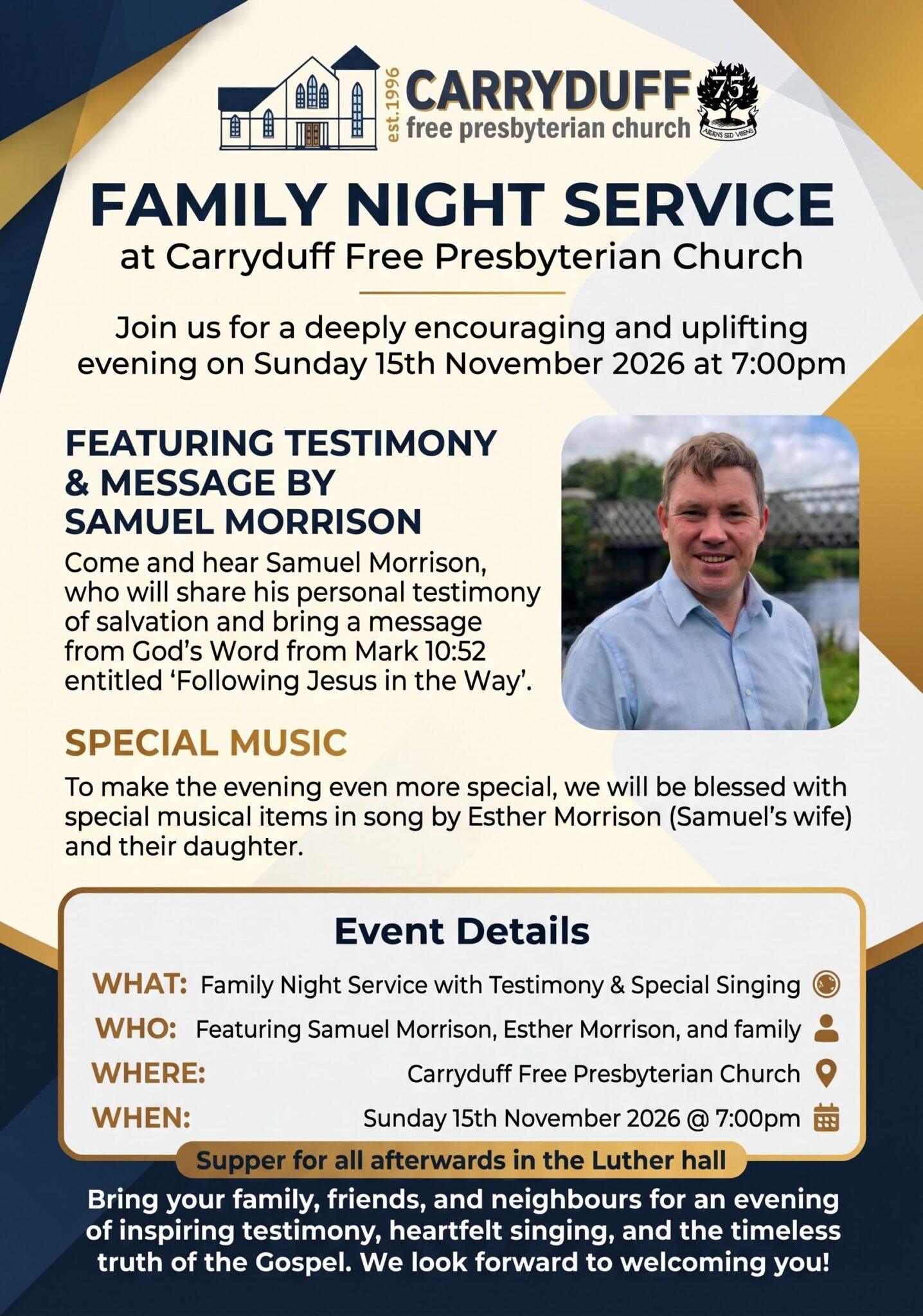
Date: SUN 7:00pm 15th November 2026
Testimony: Mr. Samuel Morrison
Bible Reference: Mark 10:52
Podcast
Part One: My Testimony
Opening and family background
Like many people of my age who stand to give a testimony in Free Presbyterian churches, I can say I was brought up in a Christian home, but I doubt there are many who can trace gospel influence back in their family as far as I can. The Morrisons were Methodists for a very long time, and the story told in the family is that the first Methodist Morrison was saved at a field meeting at which John Wesley preached, outside Ballem Allard. I cannot vouch for the complete authenticity of that story. If you go outside Ballem Allard, however, you will find Wesley’s lane, and you can go to the field where he definitely did preach, and read about it in the history books.
I said that because Christianity does not run in the blood, and you are not born into Christianity, but Christianity does run in families, and God graciously often works in families. The prayers of generations we know nothing about can still work their way out hundreds of years later. I am grateful for that, and one of the things I intend to do when I get to heaven is to go and find that man and see whether the story is true.
Whether it is true or not, I can testify personally that my sister Rachel and I were raised in a home where God’s Word was honoured and read every day. We followed McCheyne’s Bible reading scheme, and that will feature again in my testimony. If you have a TBS Bible and look at the back of it, you will find that scheme: it takes you through the Psalms and the New Testament twice and the whole of the Old Testament once, over two years. My father faithfully read it during family worship, and it was not a ritual or a matter of course; he would frequently pause and ask us questions, to see whether we were following, whether we understood, whether we were listening.
The children’s meeting and the encouragement of children’s work
I grew up in a home where a children’s meeting was held one night of the week in our front room. It had originally been in the Orange Hall in Ballem Allard and then moved out to our house. It was a great blessing even to sit under it on the times when my father would not take the meeting. I mention that to encourage anyone involved in children’s work, because about twenty years ago I had the privilege of visiting the land of Israel and standing in many of the places where the Lord Jesus stood. What shocked me, and what I did not anticipate, was that as the guide pointed out where the feeding of the five thousand took place, where Jesus stilled the waves of Galilee, and all the other incidents, the image that came to my mind was not the Bible times we had with my father at home. It was the children’s meeting, or the Sunday school class held in the kitchen. Those had buried themselves somewhere deep in my mind, and being in those places brought them flooding back. So I say again: if you are involved in children’s work, take encouragement.
We also attended all of the meetings in Kilskeery. We were there in the midweek prayer meeting, at the services held throughout the week, twice on the Lord’s Day. Wherever there was a meeting, we were brought to it. I do not say that to commend myself, but that was the standard demanded in our home: we were brought whether we wanted to go or not. Living in that environment, I would never have known a time when I did not know that I was a sinner, that I needed to be saved, and that Jesus Christ died to save sinners.
An early profession, and the Troubles in the background
In the natural course of events it would not have been seen as very remarkable that at the age of four or five, one evening probably after Bible time, I made a profession of faith. I cannot tell you anything more about it than that. But for many years I thought I was all right.
Growing up in County Fermanagh in the 1980s meant there were things going on in the background. There was the IRA murder campaign, and much of it did not register because of my age. Being stopped at a UDR checkpoint, or an RUC checkpoint, on the way home from the prayer meeting on a Wednesday evening was simply normal.
The Enniskillen bombing, 8 November 1987
Then, on 8 November 1987, the Troubles moved for my family from the background into the foreground, because that was the date the IRA bombed the cenotaph in Enniskillen. I remember being in church that morning, and my father having to leave his Sunday school class to go up, and not being told what had really happened. We were brought home by my mother, and Mrs Foster, the minister’s wife, came home with us. I remember her praying with us in the front room. It was some time later that it was explained to us what had actually happened.
My auntie Daphne had been at the cenotaph that morning, as had my uncle. The IRA had planted a bomb in reading rooms owned by the Roman Catholic Church, which were not searched by the security forces. They placed it against the gable wall. That particular Remembrance Sunday, unlike a bright, clear, crisp and dry one, had driving rain, so those who had come to see the laying of wreaths gathered under that wall for shelter. A few moments before eleven o’clock the bomb detonated, bringing the rubble and the wall down on those gathered there. Both my uncle and my aunt survived. My aunt was one of the most seriously injured people that day. When Princess Diana came over to visit the bomb victims she spent some time with my aunt, who has a Bible signed by Princess Diana. That may be an odd thing to have, but it may be the only one in the world.
I would make many criticisms of Protestantism in County Fermanagh, and there were many things wrong with the churches there. But it is to the eternal credit of the Protestant population of my home county that they did not respond in kind. Four years before that bombing, the Roman Catholic population walked out in their thousands and voted for an IRA man on hunger strike in the Maze. He was in the Maze because he had bombed a furniture shop because the owners were Protestants. He was no hero, and yet that is how their neighbours voted. Whatever propaganda there is about how badly the nationalist population was treated in Northern Ireland, I point to my home county and ask what happened in response to Enniskillen, and what the Protestant population did. By the grace of God they were given the grace not to respond in the way they had been treated.
The day of prayer and fasting, and John Woods
Moving forward to late 1993: there was one of those services we did not particularly look forward to as children in our house, but which we knew we would be obliged to attend. In 1993 Kilskeery had a day of prayer and fasting. It was not the first one we had attended, and those were a drag of a day for somebody like myself; I did not enjoy it. But you could sense there was something different about that day. In the aftermath of it God graciously moved in Kilskeery, and I think there were upwards of twenty people either restored or saved. I was aware of people getting right with God. We were aware of people who had made false professions discovering that they were false professions. But I cannot say that I personally was terribly concerned about myself.
Then one Monday morning Mrs Foster got up into the lectern in the school assembly and said that one of the pupils had approached her and told her he had got saved over the weekend, and had expressed a desire to tell the pupils about it. That caused some consternation in the rows of pupils below. Who on earth would volunteer to do the like of that? The surprise grew, certainly for myself, when the person who got up to give his testimony was John Woods, now the Reverend John Woods. He told us how he had been troubled in recent weeks, how he had felt he was resting in a false profession, and how God had dealt deeply with him and he had got right with God.
That shook me, because if there was one person in the school I would have looked at and said, there is a model of Christianity, someone I would like to emulate, someone with a knowledge of the Scriptures I would like to have, it was John. And here he was telling us he was not saved until the night before. It made me consider where I stood before God. In the weeks that followed I spoke on a number of occasions to my mother along these lines: am I right with God, who is right with God, how can you be sure, how can you know?
The assembly on Mark 10, and coming to Christ
Those matters came to a head a short time later, again in the assembly in Kilskeery, and again with Mrs Foster. She got up and spoke from Mark 10, the passage we had just read, about blind Bartimaeus. About fifteen years after that day, when I gave my testimony in Kilskeery, she came to my father afterwards and said that some of the things I said were the very words she had used that morning. It is as clear as a bell to me still. I sat in a meeting last week and heard an elder from Dromore give his testimony; he cannot tell you the date, or what was spoken about, and he is a model of Christianity. So I am not saying you have to know all the details, but God has blessed me with a memory that can remember them.
She talked about this man, blind Bartimaeus, who could not see and who cried out, Jesus, thou son of David, have mercy on me. She asked us to consider whether we had ever made that prayer, whether we had ever cried out for God to have mercy upon us. She pointed out that when the Lord Jesus spoke to him we find in verse 50 that he arose, casting away his garment, and came to Jesus. She said, imagine how filthy and dirty the garment of a blind man would be, sitting by the side of the road begging, unable to see to wash himself; and then, have you ever thrown away the old rags of sin and come as you are to Christ?
That message came with great force to me. It broke me. I saw where I stood before a holy God, and after the assembly concluded I asked to speak to Mrs Foster, and moments later in her office she led me to Christ. Unbeknownst to me, my best friend, Steven Scott, who sat on the same row as me that morning, also got saved in that same meeting. I only see Steven occasionally now; he is still in Fermanagh and I have moved to County Down, but any time I see him one of us will say to the other, do you remember that day?
I remember the following morning at break time, when Mrs Foster asked to see Steven and myself and gave us two little sky blue booklets. They were a word list published by the TBS which took you through the Bible and explained old English words. She said, I am not giving it to you for the word list, I am giving it to you for this, and turned to the back, where there was McCheyne’s Bible reading list, and told us she wanted us to follow it. I do not know what she made of me that morning, because I have a vivid recollection of standing before her shovelling crisps into my mouth while she was talking to us very solemnly about these matters. She was very gracious in that she never pointed out that I should stop and listen. She let it sit, and there was wisdom in that, because it stuck with me: that she was gracious enough not to rebuke me, and that I was listening and did take it in. By the grace of God that has been a great blessing to me through the years which followed, and I commend Robert Murray McCheyne’s reading list to you as a wonderful way to make your way through the Bible.
Since then, and the focus of the testimony
Since then I have failed my Saviour times without number. He has blessed me, and chief among those blessings is a wife who knows and loves the Lord, and who has led both of my daughters, Grace and Hannah, to Christ on occasions when I could not be there. On one occasion I was at an Orange meeting; on the other I was on parade, and it was the anniversary of VE Day. We noticed Hannah crying at the side of the road as we passed, and when the parade was over we asked what was going on, and were told that Hannah had got saved, and that my wife had pointed her to the Lord on the side of the road on VE Day. We will never forget the day Hannah got saved.
But your focus tonight should not be on Samuel Morrison, and not on the Morrisons, and not on a family: it should be on Christ. If you came into the Morrison household on a midweek morning, when the shoes cannot be found and the teeth are not brushed and somebody’s tie is still in the washing machine because it was not left out the night before, you would not see a picture of a family that is something to emulate. Follow the Saviour.
Part Two: The Sermon on Mark 10:52
Having been asked to give a testimony and bring a word on the same night, I noted that the minister had originally suggested another title but graciously agreed to change it, and that it was appropriate to turn to Mark 10, since that is the passage God used to lead me to himself thirty-three years ago. I took the closing verse of the chapter: “And Jesus said unto him, Go thy way; thy faith hath made thee whole. And immediately he received his sight, and followed Jesus in the way.” I set out three things from it.
First: the immediate transformation
Mark tells us that immediately Bartimaeus received his sight. There was an instantaneous passage from darkness into light, and the whole course of his life was transformed, literally because he gained his physical sight, and spiritually as well. The beggar had the experience Paul speaks of in 2 Corinthians 4:6, where God, who commanded the light to shine out of darkness, has shined in our hearts to give the light of the knowledge of the glory of God in the face of Jesus Christ.
Read that way, the miracle is a picture of salvation. Everyone who has the experience of true conversion has obtained it only through Jesus Christ. To use Paul’s metaphor, the darkened heart is suddenly illuminated by the light of the knowledge of the glory of God in the face of Jesus Christ. And whose face was the first face Bartimaeus saw once his eyes were opened? It was the face of Jesus Christ. I mentioned Fanny Crosby, the blind hymn writer, who when asked whether she regretted her blindness said that it only meant that the first face she would ever see would be her Saviour’s. That was true of Bartimaeus.
How did the transformation take place? Mark, under the inspiration of the Holy Spirit, describes it carefully: Jesus Christ spoke. The one who was central in the work of creation, in whom we live and move and have our being, the one who formed the eye, spoke, and he is the only one who could do anything to change the situation. Notice also that he spoke to Bartimaeus. A great number of people were following Jesus through Jericho that day, but he did not speak to the great number of people; reading down through that account in Mark 10, he never says a word to them, but he spoke to Bartimaeus. So I asked: has Jesus Christ ever spoken to you? You may have heard the Word of God preached many times, and the very words of Christ may be familiar, perhaps you can even recite the Lord’s Prayer, but has he ever spoken to you?
There is another detail worth noticing. The only person in all of Mark’s gospel, apart from Christ himself, who speaks of Christ as the son of David is blind Bartimaeus. That is significant. Mark is the gospel of Christ the servant, and his royal lineage is not dwelt upon there; for that you go to Matthew. Yet in Bartimaeus’s case, blind as he was physically, spiritual light was already dawning on his soul before his eyes were opened, and he knew that the Messiah was the son of David. The people called him Jesus of Nazareth, the name of his humiliation, the place of which it was asked whether any good thing could come out of it, but Bartimaeus knew this was the promised one, the one who was to come of the line of David. So who is king of your life? By nature we are like those of whom Christ spoke when he said that the prophecy of Isaiah is fulfilled, hearing ye shall hear and not understand, and seeing ye shall see and not perceive. You can hold the Bible in your lap and read it clearly, but your spiritual eyes are not opened to it.
Christ says, thy faith hath made thee whole. Bartimaeus was not only given his eyesight; he was made whole. His spiritual ears were opened, and his spiritually bent legs, which would have carried him down the road to destruction, were straightened. Do not think that you have gone too far, or that there is no hope for you: Jesus Christ was able to sort out everything, and he made him whole. How? By faith, faith in the only one who could ever do anything to help him, faith in Jesus Christ.
He immediately saw. Our catechism tells us that justification is an act, an instantaneous thing. You come to God a lost, undone sinner, and instantaneously you pass from death to life, from a state of condemnation into a state of justification, from being a child of the devil and a child of wrath to being a child of God. That change was immediately evident both to those around him and to himself. Not only could he see Jesus Christ, he could also look down the road and see that garment he had thrown away, and see how filthy and dirty it really was. That is how one who has battled drink or cigarettes or drugs can find that hold on their life suddenly broken: they realise how bad they were, how sinful their sin was, how rotten it was. Before, they may have seen it as a problem to be given up; now they see their sin and their degradation in a light they never saw before, because they see for the first time what Bartimaeus saw, Jesus Christ. Against the whiteness of his life and testimony, their sin seems all the blacker.
Bartimaeus abandoned the old ragged garment that carried the stains of his old life, but I do not believe for a moment that he went down the road naked. Think of the man called Legion, out of whom Christ cast the devils, which entered the pigs that charged down the cliff into the sea. We read that he was naked, and yet when the people came out of the city to see what had happened, the Scriptures tell us he was clothed. There was nobody else there; the only person who could have clothed him was Jesus Christ. I wonder whether the Lord did the same for Bartimaeus. The Bible does not say, so we cannot be dogmatic, but we can say this: he was clothed with the garment of salvation spoken of in Isaiah 61. Are your sins covered? Is your nakedness covered? All things are naked and open before him with whom we have to do.
Second: Bartimaeus followed Jesus
The first thing Christ says to Bartimaeus is, go thy way. Christ gives him total freedom. Bartimaeus could have turned and headed back into Jericho. What is the significance of Jesus performing this miracle in Jericho? Jericho was a very particular place: the city of the curse. In Joshua 6:26 Joshua adjured them, saying, cursed be the man before the Lord that riseth up and buildeth this city Jericho. God said it was never to be rebuilt.
We were all born into a place of curse. This is a cursed world. Go back to Genesis 3 and read how death and sin and suffering and all the evil in the world came in. People often ask the Christian why bad things happen to good people. First, there are no good people for them to happen to; there was only one good person who ever lived, Jesus Christ, and we nailed him to a cross. Second, the reason for suffering and death is sin. We are cursed because we live in a world of sin. And there are people who resist the call of the gospel because they love their sin; they want to stay in Jericho, and they do not want to go the way God would have them go. Many are confronted by the gospel on life’s road and turn their back on Christ and head back into Jericho. Christ said that would be the case in Matthew 7:13-14, where the gate is strait and the way narrow that leads to life, and few there be that find it.
But the one whose spiritual eyes have been opened by the grace of God will leave Jericho behind and head down the narrow way. A necessary consequence of justification and of having your spiritual eyes opened is sanctification: it is about following Jesus, walking in the way with him. The new believer will start to follow Christ, growing in love for him and in likeness to him.
How soon did Bartimaeus decide to follow Christ? It is reasonable to infer from the text that he did not have to think about it at all. It was the natural thing. He was not going anywhere else, and the desire to stay in Jericho was completely gone. He had a master to follow and a new road to take, which opened up gloriously before him. How well did he follow? Did he go all the way to Jerusalem? Did he stand at the cross, which came a relatively short time after this? Was he a Caleb, one who fully followed the Lord, or did he lose sight of Christ on occasions? Scripture does not tell us, but it leaves us with the beautiful image of Bartimaeus following Jesus Christ, and the gospel narrative suggests that he did.
Most people in the accounts of healing are not named. Bartimaeus is named, and Mark even tells us whose son he was, Timaeus. Could it be, and I only suggest this, that Bartimaeus was well known in the early church, so that when Mark sat down to write his gospel he knew him? Could it even be that Timaeus, seeing his son going down the road, thought he had better go and follow that man too? The true child of God will display perseverance. Christ describes his people in John 10:27: my sheep hear my voice, and they follow me. A true sheep will follow the Saviour. If there is no evidence of following Christ year on year, then we are not one of his sheep. But we all stumble, and we all can lose sight of Christ on occasions.
Importantly, Christ does not give up on his sheep, and he does not just leave it to them. Do not sit there thinking that you could not follow Jesus Christ, that you are not good enough to aspire to that. Neither am I, and none of us are good enough to persevere down that road. That is why it matters that two verses later in John 10 Christ says that his Father who gave them to him is greater than all, and no man is able to pluck them out of his hand. Bartimaeus followed Christ and kept following him, not because Bartimaeus was a great man able to do it, but because Jesus Christ made sure he would do it. He was one of his, and Christ looked after him on the times when he strayed, pulling him back. Christ does not save us and leave us to get on with it. He walks with us every step of the way, leads us, graciously corrects us and brings us back to the path, and does not abandon us.
Third: the exclusivity of the way
Finally, consider the exclusivity of the walk Christ keeps us on, and how the way differs from all other ways. Mark tells us Bartimaeus followed Jesus in the way, with the definite article. He did not say that he could go down this path or that and it would bring him to Christ as well. There was only one way, and it was the way. There is only one way that one whose eyes were blind and now are open can go in following Christ; every other way is the wrong way. In the modern world that sounds terribly intolerant and very narrow. It excludes the followers of Muhammad entirely; they are on the wrong road. It excludes the followers of the Watchtower Society; they are on the wrong road. It excludes those who follow a church, including a Free Presbyterian road. There is a danger in a church, and we are in the aftermath of a nomination, that third and fourth generation Free Presbyterians think that they are all right because they are on that road. No church and no group will bring you to Christ. You look down the road and think, I will be righteous and do my best. Go back to the Old Testament: what does God describe our righteousness and our good deeds as? Filthy rags. Bartimaeus cast his aside. Cast yours aside and follow Christ.
There is another man in Mark 10, and with him I closed. In verse 17 a man came running and kneeling to Christ, asking, good master, what shall I do that I may inherit eternal life? It was the best question he could possibly have asked, and he asked it of the right person. Christ pointed him to the commandments, and he claimed to have observed them from his youth. Then Jesus, beholding him, loved him, and said, one thing thou lackest: go thy way, sell whatsoever thou hast and give to the poor, and thou shalt have treasure in heaven; and come, take up the cross and follow me. Verse 22: he was sad at that saying and went away grieved, for he had great possessions. He did not follow in the way. Christ went on down the road and he turned and headed in the other direction.
I have sought tonight not to tell you about Samuel Morrison but to get you to look at Christ. I would urge you to go out not talking about Samuel Morrison, or about the great testimony you heard, or about how dramatic it was, and not to arrange for me to be brought to other churches to tell it, because it is not a testimony like that; it is pretty mundane. But I have a great Saviour. Do not follow a church, a religion, or a good life, and for goodness’ sake do not follow me. Ask yourself as you leave: am I following Jesus Christ in the way?