
Service Details
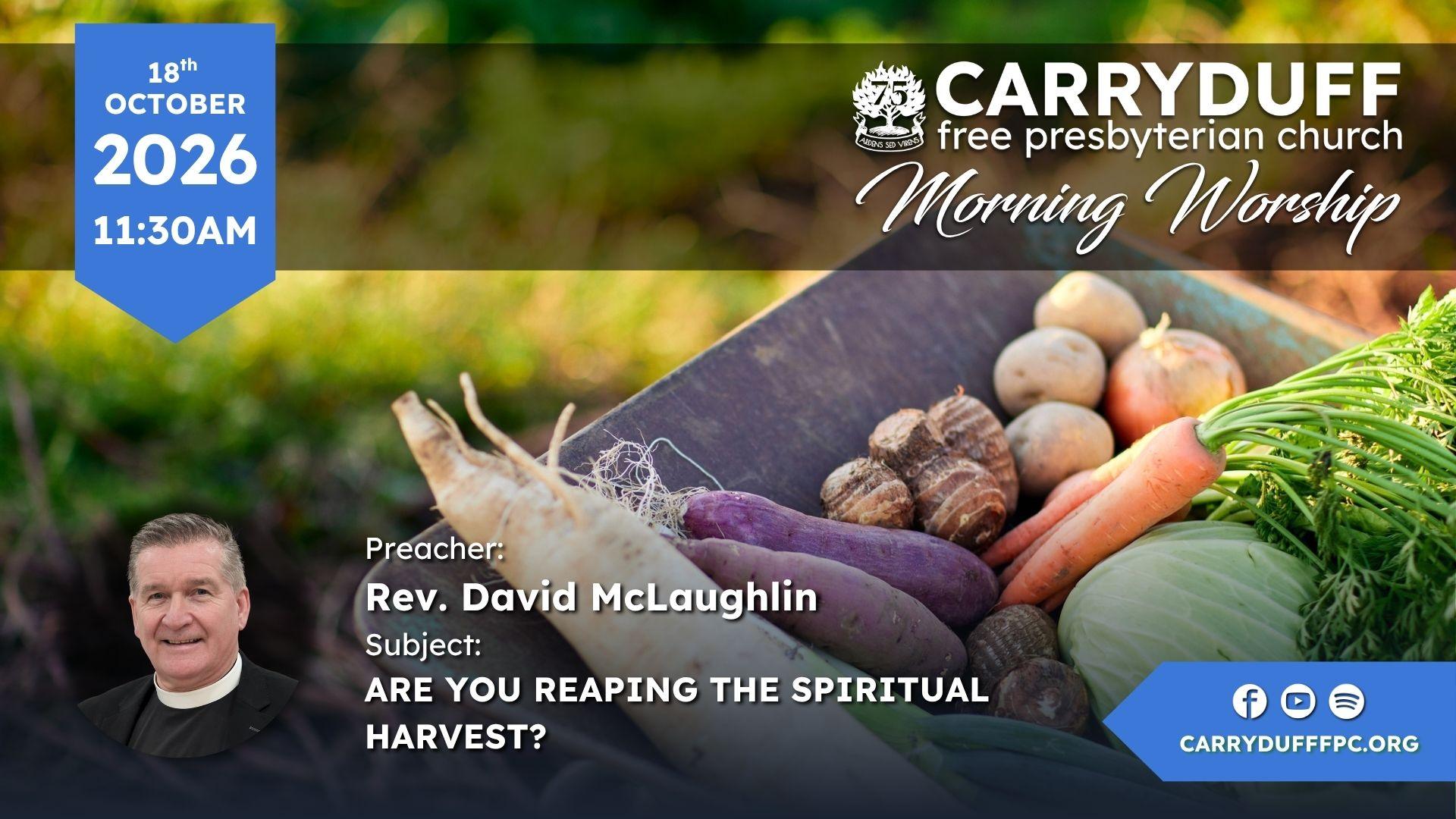
Date: SUN 11:30am 18th October 2026
Preacher: Rev. David McLaughlin
Bible Reference: John 4:35-38
Podcast
Sermon Summary
Introduction and Text
The sermon opens with the reading of John chapter 4, verses 31 to 42, from the King James Bible. The preacher establishes the context immediately: this is a passage in which the Lord Jesus Christ speaks to His disciples about meat they know not of, declaring that His meat is to do the will of Him that sent Him and to finish His work. The preacher then announces his text as John 4, verses 35 to 38, and frames his theme in the form of a searching question: “Are you reaping a spiritual harvest?”
The word “harvest” is presented as a remarkable word deserving careful thought. The preacher notes that there are 53 references to the word “harvest” in the Bible, and that these references span from the beginning of the post flood world right through to the final harvest at the end of the age. The law of first mention is highlighted as being very important. The first mention is found in Genesis 8 and 22, where God promises that while the earth remaineth, seedtime and harvest, cold and heat, summer and winter, and day and night shall not cease. This is described as a promise about God’s order of creation, and it contains within it a promise about a physical harvest. The preacher draws out the implication that there will always be a harvest, whether bad, blighted, or bumper, until the very end of time when Jesus returns in power and in glory.
The final reference to harvest is found in Revelation 14 and 15, where an angel comes out of the temple crying with a loud voice to him that sat on the cloud, commanding him to thrust in his sickle and reap, for the time has come to reap and the harvest of the earth is ripe. This is identified as the harvest of final judgment. The preacher thus presents the Bible as opening with the great promise of a physical harvest and closing with the solemn reality of a final harvest of judgment. The principle that a man reaps what he sows is applied individually, to families, to congregations, to communities, and to countries. If we sow to sin, we will reap the whirlwind.
Between these 53 references, the preacher notes there are 51 other references that all employ the language of sowing and reaping and gathering and growing. One of these is the chosen text, John 4, verses 35 to 38, which teaches about a spiritual harvest. The Lord Jesus is described as calling His disciples to recognise the opportunities presented before them. The preacher stresses that the real question is not merely whether there is a harvest, but whether we are seeing the harvest, responding to the harvest, and reaping the harvest.
The Nature of Opportunity
The preacher reflects on the language of opportunity in everyday life. Teachers tell young people about opportunities to work, to learn, to travel, to help make a difference, and to encourage someone else. Yet for the born again believer, one of the greatest privileges is to seize the opportunity to speak to someone else about the Lord Jesus Christ. Every conversation can become an opportunity, whether it be a friendship, a moment of grief, a question about the weather, an act of kindness, a particular incident, or a question about some event in history.
A personal anecdote is offered concerning an auctioneer who spoke to another man on a very wet day at an auction house. The auctioneer remarked that it was a terribly bad day, and the man rebuked him, saying that every day is a good day, it is just a pity about the weather. The preacher uses this to illustrate the importance of having a proper outlook on life and on the time that we have.
The preacher is careful to state that a conversation cannot manufacture eternal life. We cannot regenerate a sinner’s heart. Salvation is of the Lord, as Jonah 2 and 9 declares. It is all of God and all of grace. Salvation is by grace alone, through faith alone, in Christ alone, as revealed in the Scriptures alone, to the glory of God alone. Yet the Lord has appointed means to reach the lost for Christ, and one of those means is the faithful preaching of the Word of God. Another is presenting the gospel in a witnessing format, and God uses that to call sinners to repentance and faith in Christ. In every age, for every individual in Christ, in every generation, He calls, counsels, and commands His people to bear witness of Him. The harvest belongs to God, and yet He commands His people in the midst of the harvest to bear witness to Him.
First Point: The Vision for the Harvest
The first of four points drawn from the text is the vision for the harvest. The preacher directs attention to verse 35, where the Lord Jesus says, “Say not ye, there are yet four months, and then cometh harvest? Behold, I say unto you, Lift up your eyes, and look on the fields; for they are white already to harvest.” The word “behold” is likened to a stop sign at the end of a road, requiring the reader to pause, consider, look, gaze, and ponder.
The preacher emphasises who is speaking. It is the Lord Jesus Christ, and He is speaking to His disciples, and by extension to us. The context is explained in detail. The Lord Jesus had deliberately travelled through Samaria and sat at Jacob’s well near a village called Sychar. It was noonday, and He met a Samaritan woman who had come to draw water. He began a conversation with her about water, and that conversation presented the opportunity to reveal her spiritual need concerning living water. He said to her in verse 14 that whosoever drinketh of the water that He shall give him shall never thirst, but the water that He shall give him shall be in him a well of water springing up into life everlasting. Ultimately, from that initial conversation, He revealed Himself to her not just as a prophet but as the promised Messiah.
The disciples had gone into town to buy bread, and when they returned, they marvelled that Jesus was speaking to a woman, and not just any woman, but a Samaritan woman. The Jews had no dealings with the Samaritans, would not speak to them, and would not even say hello. The disciples’ attention was on the bread they were carrying and the meat they were bringing, focused on the ordinary things of life. In contrast, the Lord Jesus was concerned with spiritual and eternal things.
The preacher notes that as the disciples walked up the hill to Jacob’s well, the woman would have walked down past them. She had left her water pot and gone into the city to testify to the people about Jesus, saying, “Come, see a man that told me all things that ever I did.” Many believed in Him. It is against this background that the Lord Jesus said to His disciples, “Lift up your eyes, and look on the fields.”
There is a play on words here. It is not merely looking in the land, which the preacher admits he does all the time when driving, looking at cows and hedges, and being told off for it. It is looking upon the lives that are upon the land, upon the lives of all the people around. It is not just the landscape before them, but the crowd of people coming out of Sychar toward Him. The disciples would likely have overlooked the Samaritans, but these were the people Jesus Christ was ready to see and ready to teach.
The preacher poses a searching question: has the Church of Jesus Christ lost its vision for souls? When He said to lift up their eyes, were the disciples looking down, so focused on the necessities of life, on the things of time and sense, on the bread and meat they thought they needed? They were looking in the wrong place and at the wrong things. The challenge is whether we fail to see the spiritual opportunities all around us, opportunities standing right in front of us. We see a neighbour, but do we see a lost soul? We see a work colleague, but do we consider their need of Christ? When we see someone struggling physically or mentally, do we seize the opportunity to show Christian charity and compassion and offer them something tangible along with the hope of the gospel?
Jesus said, “Lift up your eyes.” The preacher asks whether we have a problem with our vision, with spiritual blindness. These disciples needed their vision enlarged, and we need to learn that God’s work is not confined to our expectations, our preferences, or our timetable.
The preacher addresses how we see people. We might think that a particular person is too respectable to be saved, too high up in society to listen, too hardened to be reached, such as an alcoholic, a drug addict, or a woman of the night, too busy to listen, or too indifferent to be interested in the things of God. But we do not know their hearts and minds, we do not know what goes on in their lives, and we do not know what God can do. The hymn writer says it is no secret what God can do. This woman had a hard life and a difficult past, with five husbands, and the man she was with was not her husband. The preacher invites the congregation to imagine such a scene in Ulster today and how many would think that woman could never be saved. Yet Christ spoke to her, showed her great grace and compassion, and saved her that day. We must never limit the saving power of our Lord Jesus Christ.
The preacher cites 1 Corinthians 3 and 6, where Paul says, “I have planted, Apollos watered; but God gave the increase.” We can picture Paul in his room in the church praying for the power of the gospel to work. We cannot read a person’s heart, and we cannot regenerate a person’s soul. It is not within our power. What we can do is speak a word for Jesus Christ.
An illustration is given of a farmer at harvest time. He has a field, it is harvest time, and he stands at the gate admiring his field, golden green and lovely. The weather is fine, and there is going to be a good crop, he tells himself. Yet he continues on his merry way, keeps the gate closed, and walks on. Perhaps he goes down to the pub, though the preacher notes he is not advocating going to the pub. If he never brings in the harvest or puts in the sickle, people will talk about it, saying he is a lazy farmer, stupid, good for nothing, and does not deserve the field or the farm. He has a field, the field is his, the seed has been sown and grown, it is harvest time, and he has seen it, but he fails to reap. He forgot the purpose of the field.
The preacher applies this to born again believers. It is easy to attend church, read our Bibles, offer prayer, sing hymns about the harvest, give money, and help work at home and abroad, and still fail to be properly engaged. Where is the vision for the harvest? It is not enough to admire the doctrine of evangelism but neglect the duty of evangelism. The first question is: are you seeing the harvest? We should ask the Lord to open our eyes to the person who needs a word of encouragement, to the person who needs our prayers, to family, friends, neighbours, and work colleagues, and to the person who needs to hear a clear, plain message of the gospel.
Second Point: The Value of the Harvest
The second point is the value of the gospel. The preacher returns to verse 34. The Lord Jesus is fully aware that the natural, physical harvest has its appointed season, usually about four months after the sowing. This is true in the physical and natural sense. But the Lord Jesus is challenging His disciples not to postpone their spiritual exhortation and expectations until a more convenient or better time. He is saying, literally, never assume that the opportunity is always and only somewhere in the distant future.
The preacher reflects on the danger of tomorrow. Boast not thyself of tomorrow, for no man knows what a day may bring forth. The danger is saying that we will speak to someone at another time and become more active in Christian service when life is less busy. If you want something done, ask a busy person. We say we will make the phone call when we have a more convenient time, send that text, or respond to that email on another occasion when circumstances are more suitable. In doing so, we are making excuses, not seizing the opportunity, putting off the opportunity, and not striking while the iron is hot. We are waiting for the right time, but the right time may never come. We can be so preoccupied with many other legitimate things that need to be done that we forget one of life’s priorities, which is to seize the opportunities when God brings them along.
The preacher says we need not just a vision for that but a burden. We must see the value of poor lost souls, value them, seize the opportunity to speak and tell them of the Lord Jesus, and try to win them. He is aware that to witness individually requires wisdom, prayer, and speaking to the individual in love. But there is a danger of endless postponement. We do not possess tomorrow. None of us knows what tomorrow will bring, or five minutes from now, five hours, five days, five weeks, or five months. It could all change in a second. But we have a responsibility to reach carried off for Christ.
The preacher cites Ephesians 5 and 16, where Paul says, “Redeeming the time, because the days are evil.” The word “redeem” means to buy up the opportunity. We must make good use of the time God has given us. Time is not just something we spend, it is a stewardship entrusted to us by God, and we will be accountable to Him for its use.
The preacher thinks of all the harvest opportunities of ordinary life. There is the parent who teaches and tells their children of Jesus. There is the Sunday school teacher who teaches and shares the Word of God with the children, helping to shape and mould their lives. There is the faithful preacher who is faithful to the blood and the book, preaching the Word of God Sunday by Sunday, morning and evening, and at the Bible study. There is the Christian employer and the Christian employee demonstrating honesty, integrity, and kindness.
An anecdote is told of an employer at the docks who tried to employ a man to coordinate shipping containers. He told the man that they were shipping 35 containers in the week, but he wanted him to put on the manifest that only 34 were going out. If he did that, he would give him the job, and he should go home, think about it, and come back tomorrow. The man came back and said that he desperately needed the job, but he was a Christian and would not write 34 in the manifest if there were 35. He would put 35, not 34. He was sorry, but he needed to be honest and would not take the job. The man behind the desk got up, came and thanked him, and said it was just a test. He wanted to see if he was an honest man, and he was his employee because he knew he would keep the records right going in and out of the docks. The preacher says this demonstrates honesty, integrity, and it is what we need, not just in the employee but in the employer.
Other opportunities are mentioned. When a neighbour dies, there is an opportunity to give a card through the door and speak a word in season. When someone suffers loss of some other description, such as bereavement, there is an opportunity. A church member is an opportunity to invite someone to the service. Among family and friends, there is an opportunity to witness privately or publicly. Do we recognise our God given opportunities?
The preacher cites 1 Peter 3 and 15, where Peter says, “Sanctify the Lord God in your hearts: and be ready always to give an answer to every man that asketh you a reason of the hope that is in you with meekness and fear.” We are not talking about being aggressive or insensitive, but we should not be so fearful that we cannot speak. The balance in that text is readiness, truth, meekness, and fear. The illustration is given of meeting someone willing to listen who asks if you are saved, born again, or a Christian. Are you so overcome with fear that you cannot speak, or will you seize the opportunity, pray for wisdom, and be prepared to speak a word in season for Christ?
The preacher asks whether we are seizing the harvest opportunities God gives us. We have many missed opportunities, and he confesses to missed opportunities in his own life, a multitude of them. The fields are white already unto harvest, and we must seize the opportunity.
Third Point: The Volunteers of the Harvest
The third point is the volunteers of the harvest. The preacher directs attention to verse 36, where the Lord Jesus says, “And he that reapeth receiveth wages, and gathereth fruit unto life eternal: that both he that soweth and he that reapeth may rejoice together. And herein is that saying true, One soweth, and another reapeth.” The Lord Jesus turns His attention from the fields to the labourers, the workers, and the reapers. The harvest is not gathered in merely because it is ready. The labourers must go into the field that is white already. They must go out into the field and physically work and labour to gather it in. The harvest is not just growing, it has to be gathered. The farmer at the gate has to make a decision to send in the reapers and get the harvester out.
The Lord Jesus says the reapers receive wages and gather fruit unto life eternal. The preacher clarifies that He is not saying salvation is earned as a wage. Eternal life is a gracious gift. He that believeth hath everlasting life. It is not a payment for human merit. The preacher cites Ephesians 2, 8 and 9, that by grace we are saved through faith, not of ourselves, it is the gift of God, not of works, lest any man should boast. The fruit here unto eternal life speaks of the privilege, the reward, and the joy of service rendered. The labourer and reaper serve because they have been sent into the harvest field. The sower and the reaper rejoice because God is using him, a weak vessel, a sinful vessel, to accomplish His purpose.
The preacher notes that we are all different. God has different workers: the parent, the Sunday school teacher, the youth worker, the evangelist, the elder, the pastor, and the missionary. We have all different backgrounds, and yet God uses different people in different ways to reap the harvest, and it is all one harvest. John 4 and 37 says, “One soweth, and another reapeth.” He adds in verse 38, “I sent you to reap that whereon ye bestowed no labour: other men laboured, and ye are entered into their labours.”
The preacher applies this to God’s dealings with His ancient people, the children of Israel. He sent them the patriarchs, Abraham, Isaac, and Jacob. He sent them the prophets, the major and the minor prophets. Think of the ministry of John the Baptist. All individuals from different backgrounds, but they were all part of that background to prepare for the coming of the Lord Jesus. God uses different people. This is true in the land of Israel, but it is also true of His church today.
The preacher thinks of missionaries of Northern Ireland descent. He mentions a lady called Emma, and Dr. Barnes and Pastor Victor Maxwell wrote a book about her, “Go Through with God,” which he describes as a tremendous read and encourages young people to get a copy and read it. He thinks of the life of Amy Carmichael or the life of Dr. Bill Woods, all different workers in different fields with different gifts and talents, but they are all workers in the one harvest field for Christ. Many other missionaries come to mind: Mary Slessor, Robert Moffat, Praying John Hyde, and William Carey, who went to India. What were they doing? They were all faithful in sowing the seed in their day and generation. Even though they sowed the seed, they did not see an immediate response. Others came after their day and also laboured where they had sown. They also sowed seed, and then they saw souls come to faith in Jesus Christ.
The preacher encourages the Sunday school teachers of the church to pray on for the children. He encourages parents to pray for their sons and daughters who this day are far from the Lord, to pray on till the answer comes. Perhaps you are praying for a Christian friend, and you have spoken to them in the past and long to see them come to Christ. You have laboured as an unseen, faithful labourer behind the scenes. Perhaps it is a wife who is far from Christ and needs the Saviour and has heard the gospel for years. Once the work of sowing is done, then you pray for that increase and leave the seed to germinate. It may take weeks and months, it may take years, but then another may come along and do the reaping. Who gets the glory? The Lord. The Lord knows every faithful act of service. The Lord knows when you have done something in His name. Maybe you feel that you have done something for the Lord, spoken a word, and you are quiet and reserved. You have not received any recognition. Nobody has come to give you a pat on the back or cheer you on. But your labour is not wasted. Yes, the full results are hidden now, but it will be fully revealed one day. Do not doubt, do not despair.
The preacher cites 1 Corinthians 3 and 7, that neither is he that planteth anything, neither he that watereth, but God that giveth the increase. Think of the harvest, the joy of sowing and reaping, the joy of seeing an individual come to Christ. There is no greater joy than leading a soul to saving faith in Christ, no greater joy than being involved in the work of God. Do the little that you can for Him, doing a little for the honour and glory of Christ. Be faithful in the place where God has given you. Sow the seed, water that seed with your prayers, speak a word in season and truth in love, but also be ready to reap.
The preacher asks whether you have confidence in the great Word of God. He cites Isaiah 55 and 11, that so shall My word be that goeth forth out of My mouth: it shall not return unto Me void, but it shall accomplish that which I please, and it shall prosper in the thing whereto I sent it. Remember the Lord is in charge. He is sovereign. He is in control. The Lord can overrule in His sovereignty and in His providence. The Lord can bring you into contact with an individual to do them good.
The preacher thinks of the rich young ruler. What did he have? He had everything: youth, wealth, health. He came with the right question, to the right person, in the right way, humbly, and urgently. But one thing he did not have was the truth of the gospel. Because he was not willing to give up his riches, which he loved more than he loved God, he went away sad. That was his great lack. He had everything else, and thousands are carried off with everything else, but they lack this one thing, the truth of the gospel and the knowledge of Christ. Rich in this world’s goods, rich by the blessing of God, and yet they have nothing. We should speak to them and tell them of Christ, the mighty to save.
Fourth Point: The Vocation of the Harvest
The fourth and final point is the vocation of the harvest. The preacher looks again at verse 36, that he that reapeth receiveth wages, and gathereth fruit unto life eternal. He focuses on the words “gathereth fruit unto life eternal.” That is our calling. That is the significance of this passage. It is not merely about gathering a crop for this life, it is gathering fruit unto life eternal. The gospel concerns eternal realities.
Sin is not just a problem of poor choices. It is not just a problem of unhappy circumstances. It is not that individuals need to improve. They need to be born again. They need to be regenerated. Jesus said, “Marvel not that I said unto thee, Ye must be born again.” Sin is a rebellion against a holy God, and they need to repent of that rebellion and trust in Christ as Lord and Saviour. They have immortal souls. The Lord Jesus said, “What shall it profit a man, if he shall gain the whole world, and lose his own soul? Or what shall a man give in exchange for his soul?” They need God’s salvation. This is a faithful saying and worthy of all acceptation, that Christ Jesus came into the world to save sinners, of whom I am chief. That ties into the birth, the life, the atoning death, and the bodily resurrection of Christ. Not only that, but they need to hear about the Saviour.
The message at the heart of the spiritual harvest is a message about the Saviour. It involves pointing out people’s sin, telling them they have a soul, telling them they can have salvation, for you cannot get to heaven without salvation. It involves telling them about the Saviour, that they need to repent and believe, and if they repent and believe, they are justified by God’s free sovereign grace and receive eternal life.
The preacher concludes by reflecting that there is a final day of accounting coming. There is a day of reckoning coming. The final harvest is coming. It is proper that we maintain church activities, preserve our traditions, and occupy our religious routine as far as the Sabbath day of worship, morning and evening, and the Bible study on Wednesday night are concerned. But we must desire more. We must desire that the people of our community hear the gospel. We must desire that they come to know Christ. At this minute in time, the preacher is planning a little gospel booklet that he hopes will go into every home in Carrickduff. He does not know what it will entail or what it will cost, but he has a burden that the people in the community need Christ, need to hear, and need to come, because Christ is the answer.
The preacher finishes by returning to the image of the farmer. Imagine the farmer, his harvest field is ripe, he is at the gate looking at that golden green. He does not spend his days discussing the beauty of the green. He does not say he will take a picture or a selfie and just stay outside the gate. No, the opportunity of the golden green demands action. Get the harvester in, get the sickle in, reap the crop, and bring it into the barn. Opportunity always demands action. We have a limited number of days to live. Some of us may not be here next week. The God in whose hand your breath is could take breath from your body. Relationships will change, doors will close, and opportunities may not return. We cannot do everything, but let us do what we can.
The preacher summarises the four points as a final challenge:
- Think about the vision of the harvest and lift up your eyes.
- Think about the value of the harvest and seize every opportunity.
- Be a volunteer for Jesus and speak a word for the Saviour.
- Embrace this vocation, asking what am I called to do. I am called to live in light of eternity, and in light of eternity, when men will give an account to God, I will try to reach as many as I can for Jesus Christ.
The sermon closes with the searching question once more: “Are you reaping the spiritual harvest?” The preacher confesses that this is a real challenge that has come to him as he has thought about this word “harvest.” He asks the Lord to bless the congregation, thanks them for coming and for their patience, and prays that God will use His word.
Live Broadcast
Photos