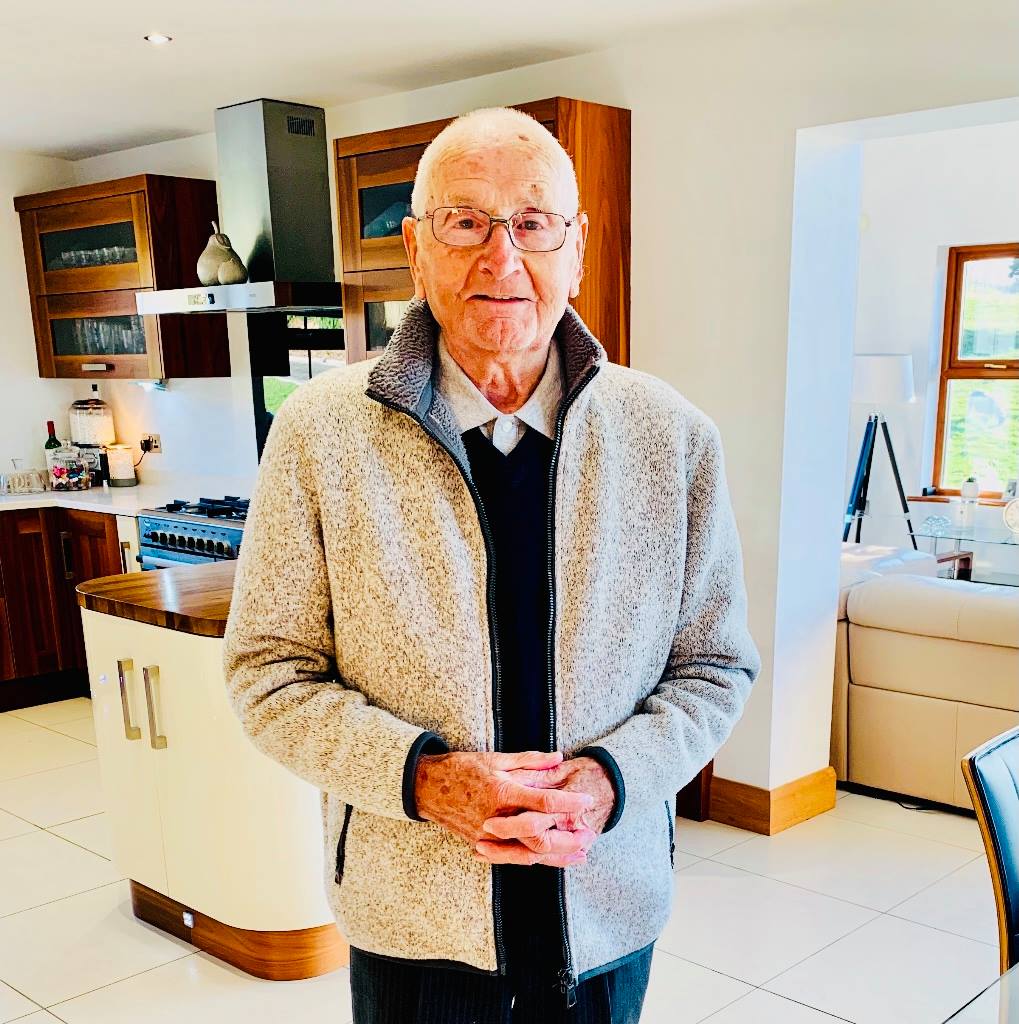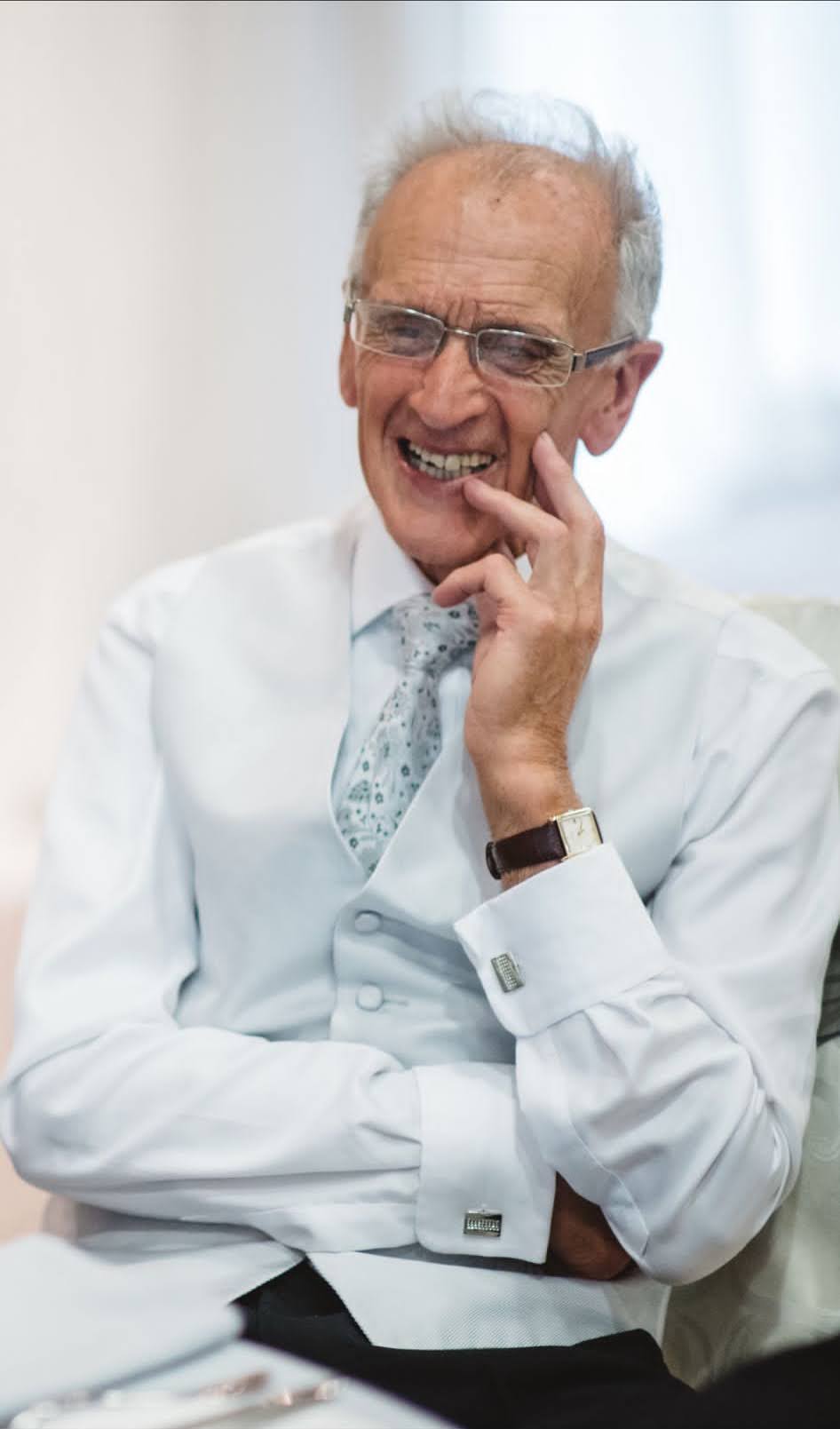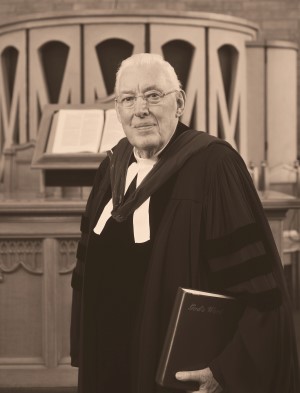

COOKE, Rev. Dr. Stanley Bertram (Bert)
5th December 2025, former Deputy Moderator of the Free Presbyterian Church, peacefully at Brooklands Nursing Home, Kilkeel, aged 96 years, formerly of Marguerite Avenue, Newcastle.
Dearly loved and devoted husband of Agnes. Much‑loved brother of Ron, Audrey (Payne) and Nancy (McKenzie), and their families. Beloved uncle and great‑uncle.
Service of Thanksgiving in Moneyslane Free Presbyterian Church, 2 Millvale Road, BT31 9PX, on Monday 8th December at 12 noon, followed by burial in the Ballygowan Free Presbyterian graveyard.
No flowers please; donations if desired online via www.douglasfuneraldirectors.com or cheques payable to FPC Mission Board, c/o Douglas Funeral Directors, 20 Dromore Road, Ballynahinch, BT24 8HP.
Bert will be lovingly remembered and sadly missed by his sorrowing wife Agnes, brother, sisters, nieces, nephews, the wider family circle and many friends.
Matthew 25:21 — His lord said unto him, Well done, thou good and faithful servant: thou hast been faithful over a few things, I will make thee ruler over many things: enter thou into the joy of thy Lord.
Live Broadcast
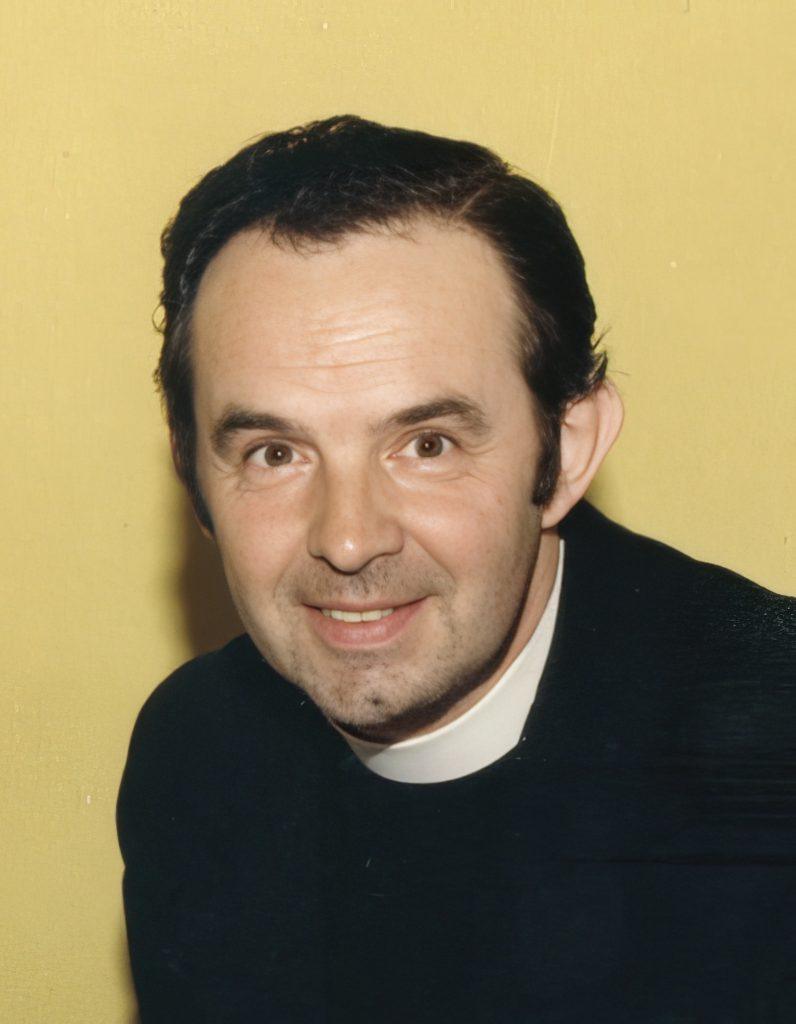
Rev. Dr. S. Bert Cooke (1929 – 2025)
A Lifelong Servant of Christ, Defender of the Faith, and Gentleman of Grace
The death of Rev. Dr. Stanley Bertram Cooke, affectionately known to generations simply as “Bert,” marks the passing of one of Ulster’s most respected ministers and one of the enduring statesmen of the Free Presbyterian Church of Ulster. His ninety‑six years were crowned by more than seventy‑five spent in Christian service — decades that saw him labour as a pastor, preacher, professor, and leader across congregations and continents. To those who knew him or whose lives were touched by his ministry, he was a man of warmth and wit, deeply grounded in truth, profoundly humble, and unwaveringly loyal to the Christ he served.
🌿 Early Years — A Christian Home and a Wayward Heart
Bert Cooke was born in Belfast in 1929, during an era when Ulster life revolved around faith, family, and community. His parents, devout Presbyterians, ensured their son was raised under the discipline and nurture of the Word of God. His father served faithfully on the committee of Ravenhill Presbyterian Church, while his mother was a quiet yet indomitable woman of prayer. She was, by every account, the spiritual anchor of the family, modelling what a godly home truly meant.
From earliest childhood, Bert was taught to memorize Scripture, to sing hymns, and to attend worship each Lord’s Day. He learned the Psalms and catechisms that formed the foundation of his later theological life. Yet, like many who are raised close to the church but far from Christ, the young man drifted in adolescence into the mirage of worldly pleasures. He later described those years without sentimentality — “a godless and worldly life” lived without prayer, faith, or peace.
Though he gave every appearance of casual detachment, his conscience was never silent. His mother’s unyielding witness and prayer — uttered so often beside the morning fire as she cleared the ashes — would one day become his own testimony of divine pursuit. Unknown to him, those prayers were laying a claim on his soul that nothing could erase.
✝️ Conversion — A Divine Visit in Belfast (1949)
Everything changed in September 1949. That autumn brought to Belfast a visiting evangelist, the celebrated Dr. Oswald J. Smith of Toronto’s People’s Church, who was conducting a gospel crusade in McQuiston Memorial Presbyterian Church. The meetings were drawing large crowds, but Cooke had no intention of attending. He considered himself indifferent to “religion” and altogether unfit for holiness.
One evening, however, prompted by a sense of maternal duty and curiosity, he went along. As over two thousand people filled the church and adjoining halls, the Spirit of God moved mightily. Smith spoke on repentance and the cross — themes familiar to Ulster ears but now piercingly directed. When the closing hymn began, “I Hear Thy Welcome Voice”, Smith abruptly paused and said, “Someone here tonight is waiting until Sunday night. But Sunday might be too late.”
Cooke’s heart stopped. Years of resistance broke in that moment. He later described hearing an almost audible voice in his spirit quoting Genesis 6:3: “My Spirit shall not always strive with man.” Trembling from conviction, he turned to his companions and whispered, “I must go.” He walked forward and, in the inquiry room, surrendered his life to Christ. From that night his direction changed utterly. He went home a new man — the rebel became a believer.
His mother wept for joy when she heard the news. “She had prayed me to the Saviour,” he said later, “and God answered her at last.” That transformation — radical, uncompromising, and evidently sincere — would mark him forever.
🔥 The Call to Preach
Within months, a new burden took hold: the call to preach the Gospel. Having once been tongue‑tied in public, Cooke soon found a new fluency in prayer and a burning zeal to tell others of Christ’s power to save. Though he had no desire for platform or prominence, the fire in his soul could not remain private.
Encouraged by his mother, he began attending Ravenhill Evangelical Mission Church, where a young Rev. Ian Paisley was rapidly becoming one of Ulster’s most dynamic voices. From the moment Cooke heard Paisley thunder forth the old Gospel, he knew he had found both a mentor and a cause greater than himself.
The two became fast friends, often travelling together for evangelistic missions. Paisley drove the car — a cramped Morris Minor that barely accommodated his towering frame — while Cooke and companions bounced along the back seat, praying for souls and sometimes for the car’s endurance. Those early expeditions, filled with laughter, hymns, and testimonies, would ignite in both men a passion for revival and an unbreakable brotherhood in the Gospel.
On Christmas Eve 1950, Bert preached his first sermon at Keswick Mission Hall. His text was 2 Corinthians 6:2 — “Now is the accepted time; behold, now is the day of salvation.” With trembling voice but full conviction, he preached for eighteen minutes. It was neither polished nor perfect, yet it came from the heart — and God blessed it. It was the beginning of a lifetime vocation.
The Birth of the Free Presbyterian Witness
When the Free Presbyterian Church of Ulster was born in 1951, following controversy within the Irish Presbyterian denomination, Cooke was an observer — a young believer watching history unfold. He saw Dr. Paisley and others stand publicly against liberalism and ecumenical compromise, and though he hesitated at first, he quickly recognized the hand of God in the bold new witness.
“It was a movement hated by many,” he later recalled, “but marked by heaven’s blessing. I began to see that truth must often be purchased with reproach.”
Cooke joined the denomination, studying theology while continuing to assist Paisley’s evangelistic missions. In time, his loyalty to the movement became absolute. He believed — and would argue until his final days — that the Free Presbyterian Church was raised up by God “so that there would still be a voice for the Gospel in a land of compromise.”
⚖️ A Test of Conviction — Mount Merrion (1950s)
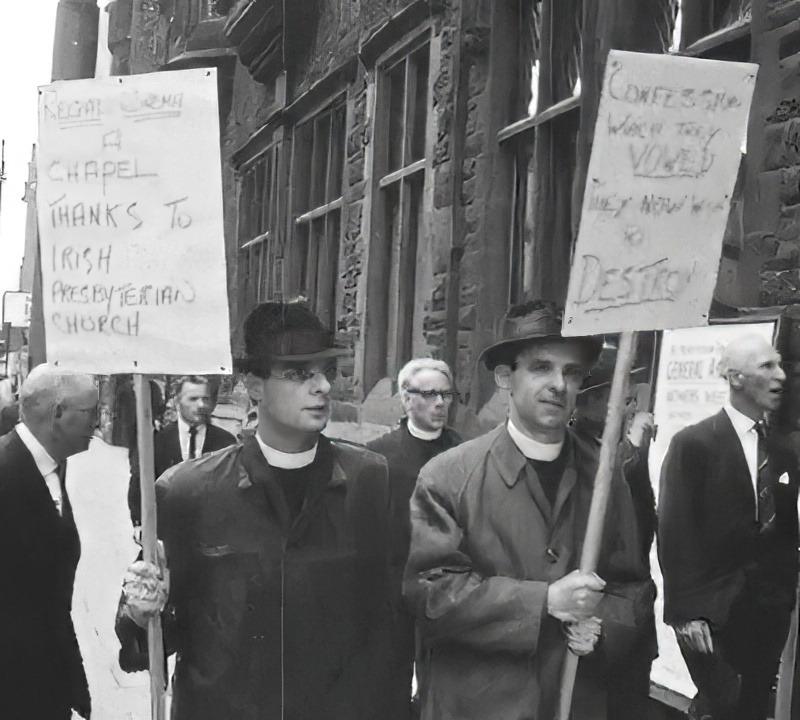
His first labour as a student preacher was shared with his cousin Rev. John Douglas in Mount Merrion Free Presbyterian Church. The congregation was small, but within a year opposition arose from within. Influential committee members disliked the church’s annual protests against apostasy in the Irish Presbyterian Assembly and demanded withdrawal.
They warned the young preacher bluntly: “If you’re not with us, you’ll lose our support — and the church will fold.”
Calmly but resolutely, the twenty‑something Cooke replied:
“If standing for the virgin birth and the blood atonement wrecks this church, then the sooner it is wrecked, the better.”
He stood his ground. A handful left; yet within months God honoured his courage, and the congregation began to revive. That experience galvanized the young minister’s confidence that obedience always outruns pragmatism. Later he would look back on that episode as the first major spiritual battle of his life and the moment when Free Presbyterianism became not merely his denomination, but his conviction.
🌾 Pastor, Builder, and Shepherd — Rasharkin and Armagh
After nine fruitful years at Mount Merrion, Dr. Cooke was called to pastor Rasharkin Free Presbyterian Church, a rural congregation in County Antrim. There, he cultivated the same spirit of biblical integrity and evangelistic fervour that had characterized his previous work. But it was in Armagh, where he was installed in December 1967, that his ministry would reach its fullest expression.
He and his devoted wife Agnes arrived to find a small group meeting in a portable hall on the city’s outskirts. The fledgling work had clearly devilish opposition. On 5th November 1967, unknown assailants attempted to bomb the Armagh Free Presbyterian Church building. This attempt came exactly one week after some 200 Roman Catholic rebels had gathered to hurl abuse, throwing missiles towards Dr. Paisley’s car and shouting provocative Republican slogans, the actions of which the police did not intervene. Dr. Cooke, while grieved by the malice behind the act, urged his congregation to respond not with anger but with steadfastness, reminding them that “no weapon that is formed against thee shall prosper.” The attack, far from deterring the fledgling fellowship, united its members in prayer and resolve, and the next Sabbath the hall was filled to capacity with worshippers determined to stand unshaken.
Within a year, the hall was once more full to bursting — a testimony to faithful preaching and fervent prayer. Cooke’s expository ministry grounded hearers in Scripture, while his evangelistic zeal drew seekers from many districts. “If I worked hard and God was pleased to bless,” he later said, “perhaps we might fill that hall one day.” By the summer of 1969 it was already overflowing.
Throughout the 1970s the congregation grew rapidly, prompting plans for a permanent building. With typical courage he urged the people to move forward in faith, securing what seemed an impossible loan at the time — £40,000, a daunting figure amid rampant inflation. “I only lost one night’s sleep over that,” he often smiled, “and the Lord gave peace the next day.”
In January 1975 the new Armagh Free Presbyterian Church Building was opened, filled on its first service despite winter gales and unfinished windows. It soon became one of the largest and most influential congregations in the denomination. From its ranks missionaries, ministers, and lay leaders spread across Ulster. Armagh gained a reputation as a “mother church,” planting fellowships in Markethill, Dungannon, Tandragee, and Tullyvallen.
Dr. Cooke laboured there for twenty‑six years, shepherding his people through growth, trials, and even the dark turmoil of the Troubles. During those years of national tension and tragedy, his pulpit pointed upward — to the eternal stability of the kingdom of God. His sermons offered neither political slogans nor vague optimism, but biblical hope: that Christ reigns, that truth still saves, and that revival remains possible.
As the Armagh Free Presbyterian Church has since recorded in heartfelt tribute:
“Dr. Cooke was the first ordained minister of the Armagh congregation. Installed on 9th December 1967, he ministered for over 26 years until his retirement at the end of February 1994. Under his ministry many souls were saved, the congregation grew significantly, and the current Church building was opened on 4th January 1975. Dr Cooke was a godly servant of the Lord and fearless in contending for the separated cause of the Gospel. We thank God for the blessing and influence his ministry had upon our lives personally, in Armagh, right through the Free Presbyterian Church, and around the world.”
They concluded their tribute with the words of Psalm 12:1: “Help, LORD; for the godly man ceaseth; for the faithful fail from among the children of men.”
Those words encapsulate the feeling across Armagh and throughout the denomination — deep gratitude for a shepherd who left an enduring mark.
🎓 Teacher, Theologian, and Deputy Moderator
Dr. Cooke’s influence extended well beyond the borders of any single congregation. He served the denomination as its first Deputy Moderator, a position in which his calm reasoning and scriptural wisdom helped steer the Free Presbyterian Church through periods of expansion and challenge.
In debates and committees he spoke little but carried great weight. Colleagues noted that when Dr. Cooke rose to speak, voices fell silent. His words carried conviction, not because he sought dominance but because he lived what he believed.
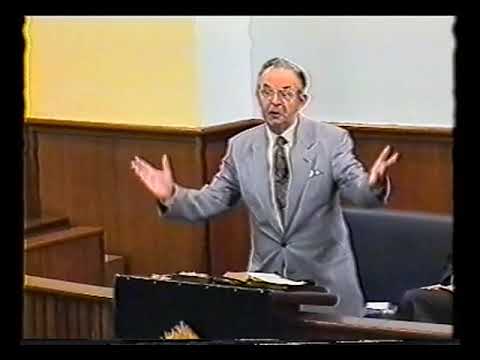
He also lent his gifts to the training of ministers as Professor of Homiletics and Pastoral Theology at the Whitefield College of the Bible in Banbridge. There, with characteristic gentleness, he instructed future pastors in the sacred responsibility of preaching. “Preaching,” he told them, “is not performance — it is revelation. The preacher must first hear from God before he speaks for God.”
His students treasure memories of his gracious correction, his anecdotal humour, and his heartfelt reminder that “a good sermon must move the heart before it can move the congregation.” Hundreds who passed through Whitefield owe not just their method but their devotion to Dr. Cooke’s influence.
Many of his students went on to pastor churches across Ulster, North America, and beyond, credits that Dr. Cooke accepted with quiet satisfaction and the refrain: “To God be all the glory.”
📜 Defender of Orthodoxy — Preaching, Polemics, and the Cause
To understand Dr. Cooke’s passion, one must recall his oft‑repeated quotation of David’s challenge in 1 Samuel 17:29: “What have I now done? Is there not a cause?” That verse captured his life’s outlook. Like young David, he stood on Scripture’s battlefield, confronting giants of unbelief and compromise, often misunderstood even by his own brethren. Yet, like David, he never faltered in courage.
His widely circulated sermons, Free Presbyterianism, Why? (delivered at Mount Merrion, Kilkeel, Lisburn, and elsewhere) and The Call of Christ, exemplify his apologetic clarity. Drawing parallels between ancient Israel’s idolatry and modern Christendom’s rebellion, he warned that many churches — though outwardly religious — had forsaken truth for popularity. To him, “ecumenism was not charity, but betrayal; not unity, but dilution.”
With encyclopedic knowledge of church history, he frequently traced the lineage of faithfulness from Reformers like Henry Cook, through the 1859 Revival, to the rise of the Free Presbyterian witness. His fierce critique of theological liberalism, especially the heresies of Professor J. E. Davey that once rocked Irish Presbyterianism, stemmed not from sectarianism but from deep sorrow that truth had been abandoned. “A church without the blood of Christ,” he said, “is not the church of Christ at all.”
In that sermon he protested the decline of mainline Protestantism, recounting the tragic apostasy of the Irish Presbyterian Church’s endorsement of Professor J. E. Davie — the man who denied the blood atonement and the deity of Christ. His aim was never merely to attack but to awaken consciences, urging believers to stand “without the camp, bearing the reproach of Christ.”
“God will not bless compromise,” he declared. “He never has, and He never will. Therefore, we must worship Him in spirit and in truth — that is the reason our church came into being.”
He reminded young Christians that “the battle for truth must be fought in every generation.” And though his tone was firm, his motivation was always love for souls and concern for the honour of his Redeemer.
Yet, while uncompromising in doctrine, his tone remained pastoral. He never rejoiced in division but grieved over apostasy. “God will not leave Himself without a witness,” he reminded congregations, “but let us take heed that we remain that witness. If we fail Him, He will raise up others to take our place.”
In every sermon the cross stood central. Human doctrine, institutions, and denominational pride were dust beside the crimson truth that “Christ died for our sins according to the Scriptures.” Like Paul, he knew nothing save Jesus Christ and Him crucified.
🌍 A Ministry Beyond Borders
Dr. Cooke’s influence reached far beyond Northern Ireland. From the 1980s onward, he preached regularly in Free Presbyterian Churches of North America, ministering in states such as South Carolina, Pennsylvania, and North Carolina. His dignified Ulster accent, balanced reasoning, and compassionate manner endeared him to congregations across the Atlantic.
Many American Christians regarded him as a spiritual father — a man whose wisdom transcended his accent and culture. He reminded new generations of ministers that reverence and reason are not enemies. At conferences and Bible schools, he often concluded with his signature appeal: “If we keep close to the Book and to the blood, all will be well.”
💒 The Pastor’s Heart
Those who knew Dr. Cooke personally describe a man of deep kindness, patience, and humour. Though meticulous and scholarly, he possessed a delightful wit and a keen memory for anecdotes from his early years with Paisley and other founders. His pastoral care was marked by compassion; his door was never closed, his counsel always Scriptural. He believed that a pastor’s real sermon was his life during the week.
He considered his congregation his extended family and carried their burdens as his own. Hospital visits, handwritten notes to the sick, and encouragement to struggling believers filled his schedule — acts seldom recorded but deeply remembered. Behind the pulpit’s authority stood the shepherd’s heart.
His wife, Agnes, was his equal in devotion and faith. Quietly supportive and perceptive, she was his companion through every challenge. Her keen spiritual insight, he admitted, often exceeded his own. When she once suggested — prophetically, it seemed — that he might one day be called to Armagh, he dismissed the idea. God, however, had already planned otherwise.
⛪ Legacy of Leadership
Within the Free Presbyterian Church of Ulster, Dr. Cooke’s name became synonymous with trustworthiness, balance, and spiritual authority. Serving as the denomination’s first Deputy Moderator, he nurtured unity even when strong personalities abounded. Colleagues often turned to him for quiet counsel and steady guidance during moments of tension. He combined doctrinal precision with gracious diplomacy — rare traits in ecclesiastical life.
In Presbytery debates he spoke sparingly but decisively. His remarks were measured not to win arguments but to win understanding. Many can still recall his soft voice cutting through noise with reasoned logic and brotherly charity. When others lost temper or focus, he restored gravity simply by speaking.
🎓 Educator and Mentor
His tenure as Professor of Homiletics and Pastoral Theology at Whitefield College of the Bible formed one of the enduring “departments of influence” within Free Presbyterianism. Hundreds of young ministers and missionaries sat under his guidance. He taught them the art of sermon craft — exposition before eloquence, truth before emotion. A single reproof or suggestion from him carried more weight than an hour of correction elsewhere, because it came wrapped in kindness and authority.
Students remembered his insistence that “the preacher must first preach to his own heart.” He taught that humility, prayer, and holiness were prerequisites to every pulpit. “A preacher’s voice,” he would say, “is forged not in debate but in devotion. You cannot proclaim private truth publicly until it has mastered your soul privately.”
Generations of graduates carried his imprint across the world, perpetuating his simple credo — to be, as he once put it, “a man of the Book, the cross, and the mercy seat.”
🌅 His Influence and Continuing Legacy
Dr. Cooke retired from the pastorate in 1994, yet “retirement” proved a misnomer. For more than two decades thereafter he continued to preach at anniversaries, conventions, and special services throughout Northern Ireland. His visits were treasured events — occasions when congregations could sit at the feet of one who had witnessed the birth and growth of their entire denomination.
At the 2011 60th Anniversary gathering of the Free Presbyterian Church, he reflected with humility, “When I first entered the ministry, I had no intention of being a Free Presbyterian, but the Lord overruled me and gave me peace to stand where He had placed me.” At Armagh’s 50th Anniversary in 2015, he preached with undimmed clarity: “Fifty years of Gospel preaching — I have no reason to change my message. Jesus Christ the same yesterday, today, and forever.”
At Armagh’s 50th Anniversary in 2015, he looked back on decades of faithfulness and concluded:
“I preached my first sermon in 1950, and I have no reason to change my message. Jesus Christ is the same yesterday, today, and forever.”
This steadfast refusal to drift with fashion or fear of men encapsulates his legacy. Generations of Free Presbyterians continue benefitting from his recorded sermons — solemn, reasoned, yet radiant with hope.
Even in later years when age and frailty limited travel, he retained sharp memory and spiritual vitality. Visitors to his nursing home found his Bible ever near, his conversation gracious, and his humour intact. “The older I get,” he would quip, “the more I look forward to eternal youth.”
🕊️ Passing to Glory
On 5th December 2025, Rev. Dr. S. Bert Cooke slipped peacefully from mortality to glory, his faithful wife Agnes by his side. He was ninety‑six. His final hours were tranquil, marked by prayer and Scripture reading. The closing verse recited at his bedside — “Henceforth there is laid up for me a crown of righteousness…” — seemed prophetic.
His passing drew tributes from across denominations and continents. Ministers remembered his integrity; congregants, his kindness; former students, his patience; and all, his faithfulness. The denomination he helped shape stood as living testimony to his labours.
🌺 The Measure of the Man
Dr. Cooke’s influence cannot be measured only by buildings erected or titles held. It lives in the transformed souls who found Christ through his preaching, in the pastors he trained, and in the countless believers he counselled through trials. His modesty belied his impact. He never sought recognition or wrote voluminous books, yet through sermons, lectures, and recorded testimonies he left behind a living library of fidelity.
He represented the old school of Ulster ministers — Bible open, doctrine clear, heart aflame. His oratory was deliberate, his intellect formidable, yet the real secret of his power lay in his brokenness before God. He trembled at His Word and wept over souls. His long years of service were marked not by applause but by consistency. He embodied what he preached: steadfastness, courage, humility.
Those closest to him often commented on his contentment. “Bert Cooke,” said one colleague, “was a man without bitterness. He preached truth without malice and held convictions without pride.” In an age of noise, he was peaceable; in an age of compromise, he was consistent.
💬 His Message Still Echoes
If one thread ran through all his preaching, it was his unwavering confidence in the sufficiency of Christ. “There is only one Gospel,” he declared again and again, “and if a man preaches any other, let him be accursed.” That conviction never wavered from his earliest to his last sermon. He resisted every attempt — from theological liberalism to superficial evangelicalism — to substitute sentiment for salvation.
His sermons, such as Free Presbyterianism, why?, were more than denominational defenses. They were passionate appeals for fidelity to Scripture across all churches. He feared not modernists but the apathy of believers. “The battle for truth,” he warned, “must be fought in every generation. You cannot live on the holiness of your fathers; you must earnestly contend for the faith yourselves.”
At the same time, his preaching was deeply evangelistic. Every sermon returned, eventually, to the cross of Christ and the call to repentance. His theological precision never smothered his compassion; his warnings were offered with tears. He often recounted leading sinners personally to Christ using Isaiah 53:6 — “All we like sheep have gone astray… and the Lord hath laid on Him the iniquity of us all.” He loved to illustrate transference by placing a Bible from one hand to another, saying, “That is salvation — my sin on Him, His righteousness on me.”
✝️ His Theology of Separation
Dr. Cooke’s lifelong defence of biblical separation was not rooted in pride but in purity. Drawing examples from Moses and Hezekiah, he reminded the Church that God blesses faithfulness more than numbers. He was unashamed to stand “in opposition” — his own words — to modernism when truth demanded it. In his celebrated Free Presbyterianism, why? sermon at Kilkeel, he declared with calm authority:
“This church was not born to court popularity or float with the winds of opinion, but to stand unashamedly for the fundamentals of the faith and to proclaim the whole counsel of God.”
For him, separation was not negative — it was positive obedience to Christ’s call: “Come out from among them, and be ye separate.”
🕊️ Legacy That Lives
Dr. Cooke’s passing leaves the Free Presbyterian Church‑of‑Ulster not orphaned but indebted. He walked from Belfast’s revivalist fervour of the mid‑twentieth‑century through the storms and successes of a global movement. His contributions shaped its theology, its training institutions, and its tone. A church once derided as “sectarian” matured under the influence of men like him into an established, disciplined fellowship.
Among his enduring legacies are the ministers he trained — pastors who now preach worldwide — and the congregations he strengthened. The very Whitefield College of the Bible remains a living monument to his vision for trained yet Spirit‑filled ministers. His notes on Homiletics still circulate among students, his recorded sermons still feed preachers’ souls.
More than anything, his memory lives in the believers he led to Christ — some now themselves grandparents, still recalling the night “Mr. Cooke” prayed with them at the penitent form or visited their home with compassion and unhurried counsel.
🌺 Final Tribute
Dr. Cooke’s long life spanned eras of immense change — from pre‑television Ulster to the digital age — yet his message never changed because the truth never did. His life could be summed up by Paul’s words in 2 Timothy 4:7‑8: “I have fought a good fight, I have finished my course, I have kept the faith. Henceforth there is laid up for me a crown of righteousness.”
He leaves behind not the noise of reputation but the fragrance of faithfulness. In an age obsessed with novelty, he embodied endurance. In a generation quick to compromise, he remained unbending yet kind.
As the Free Presbyterian Church continues into its future, few of its ministers can open their Bibles without sense of gratitude that Dr. S. Bert Cooke once sat in the same meetings, preached the same Gospel, and helped lay the same foundations. He was, in every sense, what his denomination’s founders hoped their ministers would be — preaching without fear, teaching without pride, living without reproach.
🌻 “Forward Still”
In one of his final public addresses, Dr. Cooke quoted a hymn that had followed him through his decades of service:
“When Israel out of bondage came, a sea before them lay;
The Lord reached down His mighty hand and rolled the sea away.
Forward still! ’Tis Jehovah’s will,
We will press ahead,
And He’ll roll the sea away.”
He paused after reciting it, his voice trembling with gratitude, and added quietly: “That is my testimony — He has rolled every sea away.”
Dr. S. Bert Cooke’s sea is now rolled back forever. The servant rests, the warfare is over, and the words he long cherished have become reality:
“Well done, good and faithful servant… enter thou into the joy of thy Lord.”
Rev. Dr. Stanley Bertram (Bert) Cooke
1929 – 2025
Minister of Mount Merrion, Rasharkin, and Armagh Free Presbyterian Churches.
First Deputy Moderator of the Free Presbyterian Church of Ulster.
Professor of Homiletics and Pastoral Theology, Whitefield College of the Bible.
A faithful preacher, shepherd, mentor, and servant of Jesus Christ — now at rest with the Lord he loved and served.