
Session 2 — Stand Fast in the Faith Conference, Carryduff FPC (21 March 2026)
“Wherefore come out from among them, and be ye separate, saith the Lord, and touch not the unclean thing; and I will receive you.” — 2 Corinthians 6 : 17
“Having therefore these promises, dearly beloved, let us cleanse ourselves from all filthiness of the flesh and spirit, perfecting holiness in the fear of God.” — 2 Corinthians 7 : 1
1. The Setting of the Call
Rev Colin Mercer of Dromore Free Presbyterian Church opened the mid‑morning session with prayer and a quiet assertion:
“Every great doctrine of Scripture presses down upon behaviour. If what we believe has not changed what we are, then we don’t believe it at all.”
He explained that Dr Brown’s earlier message on the authority of the Word laid a foundation; now the task was to build character upon it. “When you know the Book to be true,” he said, “you must live as though it is true.”
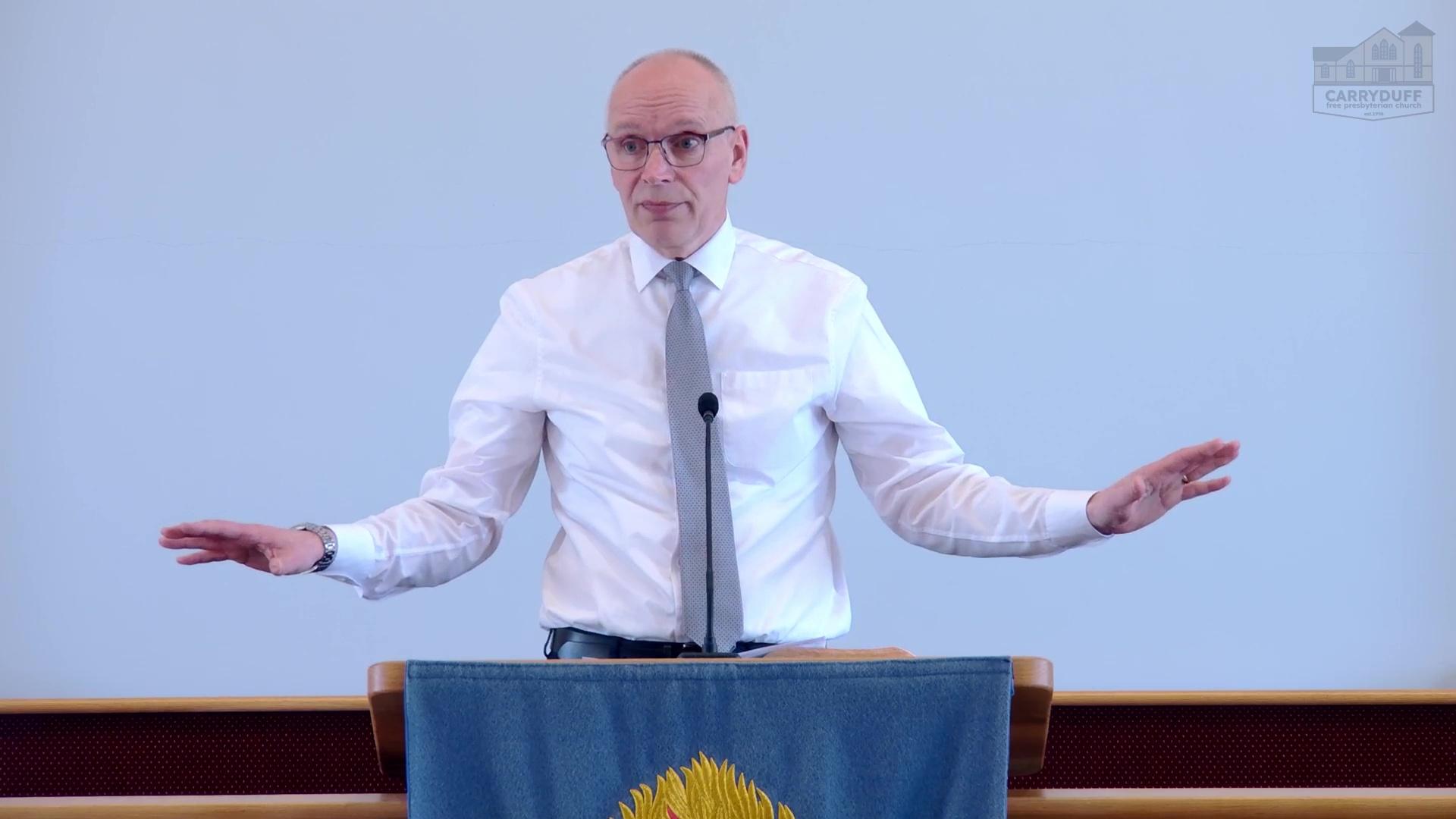
Taking 2 Corinthians 6 : 14 through 7 : 1 as his central text, he identified in Paul’s appeal “the New‑Testament charter of Christian separation.” The passage, he said, is not a relic of Victorian morality but “the living discipline of every generation that wants God’s smile.”
The sermon naturally divided under three headings written in the notes distributed to every participant:
Separation, Temperance, and Purity — “three words,” he said, “that describe the fragrance of a holy life.”
2. Separation — What It Is and Why It Is Necessary
Rev Mercer began with the word most closely associated with the Free Presbyterian witness: separation.
He defined it carefully:
“Separation is not arrogance; separation is allegiance. It is allegiance to God when the world begs for compromise.”
Drawing the contrast found in verse 14, “Be not unequally yoked together with unbelievers,” he observed that the yoke imagery comes from Deuteronomy 22:10 — the ox and the donkey forbidden to tread the same furrow. “They move at different speeds, in different directions, with different strength,” he said. “A believer and an unbeliever are just as mismatched.”
He broadened the application beyond personal relationships to the modern church scene: “Ecumenical partnerships may promise progress, but they always demand payment — and the payment is truth.”
Declaring that the word stand in the conference title presupposes resistance, he pointed to Christ’s prayer in John 17. “Our Lord did not ask that the disciples be taken out of the world but that they be kept from the evil.” Separated living therefore means remaining in the world for witness yet distinct from the world in worship and walk.
His tone sharpened when he addressed compromise in entertainment and lifestyle:
“Our age teaches tolerance as the last virtue, yet it tolerates everything except holiness. The Church can charm the world or change the world, but it cannot do both.”
Then, more tenderly: “The call to separation is not a burden chained to your ankle; it is a bridge leading you closer to the Lord.”
3. The Biblical Pattern of Separation
Rev Mercer anchored the principle historically. Noah, he said, built his altar on the other side of the flood; Abraham left Ur; Moses chose affliction with the people of God; Elijah repaired the broken altar on Mount Carmel; Daniel refused Babylon’s menu; Paul turned from the synagogue to the Gentiles.
“In every generation,” he summarised, “the godly have stood apart in order that grace might stand out.”
He added that the motive was always love, never pride: “Separation is unto God before it is away from anything else.” Quoting the Puritan Jeremiah Burroughs, he read: “The holiness of a Christian consists in this one thing — he has separated from common things to a Divine use.”
4. Temperance — Discipline in an Age of Excess
Moving to the second theme, he defined temperance as “the Holy Spirit’s control of mind, body, and appetite.” He lamented that society now equates freedom with indulgence — “a mentality that glorifies losing control.”
Using 1 Corinthians 9:24‑27, he compared believers to athletes in training: “Every man that striveth for the mastery is temperate in all things.”
Paul kept his body under discipline, not because indulgence was impossible, but because dominion by the flesh was intolerable.
Rev Mercer was explicit regarding alcohol. “Scripture does not celebrate moderation in strong drink; it commands abstinence,” he stated.
He noted that the Free Presbyterian Church has maintained from its formation an abstaining position not through social conservatism but through pastoral realism. “Alcohol ruins testimony, destroys homes, and quenches the Spirit of God,” he said. In a conference booklet footnote, he cited Proverbs 20:1 — “Wine is a mocker, strong drink is raging.”
Temperance, however, extends beyond the bottle:
“It’s self‑control on the tongue before it is on the table, restraint of thought before restraint of thirst. The uncontrolled mind is as dangerous as the unguarded mouth.”
He appealed especially to young attendees: “You do not show your maturity by how near you can walk to the cliff‑edge without falling. The mature saint measures his liberty by how close he can stay to Christ.”
5. Purity — Clean Hands and Heads and Hearts
The third main theme arose from Paul’s phrase in 7:1, “Let us cleanse ourselves from all filthiness of the flesh and spirit.”
Rev Mercer pointed out that the order — flesh and spirit — was intentional. The Corinthian church tolerated outward sins and inward attitudes alike, but holiness makes no distinction between the two.
He spoke candidly about the contemporary assault on chastity through online media and visual culture. “We live in a digital Sodom,” he said. “Temptation used to knock at the door; now it lives in your pocket. You must decide daily whether that device will serve Christ or crucify conscience.”
To illustrate purity’s beauty, he read Psalm 24 : 3‑4 — “Who shall ascend into the hill of the Lord? He that hath clean hands and a pure heart.”
“Clean hands,” he said, “speak of doing right; a pure heart speaks of wanting right. Holiness begins when duty and desire finally agree.”
He acknowledged that absolute purity belongs only to Christ, yet practical purity flows from communion with Him. “The closer you walk to Calvary, the cleaner your walk will become.”
6. Holiness as the Christian Identity
Against the world’s charge of negativity, he argued that holiness is positive happiness.
“Holiness is not a grey life; it is colour restored,” he said. “Sin drains, holiness fills. Sin enslaves, holiness frees.”
He invited the audience to re‑examine 1 Peter 1 : 15‑16 — “As He who hath called you is holy, so be ye holy in all manner of conversation.”
Every manner — speech, relationships, finances, recreation — must fall under that command. “Holiness is the universal solvent of hypocrisy.”
Rev Mercer recalled a comment once made by a secular journalist after the Belfast Orangefield Gospel Mission of 1951: “They were men of clean habits and enormous conviction; everyone else spoke, they prayed.” “That,” he said, “is what separated Christianity looks like — conviction clothed in character.”
7. The Promise of Divine Fellowship
Returning to the text, he highlighted God’s promise: “I will receive you, and will be a Father unto you.”
“Separation is not God pushing you away,” he explained, “it is God pulling you close. Sin distances; holiness draws near.”
The heart of holiness, he concluded, is fellowship with the living God.
“Many Christians feel lonely because they walk too near to the world to enjoy God’s company, and too near to God to enjoy the world’s. The answer is not compromise — it is commitment.”
8. The Cost and the Crown
Acknowledging the pressures faced by believers — especially students and workers asked to affirm cultural agendas contrary to Scripture — he offered practical counsel:
“Courteous defiance is still defiance. You can say no without shouting no, but you must still say it. Silence today will become surrender tomorrow.”
He reminded listeners that holiness has always carried a price. Noah lost popularity, Moses lost privilege, Daniel lost promotion, Paul lost liberty — “but none lost peace.” Reading Hebrews 12:14, “Without holiness no man shall see the Lord,” he added, “and no man who walks in holiness will ever regret the cost.”
9. Application — Holiness where the Rubber Meets the Road
The message concluded with a searching appeal. Rev Mercer spoke of the Free Presbyterian Church’s historic stand for holiness in worship — the reverent hymnody, modest appearance, and Sabbath observance that mark its congregations. Yet he warned that external forms mean nothing without internal reality.
“It is possible,” he said, “to keep the right day and sing the right hymns while hiding the wrong heart.”
He challenged workers, students, and homemakers alike to bring holiness into their ordinary weeks:
- in the workplace — integrity above opportunity;
- in the home — patience instead of pride;
- on the internet — truth above trend.
“The holiest Christian,” he said softly, “is not the one most discussed but the one most quietly faithful.”
10. A Holy People, a Useful Church
As the sermon closed, Rev Mercer’s voice lowered.
“The separated church,” he said, “is not first the successful church, but it will always be the useful church. The Lord employs clean instruments.”
Quoting Isaiah 52:11 — “Be ye clean, that bear the vessels of the Lord” — he urged his brethren:
“Let us not pray for greater power until we have sought greater purity. The two never come apart.”
He ended, as Paul did in 2 Corinthians 7 : 1, with those words — “perfecting holiness in the fear of God.” Then, after a brief prayer, the Moderator thanked him and announced a short break for refreshments before the following session.
Closing Reflection
Rev Mercer’s message stood out not for novelty but for clarity. It welded conviction with compassion and left the audience firmly persuaded that holiness is neither isolation nor ornament but the essence of Christian testimony.
He distilled the theme of the entire conference into a single, memorable clause:
“To stand fast in the faith, we must live fastened to the Holy One Himself.”
That settled the matter. The Word still commands the same truth it did in Corinth: the Church’s power to reach the world depends entirely on her willingness to remain distinct from it.