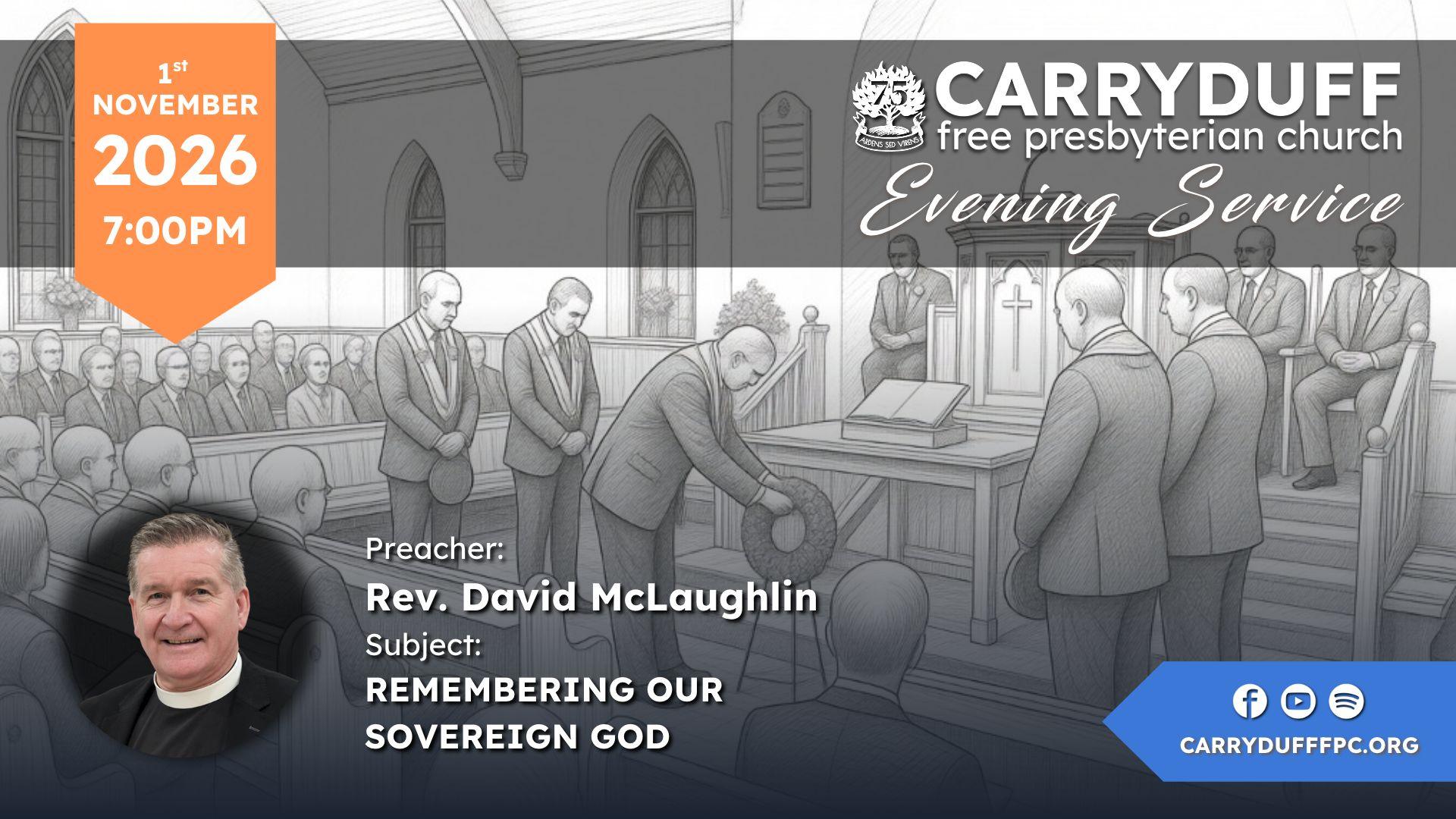

On behalf of the session, committee, and congregation, I want to record our sincere thanks to Ballynafeigh District No. 10 for their participation in this evening’s service of remembrance.
The district was represented with dignity throughout. We are grateful to the district registrar for reading Psalm 46 so clearly and reverently, and to Brother William Craig for laying the wreath on behalf of the district, a simple act that carried the weight of the whole evening. Our thanks go also to the piper, whose playing set the tone for the act of remembrance and gave the congregation space to reflect as we stood.
It was fitting that the district should be present in such numbers, and fitting that the name of Private Samuel Herbert Seymour of LOL 990 should be read in this place. He was one of your own, a son and brother of this district who survived the Somme and fell at Ypres, and the fact that his medals and keepsakes are still held by his family is a reminder that remembrance is not an abstraction. Districts such as yours keep these things alive when the rest of the world has moved on.
We convey our thanks to every brother and sister who attended, and to those who assisted with the arrangements behind the scenes. We look forward to welcoming Ballynafeigh District No. 10 again, and we pray God’s blessing on your district, your officers, and your families in the year ahead.
Service Details
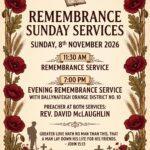
Date: SUN 7:00pm 8th November 2026
Preacher: Rev. David McLaughlin
Bible Reference: Isaiah 46:8-10
Podcast
Sermon Summary
The Occasion and Setting
The evening service of remembrance was held in Carryduff Free Presbyterian Church. The service included a public reading of Scripture, an act of remembrance with a wreath and a piper, a pastoral prayer, and then the sermon proper. The preacher addresses a gathered congregation that includes members of the Orange Institution, referred to throughout as the Loyal Institution, together with representatives of the district and private lodges. The service is framed by the annual remembrance of the war dead, and the preacher deliberately uses that civic and communal occasion as the platform for an exposition of Isaiah 46:6 to 10 under the title “Remembering Our Sovereign God”. The governing idea of the evening is that remembering the fallen is a legitimate and honourable act, but it is only properly understood when it leads the congregation to remember the God who is sovereign over history, over nations, and over the individual soul.
The Reading of Psalm 46
The bible reading is Psalm 46, introduced as Luther’s Psalm, read by a brother described as the district registrar. The psalm is summarised in full and supplies the emotional and theological register for everything that follows. Its movement is from crisis to confidence. God is described as refuge and strength, a very present help in trouble, and the conclusion drawn is that fear is unreasonable even when the earth is removed and the mountains are carried into the sea. The roaring waters and shaking mountains are set against the quiet river whose streams make glad the city of God, and against the declaration that God is in the midst of her and she shall not be moved. The psalm then moves outward to the nations: the heathen rage, the kingdoms are moved, God utters his voice and the earth melts. The refrain, that the Lord of hosts is with us and the God of Jacob is our refuge, is repeated for emphasis. The reading ends with the command to behold the works of the Lord, who makes wars to cease to the end of the earth, breaks the bow, cuts the spear in sunder, and burns the chariot in the fire, followed by the great summons, “Be still, and know that I am God.” The preacher later returns to this psalm twice, once to make the point that the knowledge of God is available to the believer in a difficult day, and once to argue that stillness before God is the only rational response to his character.
The Act of Remembrance
The preacher then leads the congregation into remembrance. The scope of the remembrance is deliberately wide:
- Those who died in the defence of freedoms, with particular attention to the fallen of the Great War.
- The Somme, with the figure of 5,550 killed by the second day of July 1916.
- The Second World War, 1939 to 1945.
- Subsequent conflicts, including Korea, the Falklands, Iraq, and Afghanistan.
- Northern Ireland specifically, where the preacher gives Troubles related murders as 3,532 in total, of whom 417 were in the British Army, 314 were members of the Royal Ulster Constabulary, 236 were Ulster Defence Regiment soldiers, and 344 were members of the Orange Institution, that is 343 brethren and one sister.
The preacher pauses to correct a figure he gave at an earlier service, explaining that he had relied on a published index which he now regards as inaccurate. This small act of public correction is worth noting because it is consistent with the sermon’s wider insistence on truthfulness and on the authority of a reliable word.
The remembrance is not confined to the dead. The preacher explicitly widens it to include the bereaved, those carrying the burden of loss, those bearing the scars of physical injury, and those who have been psychologically traumatised. He then names the services: the British Army, the Royal Navy, the Royal Air Force, the merchant navy, the reserves, and the cadets.
The address is then anchored in a single biography. The congregation is directed to a plaque in the church porch commemorating Private Samuel Herbert Seymour, a member of the 17th Machine Gun Corps, formerly of the Royal Irish Rifles, who lived in the district, fought at the Somme and survived it, and was killed in action on 9 August 1917 at the age of twenty four at Ypres. He had been a member of LOL 990 with his father and brothers, and the preacher reports that he had been appointed, along with ten other Orangemen, to serve as a guard of honour at the signing of the Ulster Covenant. He has no known grave, and his name appears on panel 56 at the Menin Gate. The preacher notes that the family were devastated and that his death medals and keepsakes are still held by surviving relatives. The point of the anecdote is to move remembrance from aggregate statistics to individual families, and it is followed by the text, “Greater love hath no man than this, than a man lay down his life for his friends.” A wreath is then laid on behalf of the district and a piper plays while the congregation stands.
The Pastoral Prayer
The prayer that follows is substantial and covers four broad areas. First, thanksgiving for those who laid down their lives in the cause of freedom and the defence of the realm, with the same list of conflicts repeated, and a petition that their memory be honoured and their sacrifice never forgotten. Second, intercession for the bereaved, named by relationship (husbands, wives, mothers, fathers, sons, daughters, brothers, sisters), asking that God would comfort those who sorrow, strengthen those who are weary, and grant the peace that passes all understanding. Third, thanksgiving for the armed forces, veterans, and the Royal British Legion, with its work of remembrance and its care for the wounded and bereaved. Fourth, a wider set of petitions:
- For those dwelling amidst war, violence, and oppression, with specific mention of Gaza and Ukraine, asking protection for the innocent, comfort for the afflicted, food for the hungry, and deliverance for the suffering.
- For persecuted Christians in Africa and throughout the world, described as murdered and driven from their homes for the sake of the faith, with a petition that their witness be strengthened and the purposes of those who seek to destroy the church be confounded.
- For King Charles III, in striking terms: that he be granted repentance, humility, and discernment, that he govern in the fear of God, uphold truth and righteousness and the Protestant Reformed faith, and exercise his royal office according to the Word.
The prayer then turns to the nation, asking for a spirit of repentance, for forgiveness of indifference and departure from God and his Word, for a restored love for the Scriptures and hunger for the gospel, and for revival of the church and the land. The language is deliberately strong: awaken this nation to its need, arise, pour out thy Spirit upon this generation, raise up faithful witnesses who will proclaim the gospel without fear and compromise, let righteousness flourish, let truth prevail, and let the knowledge of the glory of the Lord cover the land of Ulster and the United Kingdom as the waters cover the sea. The prayer closes in the name of Jesus Christ alone.
The Sermon: Text and Setting
The text is Isaiah 46:6 to 10, and the theme is “Remembering Our Sovereign God.” The preacher sets the passage against the backdrop of spiritual rebellion, religious decline, and the certainty of coming judgment on Judah. Isaiah is described as the evangelical prophet, and his day as one of tremendous spiritual and political upheaval. Judah had repeatedly turned away from the Lord despite extraordinary privileges: divine revelation, material prosperity, the temple services, the priesthood, the prophetic ministry, praise and prayer, the blood sacrifices, and the public reading of the Word. Beneath the surface, however, there was spiritual corruption, blatant idolatry, and a blind eye turned to the commandments of the Lord. At root the people had forgotten the Lord and forsaken him.
Isaiah therefore stands to preach, exposing sin, exhorting repentance, and calling the people to live under the absolute supremacy of Jehovah. Chapter 46 turns attention to Babylon and its gods. Babylon represents everything impressive in the eyes of men: empire, military power, political influence, wealth, and religious monuments. Bel and Nebo are named, and the preacher expounds the opening verses of the chapter, in which the idols are pictured as being carried about on beasts and cattle, a burden to the weary animals, bowing down and stooping, unable to deliver the burden, and themselves going into captivity. The polemic is sharp and simple: the gods of Babylon must be carried by men, whereas the God of Israel carries his people in his heart, in his mind, and in his hands. The idols are powerless to save in any situation, whereas Jehovah is mighty to save. The idols are the creation of human hands, whereas the God of the Bible is the creator of all things, the one who gives life and breath to all men.
Three Movements in the Exposition
The sermon is structured around three headings, each drawn from the text.
1. The Command to Remember
The preacher focuses on verse 8, “Remember this, and shew yourselves men: bring it again to mind, O ye transgressors.” The command is direct and searching, and it presupposes that something has been forgotten. According to the context, Judah had forgotten two things: the character of God, losing sight of his greatness, glory, grace, and goodness; and the counsel of God, losing sight of the absolute authority of his Word. The phrase “shew yourselves men” is expounded as a call to stand firm, to stand for truth and righteousness, to display spiritual maturity, and not to be carried away by the prevailing idolatry of the day. Ephesians 4:14 and 15 is cited: no longer children tossed to and fro and carried about with every wind of doctrine, but speaking the truth in love and growing up into Christ.
The preacher then dwells on the address “O ye transgressors.” God does not flatter, does not minimise sin, and does not accommodate his message to the lifestyle preferences of the hearers. Sin is defined by 1 John 3:4 as the transgression of the law, not a mere mistake or weakness. The particular sin in view, the most prominent and prevalent, was the deliberate and willful forgetting of God. The people honoured him with their lips and maintained the temple worship, but their hearts were far from him; they were, in effect, playing church and playing with sin.
From this the preacher argues that the question of who and what God is lies at the heart of the gospel. He cites the catechism definition: God is a spirit, infinite, eternal, and unchangeable in his being, wisdom, power, holiness, justice, goodness, and truth. This question matters more than what a man thinks of himself, or what a community or society thinks of an individual, and infinitely more than the opinions and philosophies of the world. Until a man has some understanding of who God is, he will never properly understand himself, or what sin is, or what sin has done, or why he needs salvation, or why the person and work of Christ in his birth, life, death, and resurrection are indispensable. The God of the Bible is not a human invention, not the product of tradition or philosophical speculation; He is the one who has revealed Himself.
Verse 9 is then treated as one of the great declarations of divine uniqueness in Scripture: “I am God, and there is none else; I am God, and there is none like me.” The Lord is not one God among many, not the greatest member of an imagined company of deities. He is eternal while man is temporal, infinite while man is finite, absolutely holy and sinless while all have sinned and come short of the glory of God, sovereign while man is a dependent creature who owes to God his breath and life. He is Creator, Maker, Provider, Sovereign Lord, Redeemer, and Righteous Judge; man is a mere creature made in the image of God. The true knowledge of God is linked to the true knowledge of ourselves: once a man glimpses the majesty and holiness of God, he begins to see himself truly. That is why the gospel begins with God. The necessity of the blood atonement cannot be understood without the justice of the divine Judge, and the love of Christ cannot be appreciated without the wrath of a holy God against sin.
This leads to the sermon’s most pointed contemporary application. The preacher says that in the United Kingdom, and especially in Ulster, the danger of forgetting God must be pressed home, and he answers the question he is often asked by members of the institution about what is wrong with Christianity in the United Kingdom. His answer is that the greatest threat is not atheism, secularism, or hedonism, and not even Islam and Islamists, although he acknowledges that as a real threat. The greatest threat is from bishops and clergymen who have forgotten who God is. The congregation is required to remember God’s covenant faithfulness, his holiness, his wrath, his justice, and equally his promises, love, grace, mercy, and truth, together with his mighty acts of creation, redemption, and providence. This is what the generation needs desperately to recover. The words of Christ in John 17:3 are cited: this is life eternal, that they might know thee, the only true God, and Jesus Christ whom thou hast sent.
2. The Counsel to Confide In
Under the second heading the preacher takes up verse 10, “My counsel shall stand.” He contrasts the powers that men trust with the power of the Word of God. Political authority, military strength, wealth, media influence, human intellect, human persuasion, and what he calls the power of the machine are all considered and set aside. The machine is illustrated with a personal anecdote: he consulted an AI system that morning for remembrance figures and it gave him the wrong number, which he had to correct that evening. The point is that machinery can err, but there is one power standing head and shoulders above every other, namely the power of the Word of God. 1 Peter 1:25 is cited, that the word of the Lord endureth forever, and Hebrews 4:12, that the word of God is quick and powerful and sharper than any two edged sword, piercing to the dividing asunder of soul and spirit and of the joints and marrow, and is a discerner of the thoughts and intents of the heart.
The preacher observes that this is an age of great information but not necessarily of wisdom, with countless opinions and endless commentary and a multitude of competing voices, and that the fundamental question in every question is: what has God said? What saith the Scriptures? The authority of true Christianity rests not on the church, not on councils, not on the Pope, but on the infallible authority of Holy Scripture. The Reformers understood this in the principle of sola Scriptura, which is carefully explained: not a denial of the need for teachers, ministers, or a trained ministry, but a declaration that the Bible alone is the supreme infallible authority for faith and practice. Luther at the Diet of Worms is quoted, refusing to recant unless convinced by Scripture and clear reason: here I stand, I can do none other, so help me God; my conscience is captive to the Word of God. The church does not stand in judgment over the Word; the Word stands in judgment over the church. Psalm 119:89 is cited, that the Word is settled forever in heaven, and Matthew 24:35, that heaven and earth shall pass away but Christ’s words shall not pass away. The Bible is powerful because God is all powerful, true because God is true, certain because God cannot lie, living because God is the living God, and eternal because God is eternal. Men change their opinions, philosophies rise and fall, kingdoms come and go, and generations pass away, but the Word of God abides forever.
3. The Character to Contemplate
The third heading returns to verse 9 and the declaration of divine uniqueness. The Lord directs the remembrance of his people towards himself, and the preacher draws out the doctrine of divine sovereignty. The authority of the Word is inseparably connected with the authority of the one who speaks it. The idols of Babylon were helpless, but the Lord is all powerful; they cannot speak or see, but the Lord speaks and declares what will happen in the future and brings it to pass. This is the God of the Protestant Reformed faith, which rightly emphasises that God is sovereign over all things and that Jehovah saves. Nothing takes place outside his will, his knowledge, his authority, or his providential government. He is never surprised by events, never frustrated by opposition, never afraid of his enemies, never overcome by circumstances.
The application is searching. The preacher asks how the congregation measures God: by circumstances, difficulties, storms, problems, and pressures, or whether circumstances and difficulties are measured by the greatness of God. The believer can sing of the faithfulness of God in a delightful day and in a dark day alike. Psalm 46:10 is brought back in: be still, and know that I am God. The congregation is told that the knowledge of God is available in a difficult day, that the fullness of God’s provision can be known, and that the river whose streams make glad the city of God is a present reality. God is also a God to be feared, who has made desolations in the earth. The command is to stop, to let go of fears and worries in the light of who God is, because God is our refuge and strength, a very present help in trouble.
The character of God, the preacher insists, confronts the hearer with the reality of sin, with the fact that all have sinned and come short of the glory of God, and with the call to repent and get right with him. God is eternally holy, man is a fallen creature, sin is exceeding sinful, and judgment is sure and certain. Salvation is found in Christ alone, not in the church: “I am the way, the truth, and the life: no man cometh unto the Father, but by me,” and Acts 4:12, that there is no other name under heaven given among men whereby we must be saved. The five solas are then stated in sequence: salvation is by grace alone, through faith alone, in Christ alone, as revealed in the Scriptures alone, to the glory of God alone, grounded in Ephesians 2:8 and 9.
The Counsel of God and the Close
Under the final movement the preacher returns to verse 10 and calls it one of the most magnificent declarations of divine sovereignty in the whole Bible: “Declaring the end from the beginning, and from ancient times the things that are not yet done, saying, My counsel shall stand, and I will do all my pleasure.” Men make plans but cannot guarantee their fulfilment; a man may say he will do something tomorrow, but tomorrow may never come, and Proverbs 27:1 is cited against boasting of tomorrow. Nations rise and fall and empires disappear. The preacher asks where the Babylonian empire is, where Bel and Nebo are, where the Medes and Persians are, where the Greeks with Alexander are, and where the Roman empire that ruled the known world is. They are gone. God remains. Fortunes change, fortunes can be lost overnight, as men discovered in the 1930s, wars begin and end and lives are lost in between, the strongest man goes to the grave, and the wisest man discovers the limits of his knowledge, especially if he does not know God. Yet God says, I am God, I change not, therefore ye sons of Jacob are not consumed. He is absolute sovereign, in control, never taken by surprise, nothing interrupts his purposes, nothing frustrates his counsel, nothing can overthrow his throne. He declares the end from the beginning and is the sovereign Lord of history.
The preacher then insists that this is not merely a doctrine for theological discussion but a doctrine for truthful declaration. The God who created the universe and spoke it into existence has spoken his saving message to a lost humanity. Romans 14:12 is cited, that every one of us shall give account of himself to God, and Acts 17:30 and 31, that God has appointed a day in which he will judge the world in righteousness by the man whom he has ordained, having given assurance to all men in that he raised him from the dead. That man is Jesus Christ, and the congregation is directed to the totality of his person and work: his birth, life, death, and resurrection.
The sermon closes by tying remembrance back to the gospel. The sacrifice of the fallen is honoured, and the statistics are repeated, but the argument is that in that sacrifice the congregation is to remember the personal work of Christ, because only God can save, only Christ can save, only Christ’s blood can cleanse from all sin, and only repentance and faith toward the Lord Jesus can reconcile a sinner to God. The final application is a series of direct questions rather than a conclusion: it is not about knowing about the cross but knowing Christ; not about knowing the sacrifices but knowing the Saviour to whom all sacrifices point; not about familiarity with the language of blood and sacrifice but about the reality of the blood of Christ applied by faith; not about knowing the hymns but knowing him. Do we see our need of him? Do we own our sinfulness? Do we bow the knee before his holiness? Do we abandon every false refuge and come to him as Redeemer and Judge? The sermon ends with the hope that the hearers will see something of this and remember their sovereign God, and with a benediction.
Recurring Themes Worth Noting
Several threads run through the whole service and give it coherence:
- Remembrance as a discipline, not a sentiment. The fallen are honoured concretely, by name, by regiment, by lodge, and by family, and the statistics are corrected when found to be wrong.
- The sufficiency and authority of Scripture. Sola Scriptura is not merely asserted but explained and defended against the alternatives of church authority, councils, and human opinion.
- The uniqueness of God over against idols. The Babylon polemic is used as a live category, not an ancient curiosity: whatever is carried rather than trusted, whatever must be protected rather than relied upon, functions as a modern Bel or Nebo.
- The sovereignty of God over history and nations. The roll call of vanished empires is the sermon’s central evidence, and it is applied to personal circumstance as well as to geopolitics.
- Christ alone as the only refuge. The remembrance of sacrifice is deliberately redirected towards the once for all sacrifice of Christ, and the sermon ends not with comfort in general but with a call to repentance and faith.
- The responsibility of the hearer. The preacher refuses to leave the congregation as spectators of a ceremony; the closing questions press for a personal verdict.
Live Broadcast
Photos