
Service Details
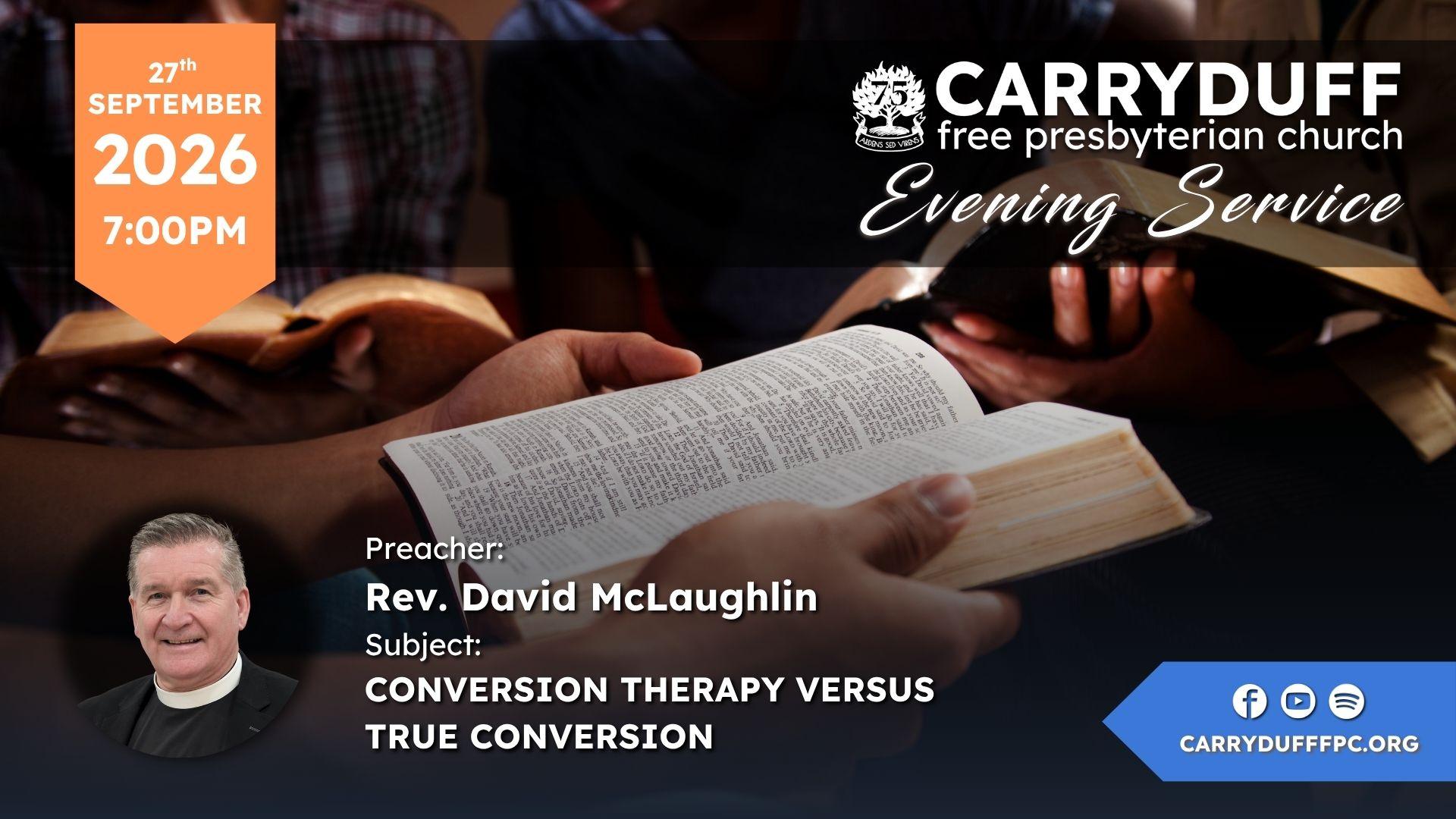
Date: SUN 7:00pm 27th September 2026
Preacher: Rev. David McLaughlin
Bible Reference: Isaiah 1:27
Podcast
Sermon Summary
Summary of the Sermon: “Conversion Therapy versus True Conversion”
Preacher: Rev. David McLaughlin Text: Isaiah 1:27 — “Zion shall be redeemed with judgment, and her converts with righteousness.” Occasion: A sermon preached in response to the Conversion Practices Criminalisation Bill before the Northern Ireland Assembly, introduced by Alliance Party MLA Owen Tennyson, which had reached its second stage.
Introduction and Framing
Rev. David McLaughlin opens by reading Isaiah 1:21–31, a passage in which the prophet denounces the faithful city that has become a harlot, whose silver has turned to dross and whose wine is mixed with water. The city’s princes are described as rebellious and companions of thieves; they accept gifts and pursue rewards, failing to judge the fatherless or plead the cause of the widow. God declares His intention to purge away the dross, restore righteous judges and counsellors, and redeem Zion with judgment. The sermon takes verse 27 as its text and titles the message “Conversion Therapy versus True Conversion.”
The preacher states plainly that he is not turning the pulpit into a political platform, nor is he attacking individuals or expressing hatred. He explicitly disavows any defence of abusive, coercive, or cruel treatment of any person, asserting that biblical Christianity offers no justification for cruelty, intimidation, or abuse. His stated aim is different: to reclaim the biblical meaning of the word conversion.
The practices that the label conversion therapy is meant to conjure up — the grotesque stuff of the past, electrocution, and the coercion or rape of vulnerable people — are already unlawful. They are covered by existing criminal law on assault, sexual offences, and the abuse of persons in care. Nothing in the statute book is missing there; no new bill is required to make those things crimes, because they already are crimes. The argument, therefore, is that a new and vaguely drafted offence is not needed to deal with behaviour that is already illegal, and that the bill’s real reach extends far beyond the horrors it invokes, into the ordinary pastoral and parental speech that the criminal law has never before presumed to police.
The Biblical Meaning of Conversion
The preacher contrasts two ideas:
- Behavioural modification — persuading, forcing, manipulating through coercive fear, or changing only externals such as language, habits, appearance, environment, and associations.
- True conversion — a supernatural work of God in the heart of the sinner, in which a person once alienated from God, loving sin and darkness, is brought into a right relationship with Him and renewed from the inside out.
He describes the convert as a spiritually dead sinner, blind to God, diseased in affections, made alive by grace through faith in Christ. He cites 2 Corinthians 5:17–18 — “if any man be in Christ, he is a new creature” — and John 3:7 — “Ye must be born again.” The gospel, he argues, does not say “improve yourself”; it summons sinners to repent and believe.
The Condition of Isaiah’s Hearers
A key point of the sermon is that Isaiah’s audience were not pagans ignorant of God. They had:
- The religious sacrifices
- The feast days and holy days of assembly
- The law of God in their hands and ears
- Raised hands in prayer and offered prayers
Yet God speaks devastatingly about their religion in Isaiah 1:11–13, declaring Himself full of burnt offerings, calling incense an abomination, and saying He cannot endure their new moons, Sabbaths, and assemblies. The problem was that their hearts were not right before God. They did not need more ceremonies or behavioural modification; they needed true conversion. The preacher points to Isaiah 1:16–18 as God’s call to wash, make clean, cease from evil, learn to do well, seek judgment, relieve the oppressed, judge the fatherless, and plead for the widow — followed by the great invitation: “Come now, and let us reason together… though your sins be as scarlet, they shall be as white as snow.”
Verse 27 is presented as the fulfilment of that invitation. God is not merely interested in reforming Zion but in redeeming her; not merely changing her but converting her.
The Necessity of True Conversion
The preacher argues that one cannot understand the nature of conversion without understanding why it is needed. The Bible’s diagnosis of the human heart is deeper than bad behaviour:
- The problem is sin. Sin is defined, in the language of the Shorter Catechism, as any want of conformity unto, or transgression of, the law of God.
- Isaiah 1:4 describes a sinful nation, a people laden with iniquity, a seed of evildoers, children that are corrupters, who have forsaken the Lord.
- Mark 7:21–23 records Jesus teaching that from within, out of the heart, proceed evil thoughts, adulteries, fornications, murders, thefts, covetousness, wickedness, deceit, lasciviousness, an evil eye, blasphemy, pride, and foolishness — all defiling the man.
- Jeremiah 17:9 declares the heart deceitful above all things and desperately wicked.
Because the problem lies within, it cannot be solved by external pressure, a change of environment, changed habits, cleaned-up vocabulary, or altered appearance. The preacher illustrates this with an anecdote about a young man, a Mr Love, who came into the Congregational Church at New Row and, after hearing the gospel, got a haircut, a new suit, and new shoes, believing that dressing as a Christian made him one — yet he still needed a new heart.
He cites Ezekiel 36:26 — “A new heart also will I give you, and a new spirit will I put within you” — and John 3:7, spoken to Nicodemus, a religious and respectable ruler, who was told not to try harder, become more respectable, change his habits, or turn over a new leaf, but to be born again. The old nature cannot be polished until it shines as Christian; the flesh cannot be educated into the Spirit. The old man is dead in sin and needs life, blind and needs sight, diseased and needs changed affections — he needs to be introduced to the Prince of Life, who came that we might have life more abundantly.
The Nature of True Conversion
The preacher breaks the nature of conversion into four elements, drawn from the text and the surrounding scriptural teaching.
1. Repentance
The word convert means to change, to turn — a change of direction. The preacher illustrates with an anecdote about driving from England through Wales towards Dublin, intending to reach Belfast but ending up miles down the road to Galway. At a toll booth, a woman let him through but told him he needed to turn around and go back the other way until he saw the sign for Belfast. That, he says, is true repentance: a turning.
- Biblical conversion involves turning from sin unto God.
- It is not merely feeling sorry.
- It is not merely changing behaviour because a politician or doctor demands it.
- It is not merely facing consequences because one has been forced or coerced.
He quotes the Shorter Catechism on repentance unto life: a saving grace whereby a sinner, having a true sense of sin and apprehension of the mercy of God in Christ, with grief and hatred of sin turns from it unto God with full purpose and endeavour after new obedience. Isaiah 1:16–17 is cited as the call to such repentance.
2. Redemption
“Zion shall be redeemed with judgment.” The word redeemed reminds us of the shedding of blood — Hebrews 9:22, “without the shedding of blood there is no remission.” The preacher proclaims that the blood of Jesus Christ cleanses from all sin because Christ’s blood was shed at Calvary.
Redemption means God does for the sinner what the sinner cannot do for himself:
- The sinner cannot pay his own ransom price.
- He cannot cleanse his own guilt.
- He cannot remove the stain of the old record of sin.
- He cannot manufacture a righteousness acceptable to God.
He cites Titus 3:5 — “Not by works of righteousness which we have done, but according to his mercy he saved us, by the washing of regeneration, and renewing of the Holy Ghost” — and 1 Peter 3:18 — Christ suffered once for sins, the just for the unjust, that He might bring us to God.
3. Receiving Christ
The preacher points to Acts 20:21 — “repentance toward God, and faith toward our Lord Jesus Christ” — as the heart of true conversion, and to 1 Thessalonians 1:9, where the converts “turned to God from idols to serve the living and true God, and to wait for his Son from heaven.”
He explains that repentance and faith are two sides of biblical conversion, flowing from regeneration and the new birth. He describes true faith as having three strands:
- Information and data — the historical facts of Christ’s birth, life, death, and resurrection.
- Assent — believing that information to be true.
- Appropriation — acting upon that information, resting in Christ, receiving Him as Lord and Saviour.
This is tied to the Shorter Catechism definition of saving faith: a saving grace whereby we rest and receive upon Christ alone for salvation as He is offered to us in the gospel.
4. Righteousness
“Her converts with righteousness.” True conversion produces righteousness — a profound change from the inside out. The preacher uses the analogy of an apple tree with bad fruit. Removing the bad apples alone solves nothing; next year more bad apples will grow. The problem is not the fruit but the root. If the root is right, good fruit follows: right living (not sinless perfection), a new relationship, a new lifestyle, a new love, a new allegiance.
He cites Romans 6:17 — “ye have obeyed from the heart that form of doctrine which was delivered you” — emphasising obedience from the heart as the operation of grace. A new heart produces a new life, and that life produces new loves and loyalties:
- Love to the Saviour
- Love to the Scriptures
- Love to the sanctuary
- Love for the Sabbath day
- Love for the souls of men
- Love to the saints
- Love to pray
- Desire to obey God’s Word
- Desire to worship Him
- Love to tell others
- Desire to be holy unto God
God changes the will, gives a new heart, and changes desires and affections — and that inward work always appears outwardly in a love for righteousness.
The Prison Cell Illustration
The preacher offers a further analogy. Imagine a man in a prison cell. The guards repaint the cell, paint the bars gold, give him new clothes, books, better manners, better food, better lighting — but he is still behind bars. His circumstances have improved, his appearance has changed, his surroundings have changed, but he is not free. What he needs is for the governor to come with the keys, open the door, and let him walk out. God’s salvation is not about making the cell more pleasant for the prisoner; it is about redemption, release, and freedom. “Whom the Son sets free is free indeed.”
The Pharisees and Judas
The preacher warns that a person can give up alcohol and still love sin; a woman of the night can become outwardly respectable and still hate God; a person can stop cursing and swearing and still be spiritually dead, blind, and diseased. The Pharisees were outwardly religious — praying, giving alms, fasting — but not regenerate, and Jesus pronounced woe upon them as hypocrites.
He closes the doctrinal section with Judas, one of the twelve. Jesus said in John 6:70, “Have not I chosen you twelve, and one of you is a devil?” Judas preached, prayed, saw miracles, was among the disciples, and kept the bag, but had not a new heart. He was not truly converted. Hence 2 Corinthians 13:5: “Examine yourselves, whether ye be in the faith; prove your own selves.”
The Application: “Her Converts”
The preacher presses the text’s phrase “her converts” as a tremendous truth: God is in the business of converting sinners. That is how a faithful city that has forsaken Him can be restored:
- The rebellious can be brought to repentance.
- The guilty can truly declare themselves righteous in Christ.
- The slaves of sin can be made servants of righteousness.
God does this by the gospel — the good news that “Christ Jesus came into the world to save sinners.” When the gospel works, there is a turning to God, and that turning produces a new life that is seen, with new hope and new assurance, all rooted in Christ.
Conclusion and Address to the Bill
Rev. McLaughlin concludes with a direct question to the congregation and online hearers: Are you genuinely converted? He clarifies what he is not asking:
- Not whether you have had a mere religious experience
- Not whether you walked an aisle, raised a hand, said a prayer, or signed a card
- Not whether you have been baptised or have your name on a roll
He asks whether there was a time when you repented and turned from sin unto God, rested on the redeeming blood of Christ, and received Him by faith — the evidence being a transformed life with a desire for right living, love, and loyalty to God and Christ.
He then returns to the political context. He states that he has read Owen Tennyson’s bill and has tried to respond to it. He rejects it on the grounds that it is vague, particularly in its definitions, and undefined when it speaks of gender identities. He contends further that it seeks to criminalise the parent and the preacher in relation to what they say, treating any coercive kind of instruction or behaviour as criminal.
His contention is that the bill is about how to change a person’s behaviour, or how to stop other individuals changing a person’s behaviour, and that it would criminalise anyone attempting to change a person’s behaviour, gender identity, or orientation. The gospel, by contrast, does not ask that question at all. The gospel asks: Has God changed your heart? Has God given you a new heart? True gospel work is from the inside out; it is about transformation.
He observes that society today has a big problem, and that our cities are as bad as Jerusalem, if not worse. Many princes, politicians, and the great and good are anti-God and anti-Christian, neither knowing God nor loving the Lord Jesus Christ. But the answer is the gospel, the presentation of Christ, and the call to confess sin — not that one has made mistakes, had difficulties, or shown weakness, but that one has sinned against a holy God. To such a one, the message is that there is forgiveness with Him that He may be feared, that forgiveness is a reality, and that salvation is available. Christ calls: “Come unto me, all ye that labour and are heavy laden, and I will give you rest.”
That, he says, is the news that must be preached in Belfast, and the nature of true conversion must be proclaimed to politicians. Conversion therapy, in his assessment, is nothing like true conversion because it is missing the biblical meaning of conversion. He alleges that Owen Tennyson wants to stop the preaching of true conversion in the province. He closes by asking the Lord to give grace to be faithful in this day and generation, invites anyone needing help to come and speak with him, and notes that he has not dealt with everything concerning the bill, adding that a letter will be issued in due course which they trust will be clear and helpful.