
Service Details
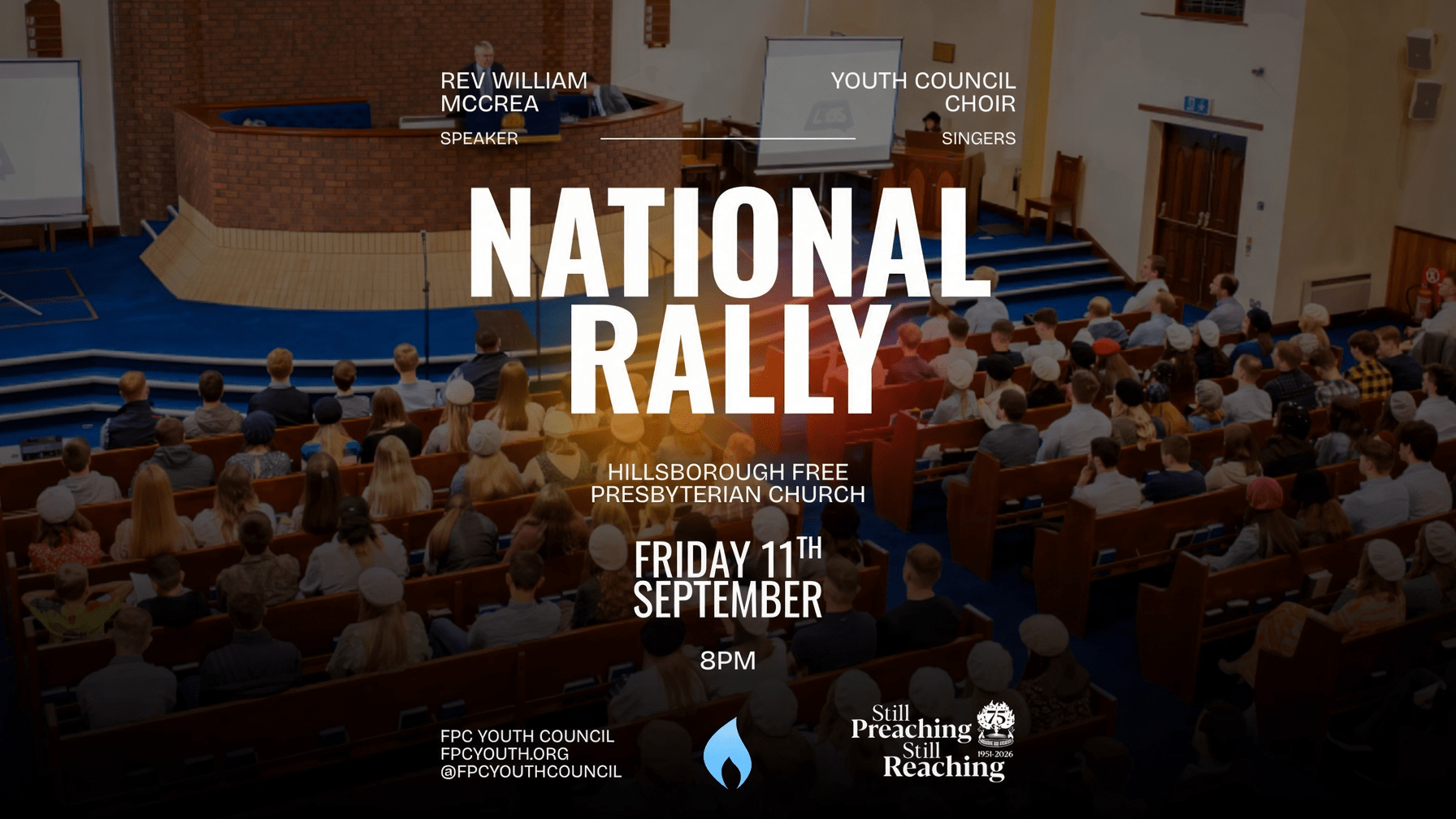
Date: FRI 8:00pm 11th September 2026
Singers: Youth Council Choir
Preacher: Rev. William McCrea
Bible Reference: Jude 1:1-3
Overview of the Service
The National Anniversary Rally of the Free Presbyterian Church of Ulster (FPC) Youth Council was held at Hillsborough Free Presbyterian Church. The gathering marked the denomination’s 75th anniversary, under the motto “still preaching and still reaching.” The Youth Council itself has been part of the denomination’s witness for 52 of those 75 years. The meeting was presided over by Rev. Julian Patterson, with Rev. William McCrea as the guest preacher.
The service opened with a warm welcome and the singing of the hymn number 16, “To God Be the Glory.” Rev. Paul Foster, a former President of the Youth Council, opened the meeting in prayer, thanking God for the gathering and asking for blessing upon the preaching of the Word and the work of the Youth Council. The prayer emphasised the finished work of Christ on the cross, His resurrection, and the need for sinners present to repent and trust in Christ.
Two video presentations followed, showcasing the year’s outreach trips (to Liverpool and Belfast) and the young people’s camp. Those featured in the videos spoke of door-to-door evangelism, open-air testimonies, Holy Bible Clubs for children, and the spiritual encouragement of fellowship. A recurring theme was the personal growth that comes through stepping out in witness, with several young people describing the experience as “challenging,” “encouraging,” and “humbling.”
A special choir, formed to mark the 75th anniversary, sang a selection of hymns including “Here Is Love” and “I Am Coming to the Cross,” accompanied by Rev. Stephen Greer. The presiding minister noted the high standard of the singing and thanked the young people for their diligence.
A further video presentation traced the history of the Youth Council, including the first delegates’ meeting on 19 February 1974, attended by 50 delegates. Former presidents and members testified to the Council’s influence, including its role in evangelism, the inter-fellowship quiz, and numerous conversions and marriages formed through its outreach work.
The New Project: A Million Pennies for the Philippines
The rally served as the launch of the Youth Council’s new project, “A Million Pennies for the Philippines.” The project will raise funds (a million pennies, equivalent to £10,000) to support congregations in the Philippines that have recently come under the care of the FPC Mission Board. These works are described as being in poor areas with significant infrastructure needs.
The name recalls a similar appeal in the 1980s, following the fall of the Berlin Wall, when a million pennies were raised to send Bibles to the Soviet Union. A video message from Rev. Ralph Hall in Western Australia encouraged prayer for the Philippines, noting:
- The dominance of Roman Catholicism in the country
- Open doors for the Gospel, particularly among children and youth
- Opportunities in schools
- Radio broadcasts every Lord’s Day in Bicalud and in a congregation in Mindanao
The entire offering taken during the service was dedicated to this project, and youth fellowship leaders were asked to collect labelled collection pots for their churches.
Announcements
The presiding minister outlined the Youth Council’s calendar for the remainder of the year and into 2026:
- Informal Bible studies on 19 September and 21 November in Mount Merrion, examining the subject of Calvinism
- Outreach at the Christmas markets on 21 November, followed by a Bible study at 8pm in Mount Merrion
- Quiz first rounds on Friday 16 October (in Kilkeel, Lisburn, and Tandragee) and Saturday 24 October (in Magherafelt), with the final in Lurgan on Friday 22 January
- Prayer times throughout October
- A delegates’ meeting on 2 November in Clogher Valley
- An encouragement trip to Olden Broad in March
- Outreach next summer to Bristol and to Canada (the latter already filled, led by Rev. Andrew Simpson)
- A missionary weekend in late September of the following year, with Rev. Hamilton and Rev. Chris Gaddon
The Sermon: “Earnestly Contend for the Faith”
The preacher took his text from Jude, verses 1–4, reading the passage before the congregation. His central exhortation came from verse 3: “it was needful for me to write unto you, and exhort you that you should earnestly contend for the faith which was once delivered unto the saints.”
The Challenge Before You
Rev. McCrea opened by declaring that you are living in “very challenging days.” He argued that the very foundations which once secured the nation and province for generations are now being swept away. In his analysis, governments across the world have given up on the older generation, believing their minds cannot be changed, and have instead turned their attention to invading and polluting the minds of young people.
Here is the narrative being pushed at you, he said: that nothing is right and nothing is wrong — a return to the days of the Judges, when “every man did that which was right in his own eyes.” He characterised the present as a “me-ism generation” in which the prevailing philosophy is “it’s my mind, it’s my body, therefore I make up the decision about what I’m going to do.”
His warning was stark: rather than producing a stable generation, this philosophy will produce one that is confused, discontented, and given up on life itself, with many “even choosing death rather than life.” Against this backdrop, he posed the question squarely to you: what should we do, and what can you do, in the face of these challenges?
What It Means to Contend
The pastor explained what it means to “earnestly contend for the faith,” linking Jude to Paul’s words to the Galatians: “stand fast in the liberty with which Christ has made us free, and be not entangled again with the yoke of bondage.” The call is not passive but active — a command to stand firm and resist entanglement.
He pressed you on whether you understand what the Free Presbyterian Church actually stands for. He insisted the denomination was not formed by chance or mistake but was “brought into being under God’s direction.” Many of you present, he noted, are Free Presbyterians simply because your grandparents separated from apostasy, or because your parents raised you in the Sunday School and youth fellowship. The test, he said, is this: if challenged, could you explain why you are a Free Presbyterian and what distinguishes this church? Citing 1 Peter 3:15, he reminded you to “be ready always to give an answer… a reason of the hope that is in you.”
Jude’s Identity and What True Salvation Really Is
Turning to the text, the preacher identified Jude as, according to the flesh, a half-brother of the Lord Jesus Christ — a son of Mary and Joseph, raised in the same home as James and Jesus. Yet he stressed a crucial point: being raised in that home did not mean Jude and James were saved. The Bible records that “his brethren did not believe in him.” Only after the cross and resurrection did James and Jude come to saving faith.
The application was direct, and it lands on you: you can be brought up in a Free Presbyterian home and still be unsaved. You may know the verses, quote the verses, and recite the verses, yet have no personal relationship with Christ.
Rev. McCrea highlighted the title Jude gives himself in verse 1: “Jude, the servant of Jesus Christ.” Jude did not boast of his family connection; he identified as a bondslave — one who has surrendered completely to his master, casting aside personal rights and time. This, the preacher observed, stands in sharp contrast to a generation that “everybody talks about their rights” but “never talks about their responsibilities.” He challenged you directly: have you truly surrendered your heart and life to Christ, or are you “half in and half out”?
He then moved through the remaining phrases of verse 1:
- “Sanctified by God the Father” — set apart, and also “beloved” — salvation begins with God’s love, for “we love him because he first loved us”
- “Preserved in Jesus Christ” — God guarded and watched over His people before conversion, and their position is now secure in Christ
- “Called” — the work of the Holy Spirit
He summarised this Trinitarian work memorably: “the Father thought it, the Son bought it, the Holy Spirit brought it.” Verse 2’s promise of “mercy… peace and love be multiplied” speaks, he said, of the abundance of blessing that belongs to the saved.
The Historical Battle: Why the FPC Exists
The heart of the sermon was a historical survey designed to answer the question “why are we here?” The preacher traced the spiritual battles of Ulster that gave rise to the denomination — battles that explain your own place in this church tonight.
The 1859 Revival. God sent a remarkable movement of the Holy Spirit that swept across Ulster, with 100,000 people saved. Even schoolchildren held prayer meetings, crying to God for their classmates and families. The revival saved the Irish Presbyterian Church and saw many new congregations opened.
The Rise of Liberalism. The pastor noted that before the revival, Dr. Henry Cook fought a great battle for the faith within the Irish Presbyterian Church, and God gave him victory. But the devil strikes back after seasons of blessing. Sixty-seven years after the 1859 revival, the church began again to turn from the faith, this time through Professor J. E. Davey, Professor of Church History at Assembly’s College. Davey attacked:
- The atoning blood of Christ
- The deity of Christ (denying His omnipotence and omniscience)
- The inspiration of Scripture (claiming hundreds of discrepancies and contradictions)
Unlike the days of Dr. Cook, the Presbyterian Church voted 707 to 82 to uphold Davey’s false teaching. He was made Principal of Assembly’s College and, in 1953, elected Moderator of the General Assembly. Ministers were permitted to sign the Westminster Confession while preaching whatever they liked. Compromise and apostasy spread.
The World Council of Churches. In 1948, the World Council of Churches was formed, uniting denominations that believed different things under the banner of “Christian unity.” Rev. McCrea quoted at length from one of its leaders, who described the movement as a ship that was not known to be seaworthy, heading for an unknown destination, with an inexperienced crew who could not agree on the nature of the church or the Lord’s Supper — yet still urged people to “come on board.” The Irish Presbyterian Church, the Church of Ireland, and the Methodist Church all boarded this vessel.
The Formation of the FPC. In 1951 in Crossgar, County Down, a group of believers sought to hold a gospel mission with a young evangelist from Belfast named Ian Paisley. The Lissara Presbyterian Church refused permission, which those believers saw as proof of the escalating liberalism flowing from Professor Davey’s falsehood. Undeterred, they held a march of witness through Crossgar to Kelly’s Lake Mission Hall, where Ian Paisley preached. Ninety-four souls were saved in that mission.
The question then arose: where would these new converts go? They could not return to a church that had sought to stop the gospel being preached. The elders of Lissara refused as well. And so, on 17 March 1951, the first congregation of the Free Presbyterian Church was formed in Crossgar.
The pastor listed the fundamentals for which the denomination stood:
- The inerrancy of Scripture
- The virgin birth
- The substitutionary death of Christ
- The vicarious atonement
- The bodily resurrection
- The physical return of Christ
- Biblical separation
For this stand, he said, they were hated, mocked, derided, and even spat upon. The motives of the young preacher from Belfast were questioned, and the major denominations, together with the Roman Catholic Church, joined to oppose the FPC’s witness.
The Command of Separation
The preacher insisted the Free Presbyterian Church is “not just another denomination” but a separatist church raised by God in the last days to separate from apostasy. He directed you to 2 Corinthians 6:14–18, reading the passage in full: “be ye not unequally yoked together with unbelievers… come out from among them, and be ye separate, saith the Lord.”
He underlined verses 17–18 as a command, not a suggestion. Ian Paisley carried this text across the province, and through that witness, people left the ecumenical churches. The Irish Presbyterian Church did eventually leave the World Council of Churches, but remained in the Irish Council of Churches, which was itself a member of the World Council.
Rev. McCrea warned of a present temptation aimed squarely at you: young people are “creeping back” and beginning to think there is nothing wrong with fellowshiping with those in the ecumenical movement. His answer was blunt: God’s Word is either right or it is wrong, and it is right. He called you to take a stand “outside the camp,” acknowledging the cost — friends lost, families estranged, even employment denied — but insisting that “God is no man’s debtor” and will honour those who honour Him.
He described the ecumenical movement as “one-way traffic to Rome”: Rome did not join the World Council of Churches, so joining the movement means going Rome’s way.
The Baton Is Now in Your Hands
The pastor turned to the application. The older generation of Free Presbyterian leaders — Dr. Paisley, Dr. Cooke, Dr. Douglas — are gone, having heard “well done, good and faithful servant.” Now, he declared, “we hand the baton to you. It’s now your day, young people.”
He warned that the devil remains subtle, whispering that you can be “half in and half out.” But if you have yielded to the lordship of Christ, you are not your own — you are in the army of the Lord. This is precisely what Jude was calling for: an earnest contending for the faith.
What You Are Called to Defend
The preacher summarised the faith you are called to defend as the whole counsel of God’s Word, centred on John 3:16 and the good news of the gospel. He pressed home the urgency of salvation:
- If you do not know Christ, you do not have everlasting life
- If you die in your sin, “where I am you cannot come”
- No preacher’s words over a coffin can change the eternal destination of a soul
He referenced the brevity of life — “boast not thyself of tomorrow” — and asked you plainly: if God were to say to you tonight, “this night thy soul shall be required of thee,” where would you be? There are only two destinations: heaven with Christ, or hell without Him. Those in heaven never want to return; those in hell never can.
He quoted Luther — “my conscience is captive to the Word of God” — and added that the Holy Spirit will never lead contrary to Scripture. The Spirit calls you out of apostasy, not into it.
The Faith Is Under Attack
Rev. McCrea noted that the faith must be defended because it is under attack. He observed that Christians are the most persecuted people in the world, yet this is seldom reported — more is said of Gaza than of the persecution of believers in Nigeria and elsewhere. The enemy works through persecution, and “certain men have crept in unawares,” while many are asleep to the danger. “Soldiers must stay awake,” he said; you cannot sit on the sideline.
Four Ways You Defend It
The preacher closed with four practical points, each one aimed at you personally:
- Receive it. You cannot defend a faith you have not received. Citing John 1:12 — “as many as received him, to them gave he power to become the sons of God” — he urged you, if unsaved, not to go another day, another night, without Christ.
- Live it. “Let your light so shine before men.” Those at school, university, or work should know you are a Christian. He urged university students to “nail your colours to the mast” from the beginning, rather than flirting with the world.
- Proclaim it. Like Paul, every believer is a debtor to those around them — family, friends, schoolmates, colleagues. He told the story of a young girl who repeatedly begged her abusive father to attend a gospel mission; on the final night he relented, and as they walked down the aisle she placed her hand on his back and said, “Here he is, Jesus, save my daddy.” He lamented the decline in evening services and called for a renewed burden for the lost.
- Suffer for it. “Be thou faithful unto death.” He pointed to the martyrs and to the Apostle Paul, who could say, “I have fought a good fight, I have finished my course, I have kept the faith.” It cost Paul his life, but he was not afraid.
The pastor concluded with a direct appeal: “We need ministers.” Quoting Isaiah’s response — “here am I, Lord, send me” — he asked what you are willing to waste your life on when God may be calling you to preach. The final exhortation was to “earnestly contend for the faith,” that the unsaved might run to Jesus and the saved might run for Him.
Conclusion and Closing Prayer
The service closed with prayer, thanking God for the challenge of handing the baton to a new generation. The closing prayer drew on Jude’s example — a man privileged to be raised in the same home as Christ, yet who only truly served Christ after conversion — and prayed that the young people would not trust in their privileges but in Christ alone, taking up the baton to “earnestly contend for the faith that was once delivered to the saints.” The congregation was reminded of the supper afterwards and encouraged to collect their collection pots for the Philippines project.