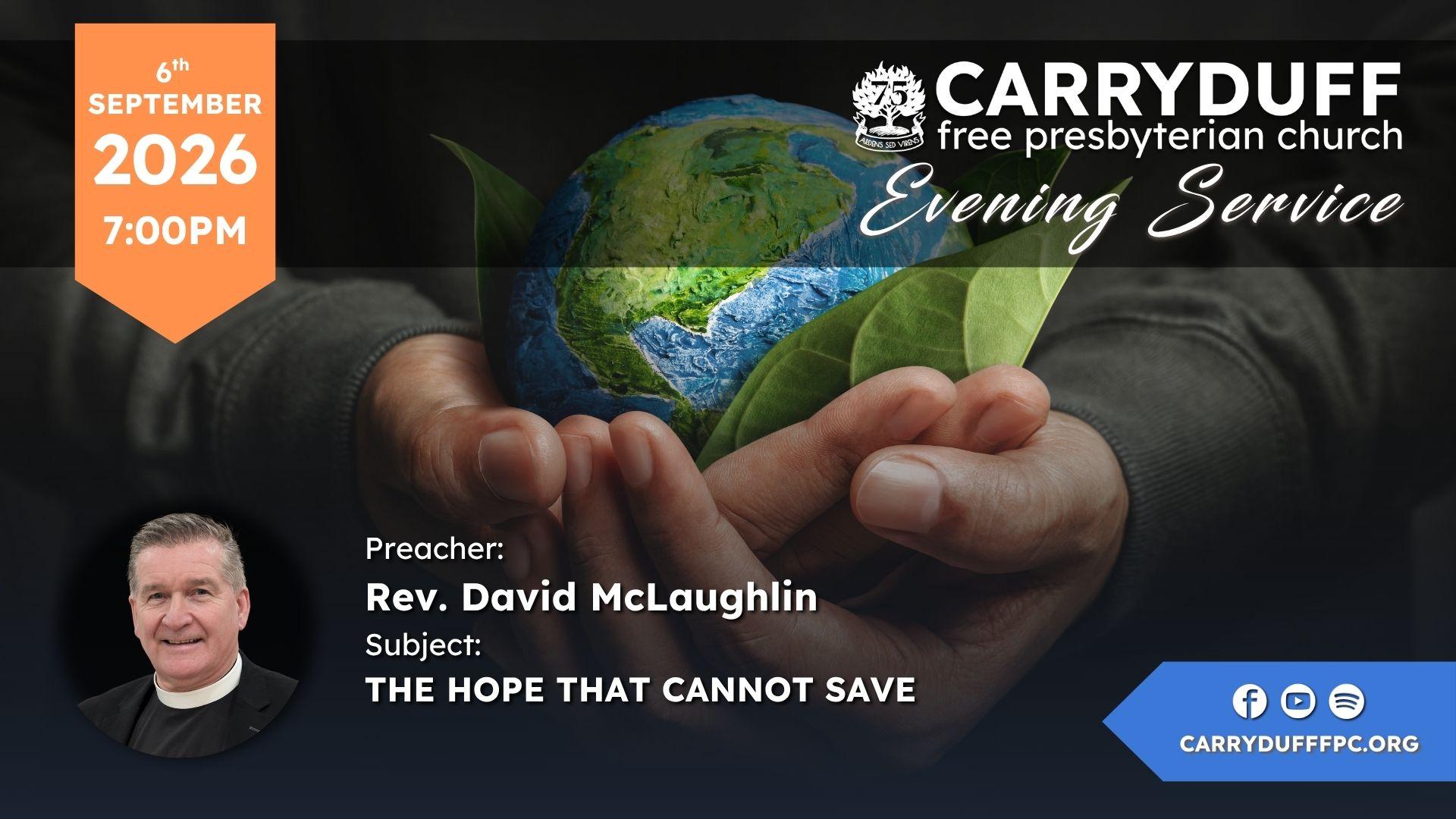

Service Details
Date: SUN 7:00pm 6th September 2026
Preacher: Rev. David McLaughlin
Bible Reference: Job 27:8
Podcast
Sermon Summary
The sermon is drawn from Job 27:8, which reads: “For what is the hope of the hypocrite, though he hath gained, when God taketh away his soul?” The preacher introduces the message by reflecting on the character of Job, who suffered immense trials—poverty, the loss of his farm and livelihood, the bereavement of his ten children in a single day, the murder of his servants, the theft of his cattle, and a dreadful disease of boils. On top of all this, his wife urged him to curse God and die, and he bore the stigma of being accused of hypocrisy by his three friends.
The preacher explains the faulty principle upon which the friends’ counsel rested: “If a man suffers greatly, he must have sinned greatly.” From this flawed premise, the friends argued further that a man who refuses to acknowledge his sin is a religious hypocrite. Job, however, knew their theology was too small for the sovereignty and providence of God. Despite losing possessions, children, health, reputation, and the respect of his wife, Job clung to the righteousness of God and His great faithfulness. Even without understanding what God was doing, Job knew the Lord was worthy of his trust.
In chapter 27, Job continues to battle the accusation of hypocrisy and vigorously defends his integrity. The preacher is careful to note that Job was not claiming sinlessness—no true believer could claim never to have sinned in thought, word, and deed. Rather, Job was refuting the accusation that his suffering proved him to be a secret sinner and a reckless hypocrite. Job then turns to consider the miserable end of the wicked, asking the searching question of the text.
The great issue of the question is simply this: what is the godless man hoping in? The preacher directs the question to his hearers: “What are you hoping in?” The verse offers a solemn warning about a hope that looks real, sounds religious, and may even endure for years, but which in the end proves false—a hope that does not save, and that eventually causes a person to perish.
The message is structured around three headings.
1. A Word to Define
The preacher first invites his hearers to define the word “hypocrite.” The Hebrew term carries several meanings:
- A pretender or stage actor – one who dresses up and pretends to be someone else, playing a part that does not match reality.
- A profane person – someone who professes allegiance to God and His word, yet whose profession has no real impact upon their life. There is a complete failure to live out the truth of Scripture, and nothing of righteousness about their character.
- One who is presumptuous – the hypocrite is not without confidence. He possesses something in his heart which he regards as hope, but it is a false, baseless hope.
A hypocrite, then, is someone who pretends to be religious—acting the part of a Christian—while remaining profane in actions, attitudes, and speech, because they have not received a new heart and are not born again of God’s Spirit. Their life has not been transformed, and yet they presume upon a hope that is not real.
The preacher applies this directly: the professing Church of Jesus Christ in Northern Ireland, and indeed throughout the United Kingdom, is full of individuals pretending to be Christians. Many have “pretended to get saved” without their lives ever being changed, yet they still presume they are ready for heaven. They can offer reasons for their profession—moral, spiritual, religious—but these reasons are often outward and vain. The preacher recounts sitting in a car with a man in Lisbon whose marriage was wrecked through sinful choices. Asked why he had professed to be saved, the man replied that his life was full of problems and he was in debt, and he thought that if he asked Jesus into his heart, Jesus would sort out his problems and deal with his debt. Job, by contrast, protested his innocence and integrity.
2. A Warning to Disclose
The second point draws attention to the phrase “though he hath gained.” One of the great dangers for the human soul is that a person can be sincerely wrong—holding nothing but a false hope, and being wrong about the state and condition of their soul. The preacher stresses several truths:
- Sincerity does not transform a false hope into a true one.
- Religiosity does not transform a false hope into a true one.
- Morality does not transform a false hope into a true one.
A person may be religious, sincerely believe themselves a Christian, profess salvation, and even believe in their heart that they belong to Christ—yet have never come to Christ in genuine repentance and faith. The preacher poses a vivid courtroom test: if there were enough evidence to convict a person of being a genuine Christian, would the judge be able to bring down his hammer and declare, “Yes, this man is a genuine Christian”?
He cites Proverbs 14:12: “There is a way which seemeth right unto a man, but the end thereof are the ways of death.” The Bible repeatedly warns of self-deception, and Bible history is littered with real stories of hypocrites:
- Cain (Genesis 4) – outwardly religious and righteous, but rotten at heart. He brought the works of his own hands—a bloodless sacrifice—whereas God required a blood sacrifice. Abel brought the blood of the lamb. Cain’s heart was filled with envy, jealousy, rage, and hatred, and after the act of worship he murdered his brother.
- Balaam – a false religious man who could not accept justification by faith alone. He sought to curse a people God had blessed, and though he said, “Let me die the death of the righteous,” he refused to live right.
- Korah – a religious impostor who refused to recognise the unique position of the high priest and rebelled against God’s order.
- Judas – one of the twelve, involved in miracles, preaching, and ministry to the needy, yet a thief all the while, taking money meant for the poor. He was never regenerate.
- Ananias and Sapphira (Acts 5) – who sold land and gave to the church, but secretly held back a portion while claiming to give it all. They lied not to man but to the Holy Ghost. It was an outward show.
- Simon Magus – who believed and was baptised but was not born again; his heart was not right before God, for he wanted to buy the gift of the Holy Spirit with money.
- Demas – who forsook the faith, having loved this present evil world.
The common denominator, the preacher observes, is that all these hoped to gain acceptance with God on the basis of being religious and outwardly good—offering a works-based righteousness. From Cain to Demas, none were accepted, because in their hearts they said, “We don’t need a Saviour. We don’t need regeneration. We don’t need to repent and believe the gospel. God will accept me because I’m basically a good person.”
The preacher turns to Matthew 23, the temple sermon, where the Lord Jesus exposed the sin of hypocrisy. Seven times in that one sermon Jesus pronounced, “Woe unto you, scribes and Pharisees, hypocrites.” The word “woe” speaks of judgment. The scribes and Pharisees devoured widows’ houses, offered long prayers at street corners for show, adorned the sepulchres of the prophets, and were beautiful outwardly while being full of dead men’s bones within. True salvation, the preacher insists, does not begin on the outside; it begins with the heart and works its way outward, impacting the bodily life.
The preacher concludes this section by confronting the works-based righteousness that persists today in false religion, false cults, and apostate Christianity. People claim, “I was a church attender, I was baptised, I give to charity, I did good works, I was honest and sincere.” But Titus 3:5 declares: “Not by works of righteousness which we have done, but according to his mercy he saved us, by the washing of regeneration and renewing of the Holy Ghost.”
3. A Wrath to Declare
The final point focuses on the solemn phrase “when God taketh away his soul.” The preacher explains that this refers to death—the moment when the soul leaves the body, when a person’s time on earth is over, their day done, their journey finished. The question of questions on that day is: what will the Lord do with the soul when it is called to stand before Almighty God and give an account?
Many refuse to think about death, judgment, or eternity. They push these realities to the back of the mind, surrounding themselves with noise, activity, and work, while avoiding the solemn reality of sin. They forget what is written:
- “There is none righteous, no, not one.”
- “For all have sinned and come short of the glory of God.”
- “The wages of sin is death, but the gift of God is eternal life.”
They avoid the reality of judgment, of heaven and hell, and refuse to recognise that they are moving day by day toward an appointed end, when they will be face to face with God.
The preacher illustrates with the story of a wealthy man who spent his life accumulating possessions—a mansion, furniture, paintings, land, investments, a pension, and a reputation for charity and success. Standing in his garden one day, he asked his servant, “When I die, how much of this will I own?” The servant answered, “None of it. You’ll leave it all.” When the man asked who would have it then, he realised that all his life he had been gathering things only for someone else to enjoy. Every possession is left behind. Every house eventually belongs to another. Every bank account is placed into another’s hands. Every earthly honour fades. Every body turns to dust. And every soul is called to stand before God.
The preacher links this to the parable of the rich farmer in Luke 12, where the Lord Jesus warned, “Take heed, and beware of covetousness: for a man’s life consisteth not in the abundance of the things which he possesseth.” The hypocrite in Job’s text has “gained much”—wealth, reputation, influence, comfort, education, possessions, friends, religiosity, respectability—but these gains are temporary. Then the sovereignty of God intervenes, for God is sovereign over life and death.
The preacher makes several solemn points about the moment of death:
- Death does not create a person’s true spiritual condition; it reveals it—and reveals it permanently.
- Death closes the door of gospel opportunity, ending the possibility of genuine repentance and faith.
- Death ends the possibility of turning from sin to the Saviour.
Citing Hebrews 9:27—“It is appointed unto men once to die, but after this the judgment”—the preacher explains that the rich man in the parable ended in hell not because he was wealthy, but because he was not rich toward God. His hope was in his possessions, and his mind was on a future without God. But God said, “Thou fool, this night thy soul shall be required of thee.” God had appointed his final night—and God has appointed each hearer’s final night. The problem was not wealth itself; a billionaire may still be rich toward God, and one who is rich toward God is richer than any billionaire. The rich man’s doom was settled and his destiny sealed.
The preacher then draws a sharp inference: the hope of the hypocrite ends in perishing. The soul is lost, and the fearful words are declared: “Depart from me, ye cursed, into everlasting fire, prepared for the devil and his angels.”
A Closing Application
The preacher turns to the 2021 census, observing that while only around four to five percent of the United Kingdom’s population attends church, a staggering 46 percent identified themselves as Christian—almost half the population. He recounts a conversation at a prayer breakfast with a brother who remarked, with irony, that “everybody in Northern Ireland is going to heaven”—they carry the name Christian, some never darkening the door of a church, yet believing themselves basically good and that God will let them in at the end.
The preacher’s message is blunt: God will not let them in. The only way God admits anyone into heaven is through the testimony, “Christ in you, the hope of glory” (Colossians 1:27). He asks directly: “Have you got Christ tonight? Was there a time when you bent the knee to Him and cried out, ‘God be merciful to me, a sinner’?” Perishing is real, and hell is real.
He closes with John 3:16: “For God so loved the world, that he gave his only begotten Son, that whosoever believeth in him should not perish, but have everlasting life.” For those who refuse to believe, the destiny is to perish in a Christless eternity. Jesus said, “If ye die in your sins, where I am, there ye cannot be.”
The hope that cannot save is a false hope. It is a word to define—the hypocrite; a warning to disclose—a hope that will be found out at the end; and a wrath to declare—when God takes away the soul. The religious impostors are scattered throughout the Old and New Testaments, and they opened their eyes in hell because they refused to repent and believe the Gospel. The sermon ends with a prayer that the Lord would have mercy on the 46 percent who profess to be Christian, and that the hearers would possess a true hope in Christ—Christ in you, the hope of glory.